Rankbit System
JEE Physics: Waves (+15.5%) | Electrostatics: Concentric Shells (-29.7%) | Modern Physics: Photoelectric Clones (+34.2%) | Mathematics: Definite Integrals (+18.1%) | Chemistry: Coordination Splitting (-11.4%) | JEE Physics: Waves (+15.5%) | Electrostatics: Concentric Shells (-29.7%) | Modern Physics: Photoelectric Clones (+34.2%) | Mathematics: Definite Integrals (+18.1%) | Chemistry: Coordination Splitting (-11.4%)

If mathrmA_2mathrmB is 30\% ionised in an aqueous solution, then the value of van't Hoff factor (i) is ________ times 10^-1.

Numerical Answer Type:
Enter a numerical value Answer: 16 to 16 +4 marks

Solution & Explanation

### Related Formula i = 1 + (y - 1)alpha ### Core Logic For electrolyte mathrmA_2mathrmB undergoing dissociation : mathrmA_2B ightarrow 2mathrmA^+ + mathrmB^2- Total count of ions produced per molecule y = 3 . Given degree of dissociation alpha = 30\% = 0.3 . Substituting into the formula : i = 1 + (3 - 1) cdot 0.3 i = 1 + 2 cdot 0.3 = 1 + 0.6 = 1.6 Expressing the value in the requested format: 1.6 = 16 times 10^-1 Thus, the integer value to enter is 16. ### Pattern Recognition Always calculate total stoichiometric species y carefully before executing the linear factor combination to avoid basic arithmetic errors. ### Evaluation Rubric / Model Answer null ### Chapter Mix Class 12 Chemistry: Solutions

Reference Study Guides

More Solutions Previous-Year Questions — Page 4

Q46 2025 Abnormal Molar Masses and Van't Hoff Factor
The observed and normal masses of compound mathrmMX_2 are 65.6 and 164 respectively. The percent degree of ionisation of mathrmMX_2 is ____ %. (Nearest integer)
Numerical Answer. Answer: 75 to 75

Solution

### Related Formula i = fractextNormal Molar MasstextObserved Molar Mass i = 1 + (n - 1)alpha ### Core Logic 1. Calculate the van 't Hoff factor (i): i = frac16465.6 = 2.5 2. Set up the dissociation equilibrium for the electrolyte mathrmMX_2: mathrmMX_2 ightarrow mathrmM^2+ + 2mathrmX^- Here, 1 molecule dissociates into n = 1 + 2 = 3 ions. 3. Relate i to the degree of ionization (alpha): i = 1 + (3 - 1)alpha = 1 + 2alpha 2.5 = 1 + 2alpha implies 2alpha = 1.5 implies alpha = 0.75 4. Convert to a percentage: textPercent dissociation = 0.75 cdot 100 = 75\% ### Pattern Recognition For a salt that dissociates into three ions (like mathrmMX_2), the relationship simplifies to i = 1 + 2alpha. Calculating i from the ratio of the molar masses lets you find alpha directly. ### Evaluation Rubric / Model Answer null ### Chapter Mix Class 12 Chemistry: Solutions
Q42 2025 Depression in Freezing Point
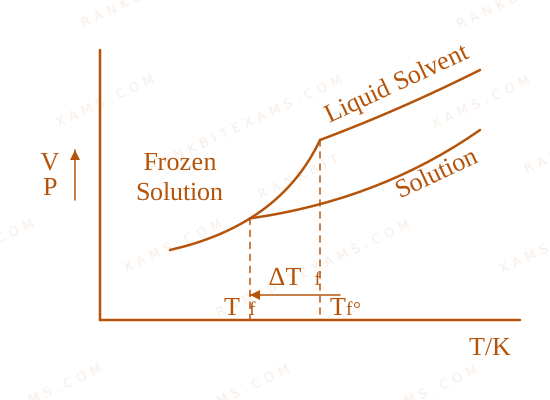
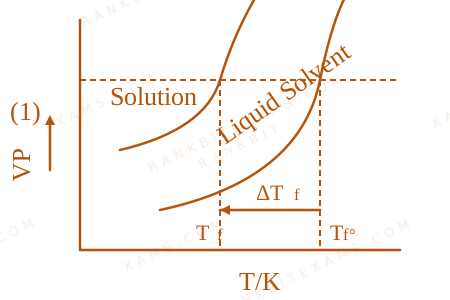
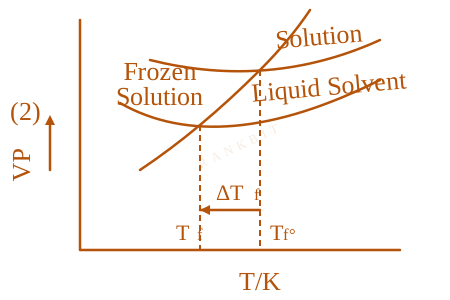
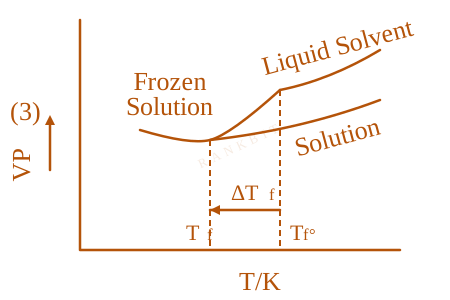
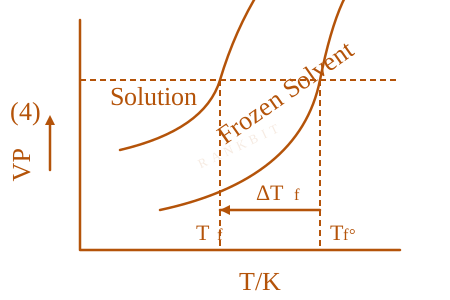
Consider the given plots of vapour pressure (VP) vs temperature (T/K) Which amongst the following options is correct graphical representation showing Delta T_mathrmf , depression in the freezing point of solvent in a solution?
  • A. Plot (1)
    Depression in Freezing Point
    Depression in Freezing Point
  • B. Plot (2)
    Depression in Freezing Point
    Depression in Freezing Point
  • C. Plot (3)
    Depression in Freezing Point
    Depression in Freezing Point
  • D. Plot (4)
    Depression in Freezing Point
    Depression in Freezing Point

Solution

### Related Formula Delta T_f = T_f^0 - T_f ### Core Logic Dissolving a non-volatile solute lower the vapor pressure of the solution relative to the pure solvent across all temperature thresholds. The freezing point is defined as the temperature at which the vapor pressure of the liquid phase matches that of its solid phase. Because the solution's vapor pressure curve lies below that of the pure liquid solvent, its intersection with the frozen solvent curve occurs at a lower temperature (T_f < T_f^0). This shift creates the characteristic freezing point depression step: Delta T_f = T_f^0 - T_f. Plot (3) correctly displays this thermodynamic behavior.
Depression in Freezing Point solution plot for Q42 - JEE Main 2025 Morning
### Pattern Recognition The vapor pressure curve for the solution always runs lower than that of the pure solvent, shifting the freezing intersection to the left. ### Evaluation Rubric / Model Answer null ### Chapter Mix Class 12 Chemistry: Solutions
Q42 2025 Osmosis and Osmotic Pressure
Assume a living cell with 0.9\% (omega/omega) of glucose solution (aqueous). This cell is immersed in another solution having equal mole fraction of glucose and water. (Consider the data upto first decimal place only) The cell will:
  • A. Shrink since solution is 0.5\%\ (omega/omega)
  • B. Shrink since solution is 0.45\%\ (omega/omega) as a result of association of glucose molecules (due to hydrogen bonding)
  • C. Swell up since solution is 1\%
  • D. Show no change in volume since solution is 0.9\%\ (omega/omega)

Solution

### Related Formula Mass percentage from mole fraction calculation: \%text w/w = fracx_1 cdot M_1x_1 cdot M_1 + x_2 cdot M_2 times 100 ### Core Logic Inside the living cell, glucose concentration is 0.9\%text w/w. The surrounding solution has equal mole fractions of glucose and water (x_textglucose = 0.5, x_textwater = 0.5). Let's calculate the mass percentage of the outer solution: - Mass of glucose component = 0.5 times 180 = 90mathrm\ g - Mass of water component = 0.5 times 18 = 9mathrm\ g - Total solution mass = 90 + 9 = 99mathrm\ g ### Step 1: Concentration Determination and Osmosis Profile Outer mass percentage: \%text w/w = frac9099 times 100 approx 90.9\% Because the external environment is highly concentrated (hypertonic) compared to the inner cell (0.9\%), water flows out of the cell via exosmosis, causing the **cell to shrink**. Note: Because the reasoning establishes shrinkage but the quantitative figures in the options are highly mismatched, this question is officially designated as a **Bonus** question. ### Pattern Recognition An equal mole fraction solution of a high-molar-mass solute (glucose, 180mathrm\ g/mol) and a low-molar-mass solvent (water, 18mathrm\ g/mol) is always extremely concentrated by mass. Placing a standard living cell into such a hypertonic solution inevitably causes fluid loss and cellular shrinkage. ### Evaluation Rubric / Model Answer null ### Chapter Mix Class 12 Chemistry: Solutions
Q37 2025 Abnormal Molar Mass and van't Hoff Factor
1.24 mathrm~g of mathrmAX_2 (molar mass 124 mathrm~g mathrm~mol^-1 ) is dissolved in 1 mathrm~kg of water to form a solution with boiling point of 100.0156^circ mathrmC , while 25.4 mathrm~g of mathrmAY_2 (molar mass 250 mathrm~g mathrm~mol^-1 ) in 2 mathrm~kg of water constitutes a solution with a boiling point of 100.0260^circ mathrmC . mathrmK_b(H_2O) = 0.52 \, K \, kg \, mol^-1 Which of the following is correct?
  • A. mathrmAX2 and mathrmAY_2 (both) are completely unionised.
  • B. mathrmAX_2 and mathrmAY_2 (both) are fully ionised.
  • C. mathrmAX_2 is completely unionised while mathrmAY_2 is fully ionised.
  • D. mathrmAX_2 is fully ionised while mathrmAY_2 is completely unionised.

Solution

### Related Formula Delta T_b = i cdot K_b cdot m ### Core Logic Step 1: Evaluate solution system mathrmAX_2 Delta T_b = 100.0156 - 100 = 0.0156^circmathrmC textMolality m = frac1.24 / 1241 = 0.01 \, mathrmmol/kg Using the elevation formula : 0.0156 = imathrmAX2 cdot 0.52 cdot 0.01 imathrmAX2 = frac0.01560.0052 = 3 Since theoretical dissociation of mathrmAX_2 ightarrow mathrmA^2+ + 2mathrmX^- produces 3 particles, i = 3 implies it is completely ionised . Step 2: Evaluate solution system mathrmAY_2 Delta T_b = 100.0260 - 100 = 0.0260^circmathrmC textMolality m = frac25.4 / 2502 = 0.0508 \, mathrmmol/kg Using the elevation formula : 0.0260 = imathrmAY2 cdot 0.52 cdot 0.0508 imathrmAY2 = frac0.02600.0264 simeq 1 Since i = 1, it behaves as a non-electrolyte, meaning it is completely unionised . Thus, option (4) is correct. ### Pattern Recognition A van't Hoff factor value matching the stoichiometric coefficient count (i=3 for mathrmAX_2) proves complete ionisation; an index near unity (i=1) confirms absolute failure to split into individual ions. ### Evaluation Rubric / Model Answer null ### Chapter Mix Class 12 Chemistry: Solutions
More Solutions Questions — jee_main_2025_29_jan_morning

Practice all Solutions previous-year questions →

YOUR FIRST PREP STEP STARTS HERE

We Map Every Repeating Question in Competitive Exams.

Say goodbye to generic mock test fatigue. RankBit uses smart analysis to group past exam questions into their foundational Repeating Question Types. Find chapter weightage, track repeating questions, and score higher with targeted practice.

Select Your Target Exam

Choose an exam track below to find formulas per chapter and patterns.

Syncing Exam Intelligence

Mapping formulas and patterns across all tracks…

PATH A — FULL LENGTH PRACTICE

Full Mock Test Hub

Simulate real NTA exam conditions with fully tracked mocks. Time yourself against past papers.

Under Development
PATH B — TARGETED PRACTICE

Topic-wise Practice Hub

Practice past-year questions one chapter at a time. Pick an exam → subject → chapter and get every PYQ for that topic — pulled together from all past papers — with the chapter's key formulas alongside.

Loading Questions... Browse Topics
Latest from the Blog
View all →

Loading articles...