If mathrmA_2mathrmB$\mathrm{A}_2\mathrm{B}$ is 30\%$30\%$ ionised in an aqueous solution, then the value of van't Hoff factor (i) is ________ times 10^-1$\times 10^{-1}$.
Numerical Answer Type:
Enter a numerical valueAnswer: 16 to 16+4 marks
Solution & Explanation
### Related Formula
i = 1 + (y - 1)alpha$i = 1 + (y - 1)\alpha$
### Core Logic
For electrolyte mathrmA_2mathrmB$\mathrm{A}_2\mathrm{B}$ undergoing dissociation :
mathrmA_2B
ightarrow 2mathrmA^+ + mathrmB^2-$\mathrm{A_2B}
ightarrow 2\mathrm{A}^+ + \mathrm{B}^{2-}$
Total count of ions produced per molecule y = 3$y = 3$ .
Given degree of dissociation alpha = 30\% = 0.3$\alpha = 30\% = 0.3$ .
Substituting into the formula :
i = 1 + (3 - 1) cdot 0.3$i = 1 + (3 - 1) \cdot 0.3$i = 1 + 2 cdot 0.3 = 1 + 0.6 = 1.6$i = 1 + 2 \cdot 0.3 = 1 + 0.6 = 1.6$
Expressing the value in the requested format:
1.6 = 16 times 10^-1$1.6 = 16 \times 10^{-1}$
Thus, the integer value to enter is 16.
### Pattern Recognition
Always calculate total stoichiometric species y$y$ carefully before executing the linear factor combination to avoid basic arithmetic errors.
### Evaluation Rubric / Model Answer
null
### Chapter Mix
Class 12 Chemistry: Solutions
Given below are two statements :
Statement (I): Molal depression constant K_f$K_f$ is given by fracM_lRT_fDelta S_fus$\frac{M_lRT_f}{\Delta S_{fus}}$, where symbols have their usual meaning.
Statement (II): K_f$K_f$ for benzene is less than the K_f$K_f$ for water.
In the light of the above statements, choose the most appropriate answer from the options given below:
A. Statement I is incorrect but Statement II is correct
B. Both Statement I and Statement II are incorrect.
C. Both Statement I and Statement II are correct
D. Statement I is correct but Statement II is incorrect
Solution
### Related Formula
K_f = fracM_1 R T_f^2Delta H_fus = fracM_1 R T_fleft(fracDelta H_fusT_fright) = fracM_1 R T_fDelta S_fus$K_f = \frac{M_1 R T_f^2}{\Delta H_{fus}} = \frac{M_1 R T_f}{\left(\frac{\Delta H_{fus}}{T_f}\right)} = \frac{M_1 R T_f}{\Delta S_{fus}}$
### Core Logic
- **Statement I is correct:** Substituting Delta S_fus = fracDelta H_fusT_f$\Delta S_{fus} = \frac{\Delta H_{fus}}{T_f}$ directly matches the given structural relationship formula.
- **Statement II is incorrect:** Standard cryoscopic constants are:
- For Benzene: K_f approx 5.12 mathrm~^circ C cdot kg cdot mol^-1$K_f \approx 5.12 \mathrm{~^\circ C \cdot kg \cdot mol^{-1}}$
- For Water: K_f approx 1.86 mathrm~^circ C cdot kg cdot mol^-1$K_f \approx 1.86 \mathrm{~^\circ C \cdot kg \cdot mol^{-1}}$
Therefore, K_f$K_f$ for benzene is greater than that of water, making Statement II false.
### Pattern Recognition
Keep numerical benchmarks for common solvent colligative constants (K_b, K_f$K_b, K_f$ for water and benzene) memorized. Benzene has a far lower enthalpy of fusion and a higher freezing point, resulting in a significantly elevated K_f$K_f$ value.
### Evaluation Rubric / Model Answer
null
### Chapter Mix
Class 12 Chemistry: Solutions
Q462025Concentration Terms
Sea water, which can be considered as a 6 molar (6 M) solution of NaCl, has a density of 2mathrm~g~mL^-1$2\mathrm{~g~mL}^{-1}$ . The concentration of dissolved oxygen left(mathrmO_2right)$\left(\mathrm{O}_2\right)$ in sea water is 5.8mathrm~ppm$5.8\mathrm{~ppm}$ . Then the concentration of dissolved oxygen left(mathrmO_2right)$\left(\mathrm{O}_2\right)$ in sea water, is mathrmx times 10^-4mathrmm$\mathrm{x} \times 10^{-4}\mathrm{m}$ . mathrmx =$\mathrm{x} =$ _______. (Nearest integer)
Given: Molar mass of NaCl is 58.5mathrm~g~mol^-1$58.5\mathrm{~g~mol}^{-1}$ Molar mass of mathrmO_2$\mathrm{O}_2$ is 32mathrm~g~mol^-1$32\mathrm{~g~mol}^{-1}$
Numerical Answer.Answer: 1.9 to 2.1
Solution
### Related Formula
textppm = fractextmass of solutetextmass of solution times 10^6$\text{ppm} = \frac{\text{mass of solute}}{\text{mass of solution}} \times 10^6$textMolality (m) = fractextmoles of solutetextmass of solvent in kg$\text{Molality (m)} = \frac{\text{moles of solute}}{\text{mass of solvent in kg}}$
### Core Logic
1. Consider 1000 mathrm~mL$1000 \mathrm{~mL}$ of seawater solution:
textMass of solution = textVolume times textdensity = 1000 times 2 = 2000 mathrm~g$\text{Mass of solution} = \text{Volume} \times \text{density} = 1000 \times 2 = 2000 \mathrm{~g}$textMass of NaCl = 6 text moles times 58.5 = 351 mathrm~g$\text{Mass of NaCl} = 6 \text{ moles} \times 58.5 = 351 \mathrm{~g}$textMass of solvent (water) = 2000 - 351 = 1649 mathrm~g = 1.649 mathrm~kg$\text{Mass of solvent (water)} = 2000 - 351 = 1649 \mathrm{~g} = 1.649 \mathrm{~kg}$
2. Compute the mass and moles of dissolved O_2$O_2$ using the ppm value:
textppm = 5.8 = fractextmass of O_22000 times 10^6 implies textmass of O_2 = 1.16 times 10^-2 mathrm~g$\text{ppm} = 5.8 = \frac{\text{mass of } O_2}{2000} \times 10^6 \implies \text{mass of } O_2 = 1.16 \times 10^{-2} \mathrm{~g}$textmoles of O_2 = frac1.16 times 10^-232 = 3.625 times 10^-4 text moles$\text{moles of } O_2 = \frac{1.16 \times 10^{-2}}{32} = 3.625 \times 10^{-4} \text{ moles}$
3. Determine the molality (m$m$) of oxygen:
textmolality = frac3.625 times 10^-41.649 approx 2.19 times 10^-4 mathrm~m$\text{molality} = \frac{3.625 \times 10^{-4}}{1.649} \approx 2.19 \times 10^{-4} \mathrm{~m}$
Matching the pattern mathbfx times 10^-4mathrmm$\mathbf{x} \times 10^{-4}\mathrm{m}$, we get mathbfx approx 2.19$\mathbf{x} \approx 2.19$. The nearest integer is **2**.
### Pattern Recognition
For high concentration saline solutions, the mass of the solvent drops significantly below the total mass of the solution. Be careful to subtract the solute weight (351 mathrm~g$351 \mathrm{~g}$) before computing molality.
### Evaluation Rubric / Model Answer
null
### Chapter Mix
Class 12 Chemistry: Solutions
Q262025Reverse Osmosis
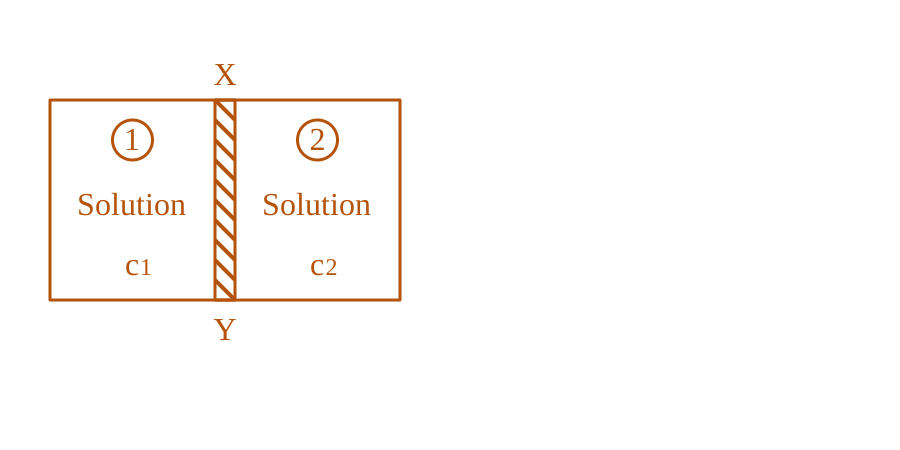
XY is the membrane / partition between two chambers 1 and 2 containing sugar solutions of concentration c_1$c_1$ and c_2$c_2$ (c_1 > c_2$c_1 > c_2$) mathrmmol~L^-1$\mathrm{mol~L^{-1}}$. For the reverse osmosis to take place identify the correct condition (Here p_1$p_1$ and p_2$p_2$ are pressures applied on chamber 1 and 2):
The diagram illustrates two chambers separated by a membrane XY containing sugar solutions of concentrations c1 and c2.
A.text(B) and (D) only$\text{(B) and (D) only}$
B.text(A) and (D) only$\text{(A) and (D) only}$
C.text(A) and (C) only$\text{(A) and (C) only}$
D.text(C) only$\text{(C) only}$
Solution
### Related Formula
pi = c R T$\pi = c R T$
where pi$\pi$ is the osmotic pressure of the solution.
### Core Logic
Given that c_1 > c_2$c_1 > c_2$, chamber 1 has a higher concentration of solute than chamber 2. Under normal conditions, solvent molecules spontaneously flow from lower concentration (chamber 2) to higher concentration (chamber 1) via osmosis.
To achieve **reverse osmosis**, the solvent must flow in the opposite direction—from chamber 1 to chamber 2. This requires applying an external pressure on the higher concentration side (chamber 1) that exceeds its osmotic pressure pi$\pi$.
textCondition for Reverse Osmosis: p_1 > pi$\text{Condition for Reverse Osmosis: } p_1 > \pi$
Cellophane and parchment paper both act as suitable semi-permeable membranes for this setup. Thus, statements (A) and (C) are correct.
### Pattern Recognition
Reverse osmosis always requires external pressure applied on the concentrated solution side (c_texthigh$c_{\text{high}}$) such that P_textapplied > pi$P_{\text{applied}} > \pi$.
### Evaluation Rubric / Model Answer
null
### Chapter Mix
Class 12 Chemistry: Solutions
Q342025Raoult's Law and Liquid-Vapour Composition
Liquid textA$\text{A}$ and textB$\text{B}$ form an ideal solution. The vapour pressure of pure liquids textA$\text{A}$ and textB$\text{B}$ are 350 and 750text mm Hg$750\text{ mm Hg}$ respectively at the same temperature. If textx_textA$\text{x}_{\text{A}}$ and textx_textB$\text{x}_{\text{B}}$ are the mole fraction of textA$\text{A}$ and textB$\text{B}$ in solution while texty_textA$\text{y}_{\text{A}}$ and texty_textB$\text{y}_{\text{B}}$ are the mole fraction of textA$\text{A}$ and textB$\text{B}$ in vapour phase then:
### Related Formula
textNegative Deviation from Raoult's Law implies textMaximum Boiling Azeotrope $\text{Negative Deviation from Raoult's Law} \implies \text{Maximum Boiling Azeotrope} $textPositive Deviation from Raoult's Law implies textMinimum Boiling Azeotrope $\text{Positive Deviation from Raoult's Law} \implies \text{Minimum Boiling Azeotrope} $textIdeal Solution implies Delta Vtextmix = 0 $\text{Ideal Solution} \implies \Delta V{\text{mix}} = 0 $
### Core Logic
Evaluating molecular interaction behaviors:
- (A) Chloroform and Acetone: Form intermolecular hydrogen bonds, showing negative deviation from Raoult's law, which forms a maximum boiling azeotrope
ightarrow$
ightarrow$ (III)
- (B) Ethanol and Water: Exhibit hydrogen bond disruptions, leading to positive deviation, forming a minimum boiling azeotrope
ightarrow$
ightarrow$ (I)
- (C) Benzene and Toluene: Highly structurally similar, forming a near-perfect ideal solution where Delta Vtextmix = 0$\Delta V{\text{mix}} = 0$
ightarrow$
ightarrow$ (IV)
- (D) Acetic acid in benzene: Acetic acid undergoes intermolecular hydrogen bonding inside the non-polar solvent, causing it to dimerize
ightarrow$
ightarrow$ (II)
### Step 1: Alignment Selection
Combining the pairs gives: (A)-(III), (B)-(I), (C)-(IV), (D)-(II).
### Pattern Recognition
Liquid properties shortcut: Acetic acid in benzene is a classic textbook example of dimerization (i=0.5$i=0.5$). Benzene-toluene is the most famous ideal solution pair. Recognizing either instantly shortcuts the options list to the correct key.
### Evaluation Rubric / Model Answer
null
### Chapter Mix
Class 12 Chemistry: Solutions
More Solutions Questions — jee_main_2025_29_jan_morning
We Map Every Repeating Question in Competitive Exams.
Say goodbye to generic mock test fatigue. RankBit uses smart analysis to group past exam questions into their foundational Repeating Question Types. Find chapter weightage, track repeating questions, and score higher with targeted practice.
Select Your Target Exam
Choose an exam track below to find formulas per chapter and patterns.
Syncing Exam Intelligence
Mapping formulas and patterns across all tracks…
PATH A — FULL LENGTH PRACTICE
Full Mock Test Hub
Simulate real NTA exam conditions with fully tracked mocks. Time yourself against past papers.
Under Development
PATH B — TARGETED PRACTICE
Topic-wise Practice Hub
Practice past-year questions one chapter at a time. Pick an exam → subject → chapter and get every PYQ for that topic — pulled together from all past papers — with the chapter's key formulas alongside.