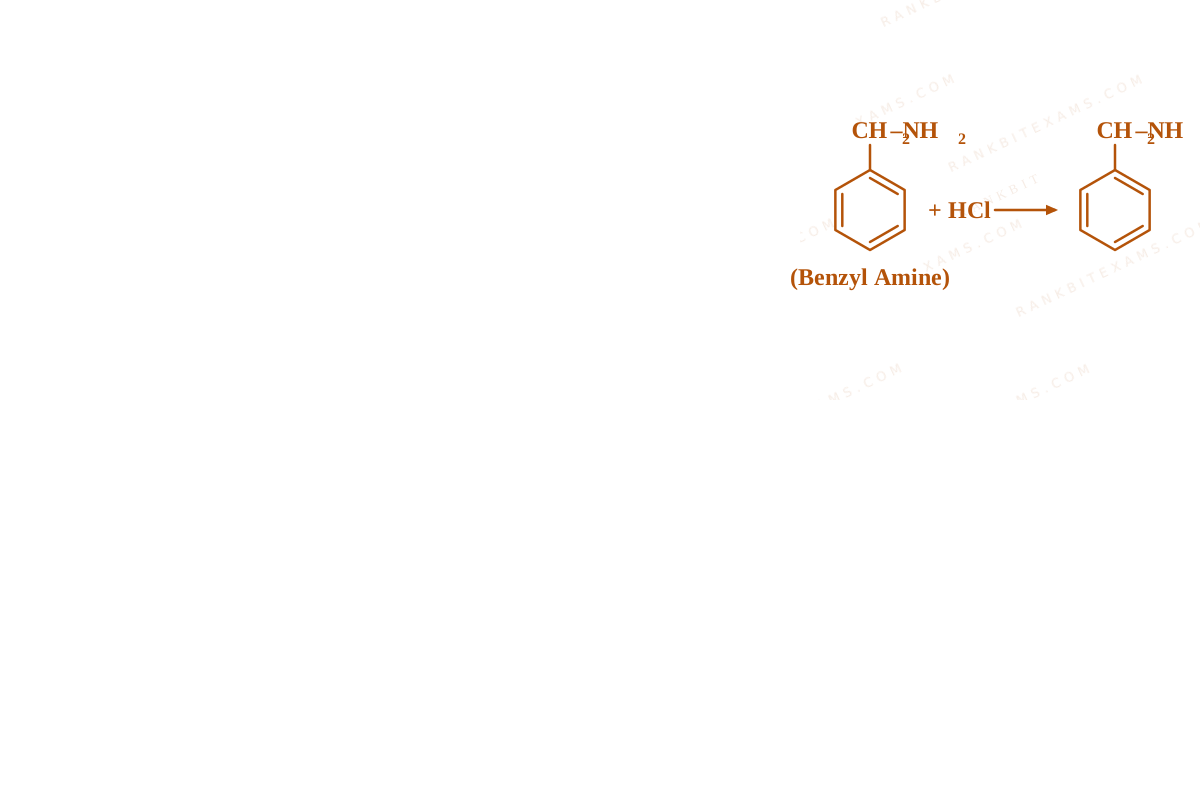
Given below are some nitrogen containing compounds.
Four amine candidates are indexed to find the optimal basic compound for reaction calculations.
Each of them is treated with HCl separately.
1.0 g of the most basic compound will consume ________ mg of HCl.
(Given molar mass in g mol ^-1$^{-1}$ C:12, H : 1, O : 16, Cl : 35.5)
Four amine candidates are indexed to find the optimal basic compound for reaction calculations.
Numerical Answer Type:
Enter a numerical valueAnswer: 341 to 341+4 marks
Solution & Explanation
### Related Formula
textMoles = fractextMasstextMolar Mass$$\text{Moles} = \frac{\text{Mass}}{\text{Molar Mass}}$$textMass of HCl consumed = n_textamine cdot M_textHCl$$\text{Mass of HCl consumed} = n_{\text{amine}} \cdot M_{\text{HCl}}$$
### Core Logic
Step 1: Identify the most basic amine
Benzylamine (mathrmC_6mathrmH_5mathrmCH_2mathrmNH_2$\mathrm{C}_6\mathrm{H}_5\mathrm{CH}_2\mathrm{NH}_2$) is the most basic compound here because its nitrogen lone pair is localized and not involved in aromatic resonance. This stands in contrast to aniline or amides, which delocalize their lone pairs into the ring or carbonyl group .
Step 2: Neutralization Stoichiometry
mathrmC_6H_5CH_2NH_2 + mathrmHCl
ightarrow mathrmC_6H_5CH_2NH_3^+ Cl^-$$\mathrm{C_6H_5CH_2NH_2} + \mathrm{HCl}
ightarrow \mathrm{C_6H_5CH_2NH_3^+ Cl^-}$$
Molar Mass of Benzylamine (mathrmC_7mathrmH_9mathrmN$\mathrm{C}_7\mathrm{H}_9\mathrm{N}$):
M = (7 cdot 12) + (9 cdot 1) + 14 = 84 + 9 + 14 = 107 \, mathrmg/mol$$M = (7 \cdot 12) + (9 \cdot 1) + 14 = 84 + 9 + 14 = 107 \, \mathrm{g/mol}$$
Moles of Benzylamine in 1.0text g$1.0\text{ g}$ :
n = frac1.0107 simeq 0.009346 \, mathrmmol$$n = \frac{1.0}{107} \simeq 0.009346 \, \mathrm{mol}$$
Since 1 mole of benzylamine reacts with 1 mole of mathrmHCl$\mathrm{HCl}$ :
textMoles of HCl consumed = 0.009346 \, mathrmmol$$\text{Moles of HCl consumed} = 0.009346 \, \mathrm{mol}$$textMass of HCl = 0.009346 cdot 36.5 = 0.3411 \, mathrmg = 341.1 \, mathrmmg
ightarrow 341$$\text{Mass of HCl} = 0.009346 \cdot 36.5 = 0.3411 \, \mathrm{g} = 341.1 \, \mathrm{mg}
ightarrow 341$$
### Pattern Recognition
Aliphatic localized clusters (like the -mathrmCH_2mathrmNH_2$-\mathrm{CH}_2\mathrm{NH}_2$ segment in benzylamine) always show higher basicity than aromatic ring-conjugated arrays.
### Evaluation Rubric / Model Answer
null
### Chapter Mix
Class 12 Chemistry: Amines
Four amine candidates are indexed to find the optimal basic compound for reaction calculations.
Q38jee_main_2025_03_april_morningReactions of Diazonium Salts
In the following reactions, which one is NOT correct?
A. Reaction Scheme (1)
B. Reaction Scheme (2)
C. Reaction Scheme (3)
D. Reaction Scheme (4)
Solution
### Core Logic
When benzene diazonium chloride is treated with ethanol (textCH_3textCH_2textOH$\text{CH}_3\text{CH}_2\text{OH}$), it undergoes a reduction reaction (deamination). Ethanol acts as a reducing agent and gets oxidized to ethanal (textCH_3textCHO$\text{CH}_3\text{CHO}$), while the diazonium group is replaced by hydrogen to yield pure **benzene**, not phenetole (ethoxybenzene). Deamination chemical verification scheme for Q38 - JEE Main 2025 Morning
### Step 1: Review of Alternative Choices
Reactions (2), (3), and (4) show standard correct transformations: hypophosphorous acid reduction to benzene, potassium iodide substitution to iodobenzene, and cuprous cyanide substitution to benzonitrile.
### Pattern Recognition
Shortcut: Remember that textH_3textPO_2$\text{H}_3\text{PO}_2$ and textCH_3textCH_2textOH$\text{CH}_3\text{CH}_2\text{OH}$ are standard classic reducing agents that reduce textArN_2^+textCl^-$\text{ArN}_2^+\text{Cl}^-$ directly down to textArH$\text{ArH}$ (benzene). They do not undergo nucleophilic ether substitution paths.
### Evaluation Rubric / Model Answer
null
### Chapter Mix
Class 12 Chemistry: Amines
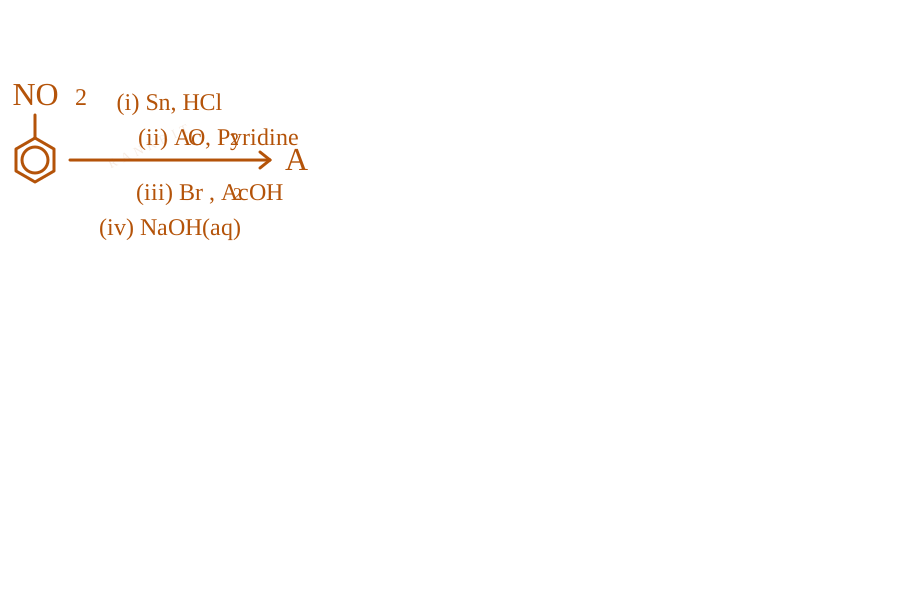
The major product (A) formed in the following reaction sequence is:
The flowchart traces the conversion of nitrobenzene using Sn/HCl, Ac2O/pyridine, Br2/AcOH, and aqueous NaOH.
A.textProduct 1$\text{Product 1}$
B.textProduct 2$\text{Product 2}$
C.textProduct 3$\text{Product 3}$
D.textProduct 4$\text{Product 4}$
Solution
### Core Logic
Let's track the chemical transformations sequentially:
1. **Step 1 (Sn + HCl$Sn + HCl$):** Nitrobenzene is cleanly reduced to yield Aniline (C_6H_5NH_2$C_6H_5NH_2$).
2. **Step 2 (Ac_2O + textPyridine$Ac_2O + \text{Pyridine}$):** Protecting step. Aniline undergoes acetylation to form Acetanilide (C_6H_5NHCOCH_3$C_6H_5NHCOCH_3$). This tempers the highly activating -NH_2$-NH_2$ group to prevent poly-bromination.
3. **Step 3 (Br_2 + AcOH$Br_2 + AcOH$):** The -NHCOCH_3$-NHCOCH_3$ amide group safely directs electrophilic bromination to the less-hindered **para** position, yielding p-bromoacetanilide.
4. **Step 4 (NaOH_(aq)$NaOH_{(aq)}$):** Basic hydrolysis removes the protecting acetyl group, restoring the free amine function to yield the final product: **p-bromoaniline**.
### Pattern Recognition
Acetylation of aniline followed by halogenation and subsequent hydrolysis is the standard synthetic pathway to produce mono-substituted para-haloanilines.
### Evaluation Rubric / Model Answer
null
### Chapter Mix
Class 12 Chemistry: Amines
Q36jee_main_2025_07_april_eveningBasicity of Amines
The descending order of basicity of following amines is:
(A) Aniline
(B) p-Methoxyaniline
(C) p-Nitroaniline
(D) textCH_3textNH_2$\text{CH}_3\text{NH}_2$
(E) (textCH_3)_2textNH$(\text{CH}_3)_2\text{NH}$
Choose the correct answer from the options given below:
The images show structural configurations of the aromatic amines: aniline, p-methoxyaniline, and p-nitroaniline.The images show structural configurations of the aromatic amines: aniline, p-methoxyaniline, and p-nitroaniline.The images show structural configurations of the aromatic amines: aniline, p-methoxyaniline, and p-nitroaniline.The images show structural configurations of the aromatic amines: aniline, p-methoxyaniline, and p-nitroaniline.
### Related Formula
textBasicity propto textAvailability of lone pair of electrons on Nitrogen atom$$\text{Basicity} \propto \text{Availability of lone pair of electrons on Nitrogen atom}$$textBasicity propto +textI, +textM groups quad textBasicity propto frac1-textI, -textM groups$$\text{Basicity} \propto +\text{I}, +\text{M groups} \quad \text{Basicity} \propto \frac{1}{-\text{I}, -\text{M groups}}$$
### Core Logic
1. Aliphatic amines vs Aromatic amines: In aromatic amines (A, B, C), the lone pair on nitrogen is delocalized into the benzene ring via resonance, decreasing basicity compared to aliphatic amines (D, E) where electron pairs are localized.
2. Among aliphatic amines (aqueous standard configurations implicit): Secondary amine (textCH_3)_2textNH$(\text{CH}_3)_2\text{NH}$ is a stronger base than primary textCH_3textNH_2$\text{CH}_3\text{NH}_2$ due to combined inductive effect (+textI$+\text{I}$) and solvation fields. Hence, textE > textD$\text{E} > \text{D}$.
3. Among substituted aromatic amines:
- **(B) p-Methoxyaniline**: -textOCH_3$-\text{OCH}_3$ exerts a strong electron-donating resonance effect (+textM$+\text{M}$), maximizing ring density and electronic availability on N.
- **(A) Aniline**: Baseline reference value with no extra substitutions.
- **(C) p-Nitroaniline**: -textNO_2$-\text{NO}_2$ acts as an intensive electron-withdrawing field (-textM, -textI$-\text{M}, -\text{I}$), pulling electron clouds heavily and quenching basicity.
### Step 1: Consolidating Rankings
Combining both structural domains cleanly provides:
textE > textD > textB > textA > textC $$\text{E} > \text{D} > \text{B} > \text{A} > \text{C} $$
### Pattern Recognition
Basicity hierarchy shortcut: Aliphatic secondary >$>$ Aliphatic primary >$>$ Aromatic with EDG (+textM$+\text{M}$) >$>$ Unsubstituted aniline >$>$ Aromatic with EWG (-textM$-\text{M}$). This immediately gives textE > textD > textB > textA > textC$\text{E} > \text{D} > \text{B} > \text{A} > \text{C}$ without deep arithmetic.
### Evaluation Rubric / Model Answer
null
### Chapter Mix
Class 12 Chemistry: Amines
Class 11 Chemistry: Organic Chemistry - Some Basic Principles and Techniques
Q28jee_main_2025_24_jan_eveningChemical Reactions of Aniline
For reaction
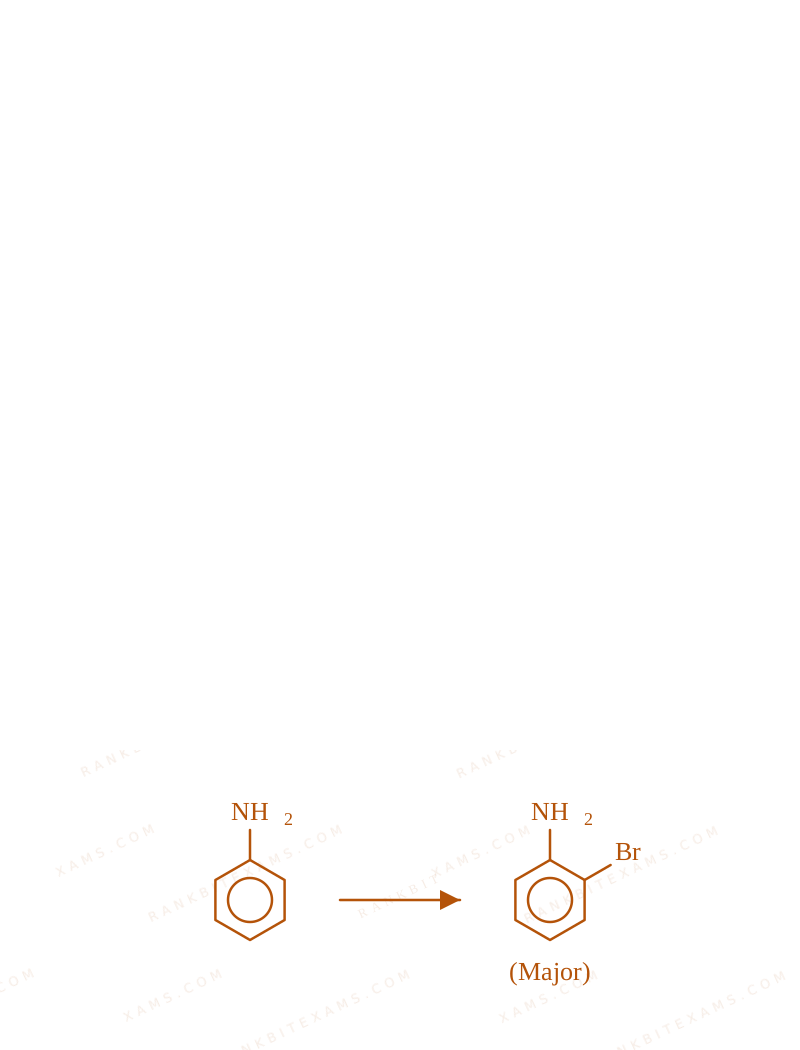
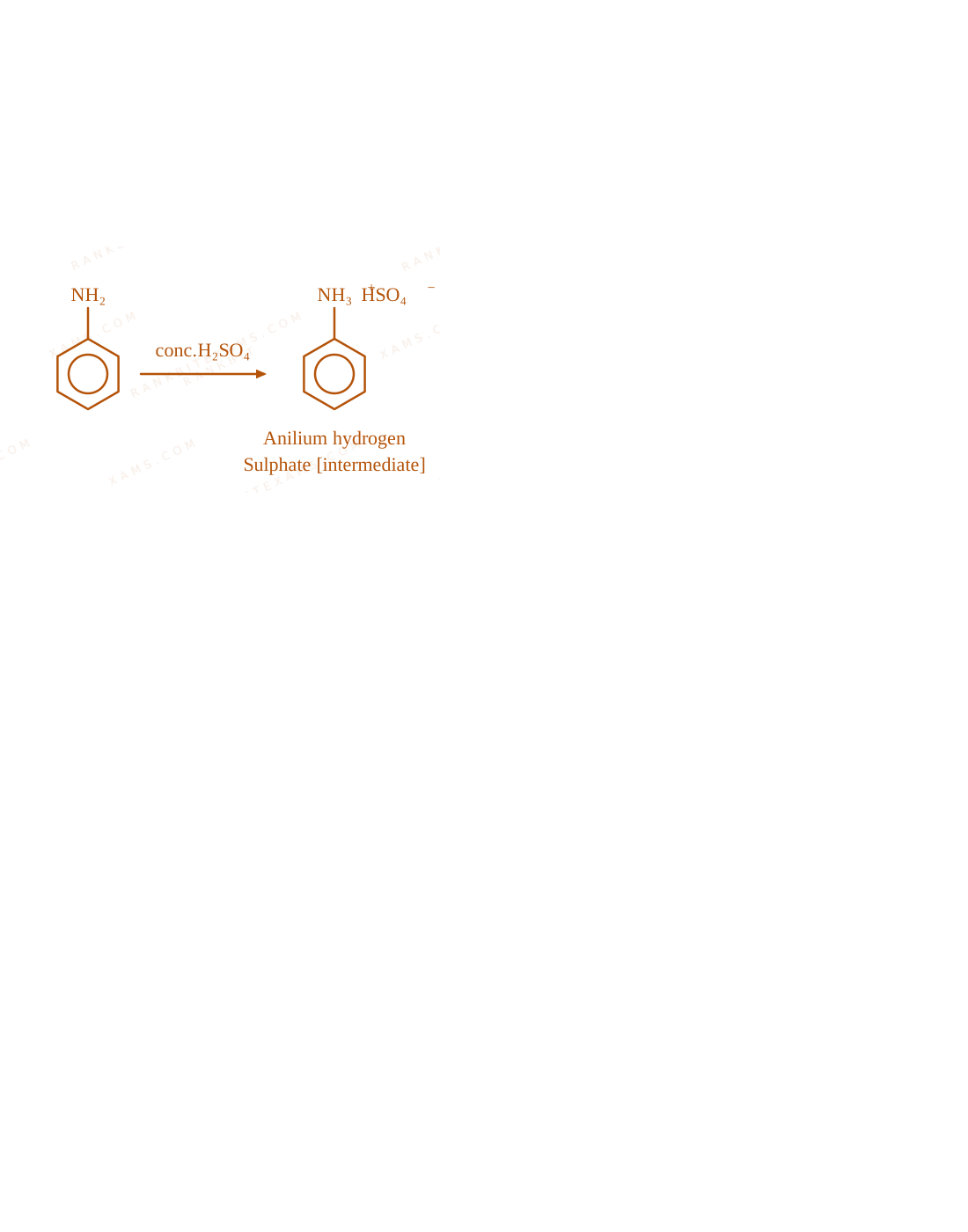
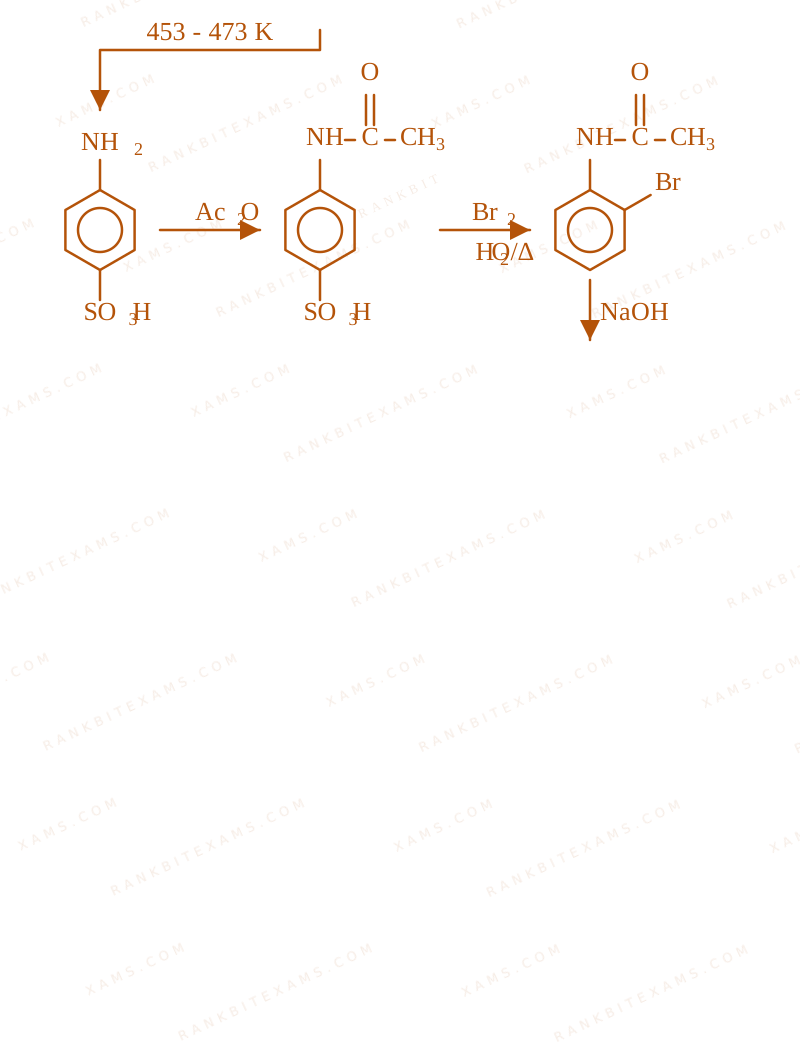
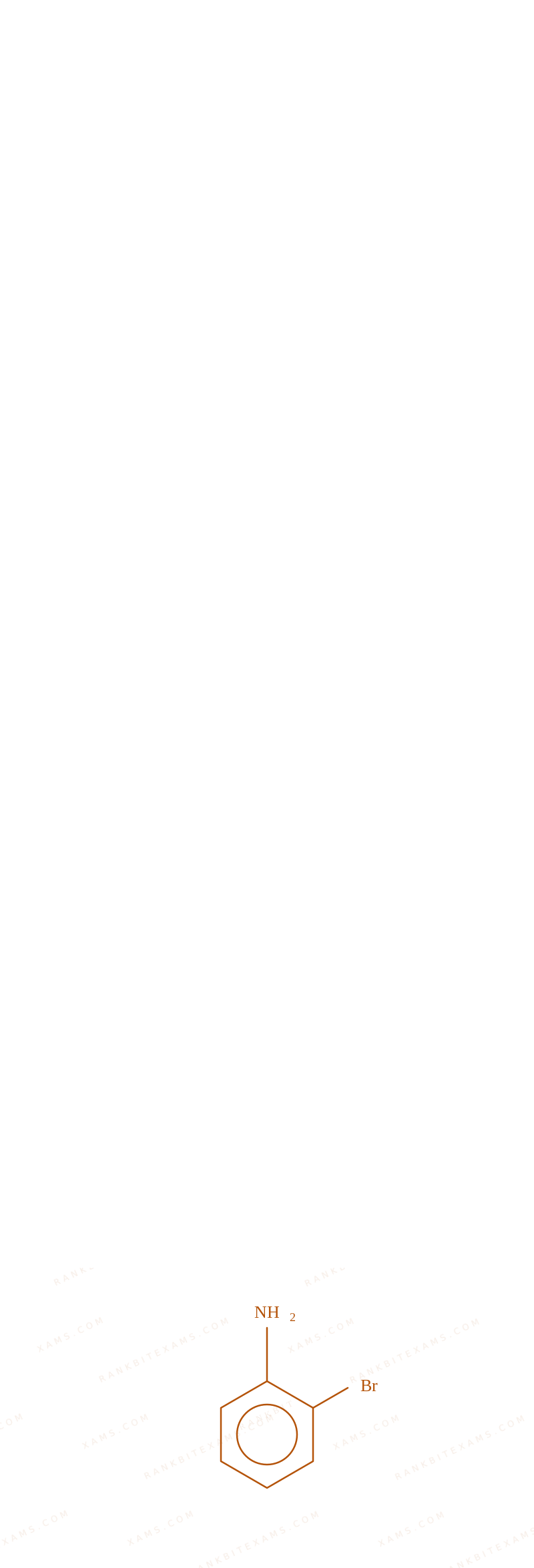
The image shows a multi-step organic conversion starting with sulfanilic acid intermediate structure mapping to a selectively brominated major product.
The correct order of set of reagents for the above conversion is :
### Core Logic
To direct selective monobromination ortho to the amino functionality while utilizing the masking capability of the sulfonic acid group:
1. Treating Aniline with conc. mathrmH2SO_4$\mathrm{H}{2}SO_{4}$ at high temperature (453-473text K$453-473\text{ K}$) yields Sulfanilic acid due to para sulfonating preference.
2. Acetylation with mathrmAc_2O$\mathrm{Ac}_{2}O$ protects the amine as an acetanilide functionality to moderate activation power and prevent over-bromination.
3. Electrophilic substitution using mathrmBr_2$\mathrm{Br}_{2}$ selectively places bromine at the position ortho to the protected acetamido group (the only available activated site since para is occupied).
4. Acidic/thermal desulfonation via mathrmH_2O(Delta)$\mathrm{H}_{2}O(\Delta)$ cleaves the para-sulfonic acid group.
5. Alkaline hydrolysis with mathrmNaOH$\mathrm{NaOH}$ removes the acetyl protecting group to regenerate the pristine primary amine structure yielding ortho-bromoaniline.
### Step-by-Step Mechanism
The reaction mechanism progresses linearly through the designated strategic intermediates:
The image shows a multi-step organic conversion starting with sulfanilic acid intermediate structure mapping to a selectively brominated major product.The image shows a multi-step organic conversion starting with sulfanilic acid intermediate structure mapping to a selectively brominated major product.The image shows a multi-step organic conversion starting with sulfanilic acid intermediate structure mapping to a selectively brominated major product.
### Pattern Recognition
When dealing with aniline conversions requiring blocked para positions followed by a removal step, look for the sequence tracking: Sulfonation
ightarrow$
ightarrow$ Protection
ightarrow$
ightarrow$ Halogenation
ightarrow$
ightarrow$ Desulfonation
ightarrow$
ightarrow$ Deprotection.
### Evaluation Rubric / Model Answer
null
### Chapter Mix
Class 12 Chemistry: Amines
Q43jee_main_2025_28_jan_eveningChemical Reactions of Amines
Identify correct statements:
(A) Primary amines do not give diazonium salts when treated with NaNO_3$NaNO_{3}$ in acidic condition.
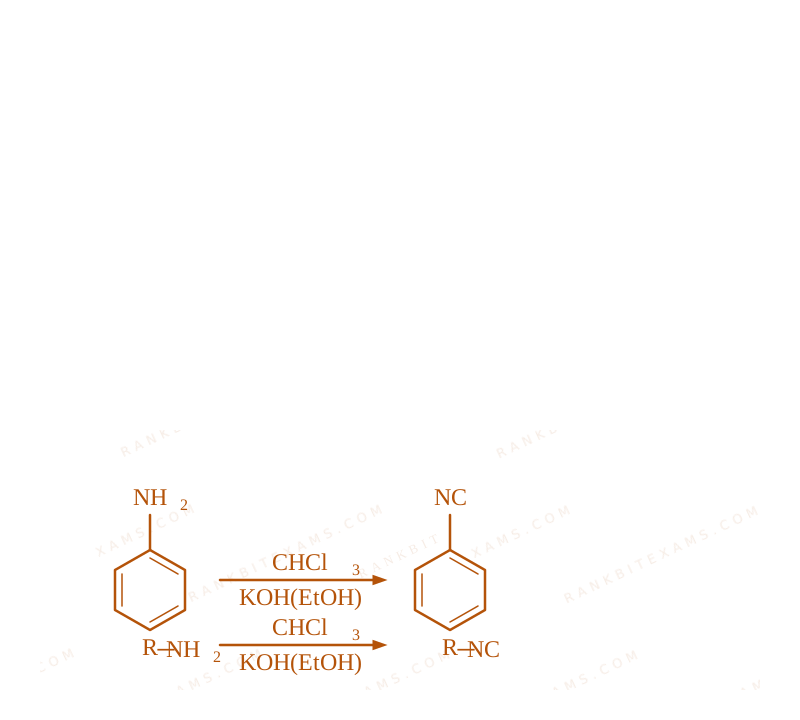
(B) Aliphatic and aromatic primary amines on heating with CHCl_3$CHCl_{3}$ and ethanolic KOH form carbylamines.
(C) Secondary and tertiary amines also give carbylamine test.
(D) Benzenesulfonyl chloride is known as Hinsberg's reagent.
(E) Tertiary amines reacts with benzenesulfonyl chloride very easily.
Choose the correct answer from the options given below :
A. (B) and (D) only
B. (A) and (B) only
C. (D) and (E) only
D. (B) and (C) only
Solution
### Related Formula
The Carbylamine reaction is specific to primary amines:
R-NH_2 + CHCl_3 + 3KOH xrightarrowDelta R-NC + 3KCl + 3H_2O$$R-NH_2 + CHCl_3 + 3KOH \xrightarrow{\Delta} R-NC + 3KCl + 3H_2O$$
### Core Logic
Evaluating each amine statement:
- (A) Primary aromatic amines form stable diazonium salts with NaNO_2/HCl$NaNO_2/HCl$ at low temperatures, making this statement false.
- (B) Both aliphatic and aromatic primary amines undergo the carbylamine test to produce foul-smelling isocyanides. This is **correct**.
- (C) Secondary and tertiary amines do not undergo the carbylamine reaction, making this statement false.
- (D) Benzenesulfonyl chloride (C_6H_5SO_2Cl$C_6H_5SO_2Cl$) is the definition of Hinsberg's reagent. This is **correct**.
- (E) Tertiary amines do not possess an acidic hydrogen on nitrogen and do not react with Hinsberg's reagent under standard analytical testing conditions, making this statement false.
### Step 1: Selecting Correct Entries
Statements (B) and (D) are verified as true.
Reaction equations summary for primary amine classification
### Pattern Recognition
Hinsberg's reagent and the carbylamine test are key analytical methods used to differentiate primary, secondary, and tertiary amines. The carbylamine test is strictly positive *only* for primary (1^circ$1^\circ$) amine groups.
### Evaluation Rubric / Model Answer
null
### Chapter Mix
Class 12 Chemistry: Amines
We Map Every Repeating Question in Competitive Exams.
Say goodbye to generic mock test fatigue. RankBit uses smart analysis to group past exam questions into their foundational Repeating Question Types. Find chapter weightage, track repeating questions, and score higher with targeted practice.
Select Your Target Exam
Choose an exam track below to find formulas per chapter and patterns.
Syncing Exam Intelligence
Mapping formulas and patterns across all tracks…
PATH A — FULL LENGTH PRACTICE
Full Mock Test Hub
Simulate real NTA exam conditions with fully tracked mocks. Time yourself against past papers.
Practice past-year questions one chapter at a time. Pick an exam → subject → chapter and get every PYQ for that topic — pulled together from all past papers — with the chapter's key formulas alongside.

.svg "Amine Basicity, Neutralization Calculation, Molar Equivalence")
)
 "aniline, p-methoxyaniline, p-nitroaniline")
 "aniline, p-methoxyaniline, p-nitroaniline")
 "aniline, p-methoxyaniline, p-nitroaniline")