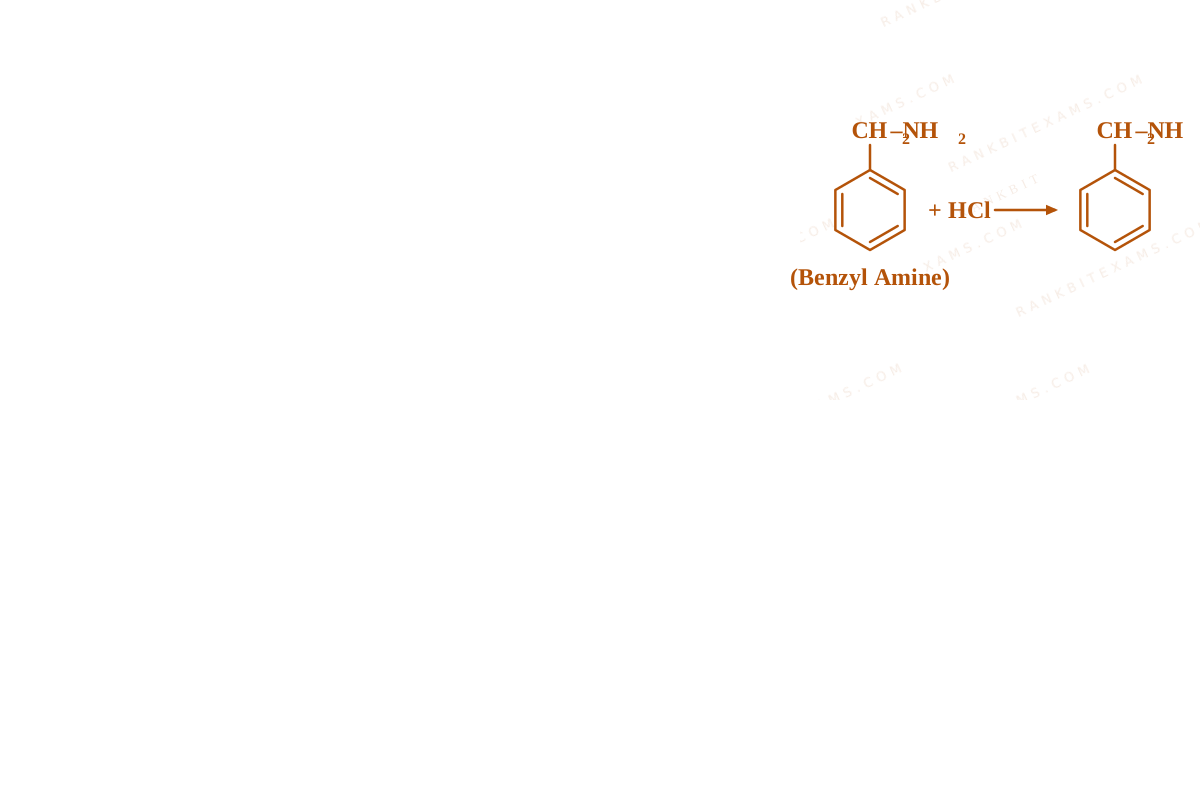
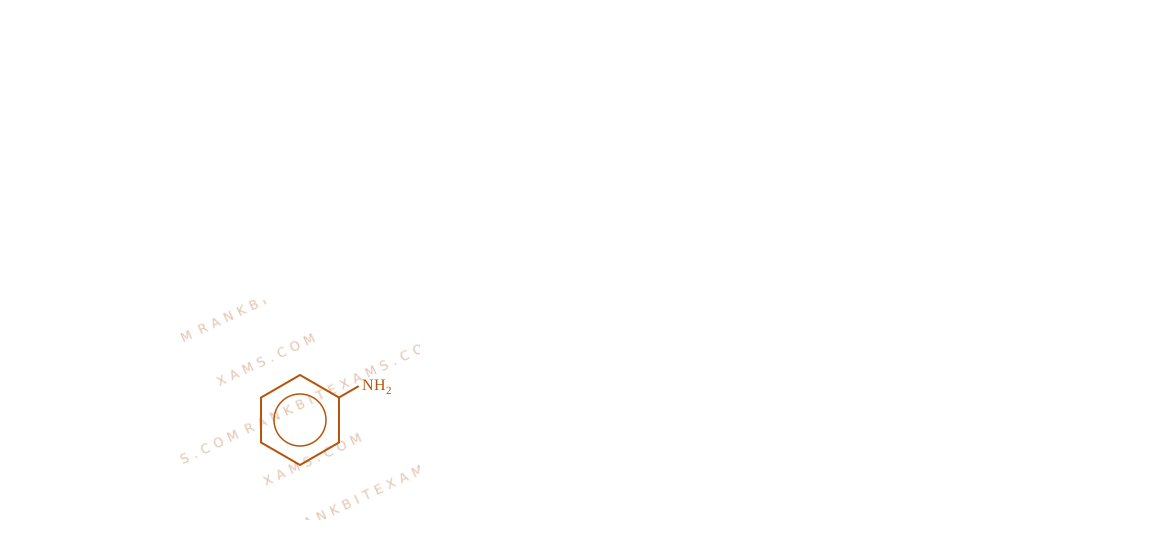
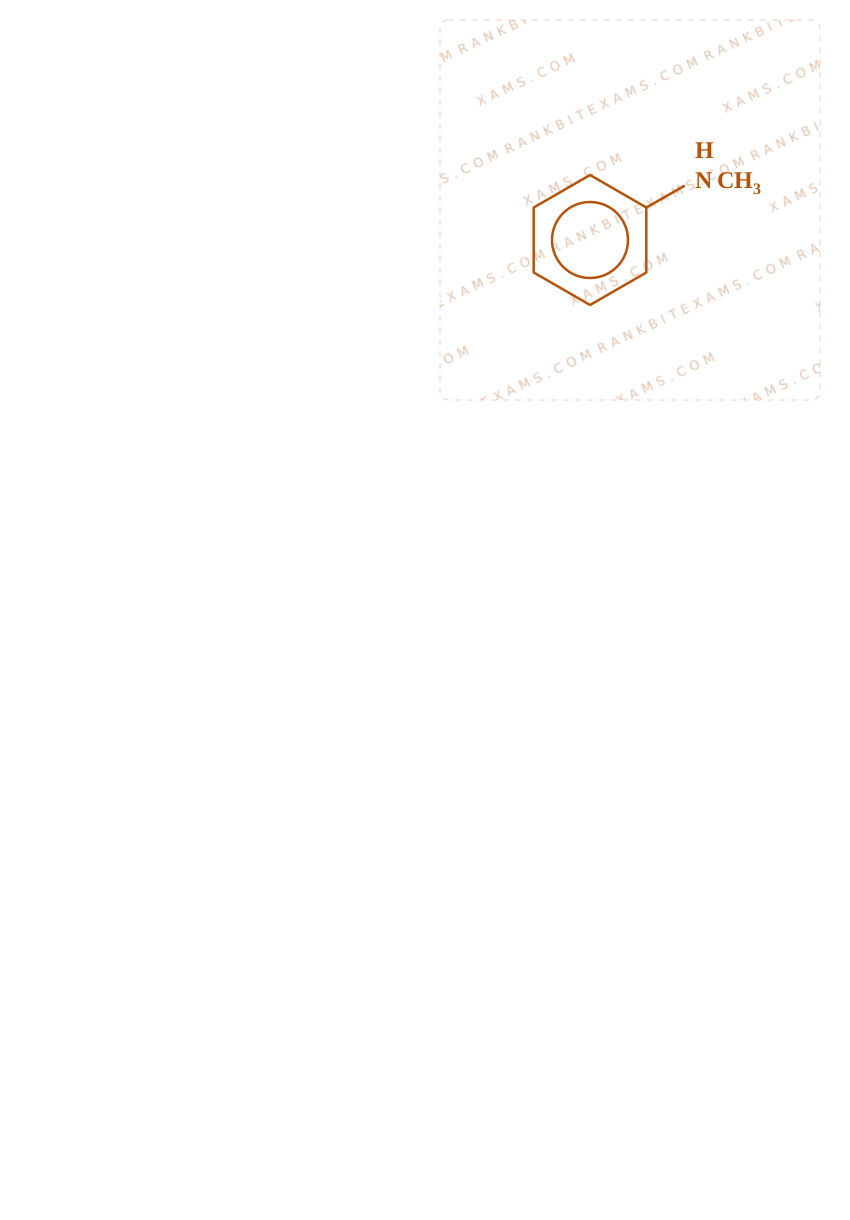
Given below are some nitrogen containing compounds.
Four amine candidates are indexed to find the optimal basic compound for reaction calculations.
Each of them is treated with HCl separately.
1.0 g of the most basic compound will consume ________ mg of HCl.
(Given molar mass in g mol ^-1$^{-1}$ C:12, H : 1, O : 16, Cl : 35.5)
Four amine candidates are indexed to find the optimal basic compound for reaction calculations.
Numerical Answer Type:
Enter a numerical valueAnswer: 341 to 341+4 marks
Solution & Explanation
### Related Formula
textMoles = fractextMasstextMolar Mass$$\text{Moles} = \frac{\text{Mass}}{\text{Molar Mass}}$$textMass of HCl consumed = n_textamine cdot M_textHCl$$\text{Mass of HCl consumed} = n_{\text{amine}} \cdot M_{\text{HCl}}$$
### Core Logic
Step 1: Identify the most basic amine
Benzylamine (mathrmC_6mathrmH_5mathrmCH_2mathrmNH_2$\mathrm{C}_6\mathrm{H}_5\mathrm{CH}_2\mathrm{NH}_2$) is the most basic compound here because its nitrogen lone pair is localized and not involved in aromatic resonance. This stands in contrast to aniline or amides, which delocalize their lone pairs into the ring or carbonyl group .
Step 2: Neutralization Stoichiometry
mathrmC_6H_5CH_2NH_2 + mathrmHCl
ightarrow mathrmC_6H_5CH_2NH_3^+ Cl^-$$\mathrm{C_6H_5CH_2NH_2} + \mathrm{HCl}
ightarrow \mathrm{C_6H_5CH_2NH_3^+ Cl^-}$$
Molar Mass of Benzylamine (mathrmC_7mathrmH_9mathrmN$\mathrm{C}_7\mathrm{H}_9\mathrm{N}$):
M = (7 cdot 12) + (9 cdot 1) + 14 = 84 + 9 + 14 = 107 \, mathrmg/mol$$M = (7 \cdot 12) + (9 \cdot 1) + 14 = 84 + 9 + 14 = 107 \, \mathrm{g/mol}$$
Moles of Benzylamine in 1.0text g$1.0\text{ g}$ :
n = frac1.0107 simeq 0.009346 \, mathrmmol$$n = \frac{1.0}{107} \simeq 0.009346 \, \mathrm{mol}$$
Since 1 mole of benzylamine reacts with 1 mole of mathrmHCl$\mathrm{HCl}$ :
textMoles of HCl consumed = 0.009346 \, mathrmmol$$\text{Moles of HCl consumed} = 0.009346 \, \mathrm{mol}$$textMass of HCl = 0.009346 cdot 36.5 = 0.3411 \, mathrmg = 341.1 \, mathrmmg
ightarrow 341$$\text{Mass of HCl} = 0.009346 \cdot 36.5 = 0.3411 \, \mathrm{g} = 341.1 \, \mathrm{mg}
ightarrow 341$$
### Pattern Recognition
Aliphatic localized clusters (like the -mathrmCH_2mathrmNH_2$-\mathrm{CH}_2\mathrm{NH}_2$ segment in benzylamine) always show higher basicity than aromatic ring-conjugated arrays.
### Evaluation Rubric / Model Answer
null
### Chapter Mix
Class 12 Chemistry: Amines
Four amine candidates are indexed to find the optimal basic compound for reaction calculations.
Which of the following amine(s) show(s) positive carbylamine test?
A. The structures depict Aniline (A) and N-Methylaniline (E) to distinguish primary and secondary aromatic amines.
B. (CH_3)_2NH$(CH_3)_2NH$
C. CH_3NH_2$CH_3NH_2$
D. (CH_3)_3N$(CH_3)_3N$
E. The structures depict Aniline (A) and N-Methylaniline (E) to distinguish primary and secondary aromatic amines.
Choose the correct answer from the options given below:
A.textA and E Only$\text{A and E Only}$
B.textC Only$\text{C Only}$
C.textA and C Only$\text{A and C Only}$
D.textB, C and D Only$\text{B, C and D Only}$
Solution
### Related Formula
textR-textNH_2 + textCHCl_3 + 3textKOH rightarrow textR-textNC + 3textKCl + 3textH_2textO$$\text{R}-\text{NH}_2 + \text{CHCl}_3 + 3\text{KOH} \rightarrow \text{R}-\text{NC} + 3\text{KCl} + 3\text{H}_2\text{O}$$
### Core Logic
Only primary (1^circ$1^\circ$) aliphatic and aromatic amines yield a positive carbylamine test (forming foul-smelling alkyl/aryl isocyanides).
- **A** is Aniline (primary aromatic amine) rightarrow$\rightarrow$ Positive
- **B** is Dimethylamine (secondary aliphatic amine) rightarrow$\rightarrow$ Negative
- **C** is Methylamine (primary aliphatic amine) rightarrow$\rightarrow$ Positive
- **D** is Trimethylamine (tertiary aliphatic amine) rightarrow$\rightarrow$ Negative
- **E** is N-Methylaniline (secondary aromatic amine) rightarrow$\rightarrow$ Negative
Thus, only A and C show a positive test.
### Pattern Recognition
Shortcut: Look directly for any amine with a plain -textNH_2$-\text{NH}_2$ functional group. Secondary (-textNH-$-\text{NH}-$) and tertiary (-textN-$-\text{N}-$) amines never react.
### Evaluation Rubric / Model Answer
null
### Chapter Mix
Class 12 Chemistry: Amines
Qjee_main_2025_08_april_eveningFunctional Group Analysis and Identification
An organic compound 'A' undergoes the following sequence of transformations:
text'A' xrightarrow[text(ii) H_3O^+]text(i) NaOH text'B' xrightarrow[text(ii) H_2SO_4, Delta]text(i) EtOH text'C'$$\text{'A'} \xrightarrow[\text{(ii) } H_3O^+]{\text{(i) } NaOH} \text{'B'} \xrightarrow[\text{(ii) } H_2SO_4, \Delta]{\text{(i) } EtOH} \text{'C'}$$
* 'A' shows a positive Lassaigne's test for nitrogen and its molar mass is 121 text g mol^-1$121 \text{ g mol}^{-1}$.
* 'B' gives effervescence with aqueous textNaHCO_3$\text{NaHCO}_3$.
* 'C' gives a characteristic fruity smell.
Identify A, B, and C from the options below:
A.
B.
C.
D.
Solution
### Core Logic
Let's perform a step-by-step diagnostic analysis:
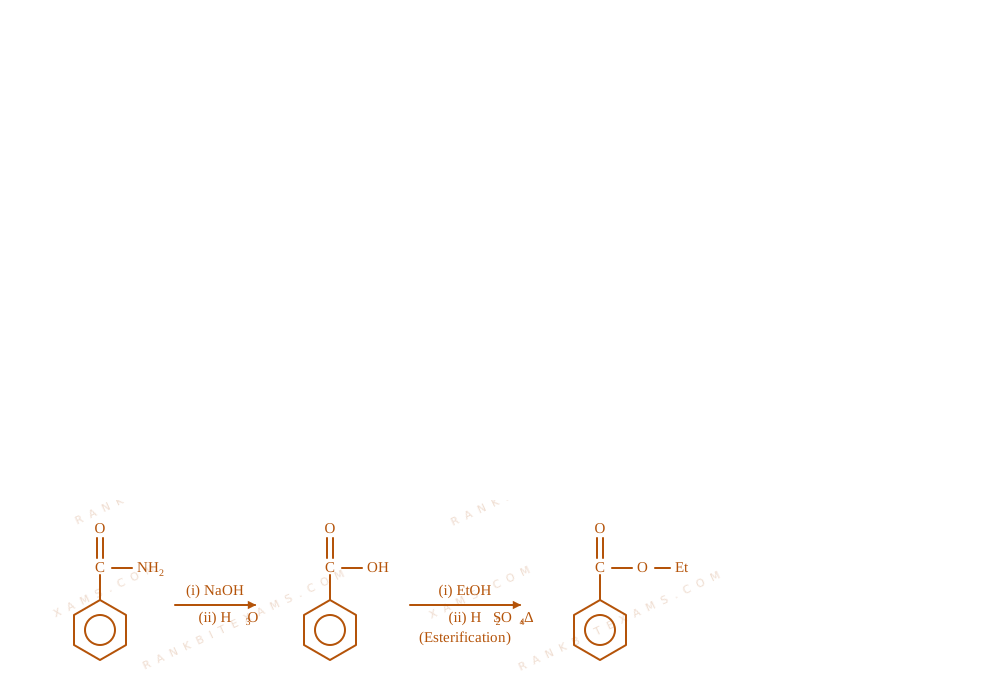
1. **Molar Mass & Nitrogen Test**: Compound 'A' has a nitrogen atom and a molar mass of 121 text g mol^-1$121 \text{ g mol}^{-1}$. Let's verify Benzamide (textC_6textH_5textCONH_2$\text{C}_6\text{H}_5\text{CONH}_2$):
textMass = (7 times 12) + (7 times 1) + 14 + 16 = 84 + 7 + 14 + 16 = 121 text g mol^-1$$\text{Mass} = (7 \times 12) + (7 \times 1) + 14 + 16 = 84 + 7 + 14 + 16 = 121 \text{ g mol}^{-1}$$
This matches perfectly.
2. **Alkaline Hydrolysis**: Hydrolysis of benzamide under basic conditions yields benzoic acid upon acidification:
textC_6textH_5textCONH_2 xrightarrow[H_3O^+]NaOH textC_6textH_5textCOOH (Compound B) + textNH_3$$\text{C}_6\text{H}_5\text{CONH}_2 \xrightarrow[H_3O^+]{NaOH} \text{C}_6\text{H}_5\text{COOH (Compound B)} + \text{NH}_3$$
Benzoic acid reactively gives effervescence with textNaHCO_3$\text{NaHCO}_3$ due to the liberation of textCO_2$\text{CO}_2$ gas.
3. **Esterification**: Reaction of benzoic acid with ethanol in the presence of acid catalyst results in the creation of ethyl benzoate, an ester with a pleasant fruity smell:
textC_6textH_5textCOOH + textEtOH xrightarrowH_2SO_4, Delta textC_6textH_5textCOOEt (Compound C) + textH_2textO$$\text{C}_6\text{H}_5\text{COOH} + \text{EtOH} \xrightarrow{H_2SO_4, \Delta} \text{C}_6\text{H}_5\text{COOEt (Compound C)} + \text{H}_2\text{O}$$Esterification reaction mechanism diagram for Q28
### Pattern Recognition
"Fruity smell" is an absolute indicator for an ester product. "Effervescence with textNaHCO_3$\text{NaHCO}_3$" dictates a carboxylic acid intermediate. Basic hydrolysis converting an organo-nitrogen compound into an acid points directly to an amide or a nitrile—molar mass calculation establishes benzamide over benzonitrile (M = 103$M = 103$).
### Evaluation Rubric / Model Answer
null
### Chapter Mix
Class 12 Chemistry: Amines
Class 12 Chemistry: Aldehydes, Ketones and Carboxylic Acids
Q41jee_main_2025_29_jan_eveningDiazotization and Coupling Reactions
Which one of the following reaction sequences will give an azo dye?
(1) Nitrobenzene treated with (i) Sn/HCl$Sn/HCl$, (ii) NaNO_2/HCl$NaNO_{2}/HCl$, (iii) beta$\beta$-naphthol, NaOH$NaOH$
(2) Benzenesulfonic acid treated with (i) SOCl_2$SOCl_2$, (ii) NH_3$NH_3$, (iii) Benzyl chloride
(3) Benzonitrile treated with (i) 70\% H_2SO_4$70\% H_2SO_4$, (ii) PCl_5$PCl_5$, (iii) Aniline
(4) Aniline treated with (i) HCl/NaNO_2$HCl/NaNO_2$, (ii) Toluene
A. Reaction sequence (1)
B. Reaction sequence (2)
C. Reaction sequence (3)
D. Reaction sequence (4)
Solution
### Core Logic
Let's track sequence (1):
1) Nitrobenzene (Ph-NO_2$Ph-NO_2$) is reduced using Sn/HCl$Sn/HCl$ to form Aniline (Ph-NH_2$Ph-NH_2$).
2) Aniline undergoing diazotization with NaNO_2/HCl$NaNO_{2}/HCl$ at cold temperatures (0-5^circC$0-5^{circ}C$) creates Benzene diazonium chloride (Ph-N_2^+Cl^-$Ph-N_{2}^{+}Cl^{-}$).
3) The diazonium salt undergoes a coupling reaction with beta$\beta$-naphthol in alkaline conditions (NaOH$NaOH$) to synthesize a highly vibrant red-orange azo dye.
Diazotization and Coupling Reactions diagram for Q41 - JEE Main 2025 Evening
### Pattern Recognition
The standard sequence for azo dye preparation is: Aromatic Nitro
ightarrow$
ightarrow$ Primary Amine
ightarrow$
ightarrow$ Diazonium Salt
ightarrow$
ightarrow$ Phenol/Naphthol Coupling.
### Evaluation Rubric / Model Answer
null
### Chapter Mix
Class 12 Chemistry: Amines
Q49jee_main_2025_28_jan_morningYield and Stoichiometric Calculations
Consider the following sequence of reactions :
The flowchart tracks a chemical conversion starting from chlorobenzene down to final compound B.
11.25 mg of chlorobenzene will produce mathrmx times 10^-1$\mathrm{x} \times 10^{-1}$ mg of product B.
(Consider the reactions result in complete conversion.)
[Given molar mass of C, H, O, N and Cl as 12, 1, 16, 14 and 35.5mathrmg\,mol^-1$35.5\mathrm{g\,mol}^{-1}$ respectively]
Numerical Answer.Answer: 93 to 93
Solution
### Core Logic
The reaction sequence details the functional conversion of chlorobenzene down to product B (aniline, with a molar mass of 93\,mathrmg\,mol^-1$93\,\mathrm{g\,mol}^{-1}$).
Following stoichiometric preservation:
textmoles of chlorobenzene = textmoles of Aniline (B)$$\text{moles of chlorobenzene} = \text{moles of Aniline (B)}$$
Molar mass of chlorobenzene (mathrmC_6mathrmH_5mathrmCl$\mathrm{C}_6\mathrm{H}_5\mathrm{Cl}$) = 112.5\,mathrmg\,mol^-1$112.5\,\mathrm{g\,mol}^{-1}$.
The flowchart tracks a chemical conversion starting from chlorobenzene down to final compound B.textmoles = frac11.25 times 10^-3\,mathrmg112.5\,mathrmg\,mol^-1 = 10^-4\,mathrmmol$$\text{moles} = \frac{11.25 \times 10^{-3}\,\mathrm{g}}{112.5\,\mathrm{g\,mol}^{-1}} = 10^{-4}\,\mathrm{mol}$$
Mass of product B produced:
textMass = 10^-4\,mathrmmol times 93\,mathrmg\,mol^-1 = 9.3 times 10^-3\,mathrmg = 9.3\,mathrmmg$$\text{Mass} = 10^{-4}\,\mathrm{mol} \times 93\,\mathrm{g\,mol}^{-1} = 9.3 \times 10^{-3}\,\mathrm{g} = 9.3\,\mathrm{mg}$$
Expressing in the specified format:
9.3\,mathrmmg = 93 times 10^-1\,mathrmmg Rightarrow x = 93$$9.3\,\mathrm{mg} = 93 \times 10^{-1}\,\mathrm{mg} \Rightarrow x = 93$$
### Pattern Recognition
Sees: Conversion sequence preserving a 1:1 mole ratio layout.
Shortcut: Directly compute target weight via W_B = W_A cdot fracM_BM_A = 11.25 cdot frac93112.5 = 9.3$W_B = W_A \cdot \frac{M_B}{M_A} = 11.25 \cdot \frac{93}{112.5} = 9.3$.
### Evaluation Rubric / Model Answer
null
### Chapter Mix
Class 12 Chemistry: Amines
Q37jee_main_2025_03_april_morningDiazonium Salts and Reactions
Identify [A], [B], and [C], respectively in the following reaction sequence:
The reaction shows Aniline reacting with sodium nitrite and hydrochloric acid to produce intermediate A, followed by treatment with potassium iodide to yield B, which then dimerizes via sodium in dry ether to form C.
A. Option (1)
B. Option (2)
C. Option (3)
D. Option (4)
Solution
### Core Logic
Let us resolve each structural step sequentially:
1. **Step 1:** Aniline undergoes diazotization when treated with textNaNO_2 + textHCl$\text{NaNO}_2 + \text{HCl}$ at 273-278text K$273-278\text{ K}$, forming benzene diazonium chloride [A]$[A]$ (textC_6textH_5textN_2^+textCl^-$\text{C}_6\text{H}_5\text{N}_2^+\text{Cl}^-$).
2. **Step 2:** Warming benzene diazonium chloride with potassium iodide (textKI$\text{KI}$) substitutes the diazonium group with iodine, producing iodobenzene [B]$[B]$ (textC_6textH_5textI$\text{C}_6\text{H}_5\text{I}$).
3. **Step 3:** Treating iodobenzene with sodium metal in dry ether causes a Fittig coupling reaction, dimerizing two phenyl radicals into biphenyl [C]$[C]$ (textC_6textH_5-textC_6textH_5$\text{C}_6\text{H}_5-\text{C}_6\text{H}_5$). The reaction shows Aniline reacting with sodium nitrite and hydrochloric acid to produce intermediate A, followed by treatment with potassium iodide to yield B, which then dimerizes via sodium in dry ether to form C.The reaction shows Aniline reacting with sodium nitrite and hydrochloric acid to produce intermediate A, followed by treatment with potassium iodide to yield B, which then dimerizes via sodium in dry ether to form C.
### Pattern Recognition
Shortcut: Aniline
ightarrow textNaNO_2/textHCl
ightarrow$
ightarrow \text{NaNO}_2/\text{HCl}
ightarrow$ Diazonium salt
ightarrow textKI
ightarrow$
ightarrow \text{KI}
ightarrow$ Iodobenzene. The final sodium metal treatment triggers a symmetrical radical dimer homocoupling (Fittig reaction) to yield a biphenyl product.
### Evaluation Rubric / Model Answer
null
### Chapter Mix
Class 12 Chemistry: Amines
Class 12 Chemistry: Haloalkanes and Haloarenes
We Map Every Repeating Question in Competitive Exams.
Say goodbye to generic mock test fatigue. RankBit uses smart analysis to group past exam questions into their foundational Repeating Question Types. Find chapter weightage, track repeating questions, and score higher with targeted practice.
Select Your Target Exam
Choose an exam track below to find formulas per chapter and patterns.
Syncing Exam Intelligence
Mapping formulas and patterns across all tracks…
PATH A — FULL LENGTH PRACTICE
Full Mock Test Hub
Simulate real NTA exam conditions with fully tracked mocks. Time yourself against past papers.
Practice past-year questions one chapter at a time. Pick an exam → subject → chapter and get every PYQ for that topic — pulled together from all past papers — with the chapter's key formulas alongside.

.svg "Amine Basicity, Neutralization Calculation, Molar Equivalence")
)


 "Diazotization, Benzene diazonium chloride, Iodobenzene, Wurtz-Fittig biphenyl")
 "Diazotization, Benzene diazonium chloride, Iodobenzene, Wurtz-Fittig biphenyl")
 "Diazotization, Benzene diazonium chloride, Iodobenzene, Wurtz-Fittig biphenyl")
