JEE Main · Physics → Steady

Electromagnetic Waves appeared 31 times across 3 years — 3.6% of Physics. This question is from Propagation of Electromagnetic Waves.

Year 2026 2025 2024 Total
Questions 10 12 9 31

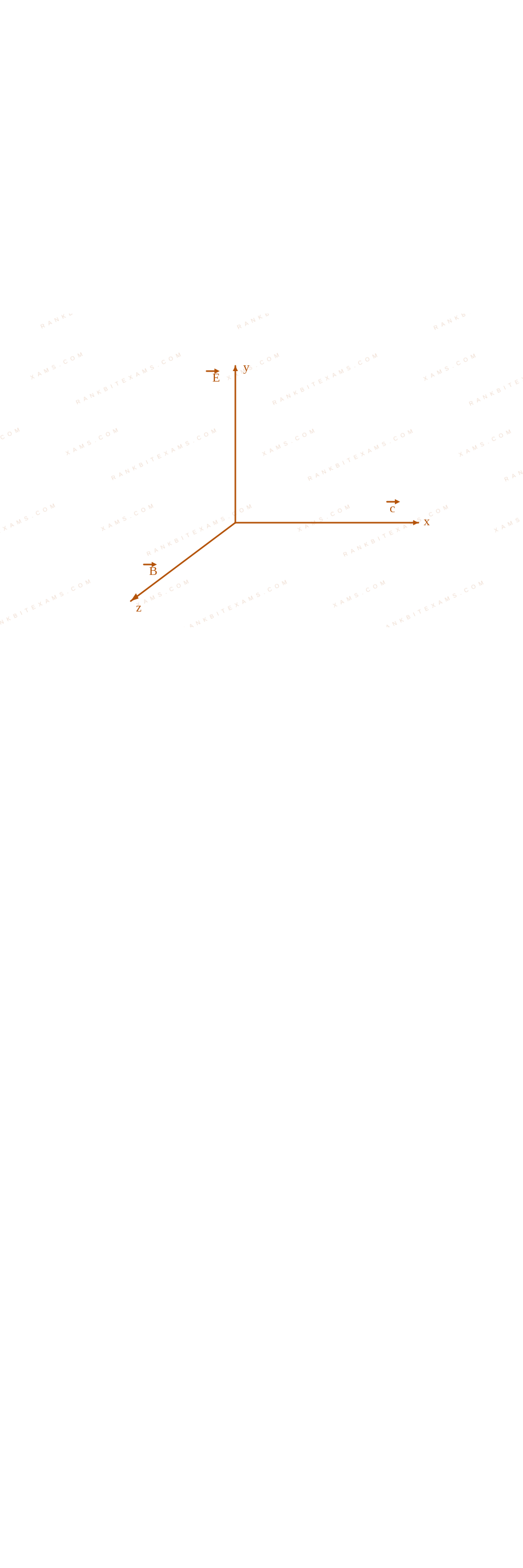
A plane electromagnetic wave propagates along the +x direction in free space. The components of the electric field, E and magnetic field, B vectors associated with the wave in Cartesian frame are:

Solution & Explanation

Related Formula
c = E × B

where, c = unit vector in the direction of wave propagation E = unit vector of the electric field B = unit vector of the magnetic field

Core Logic

Given that the wave propagates along the +x direction:

c = i

Let us test the combination Ey and Bz, which implies E = j and B = k:

E × B = j × k = i

Propagation of Electromagnetic Waves diagram for Q8 - JEE Main 2025 Evening

This cross product yields exactly the direction of propagation +x. Therefore, Ey and Bz are appropriate components representing the cross-orthogonal vectors of the EM wave.

Pattern Recognition

Always remember the cyclic relation i arrow j arrow k. Since propagation is i, our cross product must be j × k. Thus electric field along y matches magnetic field along z.

Chapter Mix

Class 12 Physics: Electromagnetic Waves

Reference Study Guides

More Electromagnetic Waves Previous-Year Questions — Page 7

Q40 jee_main_2024_31_jan_morning Energy Density Of EM Waves
In a plane EM wave, the electric field oscillates sinusoidally at a frequency of 5 × 10¹⁰ ~Hz and an amplitude of 50 ~Vm⁻¹. The total average energy density of the electromagnetic field of the wave is : [Use ε₀ = 8.85 × 10⁻¹² C² / Nm² ]
  • A. 1.106 × 10⁻⁸ Jm⁻³
  • B. 4.425 × 10⁻⁸ ~Jm⁻³
  • C. 2.212 × 10⁻⁸ ~Jm⁻³
  • D. 2.212 × 10⁻¹⁰ ~Jm⁻³

Solution

Related Formula
Utotal average = (1)/(2)ε₀ E₀²
Core Logic

For an electromagnetic wave, the total average energy density is the sum of the average energy density of the electric field and the magnetic field. They are equal, so:

Uavg = UE + UB = 2UE = 2 ( (1)/(4)ε₀ E₀² ) = (1)/(2)ε₀ E₀²

Where E₀ is the amplitude of the electric field.

Step 2: Substitution

Given: E₀ = 50 V/m ε₀ = 8.85 × 10⁻¹² C²/(N· m²)

Uavg = (1)/(2) × (8.85 × 10⁻¹²) × (50)² Uavg = (1)/(2) × 8.85 × 10⁻¹² × 2500 Uavg = 1.10625 × 10⁻⁸ J/m³
Chapter Mix

Class 12 Physics: Electromagnetic Waves

More Electromagnetic Waves Questions — jee_main_2025_29_jan_evening

Practice all Electromagnetic Waves previous-year questions →

Rankbit System
JEE Physics: Waves (+15.5%) | Electrostatics: Concentric Shells (-29.7%) | Modern Physics: Photoelectric Clones (+34.2%) | Mathematics: Definite Integrals (+18.1%) | Chemistry: Coordination Splitting (-11.4%) | JEE Physics: Waves (+15.5%) | Electrostatics: Concentric Shells (-29.7%) | Modern Physics: Photoelectric Clones (+34.2%) | Mathematics: Definite Integrals (+18.1%) | Chemistry: Coordination Splitting (-11.4%)