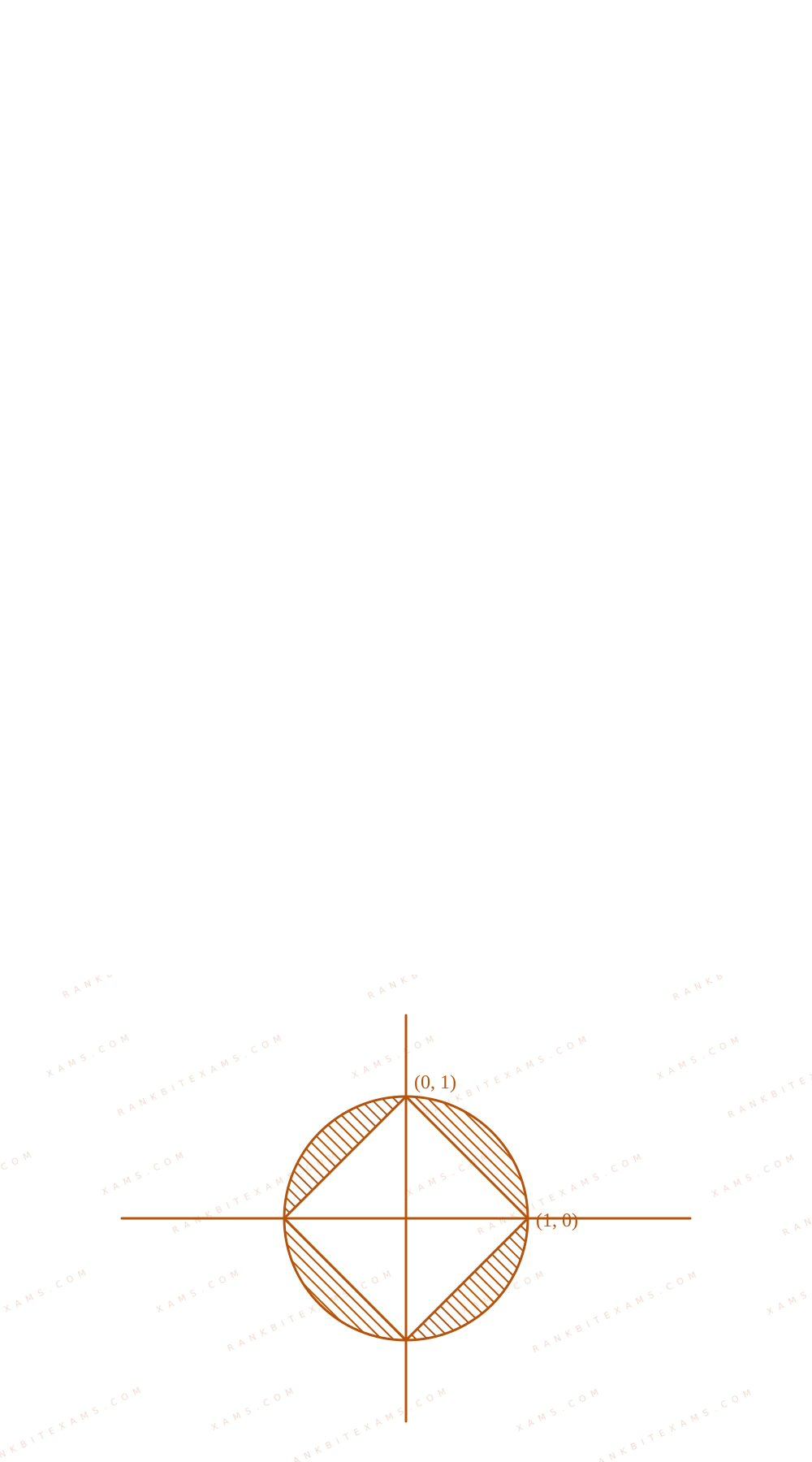
Let the area enclosed between the curves |y| = 1 - x^2 and x^2 + y^2 = 1 be alpha. If 9alpha = beta pi + gamma, beta, gamma are integers, then the value of |beta - gamma| equals

Solution & Explanation

### Related Formula Area enclosed between two symmetric functions across four quadrants: alpha = 4 times left( textArea of circle in 1^textst text quadrant - int_0^1 y_textparabola \, dx right) ### Core Logic The curves are symmetric across the axes. The region is enclosed between the unit circle x^2 + y^2 = 1 and the parabolas y = pm(1 - x^2).
Area Enclosed by Two Curves diagram for Q53 - JEE Main 2025 Evening
By symmetry, the area alpha in the first quadrant is the area under the circle minus the area under the parabola from x=0 to x=1. ### Step 1: Calculate the Area Components Area of a circle quadrant with r=1 is fracpi4. Area under the parabola: int_0^1 (1 - x^2) \, dx = left[ x - fracx^33 right]_0^1 = 1 - frac13 = frac23 ### Step 2: Evaluate the Total Area alpha = 4 left[ fracpi4 - frac23 right] = pi - frac83 Multiplying both sides by 9: 9alpha = 9pi - 24 Comparing with 9alpha = betapi + gamma, we get: beta = 9, quad gamma = -24 Hence, |beta - gamma| = |9 - (-24)| = 33 ### Pattern Recognition Symmetry helps divide the integration work by 4. Recognizing standard shapes (like a circle sector) allows you to bypass complex integration entirely for half of the problem. ### Evaluation Rubric / Model Answer null ### Chapter Mix Class 12 Mathematics: Integral Calculus

Reference Study Guides

More Integral Calculus Previous-Year Questions — Page 6

Q21 jee_main_2024_31_jan_evening Properties of Definite Integrals
left|frac120pi^3int_0^pi fracx^2sin xcos xsin^4x + cos^4x dxright| is equal to
Numerical Answer. Answer: 15 to 15

Solution

### Related Formula int_0^a x f(x) dx = fraca2 int_0^a f(x) dx quad textif f(a-x) = f(x) ### Core Logic Let I = int_0^pi fracx^2sin xcos xsin^4x + cos^4x dx. Split the integral into int_0^pi/2 + int_pi/2^pi. For the second integral, substitute x = pi - t: I = int_0^pi/2 fracsin xcos xsin^4x + cos^4x (x^2 - (pi - x)^2) dx I = int_0^pi/2 fracsin xcos xsin^4x + cos^4x (2pi x - pi^2) dx = 2pi int_0^pi/2 x f(x) dx - pi^2 int_0^pi/2 f(x) dx where f(x) = fracsin x cos xsin^4 x + cos^4 x. Since f(pi/2 - x) = f(x), we have int_0^pi/2 x f(x) dx = fracpi4 int_0^pi/2 f(x) dx. I = 2pi left(fracpi4right) int_0^pi/2 f(x) dx - pi^2 int_0^pi/2 f(x) dx = -fracpi^22 int_0^pi/2 fracsin xcos xsin^4x + cos^4x dx To evaluate this simpler integral: I = -fracpi^22 int_0^pi/2 fracsin xcos x1 - 2sin^2 xcos^2 x dx = -fracpi^22 int_0^pi/2 fracsin 2x2 - sin^2 2x dx I = -fracpi^22 int_0^pi/2 fracsin 2x1 + cos^2 2x dx Let cos 2x = t implies -2sin 2x dx = dt. Limits: 1 to -1. I = -fracpi^22 int_1^-1 frac-dt/21+t^2 = -fracpi^24 int_-1^1 fracdt1+t^2 I = -fracpi^24 [arctan t]_-1^1 = -fracpi^24 left(fracpi4 - left(-fracpi4right)right) = -fracpi^38 Finally: left| frac120pi^3 left(-fracpi^38right) right| = 15 ### Evaluation Rubric / Model Answer null ### Chapter Mix Class 12 Maths: Integrals

Q21 jee_main_2024_31_jan_morning Definite Integration by Substitution
If the integral 525 int_0^fracpi2 sin 2x cos^frac112x (1 + cos^frac52x)^frac12 dx is equal to (nsqrt2 - 64), then n is equal to
Numerical Answer. Answer: 176 to 176

Solution

### Core Logic I = int_0^fracpi2 sin 2x cdot (cos x)^frac112 (1 + (cos x)^frac52)^frac12 dx Substitute cos x = t^2 implies sin x dx = -2t dt. Since sin 2x = 2sin x cos x, we have 2(t^2)(-2t dt) = -4t^3 dt. Limits: x=0 to t=1, x=fracpi2 to t=0. I = 4 int_0^1 t^2 cdot (t^2)^frac112 sqrt1 + t^5 t dt = 4 int_0^1 t^14 sqrt1 + t^5 dt ### Step 1: Second Substitution Put 1 + t^5 = k^2 implies 5t^4 dt = 2k dk. t^5 = k^2 - 1. I = 4 int_1^sqrt2 (k^2 - 1)^2 cdot k cdot frac2k5 dk I = frac85 int_1^sqrt2 (k^6 - 2k^4 + k^2) dk ### Step 2: Evaluate the Integral I = frac85 left[ frack^77 - frac2k^55 + frack^33 right]_1^sqrt2 I = frac85 left[ frac8sqrt27 - frac8sqrt25 + frac2sqrt23 - frac17 + frac25 - frac13 right] I = frac85 left[ frac120sqrt2 - 168sqrt2 + 70sqrt2105 - frac15 - 42 + 35105 right] I = frac85 left[ frac22sqrt2105 - frac8105 right] ### Step 3: Equate with Given Form Given 525 I = nsqrt2 - 64. 525 times frac85 left( frac22sqrt2 - 8105 right) = 8 times (22sqrt2 - 8) = 176sqrt2 - 64 Comparing with (nsqrt2 - 64), we get n = 176. ### Evaluation Rubric / Model Answer null ### Chapter Mix Class 12 Maths: Integrals
Q30 jee_main_2024_31_jan_morning Properties of Definite Integrals
Let f : mathbbR to mathbbR be a function defined by f(x) = frac4^x4^x + 2 and M = int_f(a)^f(1 - a) x sin^4(x(1 - x)) dx, N = int_f(a)^f(1 - a) sin^4(x(1 - x)) dx; a neq frac12. If alpha M = beta N, alpha, beta in mathbbN, then the least value of alpha^2 + beta^2 is equal to
Numerical Answer. Answer: 5 to 5

Solution

### Related Formula f(x) + f(1-x) = frac4^x4^x + 2 + frac4^1-x4^1-x + 2 = 1 ### Core Logic Using the property f(x) + f(1-x) = 1, we have f(a) + f(1-a) = 1. Let limits be A = f(a) and B = f(1-a). Then A + B = 1. M = int_A^B x sin^4(x(1 - x)) dx ### Step 1: Apply King's Property Apply the property int_A^B g(x) dx = int_A^B g(A + B - x) dx. M = int_A^B (1 - x) sin^4((1 - x)(1 - (1 - x))) dx M = int_A^B (1 - x) sin^4(x(1 - x)) dx M = int_A^B sin^4(x(1 - x)) dx - int_A^B x sin^4(x(1 - x)) dx M = N - M ### Step 2: Conclusion 2M = N Given alpha M = beta N, we get alpha = 2 and beta = 1 (for least integral values). Thus, alpha^2 + beta^2 = 2^2 + 1^2 = 5. ### Evaluation Rubric / Model Answer null ### Chapter Mix Class 12 Maths: Integrals Class 12 Maths: Relations and Functions

More Integral Calculus Questions — jee_main_2025_29_jan_evening

Practice all Integral Calculus previous-year questions →

Rankbit System
JEE Physics: Waves (+15.5%) | Electrostatics: Concentric Shells (-29.7%) | Modern Physics: Photoelectric Clones (+34.2%) | Mathematics: Definite Integrals (+18.1%) | Chemistry: Coordination Splitting (-11.4%) | JEE Physics: Waves (+15.5%) | Electrostatics: Concentric Shells (-29.7%) | Modern Physics: Photoelectric Clones (+34.2%) | Mathematics: Definite Integrals (+18.1%) | Chemistry: Coordination Splitting (-11.4%)