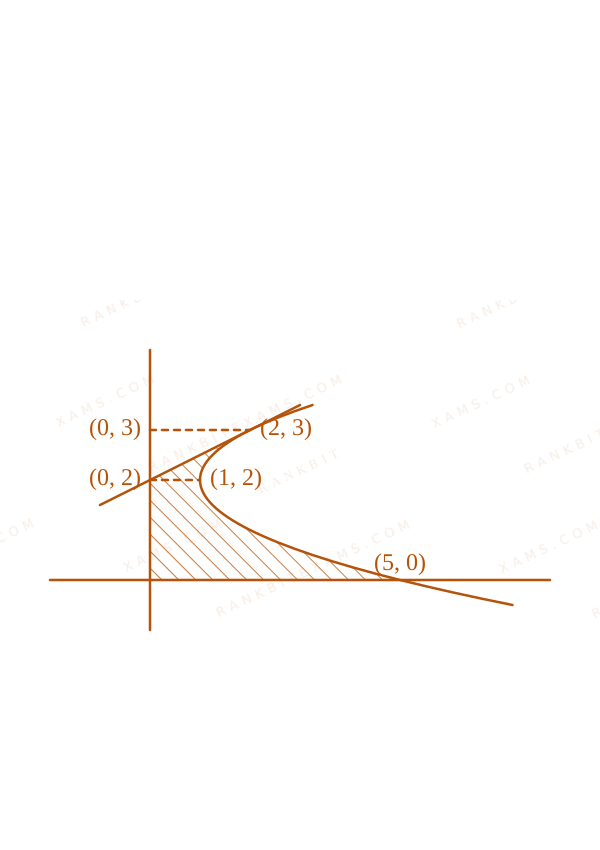
The area of the region enclosed by the parabola (y - 2)² = x - 1$(y - 2)^2 = x - 1$ , the line x - 2y + 4 = 0$x - 2y + 4 = 0$ and the positive coordinate axes is
The line is tangent to the parabola at y = 3$y = 3$. At y = 3$y = 3$, x = 2(3) - 4 = 2$x = 2(3) - 4 = 2$.
We need the area enclosed by the parabola, the line, and the positive coordinate axes.
Let's trace the boundary intercepts.
The line x = 2y - 4$x = 2y - 4$ cuts the y-axis (x=0$x=0$) at y=2$y=2$.
Parabola vertex is at (1, 2)$(1, 2)$. Parabola cuts y-axis (x=0$x=0$) at (y-2)² = -1$(y-2)^2 = -1$ (No real y-intercept).
So the curve (y-2)² = x-1$(y-2)^2 = x-1$ only exists for x ≥ 1$x \ge 1$.
Step 1: Setting up the Integral w.r.t y
Area Under Curve diagram for Q29 - JEE Main 2024 Evening
Because the area is bound by the positive coordinate axes, we track integration strictly in the first quadrant.
The required area is the area between the y-axis, the x-axis, the line, and the curve. Wait, the problem says "area enclosed by the parabola... line... and positive coordinate axes".
Let's integrate with respect to y$y$.
The boundary curves are x = (y-2)² + 1$x = (y-2)^2 + 1$ (which forms the rightmost boundary) and the axes.
The area bounded by the curve with y-axis is from y=0$y=0$ to y=3$y=3$ minus the triangular region cut by the line below y=2$y=2$.
The line intersects the x-axis (y=0$y=0$) at x=-4$x=-4$ and y-axis (x=0$x=0$) at y=2$y=2$.
The positive coordinate axes enforce boundaries at x ≥ 0, y ≥ 0$x \ge 0, y \ge 0$.
So the exact area is the integral of the parabola's x$x$-value from y=0$y=0$ to y=3$y=3$, minus the area of the small triangle outside the region bounded by the line x=2y-4$x=2y-4$ and the axes in the positive quadrant.
The area under the parabola (to the left towards the y-axis) from y=0$y=0$ to y=3$y=3$ is ∫₀³ xparabola dy$\int_0^3 x_{\text{parabola}} dy$.
The line bounds the region on the left from y=2$y=2$ to y=3$y=3$. Between y=0$y=0$ and y=2$y=2$, the area goes fully to the y-axis.
So, area = ∫₀³ xparabola dy - Area of Δ bounded by line and y-axis$\int_0^3 x_{\text{parabola}} dy - \text{Area of } \Delta \text{ bounded by line and y-axis}$.
The triangle bounded by x=2y-4, x=0, y=2, y=3$x=2y-4, x=0, y=2, y=3$ is: base is x=2(3)-4 = 2$x=2(3)-4 = 2$ at y=3$y=3$, height is 1$1$ (from y=2$y=2$ to y=3$y=3$). Triangle area = (1)/(2) × 2 × 1 = 1$\frac{1}{2} \times 2 \times 1 = 1$.
Hence, Enclosed Area = ∫₀³ ((y-2)² + 1) dy - 1$\int_{0}^{3} ((y-2)^2 + 1) dy - 1$.
Instead of evaluating horizontal strips with a broken left-bound, evaluate the total area mapped to the y-axis ∫₀³ x dy$\int_0^3 x dy$ and simply subtract the basic geometric triangle removed by the straight line.
Let I = ∫-π/6π/6 π+4x¹¹1- (|x|+π/6)dx$I = \int_{-\pi/6}^{\pi/6}\frac{\pi+4x^{11}}{1-\sin(|x|+\pi/6)}dx$.
The denominator 1 - (|x| + π/6)$1 - \sin(|x| + \pi/6)$ is an even function.
The numerator can be split into an even part (π$\pi$) and an odd part (4x¹¹$4x^{11}$).
∫₋ₐa 4x¹¹1- (|x|+π/6) dx = 0 (Since integrand is odd)$$\int_{-a}^{a} \frac{4x^{11}}{1-\sin(|x|+\pi/6)} dx = 0 \quad \text{(Since integrand is odd)}$$
Let t = x + (π)/(6) ⇒ dt = dx$t = x + \frac{\pi}{6} \Rightarrow dt = dx$.
Limits: when x = 0 ⇒ t = π/6$x = 0 \Rightarrow t = \pi/6$, when x = π/6 ⇒ t = π/3$x = \pi/6 \Rightarrow t = \pi/3$.
Symmetric limits [-a, a]$[-a, a]$ instantly demand testing for odd/even parity. Any mixed polynomial like c + k xodd$c + k x^{\text{odd}}$ over an even denominator guarantees the odd power term strictly vanishes, halving calculation time.
Chapter Mix
Class 12 Maths: Definite Integration
Class 11 Maths: Trigonometric Functions
Q25jee_main_2026_21_jan_morningAbsolute Value Integrals
A + B = 2 ((A+B)/(2)) ((A-B)/(2))$$\sin A + \sin B = 2 \sin\left(\frac{A+B}{2}\right) \cos\left(\frac{A-B}{2}\right)$$2x = 2 x x$$\sin 2x = 2 \sin x \cos x$$2x = 2 ² x - 1$$\cos 2x = 2 \cos^2 x - 1$$
Core Logic
Let I = 6∫₀π| 3x + x + 2x| dx$I = 6\int_{0}^{\pi}|\sin 3x + \sin x + \sin 2x| dx$.
Apply sum-to-product on 3x + x$\sin 3x + \sin x$:
3x + x = 2 (2x) (x)$\sin 3x + \sin x = 2 \sin(2x) \cos(x)$
So the expression becomes:
|2 (2x) x + 2x| = | 2x (2 x + 1)| = |2 x x (2 x + 1)|$|2 \sin(2x) \cos x + \sin 2x| = |\sin 2x (2 \cos x + 1)| = |2 \sin x \cos x (2 \cos x + 1)|$
Since x in [0, π]$x \in [0, \pi]$, x ≥ 0$\sin x \geq 0$. We can pull it out of the modulus.
I = 12 ∫₀π x |2 ² x + x| dx$I = 12 \int_{0}^{\pi} \sin x |2 \cos^2 x + \cos x| dx$
Step 1: Coordinate Substitution
Substitute t = x$t = \cos x$, then dt = - x dx$dt = -\sin x dx$.
Limits: when x = 0$x = 0$, t = 1$t = 1$. When x = π$x = \pi$, t = -1$t = -1$.
The roots of 2t² + t = 0$2t^2 + t = 0$ are t = 0$t = 0$ and t = -1/2$t = -1/2$.
The quadratic 2t² + t$2t^2 + t$ is negative in the interval (-1/2, 0)$(-1/2, 0)$ and positive elsewhere.
Split the integral:
Whenever an integral features a cascading sum of sine frequencies like (kx)$\sin(kx)$, pair the highest and lowest frequencies first. The resulting common factor often matches the middle term, instantly yielding a clean polynomial substitution under t = x$t = \cos x$.
Chapter Mix
Class 12 Maths: Definite Integration
Class 11 Maths: Trigonometric Functions
Q22jee_main_2026_21_jan_eveningProperties of Definite Integrals
If ∫₀¹4 ⁻¹(1-2x+4x²)dx=a ⁻¹(2)-b ₑ(5)$\int_{0}^{1}4\cot^{-1}(1-2x+4x^{2})dx=a\tan^{-1}(2)-b\log_{e}(5)$, where a, b in N$a, b \in N$, then (2a+b)$(2a+b)$ is equal to ____.
Compare with a ⁻¹(2) - b ₑ(5)$a\tan^{-1}(2) - b\log_e(5)$:
a = 4, b = 1$$a = 4, \quad b = 1$$
Therefore, 2a + b = 2(4) + 1 = 9$2a + b = 2(4) + 1 = 9$.
Pattern Recognition
Always convert ⁻¹$\cot^{-1}$ quadratic inputs into ⁻¹(x-y)/(1+xy)$\tan^{-1}\frac{x-y}{1+xy}$ forms. Apply King's property on symmetric limits; often one piece vanishes entirely.
Chapter Mix
Class 12 Maths: Definite Integrals
Class 12 Maths: Inverse Trigonometric Functions
Q15jee_main_2026_22_january_morningProperties of Definite Integrals
The value of ∫-(π)/(2)(π)/(2)((1)/([x]+4))dx$\int_{-\frac{\pi}{2}}^{\frac{\pi}{2}}\left(\frac{1}{[x]+4}\right)dx$, where [ ]$[\bullet]$ denotes the greatest integer function, is
A.(1)/(60)(21π-1)$\frac{1}{60}(21\pi-1)$
B.(1)/(60)(π-7)$\frac{1}{60}(\pi-7)$
C.(7)/(60)(3π-1)$\frac{7}{60}(3\pi-1)$
D.(7)/(60)(π-3)$\frac{7}{60}(\pi-3)$
Solution
Related Formula
The greatest integer function [x] is piecewise constant on intervals [n, n+1).$$\text{The greatest integer function } [x] \text{ is piecewise constant on intervals } [n, n+1).$$∫ₐb f(x) dx is broken into sub-intervals where f(x) is constant.$$\int_{a}^{b} f(x) dx \text{ is broken into sub-intervals where } f(x) \text{ is constant.}$$
Core Logic
The integral bounds are from -π/2 ≈ -1.57$-\pi/2 \approx -1.57$ to π/2 ≈ 1.57$\pi/2 \approx 1.57$.
We must split the integral at every integer point between these bounds.
Integration of step functions always transforms into a simple sum of rectangle areas (cᵢ × Δ xᵢ)$(c_i \times \Delta x_i)$. Immediately break the bounds at integers, turning a calculus problem into elementary arithmetic.
Chapter Mix
Class 12 Maths: Definite Integration
Q23jee_main_2026_22_january_morningIntegration by Substitution
If ∫( x)(-11)/(2)( x)(-5)/(2)dx= - p₁q₁( x)(9)/(2)- p₂q₂( x)(5)/(2)- p₃q₃( x)(1)/(2)+ p₄q₄( x)(-3)/(2)+C$\int(\sin x)^{\frac{-11}{2}}(\cos x)^{\frac{-5}{2}}dx= -\frac{p_{1}}{q_{1}}(\cot x)^{\frac{9}{2}}-\frac{p_{2}}{q_{2}}(\cot x)^{\frac{5}{2}}-\frac{p_{3}}{q_{3}}(\cot x)^{\frac{1}{2}}+\frac{p_{4}}{q_{4}}(\cot x)^{\frac{-3}{2}}+C$, where pᵢ$p_{i}$ and qᵢ$q_{i}$ are positive integers with (pᵢ, qᵢ)=1$\gcd(p_{i}, q_{i})=1$ for i=1, 2, 3, 4 and C is the constant of integration, then 15p₁p₂p₃p₄q₁q₂q₃q₄$\frac{15p_{1}p_{2}p_{3}p_{4}}{q_{1}q_{2}q_{3}q_{4}}$ is equal to ____.
Numerical Answer.Answer: 16 to 16
Solution
Related Formula
When powers of sine and cosine add up to a negative even integer, extract ² x and substitute x = t$$\text{When powers of sine and cosine add up to a negative even integer, extract } \sec^2 x \text{ and substitute } \tan x = t$$
Core Logic
Integral: I = ∫ -11/2 x -5/2 x dx$I = \int \sin^{-11/2} x \cos^{-5/2} x \, dx$
The sum of powers is -(11)/(2) - (5)/(2) = -8$-\frac{11}{2} - \frac{5}{2} = -8$.
Convert the integrand entirely into terms of x$\tan x$ and x$\sec x$ by dividing and multiplying by -11/2 x$\cos^{-11/2} x$.
I = ∫ (( x)/( x))-11/2 -11/2 x -5/2 x dx$$I = \int \left(\frac{\sin x}{\cos x}\right)^{-11/2} \cos^{-11/2} x \cos^{-5/2} x \, dx$$I = ∫ ( x)-11/2 ( x)⁻⁸ dx$$I = \int (\tan x)^{-11/2} (\cos x)^{-8} \, dx$$I = ∫ ( x)-11/2 ⁸ x dx$$I = \int (\tan x)^{-11/2} \sec^8 x \, dx$$
Step 1: Integration by Substitution
Rewrite ⁸ x = ( ² x)³ ² x = (1 + ² x)³ ² x$\sec^8 x = (\sec^2 x)^3 \sec^2 x = (1 + \tan^2 x)^3 \sec^2 x$.
I = ∫ ( x)-11/2 (1 + ² x)³ ² x dx$$I = \int (\tan x)^{-11/2} (1 + \tan^2 x)^3 \sec^2 x \, dx$$
Substitute t = x dt = ² x dx$t = \tan x \implies dt = \sec^2 x \, dx$.
If ∫ ^m x ⁿ x dx$\int \sin^m x \cos^n x \,dx$ has m+n$m+n$ as a negative even integer, unconditionally extract |m+n|x$\sec^{|m+n|}x$ and set x = t$\tan x = t$. The expansion expands gracefully into polynomial power rules without any trig substitution hassle.
Chapter Mix
Class 12 Maths: Indefinite Integration
More Integral Calculus Questions — jee_main_2024_30_january_evening
Practice past-year questions one chapter at a time. Pick an exam → subject → chapter and get every PYQ for that topic — pulled together from all past papers — with the chapter's key formulas alongside.