JEE Main · Mathematics ↓ Falling

Integral Calculus appeared 62 times across 3 years — 7.2% of Mathematics. This question is from Area Enclosed by Two Curves.

Year 2026 2025 2024 Total
Questions 18 26 18 62

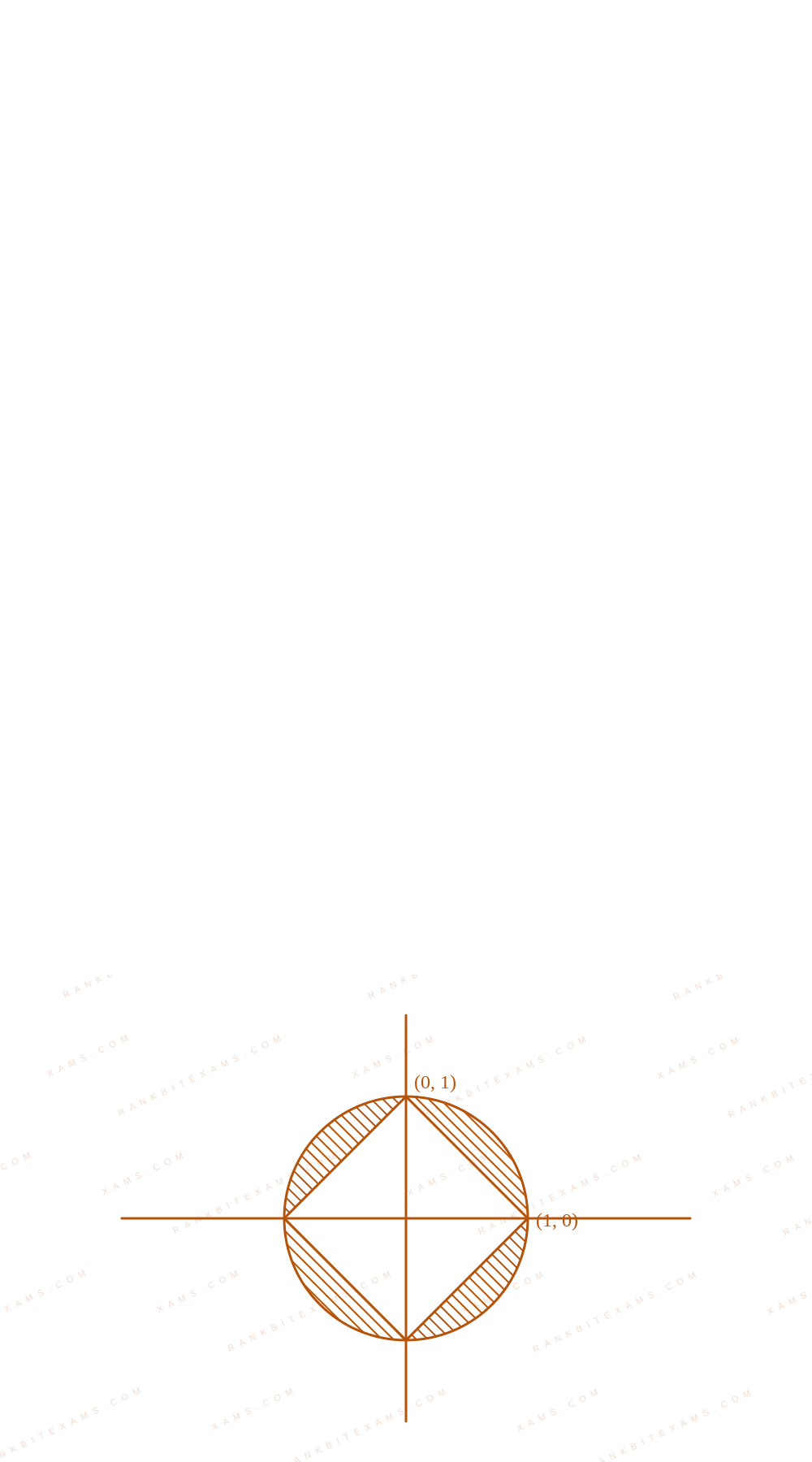
Let the area enclosed between the curves |y| = 1 - x² and x² + y² = 1 be α. If 9α = β π + γ, β, γ are integers, then the value of |β - γ| equals

Solution & Explanation

Related Formula

Area enclosed between two symmetric functions across four quadrants:

α = 4 × ( Area of circle in 1st quadrant - ∫₀¹ yparabola dx )
Core Logic

The curves are symmetric across the axes. The region is enclosed between the unit circle x² + y² = 1 and the parabolas y = ±(1 - x²).

Area Enclosed by Two Curves diagram for Q53 - JEE Main 2025 Evening

By symmetry, the area α in the first quadrant is the area under the circle minus the area under the parabola from x=0 to x=1.

Step 1: Calculate the Area Components

Area of a circle quadrant with r=1 is (π)/(4).

Area under the parabola:

∫₀¹ (1 - x²) dx = [ x - (x³)/(3) ]₀¹ = 1 - (1)/(3) = (2)/(3)
Step 2: Evaluate the Total Area
α = 4 [ (π)/(4) - (2)/(3) ] = π - (8)/(3)

Multiplying both sides by 9:

9α = 9π - 24

Comparing with 9α = βπ + γ, we get:

β = 9, γ = -24

Hence,

|β - γ| = |9 - (-24)| = 33
Pattern Recognition

Symmetry helps divide the integration work by 4. Recognizing standard shapes (like a circle sector) allows you to bypass complex integration entirely for half of the problem.

Chapter Mix

Class 12 Mathematics: Integral Calculus

Reference Study Guides

More Integral Calculus Previous-Year Questions — Page 3

Q23 jee_main_2026_23_january_evening Properties of Definite Integrals
The number of elements in the set S = x: x in [0, 100] and ∫₀x t² (x - t) dt = x² is
Numerical Answer. Answer: 16 to 16

Solution

Related Formula

Integration by parts formula: ∫ u dv = uv - ∫ v du.

Core Logic

Let I(x) = ∫₀x t² (x - t) dt. Use integration by parts. Let u = t² and dv = (x - t) dt v = (x - t).

I(x) = [t² (x - t)]₀x - ∫₀x 2t (x - t) dt I(x) = x² (0) - 0 - ∫₀x 2t (x - t) dt I(x) = x² - ∫₀x 2t (x - t) dt
Step 1: Second Integration by Parts

Now integrate ∫₀x 2t (x - t) dt by parts again: Let u = 2t and dv = (x - t) dt v = - (x - t).

= [2t(- (x - t))]₀x - ∫₀x 2(- (x - t)) dt = (-2x (0) - 0) + ∫₀x 2 (x - t) dt = 0 + [2 (x - t)]₀x = 2 (0) - 2 (x) = 2 - 2 x
Step 2: Equating and Solving

Substitute this back into the first equation:

I(x) = x² - (2 - 2 x) = x² + 2 x - 2

We are given I(x) = x². Therefore:

x² + 2 x - 2 = x² 2 x = 2 x = 1

The solutions for x = 1 are x = 2nπ, where n is an integer. We need the roots in the interval [0, 100]. 0 ≤ 2nπ ≤ 100 0 ≤ n ≤ (100)/(2π) ≈ (100)/(6.28) ≈ 15.92.

Since n must be an integer, n takes values 0, 1, 2, , 15. The total number of solutions is 16.

Pattern Recognition

Convoluted-looking definite integrals containing a shift (x-t) often rapidly unpack through successive integration by parts where the polynomial variable diminishes until exhaustion.

Chapter Mix

Class 12 Maths: Definite Integration Class 11 Maths: Trigonometric Equations

Q11 jee_main_2026_24_january_morning Integration by Substitution
Let f(t) = ∫ ( (1 - ( ₑ t))/(1 - ( ₑ t)) ) dt, t > 1. If f(eπ/2) = -eπ/2 and f(eπ/4) = α eπ/4, then α equals
  • A. -1 - √(2)
  • B. -1 - 2√(2)
  • C. 1 + √(2)
  • D. -1 + √(2)

Solution

Related Formula
∫ e^x (g(x) + g'(x)) dx = e^x g(x) + C 1 - x = 2 ²(x/2) x = 2 (x/2) (x/2)
Core Logic

Let ₑ t = x ⇒ t = e^x ⇒ dt = e^x dx.

f(t) = ∫ (1 - x)/(1 - x) e^x dx = ∫ e^x ( (1)/(2 ²(x/2)) - (2 (x/2) (x/2))/(2 ²(x/2)) ) dx = ∫ e^x ( (1)/(2)cosec²(x/2) - (x/2) ) dx
Step 1: Integration

Let g(x) = - (x/2). Then g'(x) = (1)/(2)cosec²(x/2). The integral fits the standard form ∫ e^x (g(x) + g'(x)) dx.

f(t) = -e^x ((x)/(2)) + C = -t (( ₑ t)/(2)) + C
Step 2: Finding Constant of Integration

Given f(eπ/2) = -eπ/2:

-eπ/2 ((π/2)/(2)) + C = -eπ/2 -eπ/2 (1) + C = -eπ/2 ⇒ C = 0
Step 3: Calculating Alpha

Find f(eπ/4):

f(eπ/4) = -eπ/4 ((π/4)/(2)) = -eπ/4 ((π)/(8))

Recall (π/8) = √(2) + 1.

f(eπ/4) = -eπ/4(√(2) + 1) = α eπ/4

Thus, α = -(1 + √(2)) = -1 - √(2).

Pattern Recognition

Logarithmic inputs in integrals are the classic cue to substitute t = e^x which inherently sets up the e^x(f(x) + f'(x)) format.

Chapter Mix

Class 12 Maths: Integrals Class 11 Maths: Trigonometric Functions

Q21 jee_main_2026_24_january_evening Integral Equations
If f(x) satisfies the relation f(x) = e^x + ∫₀¹ (y + x e^x) f(y) dy, then e + f(0) is equal to
Numerical Answer. Answer: 2 to 2

Solution

Related Formula
Separate variables out of definite integrals bounds: ∫ₐb k(x) h(y) dy = k(x) ∫ₐb h(y) dy
Core Logic

Expand the integral by distributing f(y):

f(x) = e^x + ∫₀¹ y f(y) dy + x e^x ∫₀¹ f(y) dy

Since the integrals evaluate to constants, let:

A = ∫₀¹ y f(y) dy B = ∫₀¹ f(y) dy

Thus, the function becomes:

f(x) = e^x + A + B x e^x
Step 1: Setting up equation for A

Substitute f(y) = e^y + A + B y e^y back into the integral for A:

A = ∫₀¹ y(e^y + A + B y e^y) dy A = ∫₀¹ (y e^y + A y + B y² e^y) dy

Integrate by parts: ∫₀¹ y e^y dy = [y e^y - e^y]₀¹ = (e - e) - (0 - 1) = 1 ∫₀¹ y² e^y dy = [y² e^y - 2y e^y + 2e^y]₀¹ = (e - 2e + 2e) - 2 = e - 2 ∫₀¹ A y dy = (A)/(2)

So,

A = 1 + (A)/(2) + B(e - 2) (A)/(2) - B(e - 2) = 1 (1)
Step 2: Setting up equation for B

Substitute f(y) back into the integral for B:

B = ∫₀¹ (e^y + A + B y e^y) dy

Integrate terms: ∫₀¹ e^y dy = e - 1 ∫₀¹ A dy = A ∫₀¹ B y e^y dy = B(1) = B

So,

B = (e - 1) + A + B

0 = e - 1 + A A = 1 - e

Step 3: Calculating f(0)

Substitute

Step 3: Calculating f(0)

Substitute $A = 1 - einto the expression forf(0): From the general equation,f(x) = e^x + A + B x e^x.

f(0) = e⁰ + A + B(0)e⁰ = 1 + Af(0) = 1 + (1 - e) = 2 - e

The question asks for

The question asks for $e + f(0):

e + f(0) = e + (2 - e) = 2
Pattern Recognition

Any integral equation containing definite integrals of the unknown function behaves exactly like a linear system of constants. Strip the independent variable

Pattern Recognition

Any integral equation containing definite integrals of the unknown function behaves exactly like a linear system of constants. Strip the independent variable $xoutside the integral and equate the numerical integral blocks to arbitrary constants likeAandB$.

Chapter Mix

Class 12 Maths: Definite Integration

Q11 jee_main_2026_28_january_morning Indefinite Integration
If ∫( 1-5 ²x ⁵x ²x)dx=f(x)+C where C is the constant of integration, then f((π)/(6))-f((π)/(4)) is equal to
  • A. 1√(3)(26+√(3))
  • B. 4√(3)(8-√(6))
  • C. 1√(3)(26-√(3))
  • D. 2√(3)(4+√(6))

Solution

Core Logic

Split the integral into two terms:

I = ∫ (1)/( ⁵ x ² x) dx - ∫ (5 ² x)/( ⁵ x ² x) dx I = ∫ ( ² x)/( ⁵ x) dx - 5 ∫ (1)/( ⁵ x) dx
Step 1: Integration by Parts

Take the first integral I₁ = ∫ (1)/( ⁵ x) · ² x dx. Apply Integration by Parts taking u = (1)/( ⁵ x) and dv = ² x dx:

I₁ = (1)/( ⁵ x) · x - ∫ ( -(5 x)/( ⁶ x) ) x dx I₁ = ( x)/( ⁵ x) + 5 ∫ ( x)/( ⁶ x) · ( x)/( x) dx I₁ = ( x)/( ⁵ x) + 5 ∫ (1)/( ⁵ x) dx
Step 2: Re-substituting into Total Integral
I = ( ( x)/( ⁵ x) + 5 ∫ (1)/( ⁵ x) dx ) - 5 ∫ (1)/( ⁵ x) dx

The integral terms exactly cancel out:

I = ( x)/( ⁵ x) + C

Thus, f(x) = ( x)/( ⁵ x).

Step 3: Function Evaluation

Calculate f((π)/(6)):

f((π)/(6)) = ( (π/6))/( ⁵(π/6)) = 1/√(3)(1/2)⁵ = 32√(3)

Calculate f((π)/(4)):

f((π)/(4)) = ( (π/4))/( ⁵(π/4)) = 1(1/√(2))⁵ = (√(2))⁵ = 4√(2)

Difference:

f((π)/(6)) - f((π)/(4)) = 32√(3) - 4√(2) = 4√(3)(8 - √(6))
Pattern Recognition

Integrals of the form ∫ (complicated term 1 - complicated term 2) dx often cancel perfectly when Integration by Parts is applied to just one of the terms. Look for derivative relationships between the numerators.

Chapter Mix

Class 12 Mathematics: Integrals

Q12 jee_main_2026_28_january_morning Definite Integration
Let f be a polynomial function such that f(x²+1)=x⁴+5x²+2, for all xin R. Then ∫₀³f(x)dx is equal to
  • A. (41)/(3)
  • B. (33)/(2)
  • C. (27)/(2)
  • D. (5)/(3)

Solution

Core Logic

We need to find the explicit form of f(t). Let x² + 1 = t. This implies x² = t - 1. Substitute this back into the given equation f(x²+1) = x⁴ + 5x² + 2:

f(t) = (t - 1)² + 5(t - 1) + 2 f(t) = (t² - 2t + 1) + 5t - 5 + 2 f(t) = t² + 3t - 2
Step 1: Evaluate the Integral

Now, we compute the definite integral:

∫₀³ f(t) dt = ∫₀³ (t² + 3t - 2) dt = [ (t³)/(3) + (3t²)/(2) - 2t ]₀³

Substitute upper limit 3:

= ( (27)/(3) + (27)/(2) - 6 ) - (0) = 9 + (27)/(2) - 6 = 3 + (27)/(2) = (33)/(2)
Chapter Mix

Class 12 Mathematics: Integrals Class 11 Mathematics: Functions

More Integral Calculus Questions — jee_main_2025_29_jan_evening

Practice all Integral Calculus previous-year questions →

Rankbit System
JEE Physics: Waves (+15.5%) | Electrostatics: Concentric Shells (-29.7%) | Modern Physics: Photoelectric Clones (+34.2%) | Mathematics: Definite Integrals (+18.1%) | Chemistry: Coordination Splitting (-11.4%) | JEE Physics: Waves (+15.5%) | Electrostatics: Concentric Shells (-29.7%) | Modern Physics: Photoelectric Clones (+34.2%) | Mathematics: Definite Integrals (+18.1%) | Chemistry: Coordination Splitting (-11.4%)