JEE Main · Mathematics ↓ Falling

Differential Equations appeared 46 times across 3 years — 5.3% of Mathematics. This question is from Linear Differential Equations.

Year 2026 2025 2024 Total
Questions 13 17 16 46

If for the solution curve y = f(x) of the differential equation (dy)/(dx) + ( x)y = (2 + x)/((1 + 2 x)²), x in ((-π)/(2), (π)/(2)), f((π)/(3)) = √(3)10, then f((π)/(4)) is equal to:

Solution & Explanation

Related Formula

Integrating factor (I.F.) for a linear differential equation (dy)/(dx) + Py = Q:

I.F. = e∫ P dx

General solution:

y · (I.F.) = ∫ Q · (I.F.) dx
Core Logic

Given P = x, compute Integrating Factor:

I.F. = e∫ x dx = eln( x) = x

Set up integrated expression solution layout:

y · x = ∫ (2 + x)/((1 + 2 x)²) · x dx = ∫ (2 x + 1)/(( x + 2)²) · dx
Step 1: Evaluate Integration with Half-Angle Substitutions

Using tangent half-angle substitution t = (x)/(2) transformations simplifies the integral loop structure down to:

y · x = (2)/(t + (3)/(t)) + C

Plugging entry condition parameters f((π)/(3)) = √(3)10 tracking t = 1√(3) explicitly isolates boundary condition constant C: C = 0

Step 2: Calculate Target Point Value

At target query point x = (π)/(4), half-angle parameters scale to t = √(2) - 1:

y · √(2) = 2√(2) - 1 + 3√(2) - 1 = 2(√(2) - 1)6 - 2√(2) y = 4 - √(2)14
Pattern Recognition

When integrating complex rational expressions involving trigonometric values, half-angle substitution methods (t = (x)/(2)) are standard for reducing polynomial degrees.

Chapter Mix

Class 12 Mathematics: Differential Equations

Reference Study Guides

More Differential Equations Previous-Year Questions — Page 8

Q23 jee_main_2024_27_jan_morning Reducible to Variable Separable
If the solution of the differential equation (2x+3y-2)dx+(4x+6y-7)dy=0, y(0)=3, is α x+β y+3 ₑ|2x+3y-γ|=6, then α+2β+3γ is equal to:
Numerical Answer. Answer: 29 to 29

Solution

Related Formula
(dy)/(dx) = f(ax+by+c)

Substitute t = ax+by+c to reduce the equation to variable separable form.

Core Logic

The differential equation can be written as:

(dy)/(dx) = -(2x+3y-2)/(4x+6y-7)

Observe that 4x+6y = 2(2x+3y). Let us substitute t = 2x+3y-2. Taking derivatives with respect to x:

(dt)/(dx) = 2 + 3(dy)/(dx) ⇒ (dy)/(dx) = (1)/(3)((dt)/(dx) - 2)
Step 1: Translating and Simplifying

Substitute t into the differential equation:

(1)/(3)((dt)/(dx) - 2) = -(t)/(2(t+2)-7) (dt)/(dx) - 2 = -(3t)/(2t-3) (dt)/(dx) = 2 - (3t)/(2t-3) (dt)/(dx) = (4t - 6 - 3t)/(2t - 3) = (t - 6)/(2t - 3)
Step 2: Variable Separation Integration

Separate the variables t and x:

∫ (2t - 3)/(t - 6) dt = ∫ dx

Decompose the fraction algebraically:

∫ (2(t-6) + 9)/(t-6) dt = ∫ ( 2 + (9)/(t-6) ) dt 2t + 9ln|t-6| = x + C
Step 3: Restoring Original Variables

Substitute t = 2x + 3y - 2 back:

2(2x + 3y - 2) + 9ln|2x + 3y - 2 - 6| = x + C 4x + 6y - 4 + 9ln|2x + 3y - 8| = x + C 3x + 6y + 9ln|2x + 3y - 8| = C + 4

Divide the entire equation by 3:

x + 2y + 3ln|2x + 3y - 8| = C'
Step 4: Finding the Constant of Integration

Given initial condition y(0) = 3 (when x=0, y=3):

0 + 2(3) + 3ln|2(0) + 3(3) - 8| = C' 6 + 3ln|1| = C' ⇒ C' = 6

Thus, the specific solution is:

x + 2y + 3ln|2x + 3y - 8| = 6
Step 5: Comparing and Final Evaluation

Comparing with the given form α x + β y + 3ln|2x + 3y - γ| = 6: α = 1, β = 2, γ = 8. Compute the required expression:

α + 2β + 3γ = 1 + 2(2) + 3(8) = 1 + 4 + 24 = 29
Pattern Recognition

When the coefficients of x and y in the numerator and denominator are proportional (i.e. a₁/a₂ = b₁/b₂), the standard procedure is to use a direct composite substitution t = ax+by which effortlessly maps to a basic logarithmic integral.

Chapter Mix

Class 12 Maths: Differential Equations
Q12 jee_main_2024_29_jan_morning Linear Differential Equations
A function y=f(x) satisfies f(x) 2x+ x-(1+ ² x)f'(x)=0 with condition f(0)=0. Then f((π)/(2)) is equal to
  • A. 1
  • B. 0
  • C. -1
  • D. 2

Solution

Related Formula
Standard Form of LDE: (dy)/(dx) + P(x)y = Q(x) I.F. = e∫ P(x)dx Solution: y · (I.F.) = ∫ Q(x) · (I.F.) dx + C
Core Logic

Given the differential equation:

y 2x + x - (1+ ² x)(dy)/(dx) = 0

Rearrange it into the standard linear differential equation format:

(1+ ² x)(dy)/(dx) - y 2x = x (dy)/(dx) - (( 2x)/(1+ ² x))y = ( x)/(1+ ² x)
Step 1: Find the Integrating Factor (I.F.)

Here, P(x) = -( 2x)/(1+ ² x).

I.F. = e∫ -( 2x)/(1+ ² x) dx

Let 1+ ² x = t, then dt = -2 x x dx = - 2x dx.

I.F. = e∫ (1)/(t) dt = eln t = t I.F. = 1+ ² x
Step 2: Solve the Differential Equation

Multiply the LDE by the integrating factor:

y · (1+ ² x) = ∫ (( x)/(1+ ² x)) · (1+ ² x) dx y(1+ ² x) = ∫ x dx y(1+ ² x) = - x + C

Apply the initial condition f(0) = 0 (which means y=0 when x=0):

0 · (1+1) = -1 + C ⇒ C = 1

The particular solution is:

y(1+ ² x) = 1 - x
Step 3: Evaluate at x = pi/2

To find f((π)/(2)), substitute x = (π)/(2):

y(1+ ²((π)/(2))) = 1 - ((π)/(2))

y(1+0) = 1 - 0 y = 1

Pattern Recognition

Whenever y and y' appear linearly separated by complex trigonometric polynomials, format aggressively into standard LDE form. The derivative of 1+ ²x is exactly - 2x, making the logarithmic integration seamless.

Chapter Mix

Class 12 Mathematics: Differential Equations Class 12 Mathematics: Integral Calculus

Q26 jee_main_2024_29_jan_morning Variable Separable Form
If the solution curve y=y(x) of the differential equation (1+y²)(1+ ₑ x)dx+x dy=0, x gt 0 passes through the point (1, 1) and y(e)=(α- ((3)/(2)))/(β+ ((3)/(2))), then α+2β is
Numerical Answer. Answer: 3 to 3

Solution

Related Formula
∫ (1)/(1+y²) dy = ⁻¹y + C ∫ f(x) f'(x) dx = ([f(x)]²)/(2) + C (A - B) = ( A - B)/(1 + A B)
Core Logic

Rearrange the given differential equation to separate variables x and y:

(1+y²)(1+ ₑ x)dx + x dy = 0 (1+ ₑ x)/(x) dx + (1)/(1+y²) dy = 0

Integrate both sides:

∫ (1+ ₑ x)/(x) dx + ∫ (1)/(1+y²) dy = C
Step 1: Execute Integration

For the first integral, let u = 1+ ₑ x, so du = (1)/(x) dx.

∫ u du = (u²)/(2) = ((1+ ₑ x)²)/(2)

For the second integral:

∫ (1)/(1+y²) dy = ⁻¹y

Putting them together:

((1+ ₑ x)²)/(2) + ⁻¹y = C
Step 2: Apply Boundary Conditions

The curve passes through (1, 1). Substitute x=1, y=1:

((1+ ₑ 1)²)/(2) + ⁻¹(1) = C

Since ₑ 1 = 0 and ⁻¹(1) = (π)/(4):

(1²)/(2) + (π)/(4) = C ⇒ C = (1)/(2) + (π)/(4)

Wait, the solution rearranges differently: ∫ ((1)/(x) + (ln x)/(x)) dx = ln x + ((ln x)²)/(2). Let's use this to stay fully synced with the PDF's algebraic step.

ln x + ((ln x)²)/(2) + ⁻¹ y = C

At (1,1):

ln(1) + ((ln 1)²)/(2) + ⁻¹(1) = C ⇒ 0 + 0 + (π)/(4) = C ⇒ C = (π)/(4)

The general equation simplifies nicely to:

ln x + ((ln x)²)/(2) + ⁻¹ y = (π)/(4)
Step 3: Evaluate at x = e

Substitute x=e into the equation to find y(e):

ln e + ((ln e)²)/(2) + ⁻¹ y = (π)/(4) 1 + (1²)/(2) + ⁻¹ y = (π)/(4) (3)/(2) + ⁻¹ y = (π)/(4) ⁻¹ y = (π)/(4) - (3)/(2) y = ((π)/(4) - (3)/(2))

Using the compound angle formula (A-B):

y = ( (π/4) - (3/2))/(1 + (π/4) (3/2)) = (1 - (3/2))/(1 + (3/2))

Comparing this format to y(e) = (α- (3/2))/(β+ (3/2)) gives:

α = 1, β = 1

Calculate α + 2β: 1 + 2(1) = 3

Pattern Recognition

For expressions involving separated x and y logarithmic terms, always split ∫ (1+ln x)/(x)dx into ∫ (1)/(x) + ∫ (ln x)/(x) to avoid carrying a non-zero shift (1)/(2) into the constant C. This allows direct identity matching for tangent sums.

Chapter Mix

Class 12 Mathematics: Differential Equations Class 11 Mathematics: Trigonometric Functions

Q15 jee_main_2024_30_january_evening Functional Equations
Let f : R - 0 → R be a function satisfying f((x)/(y)) = (f(x))/(f(y)) for all x, y, f(y) ≠ 0. If f'(1) = 2024, then
  • A. xf'(x) - 2024f(x) = 0
  • B. xf'(x) + 2024f(x) = 0
  • C. xf'(x) + f(x) = 2024
  • D. xf'(x) - 2023f(x) = 0

Solution

Related Formula
Chain rule for partial differentiation: (∂)/(∂ x) f((x)/(y)) = f'((x)/(y)) · (1)/(y)
Core Logic

Given functional equation: f((x)/(y)) = (f(x))/(f(y)) First, put x=1, y=1: f(1) = (f(1))/(f(1)) ⇒ f(1) = 1 (since f(y) ≠ 0 implies f(1) ≠ 0).

Step 1: Partial Differentiation

Partially differentiate the given equation with respect to x, keeping y constant:

f'((x)/(y)) · (1)/(y) = (1)/(f(y)) · f'(x)

Let x → y so that (x)/(y) → 1. Wait, let's substitute y = x directly:

f'(1) · (1)/(x) = (1)/(f(x)) · f'(x)
Step 2: Forming the Final Equation

We are given f'(1) = 2024. Substituting this value:

2024 · (1)/(x) = (f'(x))/(f(x))

Cross-multiplying yields:

2024 f(x) = x f'(x) ⇒ x f'(x) - 2024 f(x) = 0
Pattern Recognition

Functional equations of the form f(x/y) = f(x)/f(y) inherently describe power functions (f(x) = x^k). Partial differentiation with respect to one variable quickly resolves the derivative form without limits.

Chapter Mix

Class 11 Maths: Functions Class 12 Maths: Differential Equations

Q21 jee_main_2024_30_january_evening Linear Differential Equation
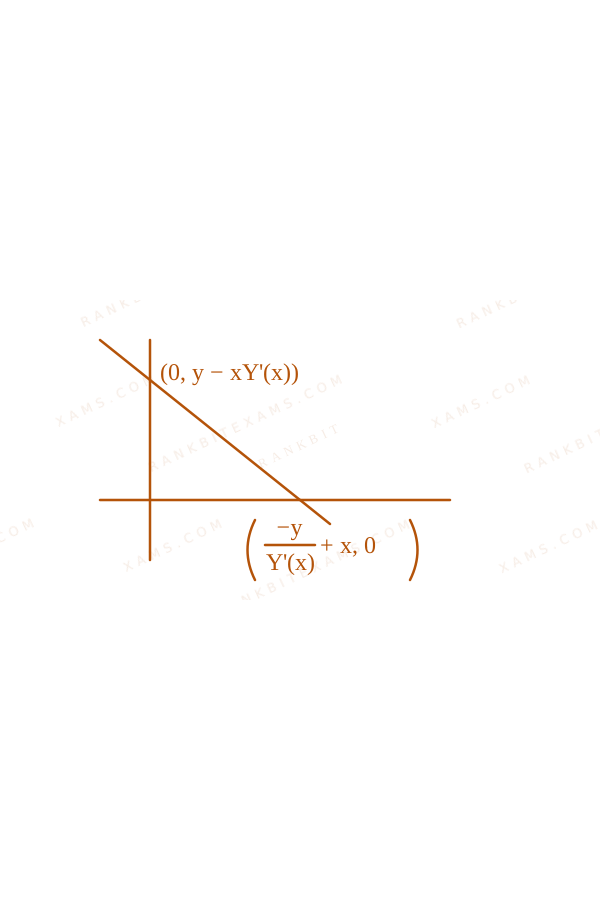
Let Y = Y(X) be a curve lying in the first quadrant such that the area enclosed by the line Y - y = Y'(x)(X - x) and the co-ordinate axes, where (x, y) is any point on the curve, is always (-y²)/(2Y'(x)) + 1 , Y'(x) ≠ 0 . If Y(1) = 1 , then 12Y(2) equals
Numerical Answer. Answer: 20 to 20

Solution

Related Formula
Equation of tangent at (x, y): Y - y = (dy)/(dx)(X - x) Area of Right Triangle: (1)/(2) × base × height
Core Logic

The line Y - y = y'(X - x) intersects the axes to form a triangle. Let's find the intercepts: X-intercept (set Y=0): -y = y'(X - x) ⇒ X = x - (y)/(y') Y-intercept (set X=0): Y - y = y'(-x) ⇒ Y = y - xy'

The area of the triangle bounded by the coordinate axes is:

Area = (1)/(2) ( x - (y)/(y') ) (y - xy') = (-y²)/(2y') + 1

Linear Differential Equation diagram for Q21 - JEE Main 2024 Evening

Step 1: Setting up the Differential Equation

Expand the Area equation:

(1)/(2) [ xy - x²y' - (y²)/(y') + xy ] = (-y²)/(2y') + 1

Multiply by 2:

2xy - x²y' - (y²)/(y') = -(y²)/(y') + 2

Cancel -(y²)/(y') from both sides: 2xy - x²y' = 2

Step 2: Solving the Linear Differential Equation

Rearrange into standard LDE form:

x² (dy)/(dx) - 2xy = -2 (dy)/(dx) - (2)/(x)y = -(2)/(x²)

Find the Integrating Factor (IF):

I.F. = e∫ -(2)/(x) dx = e-2ln x = x⁻² = (1)/(x²)

Multiply the LDE by the IF:

y · (1)/(x²) = ∫ ( -(2)/(x²) ) (1)/(x²) dx + C y x⁻² = -2 ∫ x⁻⁴ dx + C y x⁻² = -2 ( x⁻³-3 ) + C (y)/(x²) = (2)/(3x³) + C y = (2)/(3x) + Cx²
Step 3: Applying Initial Conditions

Given Y(1) = 1 (i.e., when x=1, y=1):

1 = (2)/(3(1)) + C(1)² ⇒ 1 = (2)/(3) + C ⇒ C = (1)/(3)

Thus, the curve is:

y = (2)/(3x) + (x²)/(3)

We need to find 12Y(2):

Y(2) = (2)/(3(2)) + (2²)/(3) = (1)/(3) + (4)/(3) = (5)/(3) 12Y(2) = 12 ( (5)/(3) ) = 4 × 5 = 20
Pattern Recognition

Geometrical word problems forming an Area differential equation almost always reduce to a first-order Linear Differential Equation (LDE) or an Exact differential form once you cleanly substitute the axis intercepts.

Chapter Mix

Class 12 Maths: Differential Equations Class 12 Maths: Application of Derivatives

More Differential Equations Questions — jee_main_2025_29_jan_evening

Practice all Differential Equations previous-year questions →

Rankbit System
JEE Physics: Waves (+15.5%) | Electrostatics: Concentric Shells (-29.7%) | Modern Physics: Photoelectric Clones (+34.2%) | Mathematics: Definite Integrals (+18.1%) | Chemistry: Coordination Splitting (-11.4%) | JEE Physics: Waves (+15.5%) | Electrostatics: Concentric Shells (-29.7%) | Modern Physics: Photoelectric Clones (+34.2%) | Mathematics: Definite Integrals (+18.1%) | Chemistry: Coordination Splitting (-11.4%)