JEE Main · Chemistry ↓ Falling

Coordination Compounds appeared 68 times across 3 years — 7.9% of Chemistry. This question is from Crystal Field Theory and Colors of Complexes.

Year 2026 2025 2024 Total
Questions 19 34 15 68

Consider the following low-spin complexes K₃[Co(NO₂)₆], K₄[Fe(CN)₆], K₃[Fe(CN)₆], Cu₂[Fe(CN)₆] and Zn₂[Fe(CN)₆]. The sum of the spin-only magnetic moment values of complexes having yellow colour is ________ B.M. (answer is nearest integer)

Numerical Answer Type:
Enter a numerical value Answer: 0 to 0 +4 marks

Solution & Explanation

Core Logic

From the given list, the complexes exhibiting a distinct yellow color are K₃[Co(NO₂)₆] and K₄[Fe(CN)₆].

Let's calculate the spin-only magnetic moments for these low-spin configurations:

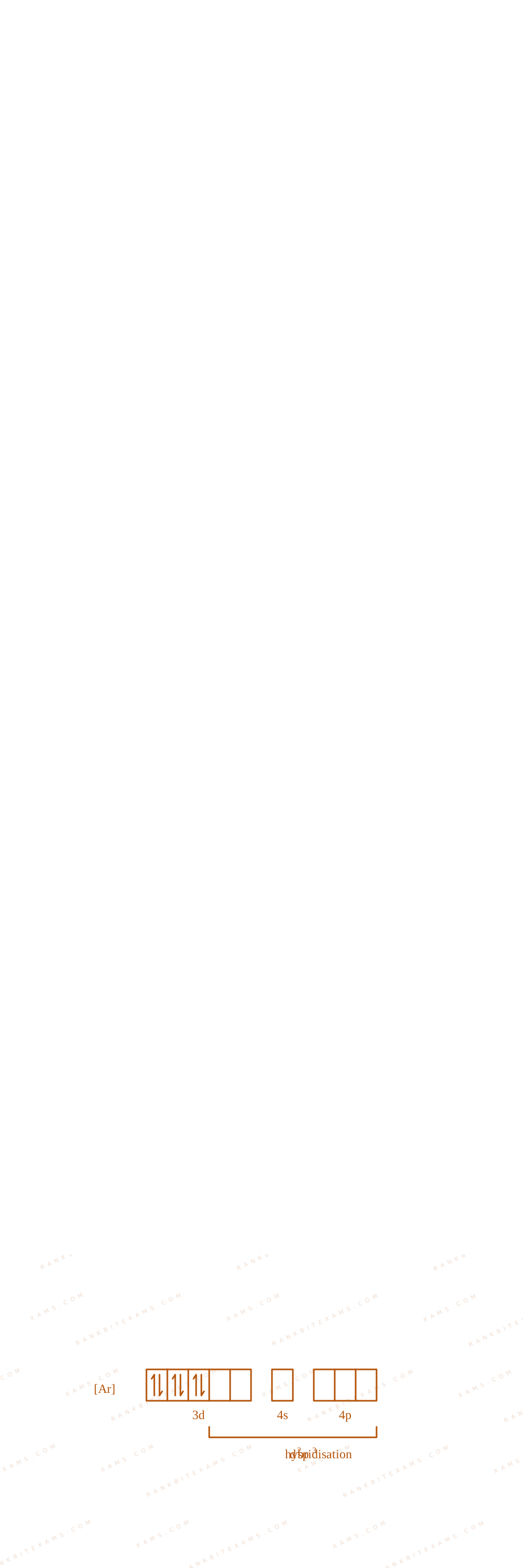
  • For K₃[Co(NO₂)₆], cobalt is in +3 oxidation state (Co³⁺ = 3d⁶).
  • In the presence of the strong ligand field (NO₂^-), all six electrons pair up completely in the t2g orbitals:

t2g⁶ eg⁰ implies n = 0 unpaired electrons implies mu = 0 BM

Crystal Field Theory and Colors of Complexes diagram for Q46 - JEE Main 2025 Evening

  • For K₄[Fe(CN)₆], iron is in +2 oxidation state (Fe²⁺ = 3d⁶).
  • In the strong field of cyanide ligands (CN^-), pairing is complete:

t2g⁶ eg⁰ implies n = 0 unpaired electrons implies mu = 0 BM

Therefore, the sum of their spin-only magnetic moments is 0 + 0 = 0.

Pattern Recognition

Low-spin d⁶ octahedral complexes always yield a fully closed-shell t2g⁶ arrangement with zero unpaired electrons, leading deterministically to a magnetic moment of 0 BM.

Chapter Mix

Class 12 Chemistry: Coordination Compounds

Reference Study Guides

More Coordination Compounds Previous-Year Questions — Page 7

Q26 jee_main_2025_29_jan_evening Magnetic Properties of Coordination Compounds
The calculated spin-only magnetic moments of K₃[Fe(OH)₆] and K₄[Fe(OH)₆] respectively are: (1) 4.90 and 4.90 B.M. (2) 5.92 and 4.90 B.M. (3) 3.87 and 4.90 B.M. (4) 4.90 and 5.92 B.M.
  • A. 4.90 and 4.90 B.M.
  • B. 5.92 and 4.90 B.M.
  • C. 3.87 and 4.90 B.M.
  • D. 4.90 and 5.92 B.M.

Solution

Related Formula
mu = sqrtn(n+2) B.M.
Core Logic

In K₃[Fe(OH)₆], iron is in the +3 oxidation state (Fe³⁺ = 3d⁵). Since OH⁻ is a weak field ligand, no pairing of electrons takes place. The number of unpaired electrons (n) is 5.

mu = sqrt5(5+2) = sqrt35 approx 5.92 B.M.

In K₄[Fe(OH)₆], iron is in the +2 oxidation state (Fe²⁺ = 3d⁶). Since OH⁻ is a weak field ligand, no pairing occurs. The number of unpaired electrons (n) is 4.

mu = sqrt4(4+2) = sqrt24 approx 4.90 B.M.
Pattern Recognition

Identify the ligand field strength first. OH⁻ is a weak field ligand in the spectrochemical series, so it does not cause pairing in either Fe²⁺ or Fe³⁺ configurations.

Chapter Mix

Class 12 Chemistry: Coordination Compounds

Q37 jee_main_2025_29_jan_evening Homoleptic Complexes and Electronic Configurations
Identify the homoleptic complexes with odd number of d electrons in the central metal. (A) [FeO₄]²⁻ (B) [Fe(CN)₆]³⁻ (C) [Fe(CN)₅NO]²⁻ (D) [CoCl₄]²⁻ (E) [Co(H₂O)₃F₃] Choose the correct answer from the options given below:
  • A. (B) and (D) only
  • B. (C) and (E) only
  • C. (A), (B) and (D) only
  • D. (A), (C) and (E) only

Solution

Core Logic

A complex is homoleptic if the metal is bound to only one kind of donor ligand group.

  • (A) [FeO₄]²⁻ is homoleptic, but Fe⁺⁶ corresponds to a 3d² (even) electronic configuration.
  • (B) [Fe(CN)₆]³⁻ is homoleptic. Fe⁺³ corresponds to a 3d⁵ (odd) configuration.
  • (C) [Fe(CN)₅NO]²⁻ is heteroleptic (contains two types of ligands).
  • (D) [CoCl₄]²⁻ is homoleptic. Co⁺² corresponds to a 3d⁷ (odd) configuration.
  • (E) [Co(H₂O)₃F₃] is heteroleptic.
Pattern Recognition

Filter by 'homoleptic' first to instantly eliminate multi-ligand mixed structures like options (C) and (E).

Chapter Mix

Class 12 Chemistry: Coordination Compounds

Q36 jee_main_2025_28_jan_morning Borax Bead Test and Crystal Field Split
The metal ion whose electronic configuration is not affected by the nature of the ligand and which gives a violet colour in non-luminous flame under hot condition in borax bead test is
  • A. Ti³⁺
  • B. Ni²⁺
  • C. Mn²⁺
  • D. Cr³⁺

Solution

Core Logic

Nickel (Ni²⁺) exhibits a d⁸ electronic profile. In regular octahedral complex splits: t2g⁶ eg² Because the lower t2g subshell is fully paired and the higher eg contains exactly 2 electrons matching Hund's rules, this orbital distribution remains configurationally identical under both strong-field and weak-field environments. Additionally, Ni²⁺ compounds produce a characteristic violet bead during hot cycles in a non-luminous flame within the qualitative borax matrix.

Pattern Recognition

Sees: Configuration invariant to ligand strength + qualitative test combination. Shortcut: A d⁸ structure in octahedral splitting always stays high-spin/low-spin identical, pointing strictly to Ni²⁺.

Chapter Mix

Class 12 Chemistry: Coordination Compounds Class 12 Chemistry: The d-and f-Block Elements

Q jee_main_2025_03_april_morning Crystal Field Theory - Color and Spectrochemical Series
The correct order of the complexes [Co(NH₃)₅(H₂O)]³⁺ (A), [Co(NH₃)₆]³⁺ (B), [Co(CN)₆]³⁻(C) and [CoCl(NH₃)₅]²⁺ (D) in terms wavelength of light absorbed is :
  • A. D>A>B>C
  • B. C>B>D>A
  • C. D>C>B>A
  • D. C>B>A>D

Solution

Related Formula

The energy of light absorbed is inversely proportional to the wavelength absorbed:

E = Δₒ = (hc)/(λ) λ ∝ (1)/(Δₒ)
Core Logic

All complexes share the same central metal ion, Co³⁺. The magnitude of the crystal field splitting energy (Δₒ) depends exclusively on the relative ligand field strength listed in the spectrochemical series:

Cl^- < H₂O < NH₃ < CN^-
Step 1: Ordering Energies and Wavelengths

The splitting energy order is:

CFSE: C (highest) > B > A > D (lowest)

Inverting this sequence to match absorption wavelength values yields:

λabsorbed: D > A > B > C
Pattern Recognition

Shortcut: Stronger field ligand larger splitting gap high photon energy shorter absorbed wavelength. Since CN^- is a strong field ligand, complex C must absorb the shortest wavelength, putting it at the very end.

Chapter Mix

Class 12 Chemistry: Coordination Compounds

More Coordination Compounds Questions — jee_main_2025_29_jan_evening

Practice all Coordination Compounds previous-year questions →

Rankbit System
JEE Physics: Waves (+15.5%) | Electrostatics: Concentric Shells (-29.7%) | Modern Physics: Photoelectric Clones (+34.2%) | Mathematics: Definite Integrals (+18.1%) | Chemistry: Coordination Splitting (-11.4%) | JEE Physics: Waves (+15.5%) | Electrostatics: Concentric Shells (-29.7%) | Modern Physics: Photoelectric Clones (+34.2%) | Mathematics: Definite Integrals (+18.1%) | Chemistry: Coordination Splitting (-11.4%)