JEE Main · Chemistry ↓ Falling

Coordination Compounds appeared 68 times across 3 years — 7.9% of Chemistry. This question is from Crystal Field Theory and Colors of Complexes.

Year 2026 2025 2024 Total
Questions 19 34 15 68

Consider the following low-spin complexes K₃[Co(NO₂)₆], K₄[Fe(CN)₆], K₃[Fe(CN)₆], Cu₂[Fe(CN)₆] and Zn₂[Fe(CN)₆]. The sum of the spin-only magnetic moment values of complexes having yellow colour is ________ B.M. (answer is nearest integer)

Numerical Answer Type:
Enter a numerical value Answer: 0 to 0 +4 marks

Solution & Explanation

Core Logic

From the given list, the complexes exhibiting a distinct yellow color are K₃[Co(NO₂)₆] and K₄[Fe(CN)₆].

Let's calculate the spin-only magnetic moments for these low-spin configurations:

  • For K₃[Co(NO₂)₆], cobalt is in +3 oxidation state (Co³⁺ = 3d⁶).
  • In the presence of the strong ligand field (NO₂^-), all six electrons pair up completely in the t2g orbitals:

t2g⁶ eg⁰ implies n = 0 unpaired electrons implies mu = 0 BM

Crystal Field Theory and Colors of Complexes diagram for Q46 - JEE Main 2025 Evening

  • For K₄[Fe(CN)₆], iron is in +2 oxidation state (Fe²⁺ = 3d⁶).
  • In the strong field of cyanide ligands (CN^-), pairing is complete:

t2g⁶ eg⁰ implies n = 0 unpaired electrons implies mu = 0 BM

Therefore, the sum of their spin-only magnetic moments is 0 + 0 = 0.

Pattern Recognition

Low-spin d⁶ octahedral complexes always yield a fully closed-shell t2g⁶ arrangement with zero unpaired electrons, leading deterministically to a magnetic moment of 0 BM.

Chapter Mix

Class 12 Chemistry: Coordination Compounds

Reference Study Guides

More Coordination Compounds Previous-Year Questions — Page 6

Q44 jee_main_2025_07_april_morning Isomerism in Coordination Compounds
An octahedral complex having molecular composition Co · 5NH₃ · Cl · SO₄ has two isomers A and B. The solution of A gives a white precipitate with AgNO₃ solution and the solution of B gives a white precipitate with BaCl₂ solution. The type of isomerism exhibited by the complex is:
  • A. Coordination isomerism
  • B. Linkage isomerism
  • C. Ionisation isomerism
  • D. Geometrical isomerism

Solution

Core Logic

The complex molecular composition is Co · 5NH₃ · Cl · SO₄. Let's formulate the formulas for the two isomers:

  • Isomer A: Gives a white precipitate of AgCl when reacted with AgNO₃. This means free chloride ions (Cl^-) are present in the outer ionization sphere:
[Co(NH₃)₅(SO₄)]Cl
  • Isomer B: Gives a white precipitate of BaSO₄ when reacted with BaCl₂. This means free sulphate ions (SO₄²⁻) are present in the outer ionization sphere:
[Co(NH₃)₅Cl]SO₄

Since these two isomers yield different ions in solution due to exchange of ligands between the coordination sphere and the ionization sphere, they exhibit Ionisation isomerism.

Pattern Recognition

Test for ions:

  • AgNO₃ PPT arrow free halide ion in outer sphere.
  • BaCl₂ PPT arrow free sulphate ion in outer sphere.
  • Outer-inner ion exchanges are always called Ionisation isomerism.
Chapter Mix

Class 12 Chemistry: Coordination Compounds
Q50 jee_main_2025_07_april_morning Valence Bond Theory
The number of paramagnetic complexes among [FeF₆]³⁻, [Fe(CN)₆]³⁻, [Mn(CN)₆]³⁻, [Co(C₂O₄)₃]³⁻, [MnCl₆]³⁻ and [CoF₆]³⁻, which involve d²sp³ hybridization is ______.
Numerical Answer. Answer: 2 to 2

Solution

Core Logic

Let's systematically analyze the coordination, ligand strength, hybridization, and magnetic behavior of each complex:

  • [FeF₆]³⁻:
  • Fe³⁺ (3d⁵). F^- is a weak-field ligand (WFL). No pairing occurs.
  • Outer-orbital complex: sp³d².
  • Paramagnetic (5 unpaired electrons).
  • [Fe(CN)₆]³⁻:
  • Fe³⁺ (3d⁵). CN^- is a strong-field ligand (SFL). Pairing occurs.
  • Config: t2g⁵ eg⁰ (one unpaired electron remains Paramagnetic).
  • Inner-orbital complex: d²sp³.
  • [Mn(CN)₆]³⁻:
  • Mn³⁺ (3d⁴). CN^- is an SFL. Pairing occurs.
  • Config: t2g⁴ eg⁰ (two unpaired electrons remain Paramagnetic).
  • Inner-orbital complex: d²sp³.
  • [Co(C₂O₄)₃]³⁻:
  • Co³⁺ (3d⁶). Oxalate is a chelating SFL here. Full pairing occurs.
  • Config: t2g⁶ eg⁰ (zero unpaired electrons Diamagnetic).
  • Inner-orbital complex: d²sp³.
  • [MnCl₆]³⁻:
  • Mn³⁺ (3d⁴). Cl^- is a WFL. No pairing occurs.
  • Outer-orbital complex: sp³d².
  • Paramagnetic (4 unpaired electrons).
  • [CoF₆]³⁻:
  • Co³⁺ (3d⁶). F^- is a WFL. No pairing occurs.
  • Outer-orbital complex: sp³d².
  • Paramagnetic (4 unpaired electrons).
  • Thus, only [Fe(CN)₆]³⁻ and [Mn(CN)₆]³⁻ are both paramagnetic and involve d²sp³ hybridization.

Pattern Recognition

VBT shortcut:

  • Strong-field ligand complexes with d⁴--d⁶ central ions form inner-orbital d²sp³ complexes.
  • Of those, check the number of electrons: d⁶ is completely paired (diamagnetic), but d⁵ ([Fe(CN)₆]³⁻) and d⁴ ([Mn(CN)₆]³⁻) both leave unpaired electrons in the t2g orbitals (paramagnetic).
Evaluation Rubric / Model Answer

Detailed individual classification of each complex based on VBT/CFT to yield the correct count of 2 inner-orbital paramagnetic complexes.

Chapter Mix

Class 12 Chemistry: Coordination Compounds
Q31 jee_main_2025_08_april_evening Isomerism in Coordination Compounds
Given below are two statements: Statement I: A homoleptic octahedral complex, formed using monodentate ligands, will not show stereoisomerism. Statement II: cis- and trans-platin are heteroleptic complexes of Pd. In the light of the above statements, choose the correct answer from the options given below:
  • A. Both Statement I and Statement II are false.
  • B. Statement I is false but Statement II is true.
  • C. Both Statement I and Statement II are true.
  • D. Statement I is true but Statement II is false.

Solution

Core Logic

Let us evaluate both statements individually:

  • Statement I: A homoleptic complex contains only one type of ligand. For an octahedral complex using monodentate ligands, the general formula is [Ma₆]. Since all coordination positions are populated identically by the exact same ligand, swapping spatial positions produces no structural difference, hence it cannot demonstrate geometrical or optical isomerism. Statement I is true.
    Stereochemical representation of octahedral homoleptic system
    Stereochemical representation of octahedral homoleptic system
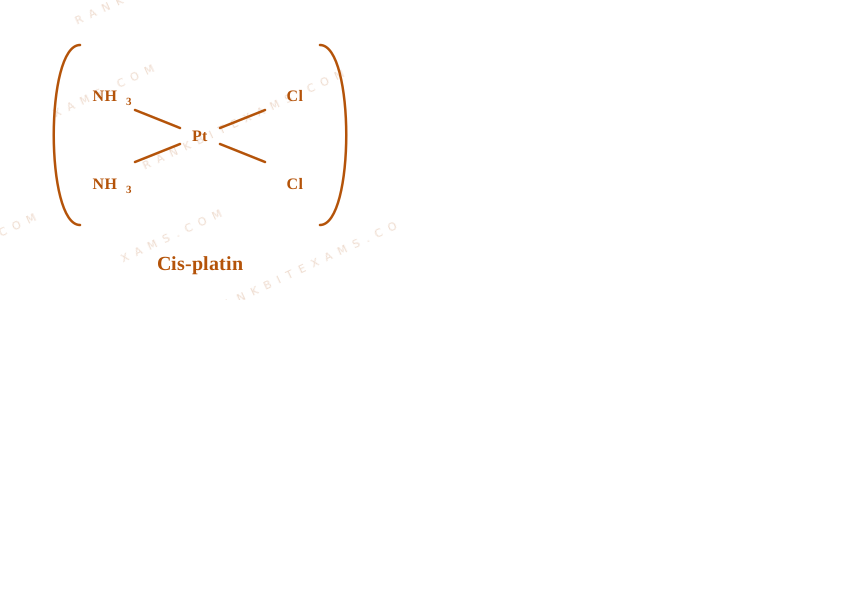
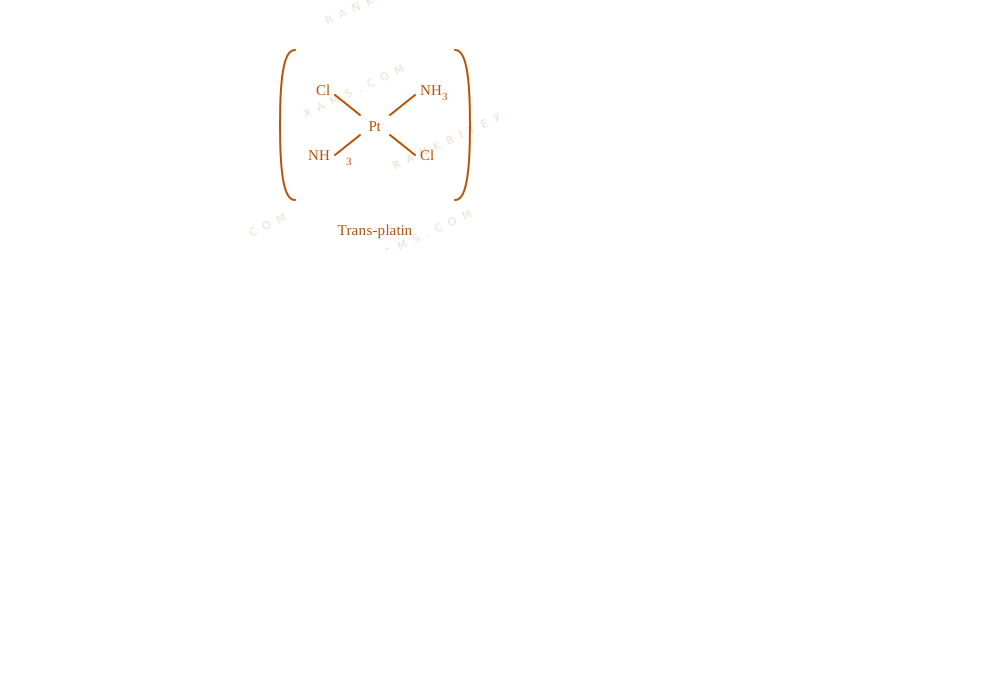
  • Statement II: Cis-platin and trans-platin have the chemical formula [Pt(NH₃)₂Cl₂]. While they are indeed heteroleptic complexes, they are coordination coordinates of Platinum (Pt), not Palladium (Pd). Statement II is false.
    Stereochemical representation of octahedral homoleptic system
    Stereochemical representation of octahedral homoleptic system
Pattern Recognition

Always read element symbols with immense focus in coordination chemistry. Changing a single letter from Pt to Pd creates a false assertion trap designed to test parsing alertness rather than chemical difficulty.

Chapter Mix

Class 12 Chemistry: Coordination Compounds
Q41 jee_main_2025_08_april_evening Valence Bond Theory
Determine the total number of chemical species from the list below that are specifically involved in an sp³d² hybridization state: [Co(NH₃)₆]³⁺, SF₆, [CrF₆]³⁻, [CoF₆]³⁻, [Mn(CN)₆]³⁻, and [MnCl₆]³⁻
  • A. 5
  • B. 6
  • C. 4
  • D. 3

Solution

Core Logic

Let us systematically determine the hybridization configuration of each species:

  • [Co(NH₃)₆]³⁺: Co³⁺ has a 3d⁶ configuration. Ammonia (NH₃) acts as a Strong Field Ligand (SFL), forcing the pairing of 3d electrons. This leaves two internal 3d orbitals vacant, leading to an inner orbital d²sp³ hybridization.
  • SF₆: Central sulfur has 6 valence electrons, forming 6 single bonds. Steric number = 6, resulting in a regular outer octahedral sp³d² hybridization.
  • [CrF₆]³⁻: Cr³⁺ has a 3d³ configuration. The t2g subshell holds 3 unpaired electrons, leaving the two eg orbitals empty regardless of ligand field strength. This results in a d²sp³ hybridization.
  • [CoF₆]³⁻: Co³⁺ has a 3d⁶ configuration. Fluoride (F^-) is a Weak Field Ligand (WFL) and cannot induce spin pairing. Thus, the complex utilizes outer shell 4d orbitals, yielding an outer orbital sp³d² configuration.
  • [Mn(CN)₆]³⁻: Mn³⁺ has a 3d⁴ configuration. Cyanide (CN^-) is a Strong Field Ligand (SFL), inducing pairing to leave two 3d slots vacant, giving a d²sp³ hybridization.
  • [MnCl₆]³⁻: Mn³⁺ has a 3d⁴ configuration. Chloride (Cl^-) is a Weak Field Ligand (WFL) and cannot cause pairing. It utilizes the outer 4d shell, resulting in an outer orbital sp³d² hybridization.
  • Counting the outer-orbital sp³d² species: SF₆, [CoF₆]³⁻, and [MnCl₆]³⁻. Total count = 3.

Pattern Recognition

Outer orbital complexes (sp³d²) require weak field ligands (like F^-, Cl^-) paired with metal configurations where internal d-orbitals cannot be cleared by pairing (d⁴, d⁵, d⁶). SF₆ is a primary group molecule that always uses outer-shell d-orbitals. This brings our total to 3.

Chapter Mix

Class 12 Chemistry: Coordination Compounds Class 11 Chemistry: Chemical Bonding and Molecular Structure

Q44 jee_main_2025_08_april_evening Valence Bond Theory
Match the coordination complexes listed in LIST-I with their geometric shape and magnetic moment characteristics described in LIST-II:
LIST-I (Complex/Species)LIST-II (Shape & magnetic moment)
A. [Ni(CO)₄]I. Tetrahedral, 2.8 BM
B. [Ni(CN)₄]²⁻II. Square planar, 0 BM
C. [NiCl₄]²⁻III. Tetrahedral, 0 BM
D. [MnBr₄]²⁻IV. Tetrahedral, 5.9 BM
Choose the correct answer from the options given below:
  • A. A-III, B-IV, C-II, D-I
  • B. A-I, B-II, C-III, D-IV
  • C. A-III, B-II, C-I, D-IV
  • D. A-IV, B-I, C-III, D-II

Solution

Core Logic

Let us apply Valence Bond Theory (VBT) and crystal field rules to evaluate each coordination complex:

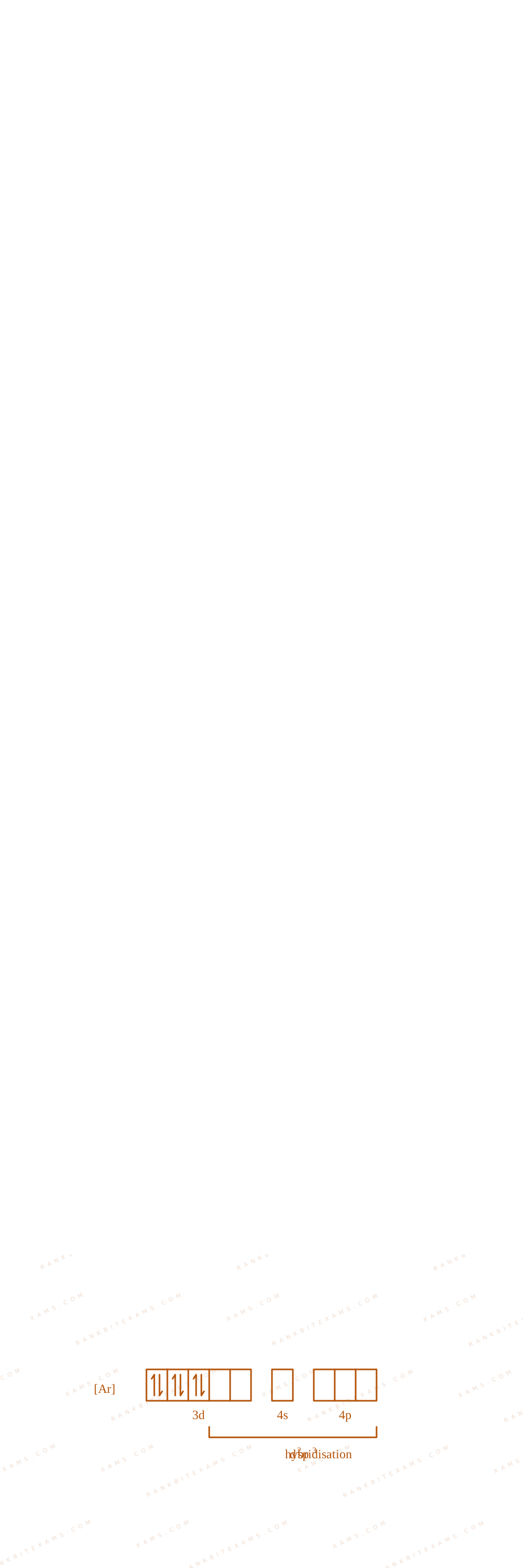
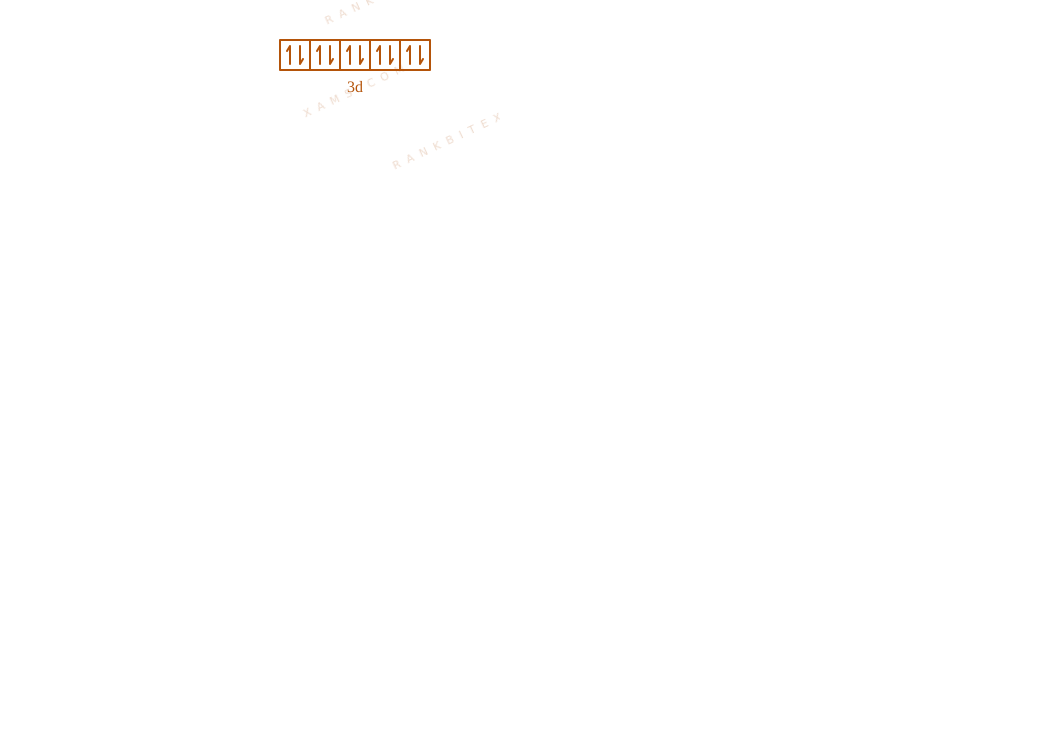
  • A. [Ni(CO)₄]: Nickel is in the 0 oxidation state (3d⁸ 4s²). Carbon monoxide (CO) is a strong field ligand, forcing the 4s electrons into the 3d shell to produce a fully paired 3d¹⁰ configuration. The vacant 4s and three 4p orbitals hybridize into an sp³ tetrahedral geometry. All spins are paired, so μ = 0 BM. Thus, A arrow III.
    Valence orbital diagram for nickel tetracarbonyl sp3 system
    Valence orbital diagram for nickel tetracarbonyl sp3 system
  • B. [Ni(CN)₄]²⁻: Nickel is in the +2 state (3d⁸). Cyanide (CN^-) is a strong field ligand, forcing the pairing of the two unpaired 3d electrons. This leaves one internal 3d orbital vacant, leading to dsp² square planar hybridization with zero unpaired electrons (μ = 0 BM). Thus, B arrow II.
    Valence orbital diagram for nickel tetracarbonyl sp3 system
    Valence orbital diagram for nickel tetracarbonyl sp3 system
  • C. [NiCl₄]²⁻: Nickel is in the +2 state (3d⁸). Chloride (Cl^-) is a weak field ligand, leaving the two 3d electrons unpaired (n = 2). The system adopts sp³ tetrahedral hybridization with a spin-only moment of μ = √(2(2+2)) = √(8) ≈ 2.8 BM. Thus, C arrow I.
    Valence orbital diagram for nickel tetracarbonyl sp3 system
    Valence orbital diagram for nickel tetracarbonyl sp3 system
  • D. [MnBr₄]²⁻: Manganese is in the +2 state (3d⁵). Bromide (Br^-) is a weak field ligand, preserving five unpaired parallel spins (n = 5). The geometry is sp³ tetrahedral with a maximum spin-only moment of μ = √(5(5+2)) = √(35) ≈ 5.9 BM. Thus, D arrow IV.
    Valence orbital diagram for nickel tetracarbonyl sp3 system
    Valence orbital diagram for nickel tetracarbonyl sp3 system
Step 1: Alignment Summary

Consolidating our results:

A-III, B-II, C-I, D-IV

This matches Option (3).

Pattern Recognition

Nickel complexes provide classic benchmarks: Nickel zero tetracarbonyl is always tetrahedral diamagnetic. Nickel +2 tetracyanide is square planar diamagnetic due to strong ligand field pairing. Spotting these properties cuts down the problem solving time significantly.

Chapter Mix

Class 12 Chemistry: Coordination Compounds

More Coordination Compounds Questions — jee_main_2025_29_jan_evening

Practice all Coordination Compounds previous-year questions →

Rankbit System
JEE Physics: Waves (+15.5%) | Electrostatics: Concentric Shells (-29.7%) | Modern Physics: Photoelectric Clones (+34.2%) | Mathematics: Definite Integrals (+18.1%) | Chemistry: Coordination Splitting (-11.4%) | JEE Physics: Waves (+15.5%) | Electrostatics: Concentric Shells (-29.7%) | Modern Physics: Photoelectric Clones (+34.2%) | Mathematics: Definite Integrals (+18.1%) | Chemistry: Coordination Splitting (-11.4%)