JEE Main · Physics → Steady

Wave Optics appeared 34 times across 3 years — 3.9% of Physics. This question is from Young's Double Slit Experiment.

Year 2026 2025 2024 Total
Questions 11 15 8 34

A double slit interference experiment performed with a light of wavelength 600nm forms an interference fringe pattern on a screen with 10th bright fringe having its centre at a distance of 10mm from the central maximum. Distance of the centre of the same 10th bright fringe from the central maximum when the source of light is replaced by another source of wavelength 660nm would be ____________________

Numerical Answer Type:
Enter a numerical value Answer: 11 to 11 +4 marks

Solution & Explanation

Related Formula
Y = nλ Dd Y ∝ λ
Core Logic

Since the fringe index n and apparatus parameters D, d remain constant across both runs:

y₂y₁ = (λ₂)/(λ₁)

Substituting the values into the proportionality equation:

y₂10 ~mm = 660 ~nm600 ~nm y₂ = 10 × 1.1 = 11 ~mm
Step 1: Final Numerical Value

The distance of the tenth bright fringe shifts to exactly 11 ~mm.

Pattern Recognition

Fringe position scales linearly with wavelength in standard Young's setups. Increasing the wavelength by 10% shifts the entire pattern outward by exactly 10%.

Chapter Mix

Class 12 Physics: Wave Optics

Reference Study Guides

More Wave Optics Previous-Year Questions — Page 7

Q41 jee_main_2024_30_january_evening Polarisation of Light
A beam of unpolarised light of intensity I₀ is passed through a polaroid A and then through another polaroid B which is oriented so that its principal plane makes an angle of 45^° relative to that of A. The intensity of emergent light is :
  • A. I₀ / 4
  • B. I₀
  • C. I₀ / 2
  • D. I₀ / 8

Solution

Related Formula
I = Iincident ² θ (Malus's Law)
Core Logic

When unpolarised light of intensity I₀ passes through the first polaroid A, it becomes plane-polarised, and its intensity drops by exactly half.

I₁ = (I₀)/(2)

When this polarised light passes through the second polaroid B, the transmitted intensity is determined by Malus's Law.

Step 1: Apply Malus's Law

The angle between the principal planes of polaroids A and B is θ = 45^°.

I₂ = I₁ ²(45^°) I₂ = ((I₀)/(2)) ( 1√(2))² I₂ = (I₀)/(2) × (1)/(2) = (I₀)/(4)
Pattern Recognition

Unpolarised to Polarised arrow I₀/2. Polarised to Polarised arrow I ²θ. At θ = 45^°, ²θ = 1/2, resulting in a final intensity of I₀/4.

Chapter Mix

Class 12 Physics: Wave Optics
Q40 jee_main_2024_30_jan_morning Diffraction from a Single Slit
The diffraction pattern of a light of wavelength 400 nm diffracting from a slit of width 0.2 ~mm is focused on the focal plane of a convex lens of focal length 100 ~cm. The width of the 1st secondary maxima will be :
  • A. 2 ~mm
  • B. 2 ~cm
  • C. 0.02 ~mm
  • D. 0.2 ~mm

Solution

Related Formula
Width of secondary maxima = (λ D)/(a)
Core Logic

In a single slit diffraction pattern, the linear width of any secondary maxima (fringe width of secondary bright bands) is given by W = (λ D)/(a), whereas the central maximum is double this width (2(λ D)/(a)).

Step 1: Parameter Identification

Given values: Slit width, a = 0.2 × 10⁻³ ~m Wavelength, λ = 400 × 10⁻⁹ ~m Distance to screen (focal length of the lens), D = 100 × 10⁻² ~m = 1 ~m

Step 2: Execution

Substitute these into the formula:

Width = 400 × 10⁻⁹0.2 × 10⁻³ × 1 Width = (400)/(0.2) × 10⁻⁶ ~m Width = 2000 × 10⁻⁶ ~m = 2 × 10⁻³ ~m Width = 2 ~mm
Pattern Recognition

Remember to strictly distinguish between central maximum (2λ D/a) and secondary maxima (λ D/a).

Chapter Mix

Class 12 Physics: Wave Optics

Q36 jee_main_2024_31_jan_evening Polarization by Reflection (Brewster's Law)
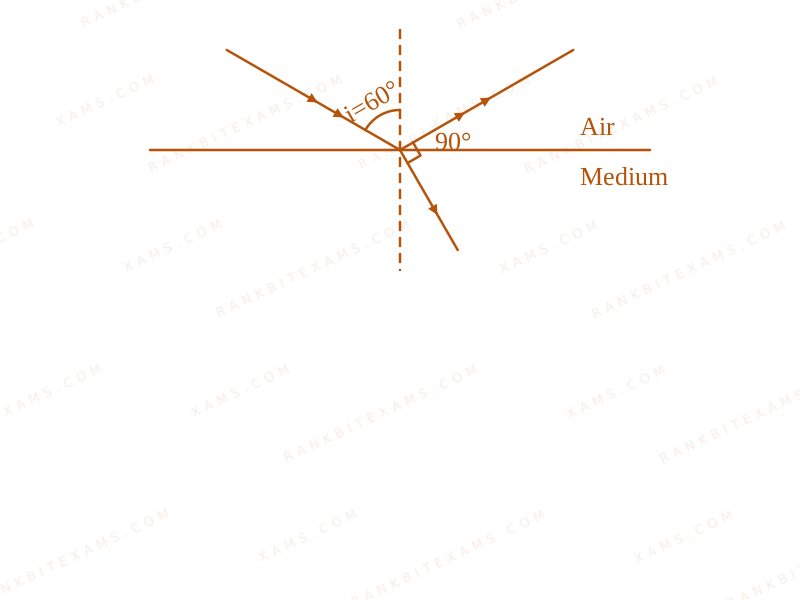
When unpolarized light is incident at an angle of 60° on a transparent medium from air. The reflected ray is completely polarized. The angle of refraction in the medium is
  • A. 30°
  • B. 60°
  • C. 90°
  • D. 45°

Solution

Related Formula

Brewster's Law states that at complete polarization upon reflection, the reflected and refracted rays are perpendicular to each other:

iₚ + r = 90°
Core Logic

The incident angle is given as iₚ = 60°. At this angle, since the reflected ray is completely polarized, the geometry of Brewster's angle applies.

Polarization by Reflection (Brewster's Law) diagram for Q36 - JEE Main 2024 Evening

Step 1: Calculate Refraction Angle
60° + r = 90° r = 90° - 60° = 30°
Pattern Recognition

The condition "reflected ray is completely polarized" is a direct trigger for Brewster's Law (iₚ + r = 90°). No refractive index (μ) calculation is needed if only the geometric angle is asked.

Chapter Mix

Class 12 Physics: Wave Optics Class 12 Physics: Ray Optics and Optical Instruments

Q56 jee_main_2024_31_jan_morning Interference Of Waves
Two waves of intensity ratio 1:9 cross each other at a point. The resultant intensities at the point, when (a) Waves are incoherent is I₁ (b) Waves are coherent is I₂ and differ in phase by 60^°. If (I₁)/(I₂) = (10)/(x) then x =
Numerical Answer. Answer: 13 to 13

Solution

Related Formula
Iincoherent = IA + IB Icoherent = IA + IB + 2√(IA IB) φ
Core Logic

Let the individual intensities be IA = I₀ and IB = 9I₀.

For incoherent waves, the net intensity is simply the algebraic sum:

I₁ = IA + IB = I₀ + 9I₀

I₁ = 10I₀

Step 2: Coherent Waves Interference

For coherent waves with a phase difference of φ = 60^°:

I₂ = IA + IB + 2√(IA IB) (60^°) I₂ = I₀ + 9I₀ + 2√((I₀)(9I₀)) ((1)/(2)) I₂ = 10I₀ + 2(3I₀) ((1)/(2)) I₂ = 10I₀ + 3I₀ = 13I₀
Step 3: Finding x

Taking the ratio:

(I₁)/(I₂) = (10I₀)/(13I₀) = (10)/(13)

Comparing with the given expression (10)/(x), we get: x = 13

Chapter Mix

Class 12 Physics: Wave Optics

More Wave Optics Questions — jee_main_2025_28_jan_morning

Practice all Wave Optics previous-year questions →

Rankbit System
JEE Physics: Waves (+15.5%) | Electrostatics: Concentric Shells (-29.7%) | Modern Physics: Photoelectric Clones (+34.2%) | Mathematics: Definite Integrals (+18.1%) | Chemistry: Coordination Splitting (-11.4%) | JEE Physics: Waves (+15.5%) | Electrostatics: Concentric Shells (-29.7%) | Modern Physics: Photoelectric Clones (+34.2%) | Mathematics: Definite Integrals (+18.1%) | Chemistry: Coordination Splitting (-11.4%)