JEE Main · Physics → Steady

Wave Optics appeared 34 times across 3 years — 3.9% of Physics. This question is from Young's Double Slit Experiment.

Year 2026 2025 2024 Total
Questions 11 15 8 34

A double slit interference experiment performed with a light of wavelength 600nm forms an interference fringe pattern on a screen with 10th bright fringe having its centre at a distance of 10mm from the central maximum. Distance of the centre of the same 10th bright fringe from the central maximum when the source of light is replaced by another source of wavelength 660nm would be ____________________

Numerical Answer Type:
Enter a numerical value Answer: 11 to 11 +4 marks

Solution & Explanation

Related Formula
Y = nλ Dd Y ∝ λ
Core Logic

Since the fringe index n and apparatus parameters D, d remain constant across both runs:

y₂y₁ = (λ₂)/(λ₁)

Substituting the values into the proportionality equation:

y₂10 ~mm = 660 ~nm600 ~nm y₂ = 10 × 1.1 = 11 ~mm
Step 1: Final Numerical Value

The distance of the tenth bright fringe shifts to exactly 11 ~mm.

Pattern Recognition

Fringe position scales linearly with wavelength in standard Young's setups. Increasing the wavelength by 10% shifts the entire pattern outward by exactly 10%.

Chapter Mix

Class 12 Physics: Wave Optics

Reference Study Guides

More Wave Optics Previous-Year Questions — Page 4

Q2 jee_main_2025_07_april_morning Superposition and Interference
Two plane polarized light waves combine at a certain point whose electric field components are E₁ = E₀ ω t E _ 2 = E _ 0 (ω t + (π)/(3)) Find the amplitude of the resultant wave.
  • A. 0.9E
  • B. E₀
  • C. 1.7E₀
  • D. 3.4E₀

Solution

Related Formula

For two waves of identical direction and frequency superimposing with phase difference φ:

Eᵣₑₛ = √(E₁² + E₂² + 2E₁E₂ φ)
Core Logic

The amplitudes of the two waves are E₁ = E₀ and E₂ = E₀.

The phase difference is:

φ = (π)/(3)

Substitute these values into the resultant amplitude equation:

Eᵣₑₛ = √(E₀² + E₀² + 2E₀² ((π)/(3)))
Step 1: Simplify the calculation

Since ((π)/(3)) = 0.5:

Eᵣₑₛ = √(2E₀² + 2E₀²(0.5)) = √(3E₀²) = √(3)E₀ ≈ 1.732E₀

This is closest to 1.7E₀.

Pattern Recognition

Sees: Equal amplitudes (A) with a phase angle of 60^° (π/3). Shortcut: The vector sum of two vectors of equal magnitude A separated by 60^° is always √(3)A ≈ 1.73A. If separated by 120^°, it is A. If 90^°, it is √(2)A.

Chapter Mix

Class 12 Physics: Wave Optics
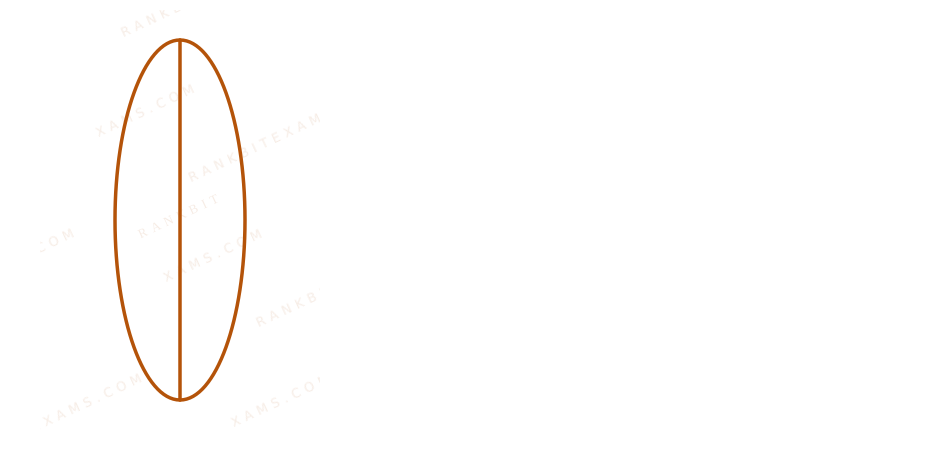
Q18 jee_main_2025_08_april_evening Young's Double Slit Experiment
In a Young's double slit experiment, the source is white light. One of the slits is covered by red filter and another by a green filter. In this case:
  • A. There shall be an interference pattern for red distinct from that for green.
  • B. There shall be no interference fringes.
  • C. There shall be alternate interference fringes of red and green.
  • D. There shall be an interference pattern, where each fringe's pattern center is green and outer edges is red.

Solution

Related Formula

For a stable, visible interference pattern to form, the light sources passing through the two slits must be coherent:

  • They must have the same wavelength (or frequency).
  • They must maintain a constant phase difference over time.
Core Logic

If one slit is covered by a red filter and the other by a green filter:

  • Only red light (λred ≈ 700~nm) passes through the first slit.
  • Only green light (λgreen ≈ 500~nm) passes through the second slit.
  • Since the two passing waves have completely different wavelengths and frequencies, they are incoherent.

Step 1: Resulting Pattern Analysis

Coherent sources are a prerequisite for producing stable bright and dark interference fringes. Incoherent waves of different frequencies merely superimpose to create a general background illumination without any distinct, observable spatial fringe lines.

Thus, there shall be no interference fringes.

Pattern Recognition

Sees: YDSE + opposite colored filters (red and green) on slits. Trap: Don't get confused thinking separate patterns will overlay. Since the slits emit different colors, the sources are incoherent, so the interference term φ = 0. Shortcut: Different colors = different wavelengths = incoherent sources = NO fringes. ✓

Chapter Mix

Class 12 Physics: Wave Optics
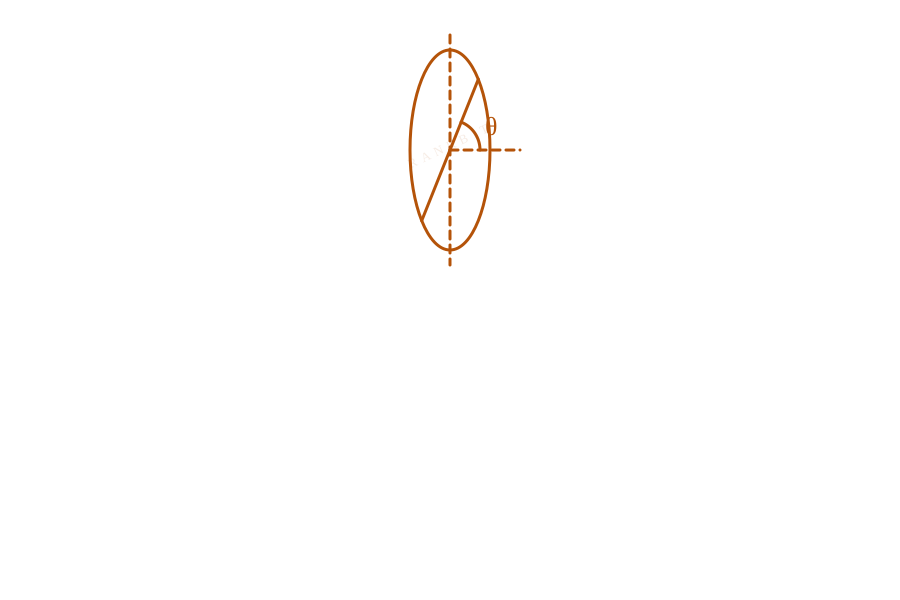
Q23 jee_main_2025_03_april_morning Interference Intensities Difference
Two coherent monochromatic light beams of intensities 4I and 9I are superimposed. The difference between the maximum and minimum intensities in the resulting interference pattern is xI. The value of x is ________.
Numerical Answer. Answer: 24 to 24

Solution

Related Formula

For superposition of two coherent beams of intensities I₁ and I₂:

Imax = (√(I₁) + √(I₂))² Imin = (√(I₁) - √(I₂))²
Core Logic

Given values:

  • I₁ = 4I
  • I₂ = 9I
  • Let's calculate the square roots of the intensities:

  • √(I₁) = √(4I) = 2√(I)
  • √(I₂) = √(9I) = 3√(I)
Step 1: Calculating Max and Min Intensities

Substitute these values into the intensity formulas:

Imax = (2√(I) + 3√(I))² = (5√(I))² = 25I Imin = (3√(I) - 2√(I))² = (1√(I))² = I
Step 2: Finding the Difference

The difference between the maximum and minimum intensities is:

Imax - Imin = 25I - I = 24I

Since this difference is given as xI:

x = 24

Pattern Recognition

Algebraic Shortcut:

Imax - Imin = (√(I₁) + √(I₂))² - (√(I₁) - √(I₂))² = 4√(I₁ I₂)

Substitute I₁ = 4I and I₂ = 9I: 4√(4I · 9I) = 4√(36 I²) = 4 × 6I = 24I. This beautiful identity (4ab formula) lets you solve the problem instantly without separately calculating maximum and minimum values!

Chapter Mix

Class 12 Physics: Wave Optics
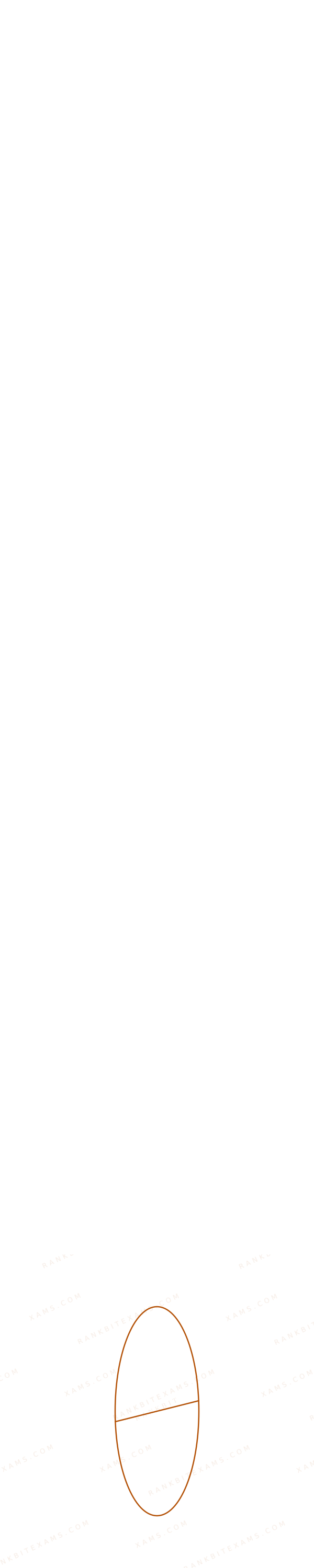
Q15 jee_main_2025_04_april_evening Polarisation
Two polarisers P₁ and P₂ are placed in such a way that the intensity of the transmitted light will be zero. A third polariser P₃ is inserted in between P₁ and P₂ at the particular angle between P₂ and P₃. The transmitted intensity of the light passing through all the three polarisers is maximum. The angle between the polarisers P₂ and P₃ is:
  • A. (π)/(4)
  • B. (π)/(6)
  • C. (π)/(8)
  • D. (π)/(3)

Solution

Related Formula

Malus's Law:

I = I₀ ²θ
Core Logic

Since P₁ and P₂ are crossed, the angle between their transmission axes is 90^°. Let the angle between P₁ and P₃ be θ. Then the angle between P₃ and P₂ is (90^° - θ). Intensity after passing through P₃: I₁ = I₀ ²θ. Intensity after passing through P₂: Iₙₑₜ = I₁ ²(90^° - θ) = I₀ ²θ ²θ.

Step 1: Maximize Net Intensity

Rewrite the expression:

Iₙₑₜ = (I₀)/(4) [2 θ θ]² = (I₀)/(4) [ (2θ)]²

For maximum transmitted intensity, (2θ) = 1 2θ = 90^° θ = 45^° = (π)/(4). The angle between P₂ and P₃ is 90^° - 45^° = 45^° = (π)/(4).

Polarizer alignment schema

Pattern Recognition

Inserting a polarization filter at exactly 45^° (π/4) between crossed polarizers symmetrically splits up components, maximizing overall transmission throughput.

Chapter Mix

Class 12 Physics: Wave Optics

More Wave Optics Questions — jee_main_2025_28_jan_morning

Practice all Wave Optics previous-year questions →

Rankbit System
JEE Physics: Waves (+15.5%) | Electrostatics: Concentric Shells (-29.7%) | Modern Physics: Photoelectric Clones (+34.2%) | Mathematics: Definite Integrals (+18.1%) | Chemistry: Coordination Splitting (-11.4%) | JEE Physics: Waves (+15.5%) | Electrostatics: Concentric Shells (-29.7%) | Modern Physics: Photoelectric Clones (+34.2%) | Mathematics: Definite Integrals (+18.1%) | Chemistry: Coordination Splitting (-11.4%)