JEE Main · Physics → Steady

Wave Optics appeared 34 times across 3 years — 3.9% of Physics. This question is from Young's Double Slit Experiment.

Year 2026 2025 2024 Total
Questions 11 15 8 34

A double slit interference experiment performed with a light of wavelength 600nm forms an interference fringe pattern on a screen with 10th bright fringe having its centre at a distance of 10mm from the central maximum. Distance of the centre of the same 10th bright fringe from the central maximum when the source of light is replaced by another source of wavelength 660nm would be ____________________

Numerical Answer Type:
Enter a numerical value Answer: 11 to 11 +4 marks

Solution & Explanation

Related Formula
Y = nλ Dd Y ∝ λ
Core Logic

Since the fringe index n and apparatus parameters D, d remain constant across both runs:

y₂y₁ = (λ₂)/(λ₁)

Substituting the values into the proportionality equation:

y₂10 ~mm = 660 ~nm600 ~nm y₂ = 10 × 1.1 = 11 ~mm
Step 1: Final Numerical Value

The distance of the tenth bright fringe shifts to exactly 11 ~mm.

Pattern Recognition

Fringe position scales linearly with wavelength in standard Young's setups. Increasing the wavelength by 10% shifts the entire pattern outward by exactly 10%.

Chapter Mix

Class 12 Physics: Wave Optics

Reference Study Guides

More Wave Optics Previous-Year Questions — Page 2

Q49 jee_main_2026_23_january_morning Interference of Light Waves and Young's Experiment
In two separate Young's double-slit experimental set-ups, two monochromatic light sources of different wavelengths are used to get fringes of equal width. The ratios of the slit separations and that of the wavelengths of light used are 2:1 and 1:2 respectively. The corresponding ratio of the distances between the slits and the respective screens (D₁ / D₂) is ____.
Numerical Answer. Answer: 4 to 4

Solution

Related Formula
β = (λ D)/(d)
Core Logic

For fringes of equal width, β₁ = β₂. We equate the fringe width expression for both setups and isolate the ratio of the screen distances D₁/D₂.

Step 1: Setup Ratios

Given: d₁d₂ = 2 λ₁λ₂ = (1)/(2)

Step 2: Equate and Solve
λ₁ D₁d₁ = λ₂ D₂d₂ D₁D₂ = ( λ₂λ₁) ( d₁d₂)

Substitute the given values:

D₁D₂ = ((2)/(1)) × (2) = 4
Pattern Recognition

Sees: "fringes of equal width" + "multiple ratios" → Immediately construct a multi-variable proportionality equality D₁D₂ = β₁ d₁ λ₂β₂ d₂ λ₁ and cancel the constant terms.

Chapter Mix

Class 12 Physics: Wave Optics
Q44 jee_main_2026_23_january_evening Polarization and Brewster's Law
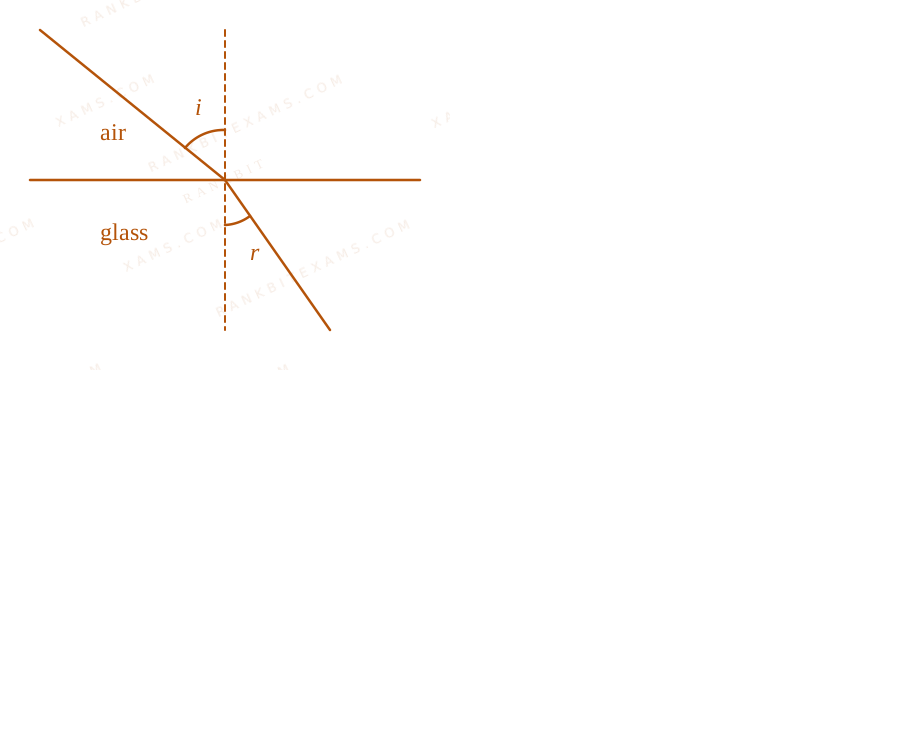
When an unpolarized light falls at a particular angle on a glass plate (placed in air), it is observed that the reflected beam is linearly polarized. The angle of refracted beam with respect to the normal is ____. ( ⁻¹ (1.52) = 57.7°, refractive indices of air and glass are 1.00 and 1.52, respectively)
  • A. 39.6°
  • B. 32.3°
  • C. 42.6°
  • D. 36.3°

Solution

Related Formula

Brewster's Law: iₚ = (μ₂)/(μ₁) r = 90° - iₚ

Core Logic

Polarization and Brewster's Law diagram for Q44 - JEE Main 2026 Evening

Linearly polarized reflected light implies the light was incident at Brewster's angle iₚ. At Brewster's angle, the reflected and refracted rays are perpendicular to each other (iₚ + r = 90°).

Step 1: Determine Incident Angle
iₚ = μg = 1.52 iₚ = ⁻¹(1.52) = 57.7°
Step 2: Calculate Angle of Refraction
r = 90° - iₚ r = 90° - 57.7° = 32.3°
Pattern Recognition

Brewster's angle immediately triggers the relationship r = 90° - i. No complex Snell's law calculation is needed if the Brewster condition is identified from "reflected beam is linearly polarized".

Chapter Mix

Class 12 Physics: Wave Optics

Q42 jee_main_2026_24_january_morning Polarization
An unpolarised light is incident at an interface of two dielectric media having refractive indices of 2 (incident medium) and 2√(3) (medium) respectively. To satisfy the condition that reflected and refracted rays are perpendicular to each other, the angle of incidence is ____.
  • A. 60°
  • B. 10°
  • C. 30°
  • D. 45°

Solution

Related Formula
Brewster's Law: θₚ = (μ₂)/(μ₁)
Core Logic

For the reflected and refracted rays to be mutually perpendicular, the angle of incidence must equal Brewster's angle, θₚ. Using Brewster's law:

θ = μrelative = (μ₂)/(μ₁)
Step 1: Calculate Angle

Given incident medium index μ₁ = 2 and refracting medium index μ₂ = 2√(3).

θ = 2√(3)2 = √(3)

Therefore, θ = 60°.

Pattern Recognition

The condition 'reflected and refracted rays perpendicular' is the strict definitional trigger for Brewster's law.

Chapter Mix

Class 12 Physics: Wave Optics

Q42 jee_main_2026_24_january_evening Young's Double Slit Experiment
In the Young's double slit experiment the intensity produced by each one of the individual slits is I₀ . The distance between two slits is 2 mm. The distance of screen from slits is 10 m. The wavelength of light is 6000 Å. The intensity of light on the screen in front of one of the slits is _.
  • A. 2I₀
  • B. I₀
  • C. (I₀)/(2)
  • D. 4I₀

Solution

Related Formula
I = 4I₀ ² ((Δ φ)/(2))

where path difference phase Δ φ = (2π)/(λ) · Δ x = (2π)/(λ) · (yd)/(D)

Core Logic

Given values: d = 2 mm = 2 × 10⁻³ m D = 10 m λ = 6000 AA = 6 × 10⁻⁷ m Position y = (d)/(2) (since it is directly in front of one of the slits).

Step 1: Calculate Phase Difference

The path difference at this position is:

Δ x = (yd)/(D) = ((d/2)d)/(D) = (d²)/(2D) Δ φ = (2π)/(λ) ( (d²)/(2D) )
Step 2: Substitution

Substitute the values:

(Δ φ)/(2) = (π d²)/(2λ D) (Δ φ)/(2) = π (2 × 10⁻³)²2 × (6 × 10⁻⁷) × 10 = π (4 × 10⁻⁶)12 × 10⁻⁶ = (π)/(3)
Step 3: Intensity Output

Using the intensity formula:

I = 4I₀ ² ((π)/(3)) I = 4I₀ ((1)/(2))² = 4I₀ ((1)/(4)) = I₀
Pattern Recognition

The point "in front of one slit" always means y = d/2. Calculate phase directly using π d² / (2 λ D).

Chapter Mix

Class 12 Physics: Wave Optics

Q41 jee_main_2026_28_january_morning Huygens Principle
Given below are two statements : Statement-I : A plane wave after passing through prism remains as plane wave but passing through small pin hole may become spherical wave. Statement-II : The curvature of a spherical wave emerging from a slit will increase for increasing slit width. In the light of the above statements, choose the correct answer from the options given below.
  • A. Both Statement-I and Statement-II are false.
  • B. Both Statement-I and Statement-II are true.
  • C. Statement-I is true but Statement-II is false.
  • D. Statement-I is false but Statement-II is true.

Solution

Related Formula

θ = (λ)/(a) (Diffraction angle)

Core Logic

Statement-I is correct because a prism changes the direction of a plane wave without changing its planar wavefront nature, whereas a small pinhole acts as a point source (Huygens' principle), generating spherical wavefronts. Statement-II is incorrect. Increasing the slit width a decreases the diffraction angle θ and reduces the spreading of the wave. A narrower slit produces a more pronounced spherical wave (high curvature) while a wider slit leads to a flatter, less curved (more planar) wave.

Step 1: Final Conclusion

Therefore, Statement I is true, and Statement II is false.

Pattern Recognition

Curvature of a wavefront coming out of an aperture is inversely related to aperture size relative to wavelength. Small aperture = high diffraction = highly curved spherical wave.

Chapter Mix

Class 12 Physics: Wave Optics

More Wave Optics Questions — jee_main_2025_28_jan_morning

Practice all Wave Optics previous-year questions →

Rankbit System
JEE Physics: Waves (+15.5%) | Electrostatics: Concentric Shells (-29.7%) | Modern Physics: Photoelectric Clones (+34.2%) | Mathematics: Definite Integrals (+18.1%) | Chemistry: Coordination Splitting (-11.4%) | JEE Physics: Waves (+15.5%) | Electrostatics: Concentric Shells (-29.7%) | Modern Physics: Photoelectric Clones (+34.2%) | Mathematics: Definite Integrals (+18.1%) | Chemistry: Coordination Splitting (-11.4%)