
JEE Main · Physics ↓ Falling

Electric Charges and Fields appeared 6 times across 3 years — 0.7% of Physics. This question is from Motion of a Charged Particle in an Electric Field.

Year 2026 2025 2024 Total
Questions 1 2 3 6

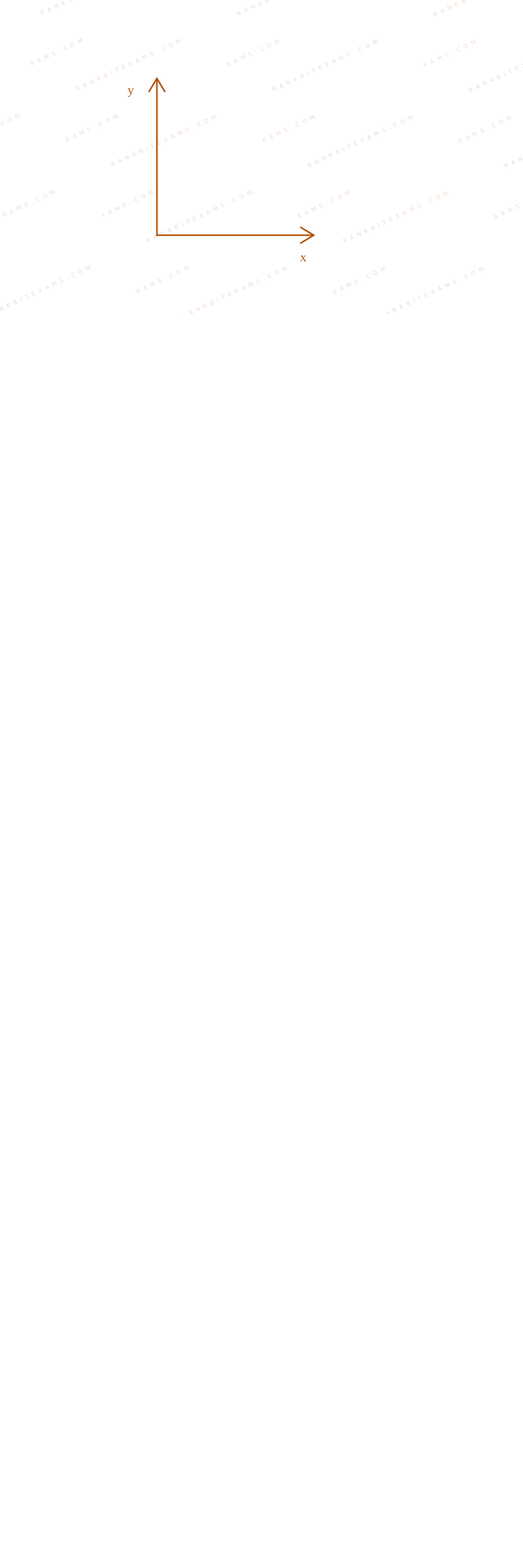
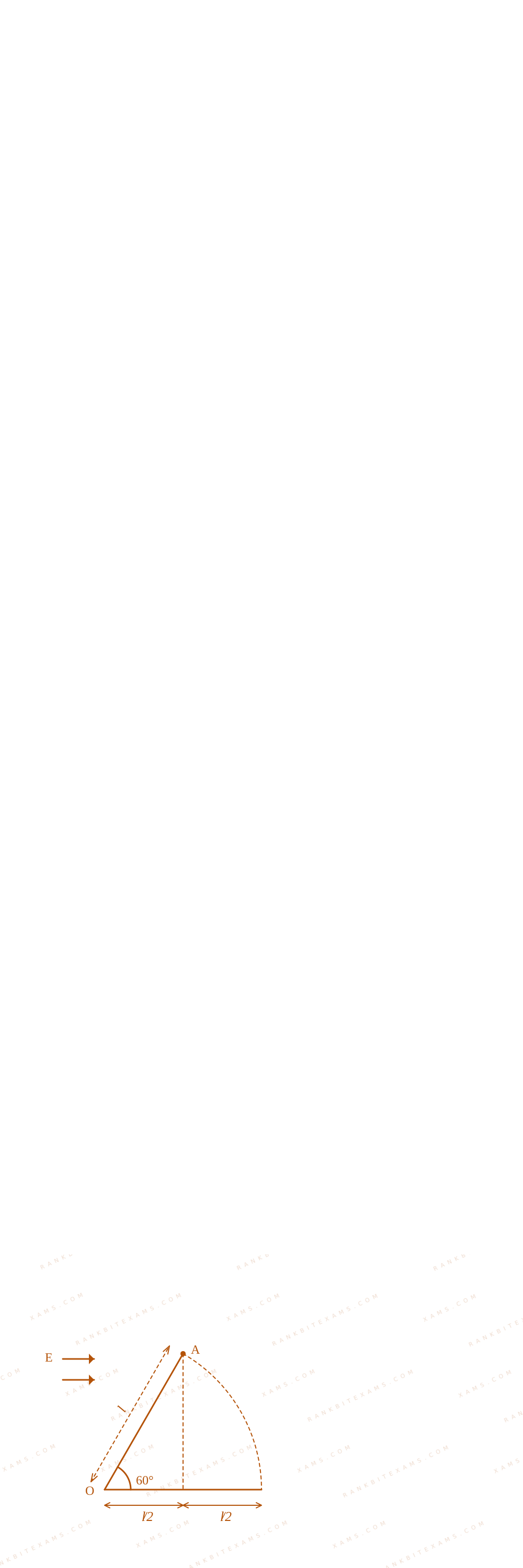
A particle of mass m and charge q is fastened to one end A of a massless string having equilibrium length , whose other end is fixed at point O . The whole system is placed on a frictionless horizontal plane and is initially at rest. If uniform electric field is switched on along the direction as shown in figure, then the speed of the particle when it crosses the x-axis is
Motion of a Charged Particle in an Electric Field diagram for Q17 - JEE Main 2025 Morning
A charge constraint tracking loop under electrostatic vector field forces on a horizontal surface.
Motion of a Charged Particle in an Electric Field diagram for Q17 - JEE Main 2025 Morning
A charge constraint tracking loop under electrostatic vector field forces on a horizontal surface.

Solution & Explanation

Core Logic

Applying the work-energy balance for the system as the particle moves from its initial position to the x-axis:

Wall = Δ k Wₑ = kf - kᵢ

Work calculation loop geometry tracking for Q17
A charge constraint tracking loop under electrostatic vector field forces on a horizontal surface.

The displacement parallel to the uniform electric field lines equals ( )/(2). Therefore, computing the work done by the electrostatic field:

qE ( )/(2) = (1)/(2) m v² - 0
Step 1: Final Expression
v = qE m

This matches option (3).

Pattern Recognition

Keep your focus on displacement along the field lines. Work relies entirely on the parallel displacement component (dₓ = 60°), completely ignoring any vertical movement components.

Chapter Mix

Class 12 Physics: Electric Charges and Fields

Reference Study Guides

More Electric Charges and Fields Previous-Year Questions — Page 2

Q59 jee_main_2024_29_jan_morning Electric Field due to an Infinite Plane Sheet
An electron is moving under the influence of the electric field of a uniformly charged infinite plane sheet S having surface charge density +σ. The electron at t = 0 is at a distance of 1 m from S and has a speed of 1 m/s. The maximum value of σ if the electron strikes S at t = 1 s is α [ m ε₀e] Cm² the value of α is
Numerical Answer. Answer: 8 to 8

Solution

Related Formula

The uniform electric field (E) produced by an infinite plane sheet with positive charge density +σ is:

E = (σ)/(2ε₀)

The constant electrostatic force acting on an electron (charge -e, mass m) directed towards the sheet is:

F = e E = (σ e)/(2ε₀) Acceleration a = -(σ e)/(2ε₀ m)
Core Logic

For the boundary limits matching a successful collision with the plate under maximum field conditions, the electron must be moving directly away from sheet

Core Logic

For the boundary limits matching a successful collision with the plate under maximum field conditions, the electron must be moving directly away from sheet $Sinitially (u = +1 \mathrm{~m/s}). The accelerating field acts as a decelerating force, turning it around to hit the sheet exactly att = 1 \mathrm{~s}.

Therefore, relative to the initial position vector pointing outwards:

  • Initial speed
Step 1: Apply Second Equation of Motion

Using $S = u t + \frac{1}{2} a t^2:

-1 = 1 × 1 + (1)/(2) a (1)²-1 = 1 + (1)/(2) a (1)/(2) a = -2 a = -4 ~m/s²
Step 2: Solve for Surface Charge Density

Equating this deceleration value to the electrostatic tracking acceleration:

-4 = -(σ e)/(2ε₀ m)σ = 8 (ε₀ m)/(e) = 8 [ (m ε₀)/(e) ]
Step 3: Extract alpha

Comparing this with the algebraic pattern

Step 3: Extract alpha

Comparing this with the algebraic pattern $\alpha \left[\frac{m \varepsilon_0}{e}\right]:

$\alpha = 8

Therefore, the value of

Therefore, the value of $\alphais8.

Pattern Recognition

Be careful with coordinate signs. If the electron were moving towards the plate initially (

Pattern Recognition

Be careful with coordinate signs. If the electron were moving towards the plate initially ($u = -1), any field value would pull it in even faster, meaning the time would be less than1 \mathrm{~s}$. The 'maximum field' boundary constraint implies the electron is thrown away and turned around at its apex peak, mapping perfectly to a return displacement.

Chapter Mix

Class 12 Physics: Electric Charges and Fields Class 11 Physics: Motion in a Straight Line

More Electric Charges and Fields Questions — jee_main_2025_28_jan_morning

Practice all Electric Charges and Fields previous-year questions →

Rankbit System
JEE Physics: Waves (+15.5%) | Electrostatics: Concentric Shells (-29.7%) | Modern Physics: Photoelectric Clones (+34.2%) | Mathematics: Definite Integrals (+18.1%) | Chemistry: Coordination Splitting (-11.4%) | JEE Physics: Waves (+15.5%) | Electrostatics: Concentric Shells (-29.7%) | Modern Physics: Photoelectric Clones (+34.2%) | Mathematics: Definite Integrals (+18.1%) | Chemistry: Coordination Splitting (-11.4%)