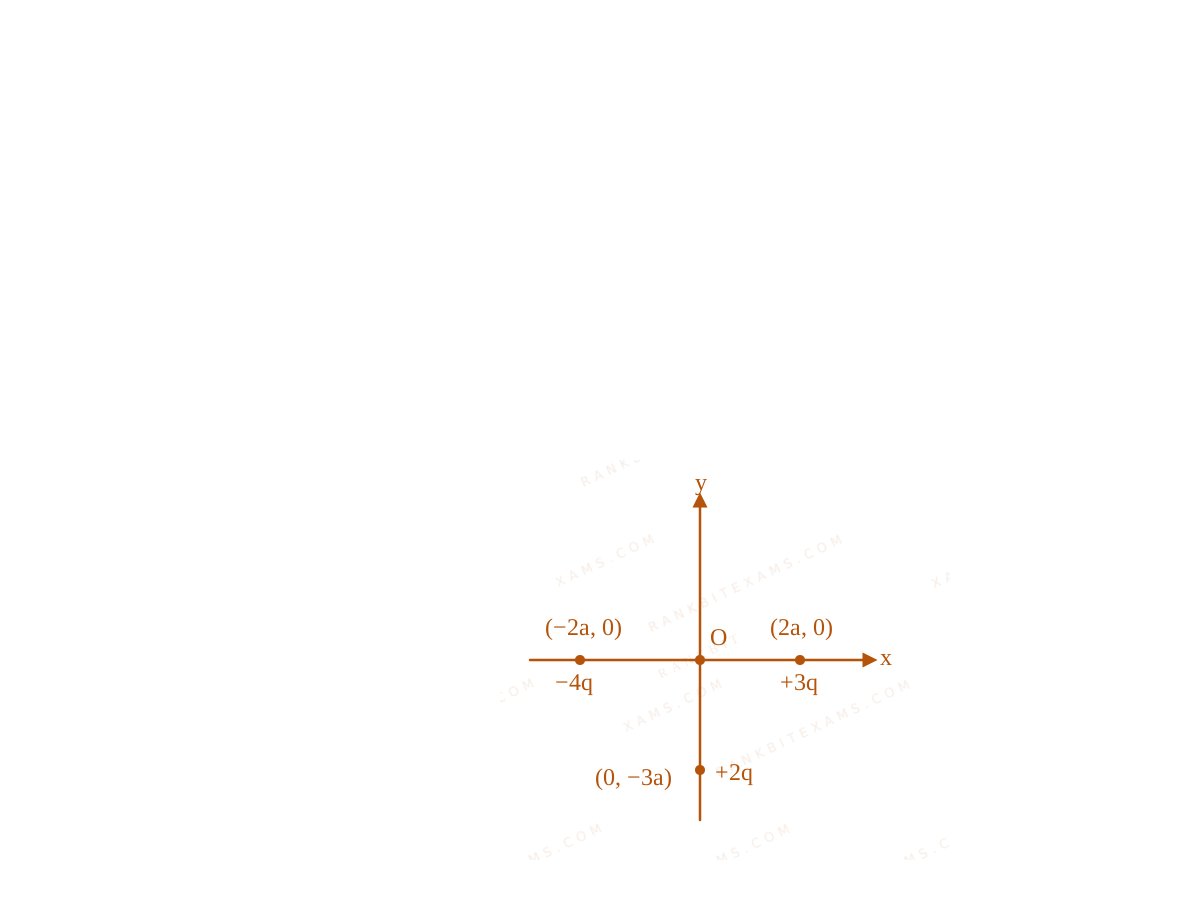
Three charges +2q, +3q and -4q are situated at (0,-3a), (2a, 0) and (-2a,0) respectively in the xy plane. The resultant dipole moment about origin is

Solution & Explanation

### Related Formula vecp = sum q_i vecr_i ### Core Logic
Coordinate geometry of three charges
The resultant dipole moment for a system of charges is given by: vecp = q_1 vecr_1 + q_2 vecr_2 + q_3 vecr_3 Substituting the given values: vecp = (2q)(-3a)hatj + (3q)(2a)hati + (-4q)(-2a)hati vecp = -6qahatj + 6qahati + 8qahati vecp = 14qahati - 6qahatj vecp = 2qa(7hati - 3hatj) ### Pattern Recognition For a system of point charges where the net charge is non-zero, the dipole moment depends on the origin. However, taking the standard formula sum q_i r_i yields the required mathematical expression directly. ### Evaluation Rubric / Model Answer null ### Chapter Mix Class 12 Physics: Electric Charges and Fields
Reference Study Guides

More Electric Charges and Fields Previous-Year Questions

Q20 jee_main_2025_02_april_evening Electric Field of a Ring
Consider a circular loop that is uniformly charged and has a radius asqrt2 . Find the position along the positive z -axis of the cartesian coordinate system where the electric field is maximum if the ring was assumed to be placed in xy-plane at the origin:
  • A. fracasqrt2
  • B. fraca2
  • C. a
  • D. 0

Solution

### Related Formula 1. Electric field intensity on the axis of a ring of radius R at axial distance z: E = frack Q zleft(z^2 + R^2right)^3/2 2. Condition for maximum electric field on the axis of a ring: z = fracRsqrt2 ### Core Logic To find where the axial field is maximized, take the first derivative of E with respect to z and set it to zero: fracdEdz = 0 implies z^2 + R^2 - 3z^2 = 0 implies z = fracRsqrt2 We are given: - Radius of the loop R = asqrt2 ### Step 1: Calculate the peak coordinate Substitute the radius R = asqrt2 into the maximized coordinate condition: z = fracasqrt2sqrt2 = a Thus, the electric field reaches its peak intensity at z = a. ### Pattern Recognition Sees: Maximum axial field location of circular charged ring. Trap: Simply picking radius R directly as the distance value, or omitting the 1/sqrt2 scaling factor. Shortcut: The peak of the axial field distribution of any ring always lies at z = fracRsqrt2. With R = asqrt2, z resolves simply to fracasqrt2sqrt2 = a. ### Evaluation Rubric / Model Answer null ### Chapter Mix Class 12 Physics: Electric Charges and Fields

Q17 jee_main_2025_28_jan_morning Motion of a Charged Particle in an Electric Field
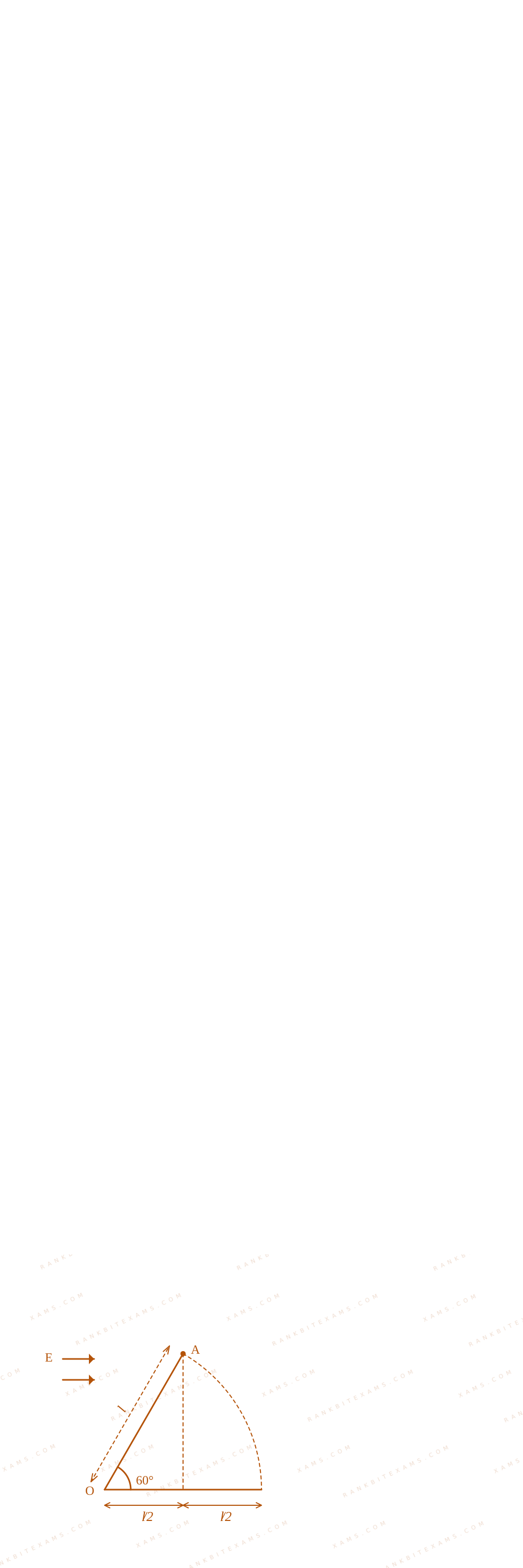
A particle of mass mathrmm and charge mathrmq is fastened to one end mathrmA of a massless string having equilibrium length ell , whose other end is fixed at point mathrmO . The whole system is placed on a frictionless horizontal plane and is initially at rest. If uniform electric field is switched on along the direction as shown in figure, then the speed of the particle when it crosses the x-axis is
Motion of a Charged Particle in an Electric Field diagram for Q17 - JEE Main 2025 Morning
A charge constraint tracking loop under electrostatic vector field forces on a horizontal surface.
Motion of a Charged Particle in an Electric Field diagram for Q17 - JEE Main 2025 Morning
A charge constraint tracking loop under electrostatic vector field forces on a horizontal surface.
  • A. sqrtfrac2mathrmqEellmathrmm
  • B. sqrtfracmathrmqEell4mathrmm
  • C. sqrtfracq mathrmE ellm
  • D. sqrtfracmathrmqEell2mathrmm

Solution

### Core Logic Applying the work-energy balance for the system as the particle moves from its initial position to the x-axis: mathrmW_textall = Delta mathrmk mathrmW_mathrme = mathrmk_mathrmf - mathrmk_mathrmi
Work calculation loop geometry tracking for Q17
A charge constraint tracking loop under electrostatic vector field forces on a horizontal surface.
The displacement parallel to the uniform electric field lines equals fracell2. Therefore, computing the work done by the electrostatic field: mathrmqE fracell2 = frac12 mathrmm v^2 - 0 ### Step 1: Final Expression mathrmv = sqrtfracmathrmqEellmathrmm This matches option (3). ### Pattern Recognition Keep your focus on displacement along the field lines. Work relies entirely on the parallel displacement component (d_x = ell cos 60^circ), completely ignoring any vertical movement components. ### Evaluation Rubric / Model Answer null ### Chapter Mix Class 12 Physics: Electric Charges and Fields
Q50 jee_main_2024_29_january_evening Electric Flux and Gauss's Law
An electric field is given by (6hati + 5hatj + 3hatk)text N/C. The electric flux through a surface area 30hatitext m^2 lying in YZ-plane (in SI unit) is:
  • A. 90
  • B. 150
  • C. 180
  • D. 60

Solution

### Related Formula The electric flux Phi through an area vector vecA in a uniform electric field vecE is: Phi = vecE cdot vecA ### Core Logic Given: * vecE = 6hati + 5hatj + 3hatk * vecA = 30hati (since the surface lies in the YZ-plane, its normal area vector points along the X-axis, which is hati) ### Step 1: Compute Dot Product Using the vector dot product: Phi = (6hati + 5hatj + 3hatk) cdot (30hati) Phi = (6 times 30) + 0 + 0 = 180text N m^2/textC Thus, the flux is 180. ### Pattern Recognition Flux through a plane parallel to YZ-plane depends only on the x-component of the electric field (E_x). Therefore, Phi = E_x times A = 6 times 30 = 180 immediately. ### Evaluation Rubric / Model Answer null ### Chapter Mix Class 12 Physics: Electric Charges and Fields
Q35 jee_main_2024_29_jan_morning Electric Flux and Gauss Law
Two charges of 5mathrmQ and -2mathrmQ are situated at the points (3a, 0) and (-5a, 0) respectively. The electric flux through a sphere of radius '4a' having center at origin is:
  • A. frac2Qvarepsilon_0
  • B. frac5Qvarepsilon_0
  • C. frac7 mathrmQvarepsilon_0
  • D. frac3Qvarepsilon_0

Solution

### Related Formula Gauss's Law states: Phi = oint vecE cdot dvecA = fracq_textenclosedvarepsilon_0 ### Core Logic We have a sphere of radius R = 4a centered at (0,0). * Charge 5Q is located at (3a, 0). Since the distance from origin is 3a lt 4a, this charge lies **inside** the sphere. * Charge -2Q is located at (-5a, 0). Since the distance from origin is 5a gt 4a, this charge lies **outside** the sphere.
Diagram representing the spatial location of charges and sphere boundary for Q35 - JEE Main 2024 Morning
### Step 1: Calculate Enclosed Charge The net enclosed charge q_textenclosed within the spherical boundary is: q_textenclosed = 5Q ### Step 2: Apply Gauss Law Using Gauss's Law, the total electric flux is: Phi = fracq_textenclosedvarepsilon_0 = frac5Qvarepsilon_0 Therefore, the electric flux is frac5Qvarepsilon_0. ### Pattern Recognition Flux depends purely on charges situated *inside* the closed surface. Charges outside the Gaussian surface contribute absolutely zero net flux because every field line entering must also exit. ### Evaluation Rubric / Model Answer null ### Chapter Mix Class 12 Physics: Electric Charges and Fields

More Electric Charges and Fields Questions — jee_main_2026_24_january_morning

Practice all Electric Charges and Fields previous-year questions →

Rankbit System
JEE Physics: Waves (+15.5%) | Electrostatics: Concentric Shells (-29.7%) | Modern Physics: Photoelectric Clones (+34.2%) | Mathematics: Definite Integrals (+18.1%) | Chemistry: Coordination Splitting (-11.4%) | JEE Physics: Waves (+15.5%) | Electrostatics: Concentric Shells (-29.7%) | Modern Physics: Photoelectric Clones (+34.2%) | Mathematics: Definite Integrals (+18.1%) | Chemistry: Coordination Splitting (-11.4%)