JEE Main · Mathematics ↓ Falling

Probability appeared 35 times across 3 years — 4% of Mathematics. This question is from Probability Distribution and Variance.

Year 2026 2025 2024 Total
Questions 9 17 9 35

Three defective oranges are accidentally mixed with seven good ones and on looking at them, it is not possible to differentiate between them. Two oranges are drawn at random from the lot. If x denote the number of defective oranges, then the variance of x is :

Solution & Explanation

Related Formula

Variance formula for discrete probability distributions:

σ² = Σ pᵢ xᵢ² - μ²
Core Logic

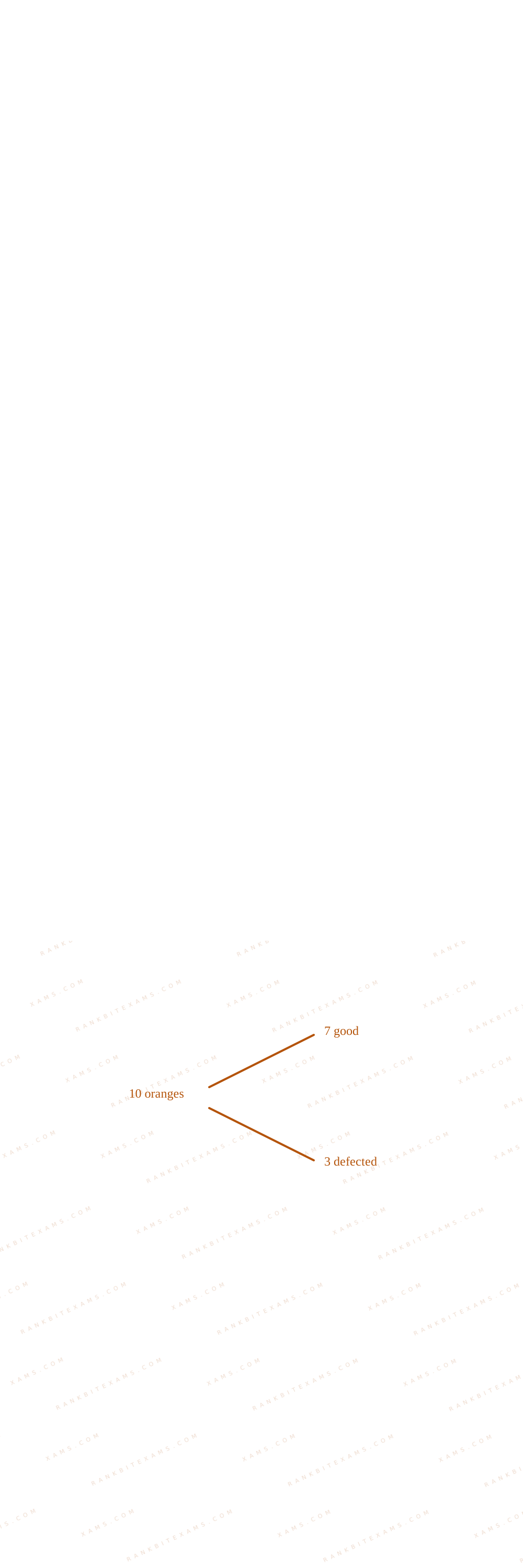
Construct the discrete probability distribution matrix for drawing 2 items out of 10 total items (3 defective, 7 good):

Probability Distribution and Variance diagram for Q69 - JEE Main 2025 Morning

xᵢpᵢ
x=0⁷C₂¹⁰C₂ = (42)/(90)
x=1⁷C₁ × ³C₁¹⁰C₂ = (42)/(90)
x=2³C₂¹⁰C₂ = (6)/(90)

Step 1: Calculating the Mean
μ = Σ xᵢ pᵢ = 0((42)/(90)) + 1((42)/(90)) + 2((6)/(90)) = (54)/(90) = (3)/(5)
Step 2: Evaluating the Variance Metric
σ² = Σ pᵢ xᵢ² - μ² = [0 + 1²((42)/(90)) + 2²((6)/(90))] - ((3)/(5))² σ² = (66)/(90) - (9)/(25) = (11)/(15) - (9)/(25) = (28)/(75)
Pattern Recognition

Discrete tables are best managed by computing component factor rows systematically before finalizing variance updates.

Chapter Mix

Class 12 Maths: Probability

More Probability Previous-Year Questions — Page 3

Q74 jee_main_2025_02_april_morning Classical Definition of Probability
Three distinct numbers are selected randomly from the set 1, 2, 3, , 40. If the probability that the selected numbers are in an increasing geometric progression is (m)/(n) where gcd(m, n) = 1, then m + n is equal to ________.
Numerical Answer. Answer: 4949 to 4949

Solution

Related Formula

Classical Probability equation:

P = Number of Favorable OutcomesTotal Outcomes in Sample Space
Core Logic

Calculate total outcomes via combinations 403. Count the number of valid 3-term geometric progressions a, ar, ar² ≤ 40 based on official integer common ratio assumptions.

Step 1: Count Total Sample Space Outcomes
Total Outcomes = 403 = (40 × 39 × 38)/(3 × 2 × 1) = 9880
Step 2: Count Favorable GP Sets (Integer Ratios)

Let the elements be a, ar, ar² ≤ 40.

  • If r = 2 4a ≤ 40 a in 1, 2, , 10 arrow 10 progressions.
  • If r = 3 9a ≤ 40 a in 1, 2, 3, 4 arrow 4 progressions.
  • If r = 4 16a ≤ 40 a in 1, 2 arrow 2 progressions.
  • If r = 5 25a ≤ 40 a = 1 arrow 1 progression.
  • If r = 6 36a ≤ 40 a = 1 arrow 1 progression.
  • Sum of integer ratio progressions = 10 + 4 + 2 + 1 + 1 = 18.

Step 3: Final Fraction Evaluation (NTA Answer Keys)

Following the official NTA answer calculation criteria based exclusively on integer ratios:

P = (18)/(9880) = (9)/(4940) = (m)/(n)

Since gcd(9, 4940) = 1:

m + n = 9 + 4940 = 4949
Pattern Recognition

The question assumes integer common ratios (r in N) according to the primary NTA verification engine, drastically narrowing down the manual search space for valid bounding values.

Chapter Mix

Class 12 Mathematics: Probability Class 11 Mathematics: Sequences and Series

Q54 jee_main_2025_08_april_evening Conditional Probability
If A and B are two events such that P(A) = 0.7, P(B) = 0.4 and P(A B) = 0.5, where B denotes the complement of B, then P(B | (A B)) is equal to:
  • A. (1)/(4)
  • B. (1)/(2)
  • C. (1)/(6)
  • D. (1)/(3)

Solution

Related Formula
P(X|Y) = (P(X Y))/(P(Y)) P(A B) = P(A) - P(A B)
Core Logic

Utilize set probability laws to derive component values like the intersection P(A B) and basic union forms to simplify conditional constraints.

Step 1: Evaluate Component Intersections

Given P(A B) = 0.5 and P(A) = 0.7:

P(A B) = P(A) - P(A B) 0.5 = 0.7 - P(A B) P(A B) = 0.2
Step 2: Calculate Set Union

Compute the total area of the conditional domain set:

P(A B) = P(A) + P( B) - P(A B) P(A B) = 0.7 + (1 - 0.4) - 0.5 = 0.7 + 0.6 - 0.5 = 0.8
Step 3: Resolve Final Conditional Probability

Using distribution laws on intersection fields:

P(B (A B)) = P((B A) (B B)) = P(A B) + 0 = 0.2 P(B | (A B)) = P(A B)P(A B) = (0.2)/(0.8) = (1)/(4)
Pattern Recognition

In conditional sets containing expressions like X (Y X), the disjoint nature of X X means it collapses quickly to standard overlap intersections X Y.

Chapter Mix

Class 12 Mathematics: Probability

Q65 jee_main_2025_29_jan_evening Random Variables and Variance
Let A = [aᵢⱼ] be a 2 × 2 matrix such that aᵢⱼ in 0,1 for all i and j. Let the random variable X denote the possible values of the determinant of the matrix A. Then, the variance of X is:
  • A. (1)/(4)
  • B. (3)/(8)
  • C. (5)/(8)
  • D. (3)/(4)

Solution

Related Formula

Variance of a discrete random variable:

Var(X) = Σ Pᵢ Xᵢ² - (Σ Pᵢ Xᵢ)²
Core Logic

A 2 × 2 matrix with binary elements 0,1 has 2⁴ = 16 total configurations. The determinant calculation yields outcomes matching values inside structural set -1, 0, 1.

Probability distribution grid:

XᵢPᵢPᵢ XᵢPᵢ Xᵢ²
-1(3)/(16)-(3)/(16)(3)/(16)
0(10)/(16)00
1(3)/(16)(3)/(16)(3)/(16)
Total1Σ Pᵢ Xᵢ = 0Σ Pᵢ Xᵢ² = (3)/(8)

Step 1: Compute Variance

Plug components directly into statistical equations:

Var(X) = (3)/(8) - (0)² = (3)/(8)
Pattern Recognition

Symmetry in probability distributions centered across 0 means the expected mean E[X] evaluates to zero immediately, saving half your calculation time during variance checks.

Chapter Mix

Class 12 Mathematics: Probability Class 12 Mathematics: Matrices and Determinants

Q66 jee_main_2025_29_jan_evening Total Probability Theorem
Bag 1 contains 4 white balls and 5 black balls, and Bag 2 contains n white balls and 3 black balls. One ball is drawn randomly from Bag 1 and transferred to Bag 2. A ball is then drawn randomly from Bag 2. If the probability, that the ball drawn is white, is 29/45, then n is equal to:
  • A. 3
  • B. 4
  • C. 5
  • D. 6

Solution

Related Formula

Total Probability Law:

P(W) = P(W|B₁)P(B₁) + P(W|B₂)P(B₂)
Core Logic

Bag 1 contents: 4W, 5B (Total 9 balls). Bag 2 contents initially: nW, 3B (Total n+3 balls).

Case 1: Transferred ball is white (P = (4)/(9)): Bag 2 now has (n+1)W and 3B (Total n+4). Probability of drawing white = (n+1)/(n+4).

Case 2: Transferred ball is black (P = (5)/(9)): Bag 2 now has nW and 4B (Total n+4). Probability of drawing white = (n)/(n+4).

Step 1: Set up Equation and Solve

Aggregate components via Total Probability Formula:

((4)/(9) × (n+1)/(n+4)) + ((5)/(9) × (n)/(n+4)) = (29)/(45) (4(n+1) + 5n)/(9(n+4)) = (29)/(45) (9n + 4)/(n+4) = (29)/(5) 5(9n + 4) = 29(n + 4) 45n + 20 = 29n + 116 16n = 96 n = 6
Pattern Recognition

Notice how the denominators inside conditional stages match up identically (n+4). Clear constants before running fraction line conversions to speed up single-variable systems.

Chapter Mix

Class 12 Mathematics: Probability

Q jee_main_2025_28_jan_morning Classical Probability and Complex Powers
Two number k₁ and k₂ are randomly chosen from the set of natural numbers. Then, the probability that the value of ik₁ + ik₂, (i = √(-1)) is non-zero, equals
  • A. (1)/(2)
  • B. (1)/(4)
  • C. (3)/(4)
  • D. (2)/(3)

Solution

Related Formula

Probability of non-zero outcome:

P(E) = 1 - P(E^ )

where E^ represents the condition ik₁ + ik₂ = 0.

Core Logic

Powers of i repeat periodically every 4 cycles: i, -1, -i, 1. Total possible outcomes for the pair (ik₁, ik₂) are 4 × 4 = 16 cases.

Step 1: Finding Unfavorable Cases

The sum is zero (ik₁ + ik₂ = 0) when the values are additive inverses:

  • (1, -1)
  • (-1, 1)
  • (i, -i)
  • (-i, i)
  • This yields exactly 4 unfavorable cases.

Step 2: Computing Probability
Probability = (16 - 4)/(16) = (12)/(16) = (3)/(4)
Pattern Recognition

Whenever modular cycles exist (like exponents of i mod 4), compress infinite natural choices safely into a single cycle map.

Chapter Mix

Class 11 Maths: Complex Numbers Class 12 Maths: Probability

Rankbit System
JEE Physics: Waves (+15.5%) | Electrostatics: Concentric Shells (-29.7%) | Modern Physics: Photoelectric Clones (+34.2%) | Mathematics: Definite Integrals (+18.1%) | Chemistry: Coordination Splitting (-11.4%) | JEE Physics: Waves (+15.5%) | Electrostatics: Concentric Shells (-29.7%) | Modern Physics: Photoelectric Clones (+34.2%) | Mathematics: Definite Integrals (+18.1%) | Chemistry: Coordination Splitting (-11.4%)