JEE Main · Mathematics ↓ Falling

Probability appeared 35 times across 3 years — 4% of Mathematics. This question is from Probability Distribution and Variance.

Year 2026 2025 2024 Total
Questions 9 17 9 35

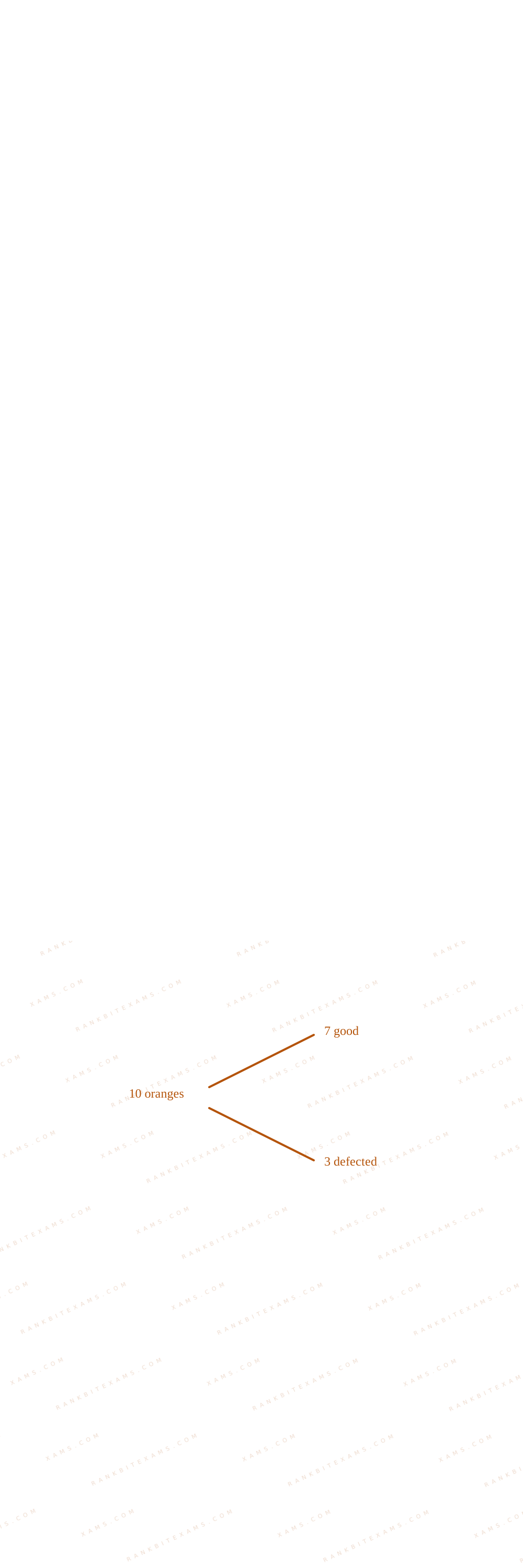
Three defective oranges are accidentally mixed with seven good ones and on looking at them, it is not possible to differentiate between them. Two oranges are drawn at random from the lot. If x denote the number of defective oranges, then the variance of x is :

Solution & Explanation

Related Formula

Variance formula for discrete probability distributions:

σ² = Σ pᵢ xᵢ² - μ²
Core Logic

Construct the discrete probability distribution matrix for drawing 2 items out of 10 total items (3 defective, 7 good):

Probability Distribution and Variance diagram for Q69 - JEE Main 2025 Morning

xᵢpᵢ
x=0⁷C₂¹⁰C₂ = (42)/(90)
x=1⁷C₁ × ³C₁¹⁰C₂ = (42)/(90)
x=2³C₂¹⁰C₂ = (6)/(90)

Step 1: Calculating the Mean
μ = Σ xᵢ pᵢ = 0((42)/(90)) + 1((42)/(90)) + 2((6)/(90)) = (54)/(90) = (3)/(5)
Step 2: Evaluating the Variance Metric
σ² = Σ pᵢ xᵢ² - μ² = [0 + 1²((42)/(90)) + 2²((6)/(90))] - ((3)/(5))² σ² = (66)/(90) - (9)/(25) = (11)/(15) - (9)/(25) = (28)/(75)
Pattern Recognition

Discrete tables are best managed by computing component factor rows systematically before finalizing variance updates.

Chapter Mix

Class 12 Maths: Probability

More Probability Previous-Year Questions — Page 2

Q17 jee_main_2026_24_january_morning Binomial Distribution
From a lot containing 10 defective and 90 non-defective bulbs, 8 bulbs are selected one by one with replacement. Then the probability of getting at least 7 defective bulbs is :
  • A. 710⁷
  • B. 8110⁸
  • C. 6710⁸
  • D. 7310⁸

Solution

Related Formula
P(X=k) = nk p^k (1-p)n-k
Core Logic

Total bulbs = 100. Defective bulbs = 10, Non-defective = 90. Probability of defective p = (10)/(100) = (1)/(10). Probability of non-defective q = (90)/(100) = (9)/(10). n = 8 draws with replacement.

Step 1: Apply Binomial Distribution

We need P(X ≥ 7) = P(X = 7) + P(X = 8).

P(X=7) = 87 ((1)/(10))⁷ ((9)/(10))¹ = 8 × (1)/(10⁷) × (9)/(10) = (72)/(10⁸) P(X=8) = 88 ((1)/(10))⁸ ((9)/(10))⁰ = 1 × (1)/(10⁸) = (1)/(10⁸)
Step 2: Sum the Probabilities
P(X ≥ 7) = (72)/(10⁸) + (1)/(10⁸) = (73)/(10⁸)
Pattern Recognition

Drawing "with replacement" firmly mandates a Binomial Distribution approach. When asked for "at least" near the maximum n, direct sum is always optimal.

Chapter Mix

Class 12 Maths: Probability

Q24 jee_main_2026_24_january_evening Sets and Probability
Let S be a set of 5 elements and P(S) denote the power set of S. Let E be an event of choosing an ordered pair (A, B) from the set P(S) × P(S) such that A B =. If the probability of the event E is 3p2q, where p, q in N, then p + q is equal to
Numerical Answer. Answer: 15 to 15

Solution

Related Formula
Probability P(E) = Number of favorable outcomesTotal number of outcomes
Core Logic

Let S = a, b, c, d, e. Since S has 5 elements, P(S) contains 2⁵ = 32 subsets. The total number of ordered pairs (A, B) that can be formed from P(S) × P(S) is:

32 × 32 = (2⁵)² = 2¹⁰ = 4⁵

Alternatively, consider element-wise mapping. For each of the 5 elements in S, it has 4 choices with respect to sets A and B:

Status in AStatus in B
Present ()Present ()
Present ()Absent (x)
Absent (x)Present ()
Absent (x)Absent (x)

Step 1: Satisfying the Condition

For A B =, no element can be present in both A and B simultaneously. This rules out the choice where an element is () in A and () in B.

Thus, each of the 5 elements has exactly 3 valid choices to ensure disjointness. Favorable cases = 3⁵.

Step 2: Calculating Probability

Probability P = FavorableTotal:

P = (3⁵)/(4⁵) = (3⁵)/((2²)⁵) = 3⁵2¹⁰

Comparing this with (3^p)/(2^q):

p = 5, q = 10 p + q = 5 + 10 = 15
Pattern Recognition

Set operations mapping down to element-wise Boolean states (In/Out) transform combinatorial subset problems directly into base-state exponentiation problems (3ⁿ vs 4ⁿ). Disjoint sets exclude exactly one state: (In, In).

Chapter Mix

Class 12 Maths: Probability Class 11 Maths: Sets

Q9 jee_main_2026_28_january_morning Bayes Theorem
A bag contains 10 balls out of which k are red and (10 - k) are black, where 0 ≤ k ≤ 10. If three balls are drawn at random without replacement and all of them are found to be black, then the probability that the bag contains 1 red and 9 black balls is :
  • A. (7)/(11)
  • B. (7)/(55)
  • C. (7)/(110)
  • D. (14)/(55)

Solution

Related Formula
P(Eᵢ | A) = (P(A|Eᵢ)P(Eᵢ))/(Σ P(A|Eⱼ)P(Eⱼ))
Core Logic

Let event A be drawing 3 black balls. Let Ek be the event that the bag initially has k red balls and (10-k) black balls. Assuming all compositions (values of k from 0 to 10) are equally likely initially, P(Ek) = (1)/(11) for all k. We want to find P(E₁ | A).

Step 1: Set up the Conditional Probabilities
P(A | Ek) = 10-kC₃¹⁰C₃

This is only non-zero when 10-k ≥ 3 k ≤ 7.

Using Bayes' theorem:

P(E₁ | A) = P(A | E₁) P(E₁)Σk=0⁷ P(A | Ek) P(Ek)

Since P(Ek) is constant, it cancels out:

P(E₁ | A) = ⁹C₃ / ¹⁰C₃Σk=0⁷ (10-kC₃ / ¹⁰C₃) = ⁹C₃Σk=0⁷ 10-kC₃
Step 2: Series Summation

The denominator is:

Σk=0⁷ 10-kC₃ = ¹⁰C₃ + ⁹C₃ + ⁸C₃ + + ³C₃

Using the identity Σr=mⁿ rCm = ⁿ⁺¹Cm+1 (Hockey-stick identity):

³C₃ + ⁴C₃ + + ¹⁰C₃ = ¹¹C₄
Step 3: Final Probability Calculation
P(E₁ | A) = ⁹C₃¹¹C₄ = ((9 × 8 × 7)/(3 × 2 × 1))/((11 × 10 × 9 × 8)/(4 × 3 × 2 × 1)) = (84)/(330) = (14)/(55)
Pattern Recognition

When picking items and calculating inverse probabilities over all uniform possible states, the denominator transforms into a simple combinations sum evaluated via the hockey-stick identity: Σ rCk = r+1Ck+1.

Chapter Mix

Class 12 Mathematics: Probability Class 11 Mathematics: Permutations and Combinations

Q4 jee_main_2026_28_january_evening Random Variables and Expectation
The probability distribution of a random variable X is given below :
X4k(30)/(7)k(32)/(7)k(34)/(7)k(36)/(7)k(38)/(7)k(40)/(7)k6k
P(X)(2)/(15)(1)/(15)(2)/(15)(1)/(5)(1)/(15)(2)/(15)(1)/(5)(1)/(15)
If E(X) = (263)/(15), then P(X < 20) is equal to:
  • A. (3)/(5)
  • B. (8)/(15)
  • C. (11)/(15)
  • D. (14)/(15)

Solution

Related Formula
E(X) = Σ Xᵢ P(Xᵢ)
Core Logic

Calculate the expected value:

E(X) = (4k)(2)/(15) + ((30k)/(7))(1)/(15) + ((32k)/(7))(2)/(15) + ((34k)/(7))(1)/(5) + ((36k)/(7))(1)/(15) + ((38k)/(7))(2)/(15) + ((40k)/(7))(1)/(5) + (6k)(1)/(15)

Factor out k and sum the products to solve for k using the given condition E(X) = (263)/(15).

Execution

Summing the terms:

E(X) = (k)/(15 × 7) [ (28 × 2) + 30(1) + 32(2) + 34(3) + 36(1) + 38(2) + 40(3) + 42(1) ] E(X) = (k)/(105) [ 56 + 30 + 64 + 102 + 36 + 76 + 120 + 42 ] = (526k)/(105)

Given E(X) = (263)/(15):

(526k)/(105) = (263)/(15) ⇒ (526k)/(7) = 263 ⇒ 2k = 7 ⇒ k = (7)/(2)

Substitute k to find the actual values of X: 4k = 14, (30)/(7)k = 15, (32)/(7)k = 16, (34)/(7)k = 17, (36)/(7)k = 18, (38)/(7)k = 19, (40)/(7)k = 20, 6k = 21.

We need P(X < 20):

P(X < 20) = ΣX=14¹⁹ P(X) = (2)/(15) + (1)/(15) + (2)/(15) + (3)/(15) + (1)/(15) + (2)/(15) = (11)/(15)
Pattern Recognition

When E(X) is provided with a parameterized state variable k, summing the discrete expected value directly unlocks the exact sample space scaling.

Chapter Mix

Class 12 Maths: Probability

Q60 jee_main_2025_02_april_evening Bayes' Theorem
Given three identical bags each containing 10 balls, whose colours are as follows: array|l|l|l|l| & Red & Blue & Green Bag I & 3 & 2 & 5 Bag II & 4 & 3 & 3 Bag III & 5 & 1 & 4 array A person chooses a bag at random and takes out a ball. If the ball is Red, the probability that it is from bag I is p and if the ball is Green, the probability that it is from bag III is q, then the value of ((1)/(p) + (1)/(q)) is:
  • A. 6
  • B. 9
  • C. 7
  • D. 8

Solution

Related Formula
Bayes' Theorem: P(E₁|A) = P(E₁) P(A|E₁)Σi=1ⁿ P(Eᵢ) P(A|Eᵢ)
Core Logic

This is a conditional probability problem. We apply Bayes' Theorem twice: first for the Red ball, then for the Green ball.

Step 1: Solve for p (Red ball)

Let E₁, E₂, E₃ be the events of choosing Bag I, Bag II, and Bag III respectively. Since bags are identical, P(E₁) = P(E₂) = P(E₃) = (1)/(3).

The probabilities of drawing a Red ball from each bag are:

  • P(R|E₁) = (3)/(10)
  • P(R|E₂) = (4)/(10)
  • P(R|E₃) = (5)/(10)
  • Applying Bayes' Theorem:

p = P(E₁|R) = (P(E₁) P(R|E₁))/(P(E₁)P(R|E₁) + P(E₂)P(R|E₂) + P(E₃)P(R|E₃)) p = ((3)/(10))/((3)/(10) + (4)/(10) + (5)/(10)) = (3)/(12) = (1)/(4)

Thus, (1)/(p) = 4.

Step 2: Solve for q (Green ball)

The probabilities of drawing a Green ball from each bag are:

  • P(G|E₁) = (5)/(10)
  • P(G|E₂) = (3)/(10)
  • P(G|E₃) = (4)/(10)
  • Applying Bayes' Theorem:

q = P(E₃|G) = (P(E₃) P(G|E₃))/(P(E₁)P(G|E₁) + P(E₂)P(G|E₂) + P(E₃)P(G|E₃)) q = ((4)/(10))/((5)/(10) + (3)/(10) + (4)/(10)) = (4)/(12) = (1)/(3)

Thus, (1)/(q) = 3.

Step 3: Calculate the requested value

Sum the inverse values:

(1)/(p) + (1)/(q) = 4 + 3 = 7
Pattern Recognition

Simplification of Bayes' denominator: Since all prior events have identical probability P(Eᵢ) = 1/k, they cancel out of the Bayes' fraction entirely, allowing you to work directly with the raw ball counts.

Chapter Mix

Class 12 Mathematics: Probability

Rankbit System
JEE Physics: Waves (+15.5%) | Electrostatics: Concentric Shells (-29.7%) | Modern Physics: Photoelectric Clones (+34.2%) | Mathematics: Definite Integrals (+18.1%) | Chemistry: Coordination Splitting (-11.4%) | JEE Physics: Waves (+15.5%) | Electrostatics: Concentric Shells (-29.7%) | Modern Physics: Photoelectric Clones (+34.2%) | Mathematics: Definite Integrals (+18.1%) | Chemistry: Coordination Splitting (-11.4%)