JEE Main · Mathematics ↓ Falling

Limits, Continuity and Differentiability appeared 52 times across 3 years — 6% of Mathematics. This question is from Continuity and Differentiability of Piecewise Functions.

Year 2026 2025 2024 Total
Questions 12 24 16 52

Let f(x) = cases 3x, & x < 0 1 + x + [ x ], x + 2 [ x ] , & 0 ≤ x ≤ 2 5, & x > 2 cases where [.] denotes greatest integer function. If α and β are the number of points, where f is not continuous and is not differentiable, respectively, then α + β equals....

Numerical Answer Type:
Enter a numerical value Answer: 5 to 5 +4 marks

Solution & Explanation

Related Formula

A function is discontinuous if left-hand and right-hand limits mismatch at boundary transitions. Non-differentiability occurs at discontinuities or sharp turns.

Core Logic

Simplify the greatest integer component [x] by expanding over integer intervals:

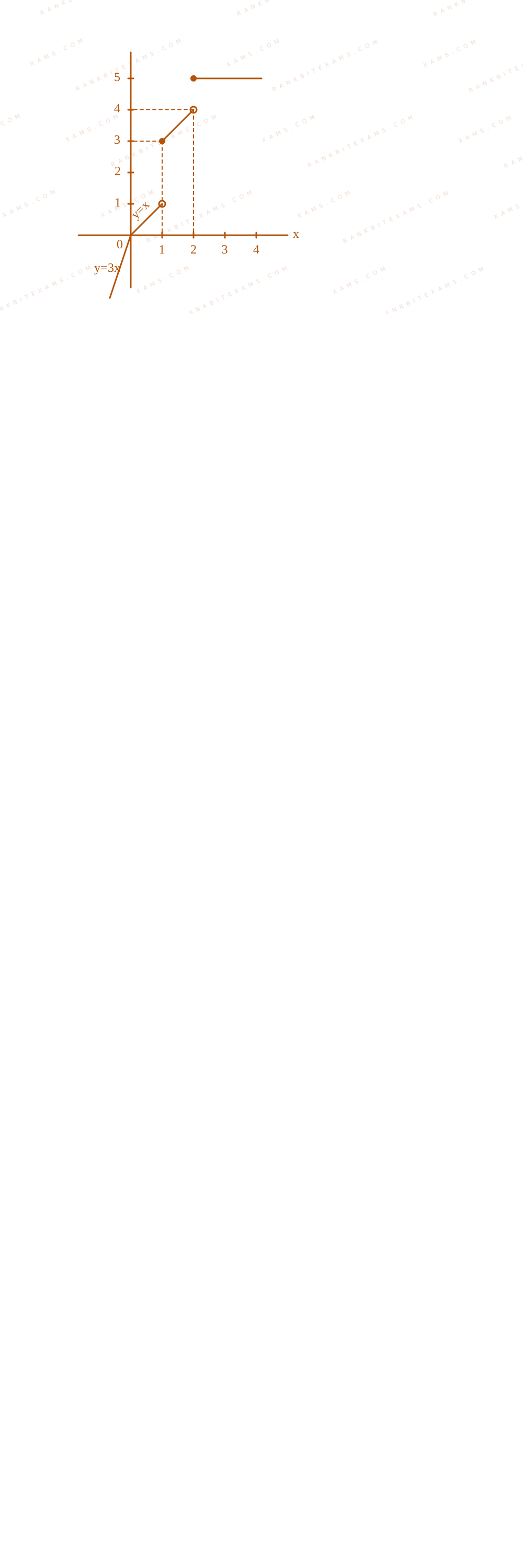
Continuity and Differentiability of Piecewise Functions diagram for Q74 - JEE Main 2025 Morning

f(x) = cases 3x, & x < 0 x, & 0 ≤ x < 1 x + 2, & 1 ≤ x < 2 5, & x > 2 cases
Step 1: Testing Continuity Limits

Check continuity at structural boundaries: At x = 0: LHM = 0, RHM = 0 Continuous. At x = 1: LHM = 1, RHM = 3 Discontinuous. At x = 2: LHM = 4, RHM = 5 Discontinuous.

Thus, α = 2 points of discontinuity (x in 1, 2).

Step 2: Testing Differentiability Parameters

Discontinuities automatically introduce non-differentiability. Now check smooth corners at the remaining continuous transition x = 0:

f^ (0^-) = 3, f^ (0^+) = 1 Not differentiable at x=0.

Thus, β = 3 points of non-differentiability (x in 0, 1, 2).

α + β = 2 + 3 = 5
Pattern Recognition

Discontinuities automatically break differentiability. Always count them first before checking derivatives at smooth corner points.

Chapter Mix

Class 12 Maths: Limits, Continuity and Differentiability

Reference Study Guides

More Limits, Continuity and Differentiability Previous-Year Questions — Page 9

Q13 jee_main_2024_27_jan_morning Continuity at a Point
Consider the function: f(x) = cases (a(7x-12-x²))/(b(x²-7x+12)) & , x < 3 (2 (x-3))/(x-[x]) & , x > 3 b & , x = 3 cases Where [x] denotes the greatest integer less than or equal to x. If S denotes the set of all ordered pairs (a, b) such that f(x) is continuous at x=3 then the number of elements in S is:
  • A. 2
  • B. Infinitely many
  • C. 4
  • D. 1

Solution

Related Formula
For continuity at x=a, x → a^- f(x) = x → a^+ f(x) = f(a) h → 0 ( h)/(h) = 1
Core Logic

We need to evaluate the Left Hand Limit (LHL) and Right Hand Limit (RHL) at x = 3. For LHL (x < 3):

f(x) = (a(7x-12-x²))/(b(x²-7x+12))

Factor the polynomials: Numerator quadratic: -(x² - 7x + 12)

f(x) = (-a(x²-7x+12))/(b(x²-7x+12)) = (-a)/(b)

Thus, x → 3^- f(x) = (-a)/(b).

Step 1: Evaluating Right Hand Limit

For RHL (x > 3), as x → 3^+, the value of the greatest integer function [x] = 3.

f(x) = (2 (x-3))/(x-[x])

Substituting [x] = 3:

x → 3^+ f(x) = x → 3^+ (2 (x-3))/(x-3)

Applying the standard limit θ → 0 ( θ)/(θ) = 1:

RHL = 2(1) = 2
Step 2: Equating Limits

For the function to be continuous at x=3, LHL = RHL = f(3). We are given f(3) = b. Therefore:

(-a)/(b) = 2 = b

From the right equation, b = 2. Substitute b into the left equation:

(-a)/(2) = 2 ⇒ a = -4
Step 3: Final Conclusion

The only ordered pair (a, b) that makes the function continuous is (-4, 2). The number of elements in the set S is 1.

Pattern Recognition

For limits involving [x] as x → k^+, you can immediately replace [x] with k. When evaluating algebraic limits where the numerator is the exact negative of the denominator, they cancel out natively leaving just the constant ratio.

Chapter Mix

Class 12 Maths: Continuity and Differentiability Class 11 Maths: Limits and Derivatives

Q18 jee_main_2024_27_jan_morning Standard Limits
If a= xarrow0 1+ 1+x⁴-√(2)x⁴ and b= xarrow0 ²x√(2)-√(1+ x), then the value of ab³ is :
  • A. 36
  • B. 32
  • C. 25
  • D. 30

Solution

Related Formula
x → 0 ( x)/(x) = 1

Rationalization: (u-v)(u+v) = u² - v²

Core Logic

Evaluate limit a by rationalizing the numerator:

a = x → 0 1+√(1+x⁴)-√(2)x⁴

Multiply by conjugate:

a = x → 0 (1+√(1+x⁴)) - 2x⁴ ( 1+√(1+x⁴) + √(2)) a = x → 0 √(1+x⁴) - 1x⁴ ( 1+√(1+x⁴) + √(2))

Rationalize again:

a = x → 0 (1+x⁴) - 1x⁴ ( 1+√(1+x⁴) + √(2)) (√(1+x⁴) + 1)

Cancel x⁴:

a = x → 0 1( 1+√(1+0) + √(2)) (√(1+0) + 1) a = 1(√(2) + √(2))(1 + 1) = 14√(2)
Step 1: Evaluating Limit b

Evaluate limit b by rationalizing the denominator:

b = x → 0 ² x√(2)-√(1+ x)

Multiply by conjugate:

b = x → 0 ² x (√(2) + √(1+ x))2 - (1+ x) b = x → 0 (1- ² x)(√(2) + √(1+ x))1 - x

Using 1- ² x = (1- x)(1+ x):

b = x → 0 (1+ x)(√(2) + √(1+ x))

Apply limit x → 0 (so 0 = 1):

b = (1+1)(√(2) + √(1+1)) = 2(2√(2)) = 4√(2)
Step 2: Final Output

Calculate the value of ab³:

ab³ = ( 14√(2)) × (4√(2))³ ab³ = (4√(2))³4√(2) = (4√(2))² ab³ = 16 × 2 = 32
Pattern Recognition

Double square-root structures require double rationalization. Do not rush to L'Hopital's rule when roots are stacked; iterative conjugation resolves xⁿ terms naturally.

Chapter Mix

Class 11 Maths: Limits and Derivatives Class 11 Maths: Trigonometric Functions

Q6 jee_main_2024_29_jan_morning L'Hopital's Rule with Integration
xarrow(π)/(2) ∫x³((π)/(2))³ (t1/3) dt(x-(π)/(2))² is equal to
  • A. (3π)/(8)
  • B. (3π²)/(4)
  • C. (3π²)/(8)
  • D. (3π)/(4)

Solution

Related Formula
Newton-Leibniz Formula: (d)/(dx) ∫h(x)g(x) f(t)dt = f(g(x)) · g'(x) - f(h(x)) · h'(x) x → a (f(x))/(g(x)) = x → a (f'(x))/(g'(x)) (L'Hopital's Rule for (0)/(0) forms)
Core Logic

Evaluate the limit L = xarrow(π)/(2) ∫x³(π/2)³ (t1/3) dt(x-(π)/(2))². When x → (π)/(2), the integral limits become from ((π)/(2))³ to ((π)/(2))³, so the numerator is 0. The denominator evaluates to 0² = 0. This is a (0)/(0) form, meaning L'Hopital's rule must be applied.

Differentiate the numerator using Newton-Leibniz theorem:

N'(x) = (d)/(dx) [ ∫x³(π/2)³ (t1/3) dt ] = (((π/2)³)1/3) · 0 - ((x³)1/3) · (d)/(dx)(x³) = 0 - (x) · 3x² = -3x² (x)

Differentiate the denominator:

D'(x) = (d)/(dx)[ (x-(π)/(2))² ] = 2(x-(π)/(2))
Step 1: Simplify and Re-evaluate Limit

Substitute the derivatives back into the limit expression:

L = xarrow(π)/(2) (-3x² x)/(2(x-(π)/(2)))

Notice that (x) = ((π)/(2) - x) = - (x - (π)/(2)). Substituting this equivalence:

L = xarrow(π)/(2) (-3x² · (- (x - (π)/(2))))/(2(x-(π)/(2))) L = xarrow(π)/(2) [ ( (x-(π)/(2)))/(x-(π)/(2)) ] × [ (3x²)/(2) ]
Step 2: Apply Standard Limit

Since θ → 0 ( θ)/(θ) = 1, where θ = x - (π)/(2):

L = 1 × (3(π/2)²)/(2) L = (3 · (π²)/(4))/(2) = (3π²)/(8)
Pattern Recognition

Integral over a variable boundary over a 0-yielding polynomial denominator is the classic signal for the Newton-Leibniz differentiation combined with L'Hopital's rule. Watch out for shifting x to - (x - (π)/(2)) to match the denominator structure for standard trigonometric limits.

Chapter Mix

Class 11 Mathematics: Limit and Continuity Class 12 Mathematics: Integral Calculus

Q19 jee_main_2024_29_jan_morning First Principle of Differentiation
Suppose f(x)= (2^x+2-x) x ⁻¹(x²-x+1)(7x²+3x+1)³. Then the value of f'(0) is equal to
  • A. π
  • B. 0
  • C. √(π)
  • D. (π)/(2)

Solution

Related Formula
f'(0) = h → 0 (f(h) - f(0))/(h)

Standard Limits: h → 0 ( h)/(h) = 1

Core Logic

First, evaluate f(0) to ensure the first principle approach simplifies:

f(0) = (2⁰ + 2⁻⁰) (0) ⁻¹(0-0+1)(0+0+1)³

Since (0) = 0, the entire numerator collapses, giving f(0) = 0.

Set up the limit definition of the derivative at x = 0:

f'(0) = h → 0 (f(h) - 0)/(h) f'(0) = h → 0 (1)/(h) ( (2^h + 2-h) h ⁻¹(h²-h+1)(7h²+3h+1)³ )
Step 1: Group Standard Limit Forms

Regroup the expression to isolate the known limit forms:

f'(0) = h → 0 ( ( h)/(h) ) × ( 2^h + 2-h ) × ⁻¹(h²-h+1)(7h²+3h+1)³

Now, evaluate the limit of each independent non-zero segment as h → 0:

  • h → 0 ( h)/(h) = 1
  • h → 0 (2^h + 2-h) = 2⁰ + 2⁻⁰ = 1 + 1 = 2
  • h → 0 ⁻¹(h²-h+1) = ⁻¹(1) = √((π)/(4)) = √(π)2
  • h → 0 (7h²+3h+1)³ = (0+0+1)³ = 1
Step 2: Combine Limits

Multiply the evaluated continuous components together:

f'(0) = 1 × 2 × √(π)21 f'(0) = √(π)
Pattern Recognition

If you are asked to find f'(0) for a massive, horrifying fraction where f(0)=0 (usually due to a rogue x, x, or x term), completely ignore the quotient rule. Use the first principle formula h→0 f(h)/h to instantly isolate standard limit identities and plug 0 into everything else.

Chapter Mix

Class 11 Mathematics: Limit and Continuity Class 11 Mathematics: Derivatives

Q14 jee_main_2024_30_january_evening Differentiability
Let a and b be real constants such that the function f defined by f(x) = cases x² + 3x + a, & x ≤ 1 bx + 2, & x gt 1 cases be differentiable on R. Then, the value of ∫₋₂²f(x)dx equals
  • A. (15)/(6)
  • B. (19)/(6)
  • C. 21
  • D. 17

Solution

Related Formula
For differentiability at x=c: x → c^- f(x) = x → c^+ f(x) (Continuity) x → c^- f'(x) = x → c^+ f'(x) (Differentiability)
Core Logic

Function f(x) is continuous at x=1:

x → 1^- (x² + 3x + a) = x → 1^+ (bx + 2) 1 + 3 + a = b + 2 ⇒ 4 + a = b + 2 ⇒ a = b - 2 (i)

Function f(x) is differentiable at x=1:

f'(x) = cases 2x + 3, & x lt 1 b, & x gt 1 cases

Equating left-hand and right-hand derivatives at x=1:

2(1) + 3 = b ⇒ b = 5

Substitute b = 5 into (i): a = 5 - 2 = 3

Step 1: Setting up the Integral

Now we have the full function:

f(x) = cases x² + 3x + 3, & x ≤ 1 5x + 2, & x gt 1 cases

We need to evaluate ∫₋₂² f(x) dx:

I = ∫₋₂¹ (x² + 3x + 3) dx + ∫₁² (5x + 2) dx
Step 2: Evaluating the Integrals

First integral:

∫₋₂¹ (x² + 3x + 3) dx = [ (x³)/(3) + (3x²)/(2) + 3x ]₋₂¹ = ( (1)/(3) + (3)/(2) + 3 ) - ( (-8)/(3) + (12)/(2) - 6 ) = ( (1)/(3) + (3)/(2) + 3 ) - ( (-8)/(3) + 0 ) = (9)/(3) + (3)/(2) + 3 = 3 + (3)/(2) + 3 = (15)/(2)

Second integral:

∫₁² (5x + 2) dx = [ (5x²)/(2) + 2x ]₁² = ( (20)/(2) + 4 ) - ( (5)/(2) + 2 ) = 14 - (9)/(2) = (19)/(2)

Total sum:

I = (15)/(2) + (19)/(2) = (34)/(2) = 17
Pattern Recognition

Piecewise unknown parameters are locked by continuity first, then differentiability. Splitting the integral limit at the critical node correctly processes the integration paths.

Chapter Mix

Class 12 Maths: Continuity and Differentiability Class 12 Maths: Integral Calculus

More Limits, Continuity and Differentiability Questions — jee_main_2025_28_jan_morning

Practice all Limits, Continuity and Differentiability previous-year questions →

Rankbit System
JEE Physics: Waves (+15.5%) | Electrostatics: Concentric Shells (-29.7%) | Modern Physics: Photoelectric Clones (+34.2%) | Mathematics: Definite Integrals (+18.1%) | Chemistry: Coordination Splitting (-11.4%) | JEE Physics: Waves (+15.5%) | Electrostatics: Concentric Shells (-29.7%) | Modern Physics: Photoelectric Clones (+34.2%) | Mathematics: Definite Integrals (+18.1%) | Chemistry: Coordination Splitting (-11.4%)