JEE Main · Mathematics ↓ Falling

Limits, Continuity and Differentiability appeared 52 times across 3 years — 6% of Mathematics. This question is from Continuity and Differentiability of Piecewise Functions.

Year 2026 2025 2024 Total
Questions 12 24 16 52

Let f(x) = cases 3x, & x < 0 1 + x + [ x ], x + 2 [ x ] , & 0 ≤ x ≤ 2 5, & x > 2 cases where [.] denotes greatest integer function. If α and β are the number of points, where f is not continuous and is not differentiable, respectively, then α + β equals....

Numerical Answer Type:
Enter a numerical value Answer: 5 to 5 +4 marks

Solution & Explanation

Related Formula

A function is discontinuous if left-hand and right-hand limits mismatch at boundary transitions. Non-differentiability occurs at discontinuities or sharp turns.

Core Logic

Simplify the greatest integer component [x] by expanding over integer intervals:

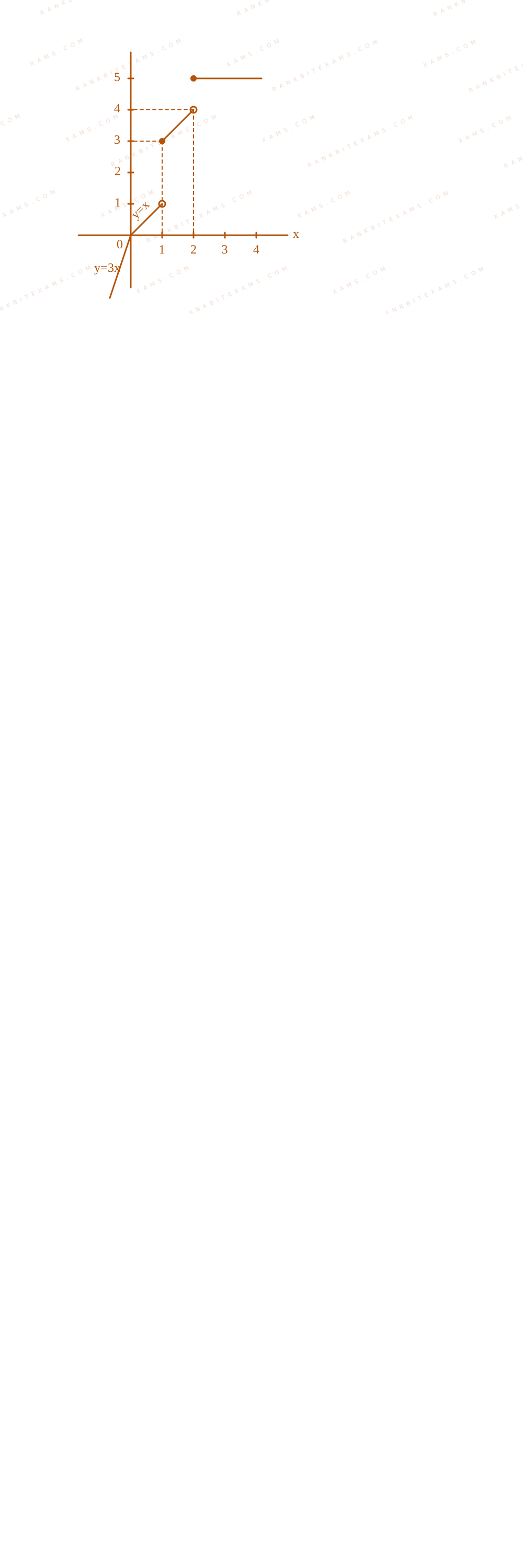
Continuity and Differentiability of Piecewise Functions diagram for Q74 - JEE Main 2025 Morning

f(x) = cases 3x, & x < 0 x, & 0 ≤ x < 1 x + 2, & 1 ≤ x < 2 5, & x > 2 cases
Step 1: Testing Continuity Limits

Check continuity at structural boundaries: At x = 0: LHM = 0, RHM = 0 Continuous. At x = 1: LHM = 1, RHM = 3 Discontinuous. At x = 2: LHM = 4, RHM = 5 Discontinuous.

Thus, α = 2 points of discontinuity (x in 1, 2).

Step 2: Testing Differentiability Parameters

Discontinuities automatically introduce non-differentiability. Now check smooth corners at the remaining continuous transition x = 0:

f^ (0^-) = 3, f^ (0^+) = 1 Not differentiable at x=0.

Thus, β = 3 points of non-differentiability (x in 0, 1, 2).

α + β = 2 + 3 = 5
Pattern Recognition

Discontinuities automatically break differentiability. Always count them first before checking derivatives at smooth corner points.

Chapter Mix

Class 12 Maths: Limits, Continuity and Differentiability

Reference Study Guides

More Limits, Continuity and Differentiability Previous-Year Questions — Page 7

Q57 jee_main_2025_24_jan_evening Continuity and Differentiability of Composite Functions
Let [x] denote the greatest integer function, and let m and n respectively be the numbers of the points, where the function f(x)=[x]+|x-2|, -2
  • A. 6
  • B. 9
  • C. 8
  • D. 7

Solution

Related Formula

The greatest integer function [x] is discontinuous at all integer points. The absolute value function |x-x₀| is continuous everywhere but non-differentiable at its corner tip x = x₀.

Core Logic

Break down the function f(x) = [x] + |x-2| in the open domain (-2, 3) across sub-intervals between integers:

f(x) = cases -2 - (x-2) = -x & -2 < x < -1 -1 - (x-2) = -x+1 & -1 ≤ x < 0 0 - (x-2) = -x+2 & 0 ≤ x < 1 1 - (x-2) = -x+3 & 1 ≤ x < 2 2 + (x-2) = x & 2 ≤ x < 3 cases
Step 1: Count Discontinuity Points (m)

Evaluate the limits at internal integers -1, 0, 1, 2:

  • At x = -1: LHL = 1, RHL = 2 ⇒ Discontinuous.
  • At x = 0: LHL = 1, RHL = 2 ⇒ Discontinuous.
  • At x = 1: LHL = 1, RHL = 2 ⇒ Discontinuous.
  • At x = 2: LHL = 1, RHL = 2 ⇒ Discontinuous.
  • Thus, f(x) is discontinuous at exactly 4 integer locations , meaning m = 4.

Step 2: Count Non-Differentiability Points (n)

Since discontinuity automatically implies non-differentiability, the points -1, 0, 1, 2 are non-differentiable. Let's check if there are other sharp corners. The modulus part |x-2| turns sharp at x=2, which is already covered in our discontinuity list. Hence, there are no additional non-differentiable points.

Thus, n = 4.

Step 3: Total Evaluation

Calculate the Σ requested :

m + n = 4 + 4 = 8
Pattern Recognition

For expressions containing [x], the discontinuity at integers usually drives the overall non-differentiability tally, making any coincidental sharp points from continuous elements redundant if they happen at the exact same integers.

Chapter Mix

Class 12 Mathematics: Limits, Continuity and Differentiability

Q68 jee_main_2025_24_jan_evening Number of Real Solutions of Equations
The number of real solution(s) of the equation x²+3x+2= |x-3|, |x+2| is:
  • A. 2
  • B. 0
  • C. 3
  • D. 1

Solution

Related Formula

The function f(x), g(x) chooses the lower vertical path between the two curves at any coordinate x.

Core Logic

Analyze the conditions for the right-hand function |x-3|, |x+2|:

  • The intersection of |x-3| = |x+2| happens at x - 3 = -(x + 2) ⇒ 2x = 1 ⇒ x = 0.5.
  • For x ≤ 0.5, |x+2| ≤ |x-3| ⇒ = |x+2|.
  • For x > 0.5, |x-3| ≤ |x+2| ⇒ = |x-3|.
  • Min function intersection graph for Q68 - JEE Main 2025 Evening
    Min function intersection graph for Q68 - JEE Main 2025 Evening

Step 1: Check Interval x ≤ -2

Here, |x+2| = -(x+2) = -x-2:

x² + 3x + 2 = -x - 2 ⇒ x² + 4x + 4 = 0 (x+2)² = 0 ⇒ x = -2

This is a valid solution as it lies precisely within the interval condition boundary.

Step 2: Check Interval -2 < x ≤ 0.5

Here, |x+2| = x+2:

x² + 3x + 2 = x + 2 ⇒ x² + 2x = 0 x(x+2) = 0 ⇒ x = 0 or x = -2

Only x = 0 fits inside this interval.

Step 3: Check Interval x > 0.5

Here, = |x-3| = 3-x:

x² + 3x + 2 = 3 - x ⇒ x² + 4x - 1 = 0 x = -4 ± √(16 - 4(1)(-1))2 = -2 ± √(5)

Evaluating values: -2 + √(5) ≈ 0.236, which does not satisfy x > 0.5. Thus, no real roots occur in this span.

Combining valid points, we find exactly 2 distinct real solutions (x = -2, 0).

Pattern Recognition

Sketching a rough visualization showing the parabola crossing below the sharp wedge of the combined absolute values makes it visually clear that there are exactly two crossing points, confirming the algebraic count.

Chapter Mix

Class 11 Mathematics: Quadratic Equations Class 12 Mathematics: Limits, Continuity and Differentiability

Q57 jee_main_2025_24_jan_morning Limits of Algebraic and Trigonometric Functions
x → 0 x (√(2 ² x + 3 x) - √( ² x + x + 4)) is equal to :
  • A. 0
  • B. 12√(5)
  • C. 1√(15)
  • D. - 12√(5)

Solution

Related Formula

To evaluate limits of indeterminate types containing radical forms, rationalize the numerator directly by multiplying by its conjugate element matching:

(√(A) - √(B))(√(A) + √(B)) = A - B
Core Logic

Rewrite the expression as a fraction with x in the denominator and rationalize the numerator:

x → 0 (2 ² x + 3 x) - ( ² x + x + 4) x · (√(2 ² x + 3 x) + √( ² x + x + 4)) = x → 0 ² x + 3 x - x - 4 x · (√(2 ² x + 3 x) + √( ² x + x + 4))
Step 1: Simplify Numerator and Group Terms

Express the numerator terms to isolate algebraic patterns:

² x + 3 x - 4 - x = ( x - 1)( x + 4) - x

Substitute this back into our rationalized limit format:

= x → 0 ( x - 1)( x + 4) - x x · (√(2 ² x + 3 x) + √( ² x + x + 4))
Step 2: Distribute x in Denominator

Split the limit across the two separated numerator expressions:

= x → 0 [ ( x - 1)/( x) · ( x + 4) - 1 ] · 1√(2(1)+3) + √(1+0+4)

Evaluate the limit component values:

x → 0 ( x - 1)/( x) = x → 0 (-2 ²(x/2))/(2 (x/2) (x/2)) = x → 0 [- (x/2)] = 0

Substituting this zero value simplifies the numerator expression directly:

= [ 0 · (1 + 4) - 1 ] · 1√(5) + √(5) = -12√(5)
Pattern Recognition

Recognizing that ( x - 1)/( x) → 0 as x → 0 isolates the non-vanishing trigonometric components without needing full multi-stage application of L'Hôpital's rule.

Chapter Mix

Class 11 Mathematics: Limits and Derivatives

Q72 jee_main_2025_28_jan_evening Limits of Trigonometric Functions
Let f(x)= narrow ∞Σr=0ⁿ( (x/2r+1)+ ³(x/2r+1)1- ²(x/2r+1)). Then xarrow0 ex-ef(x)(x-f(x)) is equal to
Numerical Answer. Answer: 1 to 1

Solution

Related Formula

Trigonometric identity:

( θ + ³θ)/(1- ²θ) = θ ( (1+ ²θ)/(1- ²θ) ) = ( θ)/( 2θ)

Also note standard telescopic identity:

2φ - φ = ( φ)/( 2φ)
Core Logic

Let θ = x2r+1. The term inside the summation simplifies to:

((x)/(2^r)) - ( x2r+1)

Now, evaluating the summation:

Σr=0ⁿ [ ((x)/(2^r)) - ( x2r+1) ] = x - ( x2ⁿ⁺¹)

Taking the limit as n → ∞, ( x2ⁿ⁺¹) → (0) = 0. Therefore, f(x) = x.

Step 1: Evaluate the Limit

We need to find:

xarrow0 ex-exx- x

Factor out ex from the numerator:

xarrow0 ex · [ ex- x - 1x- x ]

Let u = x - x. As x → 0, u → 0. The limit becomes:

uarrow0 e⁰ · [ (e^u - 1)/(u) ] = 1 × 1 = 1
Pattern Recognition

Standard limit substitution y → 0 (e^y - 1)/(y) = 1 applies cleanly whenever the argument in the exponent matches the entire denominator layout.

Chapter Mix

Class 11 Mathematics: Trigonometry Class 12 Mathematics: Limits, Continuity and Differentiability

Q jee_main_2025_29_jan_morning Limits of Special Series
The value of n→ ∞(ΣK = 1ⁿ(k³ + 6k² + 11k + 5)/((k + 3)!)) is:
  • A. (4)/(3)
  • B. 2
  • C. (7)/(3)
  • D. (5)/(3)

Solution

Related Formula
Σk=1∞ ( (1)/(k!) - (1)/((k+3)!) ) Telescoping Series simplification
Core Logic

Rewrite the numerator polynomial to establish factor terms matching the factorial expansion base (k+3):

k³ + 6k² + 11k + 5 = (k³ + 6k² + 11k + 6) - 1 = (k+1)(k+2)(k+3) - 1
Step 1: Simplify General Term
Tk = ((k+1)(k+2)(k+3))/((k+3)!) - (1)/((k+3)!) Tk = (1)/(k!) - (1)/((k+3)!)

This creates a clean telescoping layout format structure.

Step 2: Sum the Series

Writing out expanded \partial sums up to infinity:

S = ( (1)/(1!) + (1)/(2!) + (1)/(3!) + (1)/(4!) + ) - ( (1)/(4!) + (1)/(5!) + (1)/(6!) + )

All higher terms cancel out systematically, leaving exactly the leading remaining fragments:

S = (1)/(1!) + (1)/(2!) + (1)/(3!) = 1 + (1)/(2) + (1)/(6) = (10)/(6) = (5)/(3)
Pattern Recognition

Whenever factorials dominate fraction denominators, manipulate structural terms to align components via Telescoping sums (Vₙ - Vn-k).

Chapter Mix

Class 11 Mathematics: Limits, Continuity and Differentiability Class 11 Mathematics: Sequences and Series

More Limits, Continuity and Differentiability Questions — jee_main_2025_28_jan_morning

Practice all Limits, Continuity and Differentiability previous-year questions →

Rankbit System
JEE Physics: Waves (+15.5%) | Electrostatics: Concentric Shells (-29.7%) | Modern Physics: Photoelectric Clones (+34.2%) | Mathematics: Definite Integrals (+18.1%) | Chemistry: Coordination Splitting (-11.4%) | JEE Physics: Waves (+15.5%) | Electrostatics: Concentric Shells (-29.7%) | Modern Physics: Photoelectric Clones (+34.2%) | Mathematics: Definite Integrals (+18.1%) | Chemistry: Coordination Splitting (-11.4%)