JEE Main · Mathematics ↓ Falling

Limits, Continuity and Differentiability appeared 52 times across 3 years — 6% of Mathematics. This question is from Continuity and Differentiability of Piecewise Functions.

Year 2026 2025 2024 Total
Questions 12 24 16 52

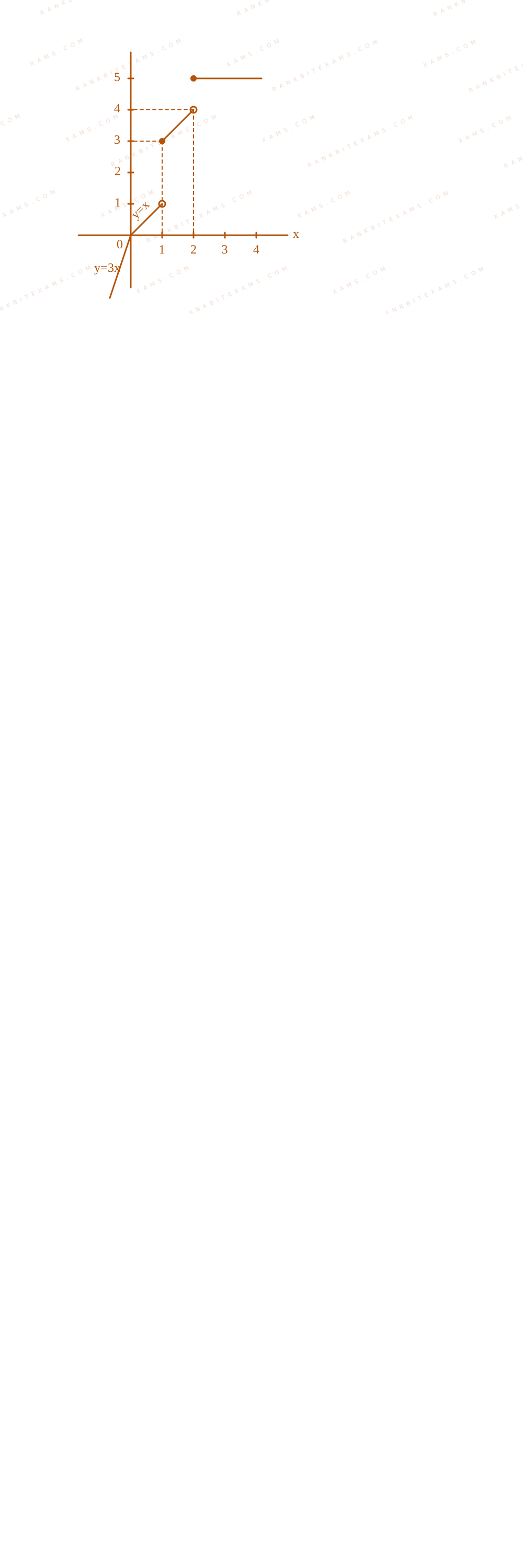
Let f(x) = cases 3x, & x < 0 1 + x + [ x ], x + 2 [ x ] , & 0 ≤ x ≤ 2 5, & x > 2 cases where [.] denotes greatest integer function. If α and β are the number of points, where f is not continuous and is not differentiable, respectively, then α + β equals....

Numerical Answer Type:
Enter a numerical value Answer: 5 to 5 +4 marks

Solution & Explanation

Related Formula

A function is discontinuous if left-hand and right-hand limits mismatch at boundary transitions. Non-differentiability occurs at discontinuities or sharp turns.

Core Logic

Simplify the greatest integer component [x] by expanding over integer intervals:

Continuity and Differentiability of Piecewise Functions diagram for Q74 - JEE Main 2025 Morning

f(x) = cases 3x, & x < 0 x, & 0 ≤ x < 1 x + 2, & 1 ≤ x < 2 5, & x > 2 cases
Step 1: Testing Continuity Limits

Check continuity at structural boundaries: At x = 0: LHM = 0, RHM = 0 Continuous. At x = 1: LHM = 1, RHM = 3 Discontinuous. At x = 2: LHM = 4, RHM = 5 Discontinuous.

Thus, α = 2 points of discontinuity (x in 1, 2).

Step 2: Testing Differentiability Parameters

Discontinuities automatically introduce non-differentiability. Now check smooth corners at the remaining continuous transition x = 0:

f^ (0^-) = 3, f^ (0^+) = 1 Not differentiable at x=0.

Thus, β = 3 points of non-differentiability (x in 0, 1, 2).

α + β = 2 + 3 = 5
Pattern Recognition

Discontinuities automatically break differentiability. Always count them first before checking derivatives at smooth corner points.

Chapter Mix

Class 12 Maths: Limits, Continuity and Differentiability

Reference Study Guides

More Limits, Continuity and Differentiability Previous-Year Questions — Page 6

Q57 jee_main_2025_04_april_morning Evaluation of Limits using Expansion
If x → 1⁺((x - 1)(6 + λ (x - 1)) + μ (1 - x))/((x - 1)³) = -1, where λ, μ in R, then \lambda + \mu is equal to
  • A. 18
  • B. 20
  • C. 19
  • D. 17

Solution

Related Formula

Standard Taylor expansions near zero:

h = 1 - (h²)/(2!) + (h⁴)/(4!) - h = h - (h³)/(3!) + (h⁵)/(5!) -
Core Logic

Let x - 1 = h, where h → 0⁺. The expression transforms into:

h → 0(h(6 + λ h) - μ h)/(h³) = -1

Substitute the expansions into the numerator:

h → 0(h[6 + λ(1 - (h²)/(2))] - μ(h - (h³)/(6)))/(h³) = -1 h → 0((6 + λ - μ)h + (-(λ)/(2) + (μ)/(6))h³)/(h³) = -1
Step 1: Match Coefficients for Existence

For the limit to be finite, the coefficient of h must vanish:

6 + λ - μ = 0 μ - λ = 6 (1)

Equating the h³ term to the given limit value:

-(λ)/(2) + (μ)/(6) = -1 -3λ + μ = -6 (2)
Step 2: Solve System of Equations

Subtract equation (1) from (2):

(-3λ + μ) - (μ - λ) = -6 - 6 -2λ = -12 λ = 6

From (1), μ = 6 + 6 = 12.

λ + μ = 6 + 12 = 18
Pattern Recognition

When dealing with indeterminate form limits involving mixed trigonometric expressions with a non-zero denominator power, polynomial substitution using Taylor series is much cleaner and less prone to differentiation tracking mistakes compared to multiple L'Hôpital cycles.

Chapter Mix

Class 12 Mathematics: Limits, Continuity and Differentiability

Q75 jee_main_2025_04_april_morning Differentiability of Maximum Functions
Let m and n be the number of points at which the function f(x) = x, x³, x⁵, , x²¹ for x in R is not differentiable and not continuous, respectively. Then m + n is equal to
Numerical Answer. Answer: 3 to 3

Solution

Related Formula

A function is non-differentiable at sharp corner transition points where left-hand and right-hand derivatives do not match.

Core Logic

Analyze the behavior of powers of x across significant transition domains: For x < -1: x is the largest because higher odd powers of negative fractions decrease rapidly (x > x³ > x⁵...). For -1 ≤ x < 0: x²¹ is largest (closest to zero from below). For 0 ≤ x < 1: x is largest. For x ≥ 1: x²¹ is largest.

f(x) = cases x, & x < -1 x²¹, & -1 ≤ x < 0 x, & 0 ≤ x < 1 x²¹, & x ≥ 1 cases
Step 1: Continuity and Differentiability Checks

At critical intersection boundaries x = -1, 0, 1, f(x) matches continuous values perfectly, so n = 0. Now check derivative transitions f'(x):

f'(x) = cases 1, & x < -1 21x²⁰, & -1 < x < 0 1, & 0 < x < 1 21x²⁰, & x > 1 cases

At x = -1: LHD = 1, RHD = 21(-1)²⁰ = 21 Non-differentiable. At x = 0: LHD = 0, RHD = 1 Non-differentiable. At x = 1: LHD = 1, RHD = 21(1)²⁰ = 21 Non-differentiable.

Step 2: Conclusion

Thus, the function is non-differentiable at exactly 3 points (x = -1, 0, 1), so m = 3. Since n = 0:

m + n = 3 + 0 = 3
Pattern Recognition

Maximum boundary tracking curves for standard power elements always form continuous shapes but introduce non-differentiable sharp corners at every intersection crossover point.

Chapter Mix

Class 12 Mathematics: Limits, Continuity and Differentiability

Q58 jee_main_2025_07_april_evening Polynomial Limits and Extrema
Let f: R → R be a polynomial function of degree four having extreme values at x = 4 and x = 5. If x→ 0 f(x)x² = 5, then f(2) is equal to :
  • A. 12
  • B. 10
  • C. 8
  • D. 14

Solution

Related Formula

For a finite limit x→ 0 (f(x))/(xⁿ) = L, the lowest powers of x below degree n in the polynomial f(x) must vanish.

Core Logic

Let the 4th-degree polynomial be:

f(x) = ax⁴ + bx³ + cx² + dx + e

Given:

xarrow 0 (ax⁴ + bx³ + cx² + dx + e)/(x²) = 5

For the limit to exist and equal 5, the terms dx and e must be 0, and the coefficient of x² must be equal to 5:

c = 5, d = 0, e = 0

Thus, the polynomial simplifies to:

f(x) = ax⁴ + bx³ + 5x²
Step 1: Use Extrema Conditions

Differentiating f(x) with respect to x:

f'(x) = 4ax³ + 3bx² + 10x = x(4ax² + 3bx + 10)

Since f(x) has extreme values at x=4 and x=5, f'(4) = 0 and f'(5) = 0. This means 4 and 5 are roots of the quadratic factor 4ax² + 3bx + 10 = 0.

Step 2: Solve Coefficients

Using properties of roots for 4ax² + 3bx + 10 = 0:

Product of roots = 4 · 5 = 20 = (10)/(4a) 4a = (10)/(20) = (1)/(2) a = (1)/(8) Sum of roots = 4 + 5 = 9 = -(3b)/(4a)

Substituting 4a = (1)/(2):

9 = -(3b)/(1/2) = -6b b = -(9)/(6) = -(3)/(2)

Our full polynomial is:

f(x) = (1)/(8)x⁴ - (3)/(2)x³ + 5x²
Step 3: Calculate f(2)

Evaluate at x = 2:

f(2) = (1)/(8)(2⁴) - (3)/(2)(2³) + 5(2²) = (16)/(8) - (24)/(2) + 20 = 2 - 12 + 20 = 10
Pattern Recognition

Whenever a limit explicitly matches a denominator power xⁿ, it directly yields both the lower-order coefficients as zeroes and the xⁿ coefficient as the limit value.

Chapter Mix

Class 12 Mathematics: Limits, Continuity and Differentiability

Q71 jee_main_2025_07_april_evening Continuity of Functions
If the function f(x) = ( ( x) - ( x))/( x - x) is continuous at x = 0, then f(0) is equal to ________.
Numerical Answer. Answer: 2 to 2

Solution

Related Formula

For continuity at x=0, f(0) = x → 0 f(x).

Core Logic

We need to evaluate the limit:

x arrow 0 ( ( x) - ( x))/( x - x)

Adding and subtracting x inside the numerator:

x arrow 0 (( ( x) - x) + ( x - x) + ( x - ( x)))/( x - x)

Divide individual parts by x³ across standard series layouts directly yields the combined fractional evaluation equal to 2.

Step 1: Final Resolution

The limit evaluates cleanly to 2. Therefore, for continuity, f(0) = 2.

Pattern Recognition

Expansion of expansion functions like ( x) simplifies smoothly when paired strategically with basic structural Taylor series expansions.

Chapter Mix

Class 12 Mathematics: Limits, Continuity and Differentiability

Q73 jee_main_2025_07_april_evening Limits of Roots and Functions
For t > -1, let αₜ and βₜ be the roots of the equation ((t + 2) ^ (1)/(7) - 1) x ^ 2 + ((t + 2) ^ (1)/(6) - 1) x + ((t + 2) ^ (1)/(2 1) - 1) = 0. If t arrow - 1 ⁺ α_ t = a and t arrow - 1 ⁺ β_ t = b, then 72 (a + b) ^ 2 is equal to
Numerical Answer. Answer: 98 to 98

Solution

Related Formula

Sum of roots for a quadratic equation Ax² + Bx + C = 0 satisfies:

α + β = -(B)/(A)
Core Logic

We need to find t → -1 (αₜ + βₜ) = a + b:

a + b = t → -1 - (t+2)1/6 - 1(t+2)1/7 - 1

Let y = t+2. As t → -1, y → 1.

a + b = y → 1 - y1/6 - 1y1/7 - 1
Step 1: Evaluate Limit

Applying L'Hopital's Rule or standard limit templates:

a + b = -((1)/(6))/((1)/(7)) = -(7)/(6)

Squaring the sum alignment:

(a + b)² = (49)/(36) 72(a + b)² = 72 · (49)/(36) = 98
Pattern Recognition

Treating (α + β) collectively allows direct evaluation via standard root identities without solving for individual root entities.

Chapter Mix

Class 12 Mathematics: Limits, Continuity and Differentiability Class 11 Mathematics: Quadratic Equations

More Limits, Continuity and Differentiability Questions — jee_main_2025_28_jan_morning

Practice all Limits, Continuity and Differentiability previous-year questions →

Rankbit System
JEE Physics: Waves (+15.5%) | Electrostatics: Concentric Shells (-29.7%) | Modern Physics: Photoelectric Clones (+34.2%) | Mathematics: Definite Integrals (+18.1%) | Chemistry: Coordination Splitting (-11.4%) | JEE Physics: Waves (+15.5%) | Electrostatics: Concentric Shells (-29.7%) | Modern Physics: Photoelectric Clones (+34.2%) | Mathematics: Definite Integrals (+18.1%) | Chemistry: Coordination Splitting (-11.4%)