Let the equation of the circle, which touches x-axis at the point (a, 0), a > 0$a > 0$ and cuts off an intercept of length b on y-axis be x² + y² - α x + β y + γ = 0$x^2 + y^2 - \alpha x + \beta y + \gamma = 0$. If the circle lies below x-axis, then the ordered pair (2a, b²)$(2a, b^2)$ is equal to:
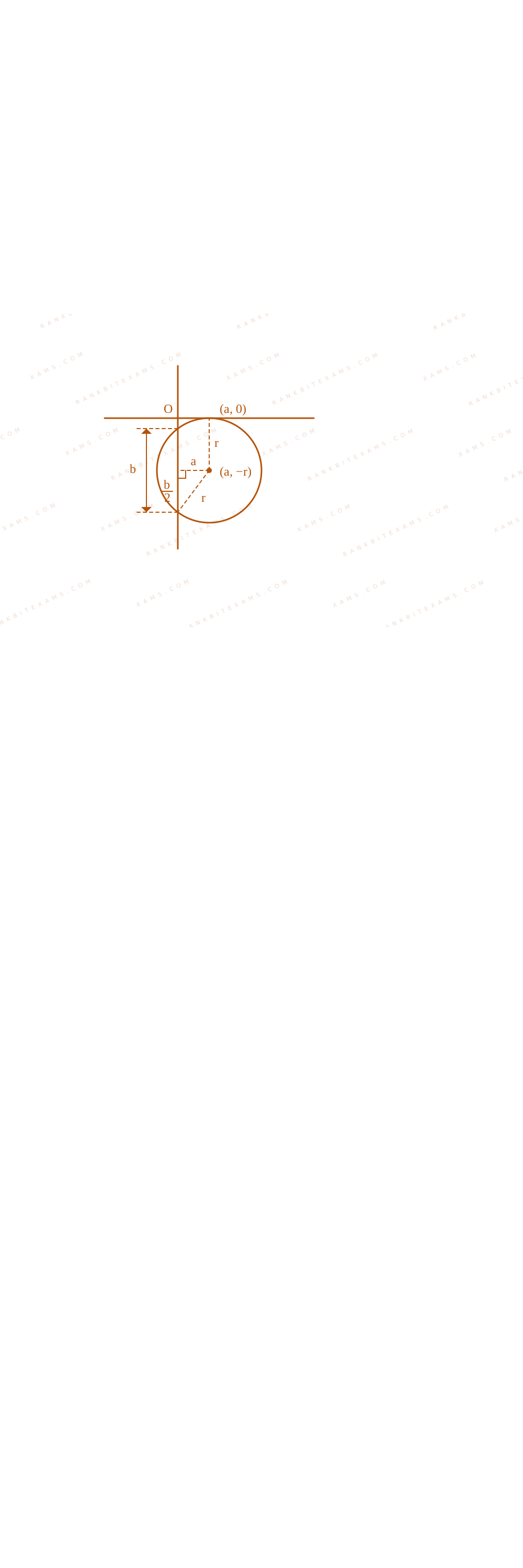
Since the circle touches the x-axis at (a,0)$(a,0)$ and lies entirely below it, its center is located at (a, -p)$(a, -p)$ where p$p$ matches its radius r$r$.
By Pythagoras' theorem: Circles Touching Axes and Intercepts diagram for Q58 - JEE Main 2025 Morning
Thus, the mapped ordered pair (2a, b²)$(2a, b^2)$ evaluates directly to (α, β² - 4γ)$(\alpha, \beta^2 - 4\gamma)$.
Pattern Recognition
Tangency conditions fix center parameters to match radius scale sizes instantly, reducing variable overhead in coordinate transformations.
Chapter Mix
Class 11 Maths: Circles
More Circles Previous-Year Questions — Page 2
Q12jee_main_2026_28_january_eveningParametric Form and Chord Intersections
Let the circle x² + y² = 4$x^{2} + y^{2} = 4$ intersect x-axis at the points A(a, 0), a > 0$A(a, 0), a > 0$ and B(b, 0)$B(b, 0)$. Let P(2 α, 2 α), 0 < α < (π)/(2)$P(2 \cos\alpha, 2 \sin\alpha), 0 < \alpha < \frac{\pi}{2}$ and Q(2 β, 2 β)$Q(2 \cos\beta, 2 \sin\beta)$ be two points such that (α - β) = (π)/(2)$(\alpha - \beta) = \frac{\pi}{2}$. Then the point of intersection of AQ$AQ$ and BP$BP$ lies on:
Intersection of circle with x-axis provides A(2,0)$A(2,0)$ and B(-2,0)$B(-2,0)$.
Let the point of intersection of AQ$AQ$ and BP$BP$ be R(h, k)$R(h, k)$.
Since R$R$ lies on BP$BP$, the slope mBR = mBP$m_{BR} = m_{BP}$:
Locus of R$R$ is x² + y² - 4y - 4 = 0$x^2 + y^2 - 4y - 4 = 0$.
Pattern Recognition
Connecting chords from extreme diameter vertices to points whose parametric angles differ by π/2$\pi/2$ reliably generates perpendicular-like slope products or standard tangent angle identities, mapping directly to a circular locus.
Chapter Mix
Class 11 Maths: Circles
Q75jee_main_2025_02_april_morningTangent Properties of Circles
The absolute difference between the squares of the radii of the two circles passing through the point (-9, 4)$(-9, 4)$ and touching the lines x + y = 3$x + y = 3$ and x - y = 3$x - y = 3$, is equal to ________.
Numerical Answer.Answer: 768 to 768
Solution
Related Formula
Perpendicular distance from point (x₀, y₀)$(x_0, y_0)$ to line Ax + By + C = 0$Ax + By + C = 0$:
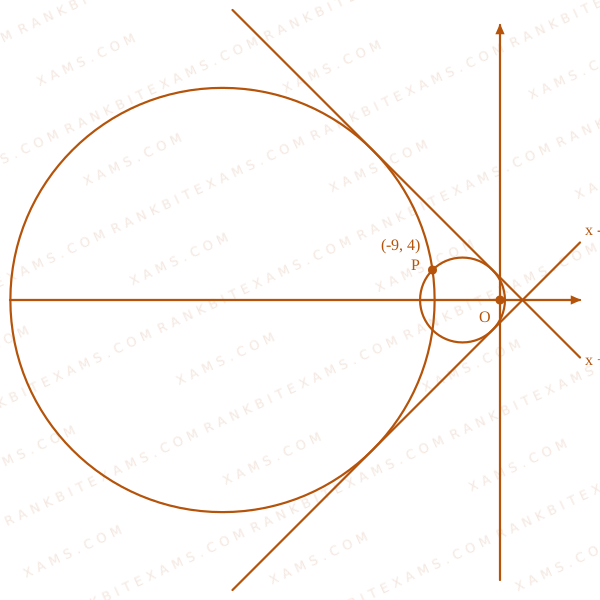
Since the circle touches two symmetric intersecting lines, its center must lie on their angle bisector (x$x$-axis). Use this property to find the center parameters. Tangent Properties of Circles diagram for Q75 - JEE Main 2025 Morning
Step 1: Establish Center and Radius Equations
The lines are x+y-3=0$x+y-3=0$ and x-y-3=0$x-y-3=0$. The intersection point is (3,0)$(3,0)$, and the bisector line is the x$x$-axis.
Let the center be C(a, 0)$C(a, 0)$. The radius r$r$ is the perpendicular distance to either line:
Recognizing that the center must lie on the line of symmetry (x$x$-axis) eliminates one variable parameter immediately, reducing a difficult geometric system to a simple single-variable quadratic equation.
Chapter Mix
Class 11 Mathematics: Circles
Class 11 Mathematics: Straight Lines
Qjee_main_2025_07_april_morningTangent and Normal to a Circle
Let C₁$C_1$ be the circle in the third quadrant of radius 3, that touches both coordinate axes. Let C₂$C_2$ be the circle with centre (1, 3) that touches C₁$C_1$ externally at the point (α, β)$(\alpha, \beta)$. If (β - α)² = (m)/(n)$(\beta - \alpha)^2 = \frac{m}{n}$, (m, n) = 1$\gcd(m, n) = 1$, then m + n$m + n$ is equal to:
A.9$9$
B.13$13$
C.22$22$
D.31$31$
Solution
Related Formula
For a circle in the third quadrant touching both coordinate axes, the center layout is (-r, -r)$(-r, -r)$ and equation looks like:
For external contact between circles C₁$C_1$ and C₂$C_2$, the distance between centers equals the sum of their radii:
C₁C₂ = r₁ + r₂$$C_1C_2 = r_1 + r_2$$
Core Logic
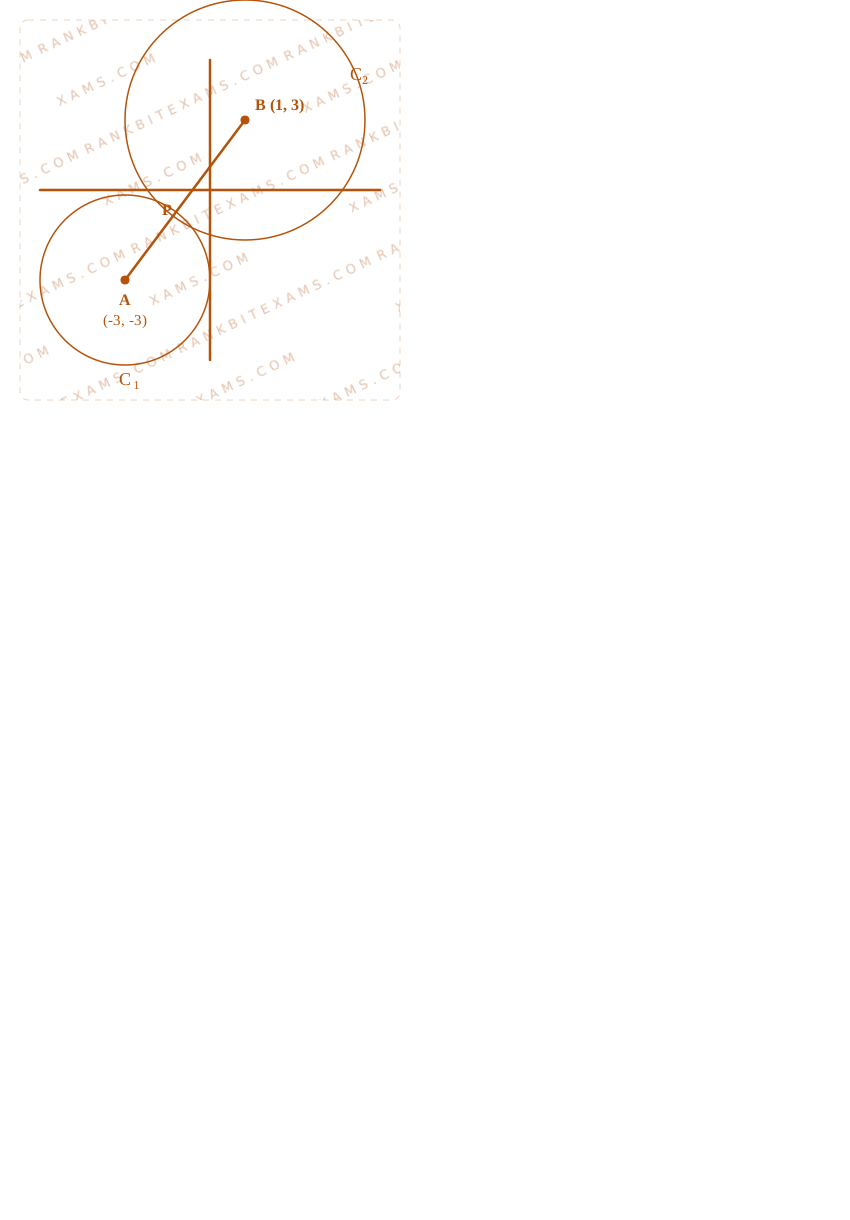
Circle C₁$C_1$ has radius r₁ = 3$r_1 = 3$ and touches both axes in the third quadrant, so its center is A(-3, -3)$A(-3, -3)$.
Circle C₂$C_2$ has center B(1, 3)$B(1, 3)$.
Step 2: Locate the Contact Point via Section Formula
The point of contact P(α, β)$P(\alpha, \beta)$ divides the line segment joining centers A(-3, -3)$A(-3, -3)$ and B(1, 3)$B(1, 3)$ internally in the ratio r₁ : r₂ = 3 : (2√(13) - 3)$r_1 : r_2 = 3 : (2\sqrt{13} - 3)$.
Comparing with (m)/(n)$\frac{m}{n}$ where (m, n) = 1$\gcd(m, n) = 1$ gives m = 9, n = 13$m = 9, n = 13$.
m + n = 9 + 13 = 22$$m + n = 9 + 13 = 22$$
Pattern Recognition
Notice that computing (β - α)$(\beta - \alpha)$ directly cancels out the irrational √(13)$\sqrt{13}$ term from the numerator before squaring, saving a significant amount of tedious arithmetic expansion.
Chapter Mix
Class 11 Mathematics: Coordinate Geometry
Class 11 Mathematics: Circles
Q64jee_main_2025_29_jan_eveningEquation of a Circle
Let a circle C$C$ pass through the points (4,2)$(4,2)$ and (0,2)$(0,2)$, and its centre lie on 3x + 2y + 2 = 0$3x + 2y + 2 = 0$. Then the length of the chord, of the circle C$C$, whose mid-point is (1,2)$(1,2)$, is:
A.√(3)$\sqrt{3}$
B.2√(3)$2\sqrt{3}$
C.4√(2)$4\sqrt{2}$
D.2√(2)$2\sqrt{2}$
Solution
Related Formula
Length of a chord with perpendicular distance d$d$ from the center of a circle of radius r$r$ is:
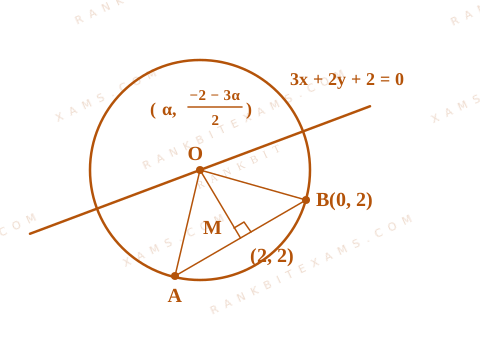
Points A(4,2)$A(4,2)$ and B(0,2)$B(0,2)$ have the same y-coordinate, meaning chord AB$AB$ is horizontal. The perpendicular bisector of a horizontal chord is vertical.
Equation of a Circle diagram for Q64 - JEE Main 2025 Evening
Midpoint of AB$AB$ is M(2,2)$M(2,2)$. Thus, the vertical line passing through the center is x = 2$x = 2$.
Step 1: Identify Center and Radius
Since the center lies on the line 3x + 2y + 2 = 0$3x + 2y + 2 = 0$, substitute x = 2$x = 2$ to find the y-coordinate:
Points sharing a coordinate define standard vertical or horizontal perpendicular configurations immediately. Always exploit geometrical configurations before jumping into standard circle equations.
Practice past-year questions one chapter at a time. Pick an exam → subject → chapter and get every PYQ for that topic — pulled together from all past papers — with the chapter's key formulas alongside.