
The area (in sq. units) of the region (x, y): 0 ≤ y ≤ 2|x| + 1, 0 ≤ y ≤ x² + 1, |x| ≤ 3 is

Solution & Explanation

Related Formula

Area under a curve using definite integration bounded by curves:

Area = 2 ∫ₐ^b f(x) dx
Core Logic

Since both bounding graphs are symmetric about the y-axis, we can integrate over the positive domain (x ≥ 0) and double the result:

Area Bounded by Curves and Absolute Value Functions diagram for Q70 - JEE Main 2025 Morning
Intersecting points: x² + 1 = 2x + 1 x = 2.

Step 1: Setting Up the Bound Segments

The region splits into two integral segments based on which curve sits lower: Segment 1: From 0 to 2, bounded by the parabola y = x² + 1. Segment 2: From 2 to 3, bounded by the straight line y = 2x + 1.

Step 2: Performing Integration
$Area = 2 [ ∫₀² (x² + 1) dx + ∫₂³ (2x + 1) dx ]= 2 [ ( (8)/(3) + 2 ) + (9 + 3 - 4 - 2) ] = 2 [ (14)/(3) + 6 ] = (64)/(3)$
Pattern Recognition

Exploiting structural symmetry drops the integration limits, avoiding messy sign evaluations with absolute terms.

Chapter Mix

Class 12 Maths: Area Under Curves

More Area Under Curves Previous-Year Questions — Page 6

Q5 jee_main_2024_31_jan_morning Area bounded by Parabolas and Inequalities
The area of the region (x,y): y² ≤ 4x, x < 4, (xy(x - 1)(x - 2))/((x - 3)(x - 4)) > 0, x ≠ 3 is
  • A. (16)/(3)
  • B. (64)/(3)
  • C. (8)/(3)
  • D. (32)/(3)

Solution

Core Logic

Given y² ≤ 4x and x < 4. Analyze the inequality (xy(x-1)(x-2))/((x-3)(x-4)) > 0 considering y > 0 and y < 0 separately.
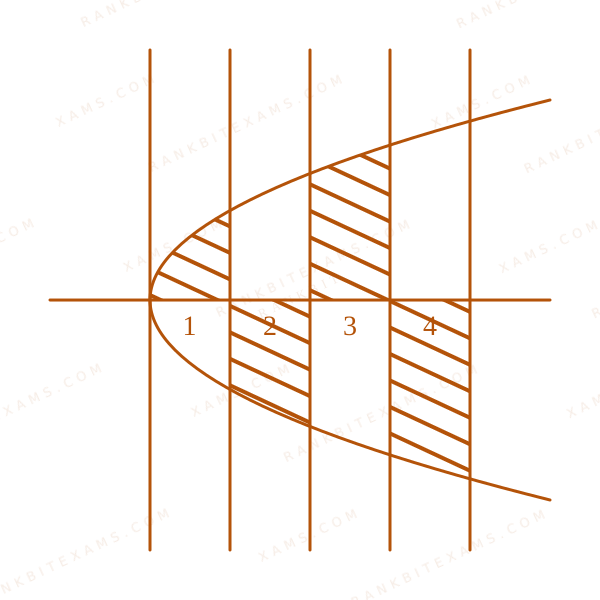
Area bounded by Parabolas and Inequalities diagram for Q5 - JEE Main 2024 Morning

Step 1: Case I (y > 0)

If y > 0, the inequality reduces to (x(x-1)(x-2))/((x-3)(x-4)) > 0. Using wavy curve method and given x in (0, 4): x in (0, 1) (2, 3).

Step 2: Case II (y < 0)

If y < 0, the inequality reduces to (x(x-1)(x-2))/((x-3)(x-4)) < 0. Using wavy curve method and given x in (0, 4): x in (1, 2) (3, 4).

Step 3: Area Computation

Because the regions map perfectly without overlap in opposite quadrants relative to the x-axis, they form complete parabolic strips when combined: Area = 2 ∫₀⁴ √(x) dx = 2 · (2)/(3)[x3/2]₀⁴ = (4)/(3) · 8 = (32)/(3).

Chapter Mix

Class 12 Maths: Area Under Curves Class 11 Maths: Linear Inequalities

Rankbit System
JEE Physics: Waves (+15.5%) | Electrostatics: Concentric Shells (-29.7%) | Modern Physics: Photoelectric Clones (+34.2%) | Mathematics: Definite Integrals (+18.1%) | Chemistry: Coordination Splitting (-11.4%) | JEE Physics: Waves (+15.5%) | Electrostatics: Concentric Shells (-29.7%) | Modern Physics: Photoelectric Clones (+34.2%) | Mathematics: Definite Integrals (+18.1%) | Chemistry: Coordination Splitting (-11.4%)