The area (in sq. units) of the region
(x, y): 0 ≤ y ≤ 2|x| + 1, 0 ≤ y ≤ x² + 1, |x| ≤ 3$$\{(x, y): 0 \le y \le 2|x| + 1, 0 \le y \le x^2 + 1, |x| \le 3\}$$
is
A.(80)/(3)$\frac{80}{3}$
B.(64)/(3)$\frac{64}{3}$
C.(17)/(3)$\frac{17}{3}$
D.(32)/(3)$\frac{32}{3}$
Solution & Explanation
Related Formula
Area under a curve using definite integration bounded by curves:
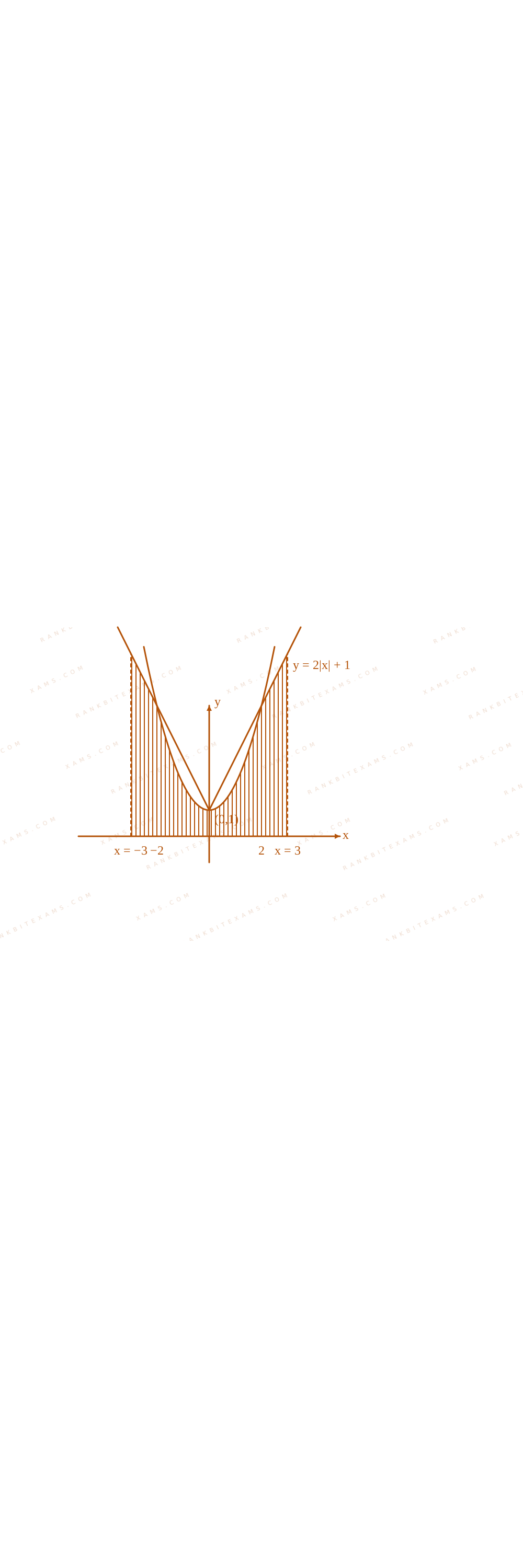
Since both bounding graphs are symmetric about the y-axis, we can integrate over the positive domain (x ≥ 0$x \ge 0$) and double the result: Area Bounded by Curves and Absolute Value Functions diagram for Q70 - JEE Main 2025 Morning
Intersecting points: x² + 1 = 2x + 1 x = 2$x^2 + 1 = 2x + 1 \implies x = 2$.
Step 1: Setting Up the Bound Segments
The region splits into two integral segments based on which curve sits lower:
Segment 1: From 0$0$ to 2$2$, bounded by the parabola y = x² + 1$y = x^2 + 1$.
Segment 2: From 2$2$ to 3$3$, bounded by the straight line y = 2x + 1$y = 2x + 1$.
Exploiting structural symmetry drops the integration limits, avoiding messy sign evaluations with absolute terms.
Chapter Mix
Class 12 Maths: Area Under Curves
More Area Under Curves Previous-Year Questions — Page 5
Qjee_main_2024_29_january_eveningArea Under Curves
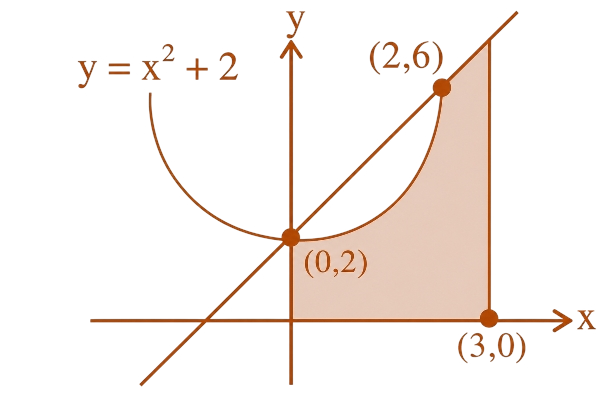
Let the area of the region (x,y):0≤ x≤ 3,0≤ y≤ x² +2,2x + 2$\{(x,y):0\leq x\leq 3,0\leq y\leq \min \{x^2 +2,2x + 2\} \}$ be A$A$. Then 12A$12A$ is equal to
Numerical Answer.Answer: 164 to 164
Solution
Related Formula
Area A = ∫ f(x), g(x) dx$$\text{Area } A = \int \min\{f(x), g(x)\}\, dx$$
Core Logic
Let us find the point of intersection of the curves y = x² + 2$y = x^2 + 2$ and y = 2x + 2$y = 2x + 2$:
x² + 2 = 2x + 2 x² - 2x = 0 x = 0 or x = 2$$x^2 + 2 = 2x + 2 \implies x^2 - 2x = 0 \implies x = 0 \text{ or } x = 2$$
For min/max boundary sets, always compute intersections first to accurately split integration domains into separate regions.
Chapter Mix
Class 12 Mathematics: Application of Integrals
Qjee_main_2024_27_jan_morningArea Under Curve
Let the area of the region (x, y): x²y + 4 ≥ 0, x+2y²≥0, x+4y²≤8, y≥0$\{(x, y): x^2y + 4 \ge 0, x+2y^{2}\ge0, x+4y^{2}\le8, y\ge0\}$ be (m)/(n)$\frac{m}{n}$ where m$m$ and n$n$ are coprime numbers. Then m+n$m+n$ is equal to:
We need to find the area bounded by the curves in the first quadrant (since y ≥ 0$y \ge 0$). Note that the first inequality x²y + 4 ≥ 0$x^2y + 4 \ge 0$ is trivially satisfied for all x, y ≥ 0$x, y \ge 0$.
So we focus on bounding x$x$ using:
Right curve: x = 8 - 4y²$x = 8 - 4y^2$
Left curve: x = -2y²$x = -2y^2$
However, there might be constraints where these cross or hit the axes. We must inspect intersections.
Step 1: Finding Intersection Points
Where do the left and right parabolas intersect?
8 - 4y² = -2y² ⇒ 2y² = 8 ⇒ y² = 4 ⇒ y = 2$8 - 4y^2 = -2y^2 \Rightarrow 2y^2 = 8 \Rightarrow y^2 = 4 \Rightarrow y = 2$ (Since y ≥ 0$y \ge 0$).
Wait, does x$x$ have boundaries? Since x$x$ can't drop arbitrarily into negative territory if it's restricted by other axes. Let's check x²y + 4 ≥ 0$x^2y + 4 \ge 0$. If x = -2y²$x = -2y^2$, then y$y$ must be bounded, but wait - the question limits are actually split into two regions depending on x²y+4 ≥ 0$x^2y+4 \ge 0$? Wait, the first inequality x²y+4 ≥ 0$x^2y+4 \ge 0$ might not be trivial if x$x$ is negative.
If x = -2y²$x = -2y^2$, then (-2y²)² y + 4 ≥ 0 ⇒ 4y⁵ + 4 ≥ 0$(-2y^2)^2 y + 4 \ge 0 \Rightarrow 4y^5 + 4 \ge 0$, which is true for all y ≥ 0$y \ge 0$.
Wait, there seems to be a misinterpretation of the first inequality. Let's look closer at the PDF solution boundaries.
The integration is broken at y=1$y=1$.
Why? x+2y² ≥ 0 ⇒ x ≥ -2y²$x+2y^2 \ge 0 \Rightarrow x \ge -2y^2$. Wait, the solution states another left curve: 2y-4$2y-4$. Is x²y+4 ≥ 0$x^2y+4 \ge 0$ actually x + 2y - 4 ≥ 0$x + 2y - 4 \ge 0$?
Yes, OCR shows `x^2y+4` but the solution integrates `(2y-4)`. Thus the original condition is likely x - 2y + 4 ≥ 0 ⇒ x ≥ 2y - 4$x - 2y + 4 \ge 0 \Rightarrow x \ge 2y - 4$!
Let's assume the left boundary splits between x = -2y²$x = -2y^2$ and x = 2y - 4$x = 2y - 4$.
Step 2: Region Bounds
Intersection of x = -2y²$x = -2y^2$ and x = 2y - 4$x = 2y - 4$:
-2y² = 2y - 4 ⇒ y² + y - 2 = 0 ⇒ (y+2)(y-1) = 0 ⇒ y = 1$-2y^2 = 2y - 4 \Rightarrow y^2 + y - 2 = 0 \Rightarrow (y+2)(y-1) = 0 \Rightarrow y = 1$.
Intersection of x = 2y - 4$x = 2y - 4$ and x = 8 - 4y²$x = 8 - 4y^2$:
2y - 4 = 8 - 4y² ⇒ 4y² + 2y - 12 = 0 ⇒ 2y² + y - 6 = 0 ⇒ (2y-3)(y+2) = 0 ⇒ y = 3/2$2y - 4 = 8 - 4y^2 \Rightarrow 4y^2 + 2y - 12 = 0 \Rightarrow 2y^2 + y - 6 = 0 \Rightarrow (2y-3)(y+2) = 0 \Rightarrow y = 3/2$.
So the region shifts left boundary at y=1$y=1$ and closes entirely at y=3/2$y=3/2$.
This implies m = 107$m = 107$ and n = 12$n = 12$.
Since 107 and 12 are coprime, m + n = 107 + 12 = 119$m + n = 107 + 12 = 119$.
Pattern Recognition
When dealing with multiple inequalities bounded by y ≥ 0$y \ge 0$, always project horizontally (integrate wrt y$y$) as the bounds natively trace left-to-right distances. Find intersection nodes to partition the integral correctly.
Chapter Mix
Class 12 Maths: Application of Integrals
Q28jee_main_2024_29_jan_morningArea Under Curves
The area (in sq. units) of the part of circle x²+y²=169$x^2+y^2=169$ which is below the line 5x-y=13$5x-y=13$ is (πα)/(2β)-(65)/(2)+(α)/(β) ⁻¹((12)/(13))$\frac{\pi\alpha}{2\beta}-\frac{65}{2}+\frac{\alpha}{\beta}\sin^{-1}(\frac{12}{13})$ where α,β$\alpha,\beta$ are coprime numbers. Then α+β$\alpha+\beta$ is equal to
Numerical Answer.Answer: 171 to 171
Solution
Related Formula
Standard Integral: ∫ √(a²-y²) dy = (y)/(2)√(a²-y²) + (a²)/(2) ⁻¹((y)/(a)) + C$$\text{Standard Integral: } \int \sqrt{a^2-y^2} dy = \frac{y}{2}\sqrt{a^2-y^2} + \frac{a^2}{2}\sin^{-1}\left(\frac{y}{a}\right) + C$$Area of right triangle = (1)/(2) × base × height$$\text{Area of right triangle } = \frac{1}{2} \times \text{base} \times \text{height}$$
Core Logic
First, find the points of intersection between the circle x²+y²=169$x^2+y^2=169$ and the line 5x-y=13 ⇒ y = 5x-13$5x-y=13 \Rightarrow y = 5x-13$.
Substitute y$y$ into the circle equation:
The solutions are x=0$x=0$ and x=5$x=5$.
When x=0, y=-13$x=0, y=-13$. Point is (0, -13)$(0, -13)$.
When x=5, y=12$x=5, y=12$. Point is (5, 12)$(5, 12)$.
The required area is bounded below the line x = (y+13)/(5)$x = \frac{y+13}{5}$ and above the right-hand boundary of the circle x = √(169-y²)$x = \sqrt{169-y^2}$ across the y-axis boundaries [-13, 12]$[-13, 12]$.
Area Under Curves
Step 1: Setup Area Integral
Integrate with respect to y$y$ (from left to right curves, bounded horizontally):
Split the integral into two parts:
Part A (Circle): ∫₋₁₃¹² √(169-y²) dy$\int_{-13}^{12} \sqrt{169-y^2} dy$
Part B (Line): ∫₋₁₃¹² (y+13)/(5) dy$\int_{-13}^{12} \frac{y+13}{5} dy$
Comparing this exactly with the given format (πα)/(2β) - (65)/(2) + (α)/(β) ⁻¹((12)/(13))$\frac{\pi\alpha}{2\beta} - \frac{65}{2} + \frac{\alpha}{\beta}\sin^{-1}(\frac{12}{13})$:
We see that (α)/(β) = (169)/(2)$\frac{\alpha}{\beta} = \frac{169}{2}$.
Since 169 and 2 are coprime, α = 169$\alpha = 169$ and β = 2$\beta = 2$.
When evaluating line integrals forming a triangle with horizontal bounds, bypass algebraic integration and visually calculate (1)/(2) · b · h$\frac{1}{2} \cdot b \cdot h$. Here, base=25 along y-axis, height=5 along x-axis, area = 125/2$125/2$. Instantly saves integration time.
Chapter Mix
Class 12 Mathematics: Application of Integrals
Class 11 Mathematics: Straight Lines
Q8jee_main_2024_30_jan_morningArea under Curves
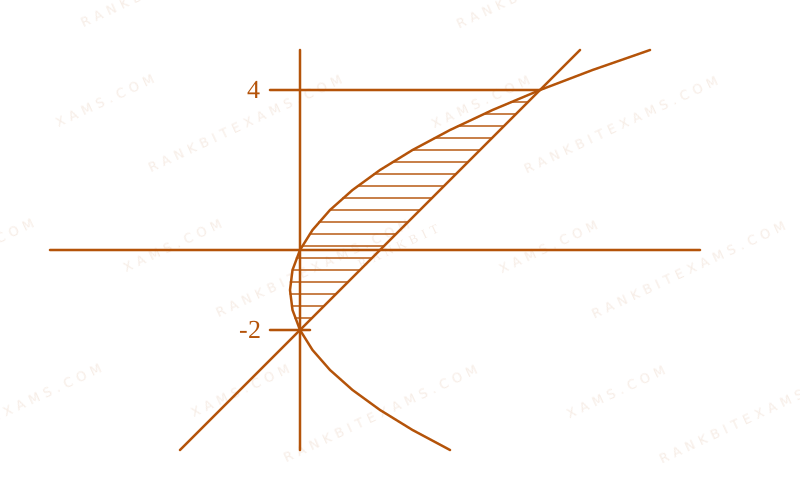
The area (in square units) of the region bounded by the parabolay² = 4(x - 2)$y^2 = 4(x - 2)$ and the line y = 2x - 8$y = 2x - 8$
The solution simplifies it directly to 9$9$ square units.
Pattern Recognition
For a horizontal parabola interacting with a line, integrating along the y-axis is always cleaner than splitting it into multiple integrals along the x-axis.
Chapter Mix
Class 12 Maths: Application of Integrals
Q11jee_main_2024_31_jan_eveningArea Under Curves
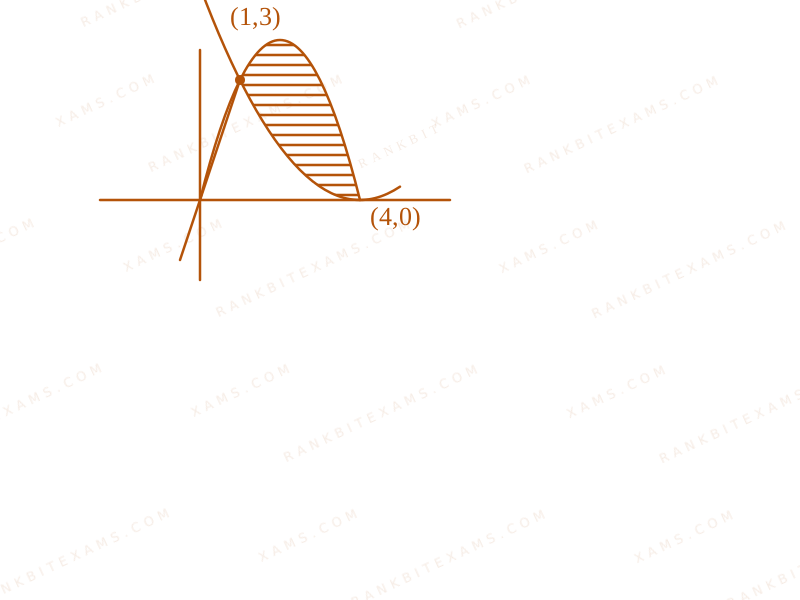
The area of the region enclosed by the parabola y = 4x - x²$y = 4x - x^2$ and 3y = (x - 4)²$3y = (x - 4)^2$ is equal to
Practice past-year questions one chapter at a time. Pick an exam → subject → chapter and get every PYQ for that topic — pulled together from all past papers — with the chapter's key formulas alongside.