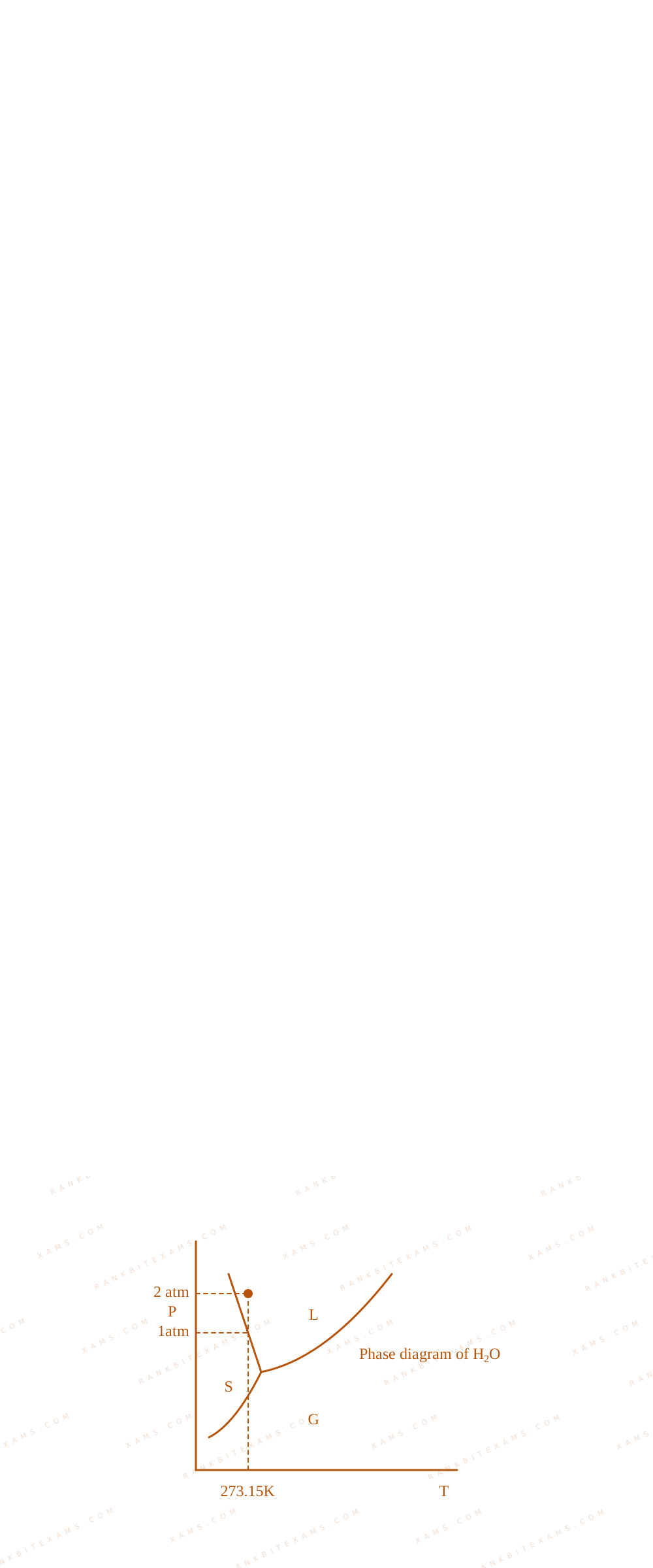
Ice and water are placed in a closed container at a pressure of 1 atm and temperature 273.15K . If pressure of the system is increased 2 times, keeping temperature constant, then identify correct observation from following:

Solution & Explanation

Core Logic

Water has a unique property where the density of the liquid phase is greater than the density of the solid phase (ice). Consequently, the molar volume of ice is larger than that of liquid water:

Vm(ice) > Vm(water)

According to Le Chatelier's Principle, increasing the pressure favors the phase that occupies a smaller volume to alleviate the applied stress. Thus, shifting the system forward converts ice into liquid water:

Phase shift diagram for Q34 - JEE Main 2025 Morning

If the pressure is increased considerably (such as doubling it to 2 atm) at 273.15K, the melting point decreases, causing the entire solid phase (ice) to disappear completely.

Pattern Recognition

Sees: Ice-water system under pressure change. Trap: Assuming that an increase in pressure always favors the solid phase. Water has an anomalous phase curve with a negative slope.

Chapter Mix

Class 11 Chemistry: Chemical Thermodynamics

More Chemical Thermodynamics Previous-Year Questions — Page 8

Q jee_main_2025_29_jan_morning First Law of Thermodynamics and Heat Capacity
500 ~J of energy is transferred as heat to 0.5 ~mol of Argon gas at 298 ~K and 1.00 atm . The final temperature and the change in internal energy respectively are : Given: R = 8.3 JK⁻¹ mol⁻¹
  • A. 348K and 300J
  • B. 378K and 300J
  • C. 368K and 500J
  • D. 378K and 500J

Solution

Formulas Used

For an ideal gas undergoing a constant pressure process (1.00 atm):

qₚ = n · Cₚ · Δ T

Change in internal energy (Δ U):

Δ U = n · Cv · Δ T

For a monoatomic gas like Argon:

  • Cv = (3)/(2) R
  • Cₚ = (5)/(2) R
Core Logic

Step 1: Calculate the final temperature (Tf) Heat transferred at constant pressure (qₚ) = 500 J

500 = 0.5 × ((5)/(2) × 8.3) × (Tf - 298) 500 = 0.5 × 20.75 × (Tf - 298) 500 = 10.375 × (Tf - 298) Tf - 298 = (500)/(10.375) ≈ 48.2 K Tf = 298 + 48.2 = 346.2 K ≈ 348 K

---

Step 2: Calculate the change in internal energy (Δ U)

Δ U = n · Cv · Δ T

Alternatively, using the ratio of heat capacities:

Δ U = ((Cv)/(Cₚ)) × qₚ = (3)/(5) × 500 J = 300 J

Thus, the final temperature is 348 K and the change in internal energy is 300 J.

Pattern Recognition

For a monoatomic ideal gas under constant pressure, exactly 60% of the heat added ((Cv)/(Cₚ) = (3)/(5)) goes into increasing the internal energy (Δ U), while 40% is lost to expansion work (W).

Correct Option: (A)

Q79 jee_main_2024_01_february_morning First Law of Thermodynamics
Choose the correct option for free expansion of an ideal gas under adiabatic condition from the following:
  • A. q = 0, Δ T ≠ 0, w = 0
  • B. q = 0, Δ T < 0, w ≠ 0
  • C. q ≠ 0, Δ T = 0, w = 0
  • D. q = 0, Δ T = 0, w = 0

Solution

Core Logic

Free expansion means expansion against a vacuum (Pₑₓₜ = 0). Work done: w = -Pₑₓₜ Δ V. Since Pₑₓₜ = 0, w = 0.

Adiabatic condition means there is no heat exchange with the surroundings. Heat transfer: q = 0.

According to the First Law of Thermodynamics, Δ U = q + w. Since q = 0 and w = 0, the change in internal energy Δ U = 0.

For an ideal gas, internal energy is a function of temperature only (Δ U = nCvΔ T). If Δ U = 0, then Δ T = 0.

Step 1: Final Parameter Check

Evaluating all parameters simultaneously: q = 0 w = 0 Δ T = 0

Pattern Recognition

Adiabatic + Free Expansion of IDEAL gas arrow Nothing changes thermodynamically except volume and pressure. q = 0, w = 0, Δ U = 0, Δ T = 0, Δ H = 0.

Chapter Mix

Class 11 Chemistry: Thermodynamics

Q jee_main_2024_29_january_evening Enthalpy of Phase Transition
Standard enthalpy of vapourisation for CCl₄ is 30.5 kJ mol⁻¹. Heat required for vapourisation of 284g of CCl₄ at constant temperature is ________ kJ. (Given molar mass in g mol-; C = 12, Cl = 35.5)
Numerical Answer. Answer: 56 to 56.25

Solution

Related Formula
Q = n × Δ Hvap⁰ where n = MassMolar Mass
Core Logic

First, calculate the molar mass of carbon tetrachloride (CCl₄):

Molar mass = 12 + 4(35.5) = 12 + 142 = 154 g/mol

Next, calculate the total number of moles present in 284 g of the substance:

n = (284)/(154) ≈ 1.844 moles
Step 1: Enthalpy Calculation

Calculate the total energy required for vaporization:

Δ H = 1.844 mol × 30.5 kJ/mol ≈ 56.24 kJ

Rounding to the nearest integer value gives 56.

Pattern Recognition

Enthalpy of vaporization is an intensive property given per mole. Scale it linearly by multiplying by the total number of moles to find the total extensive heat required.

Chapter Mix

Class 11 Chemistry: Chemical Thermodynamics

Q84 jee_main_2024_27_jan_morning Isothermal Expansion and Work Calculations
If three moles of an ideal gas at 300 K expand isothermally from 30 dm³ to 45 dm³ against a constant opposing pressure of 80 kPa, then the amount of heat transferred is J.
Numerical Answer. Answer: 1200 to 1200

Solution

Related Formula

First law of thermodynamics framework:

Δ U = Q + W

For an isothermal processes involving ideal gases, internal energy change is zero:

Δ U = 0 Q = -W

Irreversible work formula expanding against constant external pressure:

W = -Pₑₓₜ Δ V = -Pₑₓₜ(V₂ - V₁)
Step 1: Calculate structural work values

Given values:

Pₑₓₜ = 80 kPa = 80 × 10³ Pa V₁ = 30 dm³ = 30 × 10⁻³ m³ V₂ = 45 dm³ = 45 × 10⁻³ m³ Δ V = (45 - 30) × 10⁻³ = 15 × 10⁻³ m³ W = -80 × 10³ × (15 × 10⁻³) = -1200 J
Step 2: Solve for heat magnitude
$Q = -W = -(-1200 J) = 1200 J
Pattern Recognition

Constant opposing pressure indicates an irreversible process path. Use

Pattern Recognition

Constant opposing pressure indicates an irreversible process path. Use $W = -P\Delta V$ instead of logarithmic integrals.

Chapter Mix

Class 11 Chemistry: Thermodynamics

Q jee_main_2024_29_jan_morning Spontaneity and Gibbs Free Energy
Which of the following is not correct?
  • A. Δ G is negative for a spontaneous reaction
  • B. Δ G is positive for a spontaneous reaction
  • C. Δ G is zero for a reversible reaction
  • D. Δ G is positive for a non-spontaneous reaction

Solution

Core Logic

According to the second law of thermodynamics, at constant temperature and pressure, the change in Gibbs free energy (Δ G) dictates the spontaneity of a process.

  • If Δ G lt 0 (negative), the process is spontaneous.
  • If Δ G gt 0 (positive), the process is non-spontaneous.
  • If Δ G = 0, the system is in equilibrium (reversible process).
  • Therefore, the statement "Δ G is positive for a spontaneous reaction" is factually incorrect.

Chapter Mix

Class 11 Chemistry: Thermodynamics

More Chemical Thermodynamics Questions — jee_main_2025_28_jan_morning

Practice all Chemical Thermodynamics previous-year questions →

Rankbit System
JEE Physics: Waves (+15.5%) | Electrostatics: Concentric Shells (-29.7%) | Modern Physics: Photoelectric Clones (+34.2%) | Mathematics: Definite Integrals (+18.1%) | Chemistry: Coordination Splitting (-11.4%) | JEE Physics: Waves (+15.5%) | Electrostatics: Concentric Shells (-29.7%) | Modern Physics: Photoelectric Clones (+34.2%) | Mathematics: Definite Integrals (+18.1%) | Chemistry: Coordination Splitting (-11.4%)