JEE Main · Chemistry → Steady

Aldehydes, Ketones and Carboxylic Acids appeared 46 times across 3 years — 5.4% of Chemistry. This question is from Reactions of Carbonyl Compounds.

Year 2026 2025 2024 Total
Questions 14 21 11 46

Both acetaldehyde and acetone (individually) undergo which of the following reactions? A. Iodoform Reaction B. Cannizaro Reaction C. Aldol condensation D. Pollen's Test E. Clemmensen Reduction Choose the correct answer from the options given below:

Solution & Explanation

Core Logic

Let us check each option pathway:

  • A. Iodoform Reaction: Positive for both because both contain the CH₃-C=O methyl ketone fragment.
  • B. Cannizaro Reaction: Negative for both because both contain α-hydrogens.
  • C. Aldol Condensation: Positive for both because they have α-hydrogens available for enolization.
  • D. Pollen's Test (Tollen's Test): Positive only for acetaldehyde (aldehyde); negative for acetone (ketone).
  • E. Clemmensen Reduction: Positive for both as they contain reducible carbonyl groups.
  • Thus, both react via A, C, and E.

Pattern Recognition

Sees: Functional comparison of Acetaldehyde and Acetone. Shortcut: Ketones do not respond to Tollen's test, which instantly eliminates choices featuring statement D.

Chapter Mix

Class 12 Chemistry: Aldehydes, Ketones and Carboxylic Acids

Reference Study Guides

More Aldehydes, Ketones and Carboxylic Acids Previous-Year Questions — Page 8

Q jee_main_2024_01_february_morning Preparation of Aldehydes
Identify A and B in the following sequence of reaction
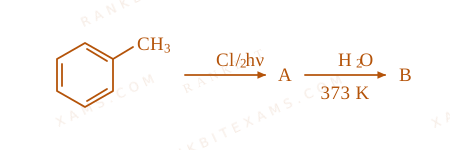
Preparation of Aldehydes diagram for Q69 - JEE Main 2024 Morning
The image shows a reaction scheme starting with toluene reacting with Cl2/hv to give A, followed by H2O at 373 K to give B.
  • A.
  • B.
  • C.
  • D.

Solution

Core Logic

Step 1: Free radical side-chain halogenation of toluene. Toluene reacts with Cl₂ in the presence of light (hν) to undergo substitution on the methyl group. Under typical conditions intended to yield an aldehyde later, di-chlorination occurs forming benzal chloride (A).

Step 2: Hydrolysis. Benzal chloride upon hydrolysis with H₂O at 373 K yields a gem-diol intermediate which is unstable and loses water to form Benzaldehyde (B).

C₆H₅CH₃ Cl₂ / hν C₆H₅CHCl₂ H₂O, 373K C₆H₅CHO
Step 1: Identify Structures

(A) = Benzal chloride (C₆H₅CHCl₂) (B) = Benzaldehyde (C₆H₅CHO)
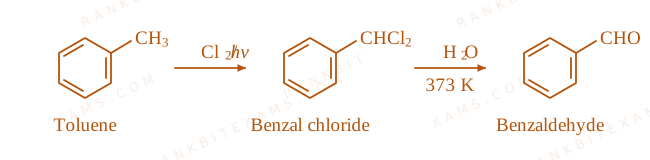
Preparation of Aldehydes diagram for Q69 - JEE Main 2024 Morning
The image shows a reaction scheme starting with toluene reacting with Cl2/hv to give A, followed by H2O at 373 K to give B.

Pattern Recognition

Toluene Cl₂, hν targets the side chain. If the next step is hydrolysis to an aldehyde, you must have stopped at the gem-dihalide stage (CHCl₂).

Chapter Mix

Class 12 Chemistry: Aldehydes, Ketones and Carboxylic Acids Class 11 Chemistry: Hydrocarbons
Q jee_main_2024_01_february_morning Reactions of Carbonyl Compounds
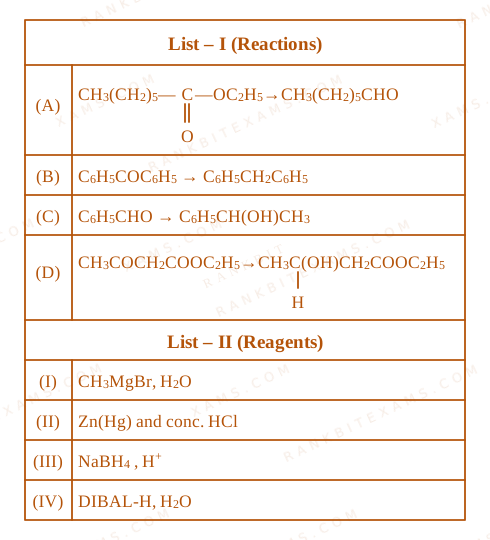
Match List - I with List - II.
List - I (Reactions)List - II (Reagents)
(A) CH₃(CH₂)₅-CO-OC₂H₅ arrow CH₃(CH₂)₅CHO(I) CH₃MgBr, H₂O
(B) C₆H₅COC₆H₅ arrow C₆H₅CH₂C₆H₅(II) Zn(Hg) and conc. HCl
(C) C₆H₅CHO arrow C₆H₅CH(OH)CH₃(III) NaBH₄, H^+
(D) CH₃COCH₂COOC₂H₅ arrow CH₃CH(OH)CH₂COOC₂H₅(IV) DIBAL-H, H₂O
Choose the correct answer from options given below:
Reactions of Carbonyl Compounds
  • A. A-(III), (B)-(IV), (C)-(I), (D)-(II)
  • B. A-(IV), (B)-(II), (C)-(I), (D)-(III)
  • C. A-(IV), (B)-(II), (C)-(III), (D)-(I)
  • D. A-(III), (B)-(IV), (C)-(II), (D)-(I)

Solution

Core Logic

Let's analyze the transformation happening in each reaction:

(A) CH₃(CH₂)₅COOC₂H₅ arrow CH₃(CH₂)₅CHO An ester is reduced to an aldehyde. This is a selective reduction achieved using DIBAL-H (Diisobutylaluminium hydride) followed by hydrolysis. Thus, (A) arrow (IV).

(B) C₆H₅COC₆H₅ arrow C₆H₅CH₂C₆H₅ A ketone (carbonyl group >C=O) is fully reduced to an alkane (>CH₂) methylene group. This is the Clemmensen reduction, which uses Zinc amalgam and concentrated HCl. Thus, (B) arrow (II).

(C) C₆H₅CHO arrow C₆H₅CH(OH)CH₃ Benzaldehyde (aldehyde) is converted into a secondary alcohol with an extra methyl group. This is a nucleophilic addition of a Grignard reagent (CH₃MgBr) followed by hydrolysis. Thus, (C) arrow (I).

(D) CH₃COCH₂COOC₂H₅ arrow CH₃CH(OH)CH₂COOC₂H₅ A ketone group is reduced to a secondary alcohol while the ester group remains intact. NaBH₄ is a mild reducing agent that reduces aldehydes and ketones but generally does not touch esters. Thus, (D) arrow (III).

Pattern Recognition

Ester arrow Aldehyde = DIBAL-H Ketone arrow Alkane = Clemmensen (Zn(Hg)/HCl) or Wolff-Kishner Carbonyl arrow Alcohol with carbon chain extension = Grignard Reagent Ketone arrow Alcohol (leaving ester intact) = NaBH₄

Chapter Mix

Class 12 Chemistry: Aldehydes, Ketones and Carboxylic Acids

Q jee_main_2024_29_jan_morning Reactions of Carbonyl Compounds
The final product A formed in the following multistep reaction sequence is
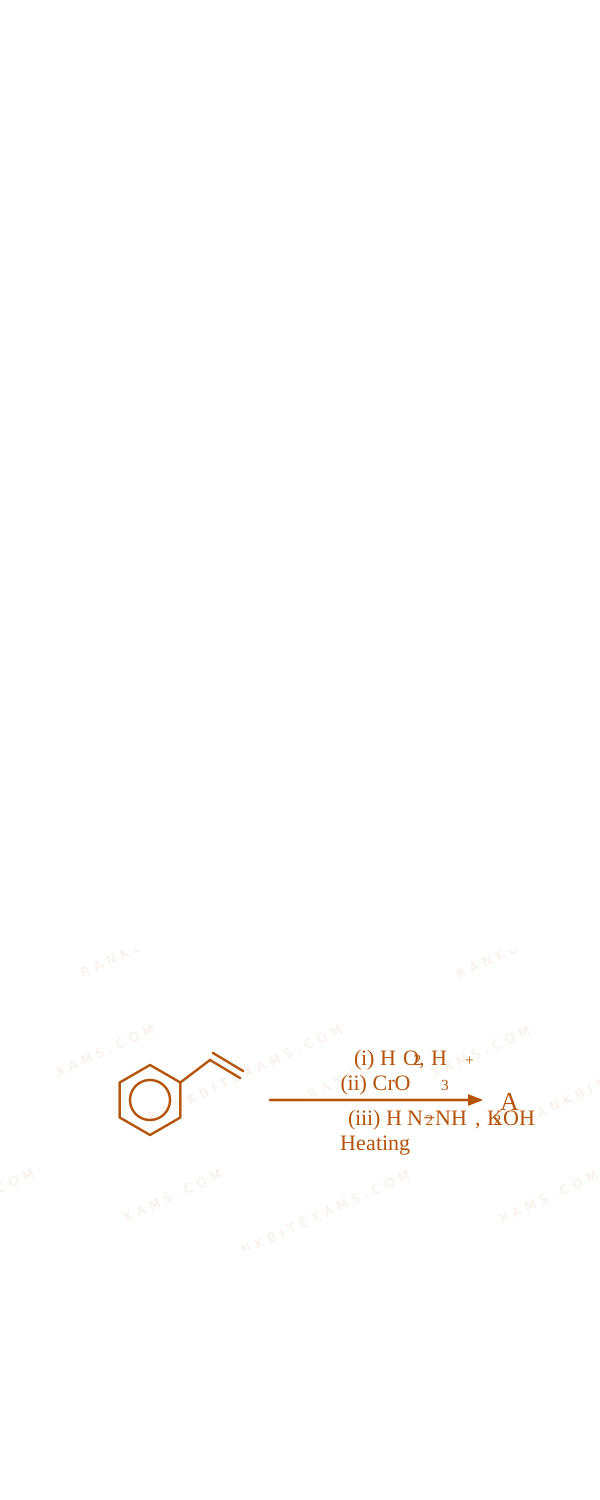
Reactions of Carbonyl Compounds diagram for Q77 - JEE Main 2024 Morning
A reaction sequence starting with styrene undergoing Markovnikov hydration, followed by oxidation with CrO3, and finally reduction with hydrazine and KOH.
  • A.
  • B.
  • C.
  • D.

Solution

Core Logic

The reaction sequence proceeds in three distinct steps from the starting material, styrene (Ph-CH=CH₂).

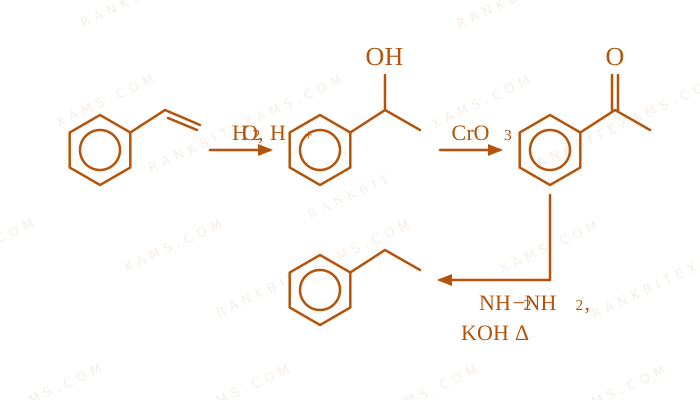
Step 1: Acid-catalyzed Hydration Styrene reacts with H₂O, H^+ to undergo electrophilic addition. Protonation yields the more stable secondary benzylic carbocation. Attack by water followed by deprotonation gives 1-phenylethanol (Ph-CH(OH)-CH₃).

Step 2: Oxidation 1-phenylethanol is a secondary alcohol. Treatment with chromium trioxide (CrO₃, Jones reagent condition) oxidizes the secondary alcohol to a ketone. This yields acetophenone (Ph-CO-CH₃).

Step 3: Wolff-Kishner Reduction Acetophenone is treated with hydrazine (NH₂-NH₂) and a strong base (KOH) under heating. This is the classic Wolff-Kishner reduction, which completely reduces the carbonyl group (C=O) to a methylene group (-CH₂-). The final product is ethylbenzene (Ph-CH₂-CH₃).

Step 1: Overall Reaction Pathway

Reactions of Carbonyl Compounds diagram for Q77 - JEE Main 2024 Morning
A reaction sequence starting with styrene undergoing Markovnikov hydration, followed by oxidation with CrO3, and finally reduction with hydrazine and KOH.

The final product A is ethylbenzene.

Chapter Mix

Class 11 Chemistry: Hydrocarbons Class 12 Chemistry: Alcohols Phenols and Ethers Class 12 Chemistry: Aldehydes Ketones and Carboxylic Acids

Q jee_main_2024_29_jan_morning Chemical Reactions of Aldehydes and Ketones
From the compounds given below, number of compounds which give positive Fehling's test is _____. Benzaldehyde, Acetaldehyde, Acetone, Acetophenone, Methanal, 4-nitrobenzaldehyde, cyclohexane carbaldehyde.
Numerical Answer. Answer: 3 to 3

Solution

Core Logic

Fehling's test is a mild oxidizing test used primarily to distinguish aliphatic aldehydes from ketones and aromatic aldehydes.

  • Aliphatic aldehydes (like methanal, acetaldehyde, cyclohexane carbaldehyde) give a positive Fehling's test (formation of red-brown precipitate of Cu₂O).
  • Aromatic aldehydes (like benzaldehyde, 4-nitrobenzaldehyde) lack alpha-hydrogens in a purely aliphatic environment and are not sufficiently easily oxidized to give a positive Fehling's test.
  • Ketones (like acetone, acetophenone) generally do not give a positive Fehling's test (except α-hydroxy ketones).
Step 1: Evaluation of Given Compounds
  • Benzaldehyde: Aromatic aldehyde arrow Negative
  • Acetaldehyde (CH₃CHO): Aliphatic aldehyde arrow Positive
  • Acetone: Ketone arrow Negative
  • Acetophenone: Ketone arrow Negative
  • Methanal (HCHO): Aliphatic aldehyde arrow Positive
  • 4-nitrobenzaldehyde: Aromatic aldehyde arrow Negative
  • Cyclohexane carbaldehyde: Aliphatic aldehyde arrow Positive
  • The compounds giving a positive test are Acetaldehyde, Methanal, and Cyclohexane carbaldehyde.

Pattern Recognition

Tollens' reagent oxidizes ALL aldehydes (aliphatic + aromatic). Fehling's reagent is weaker and only oxidizes ALIPHATIC aldehydes.

Chapter Mix

Class 12 Chemistry: Aldehydes Ketones and Carboxylic Acids

Q jee_main_2024_30_january_evening Cannizzaro Reaction
m-chlorobenzaldehyde on treatment with 50% KOH solution yields
  • A.
  • B.
  • C.
  • D.

Solution

Core Logic

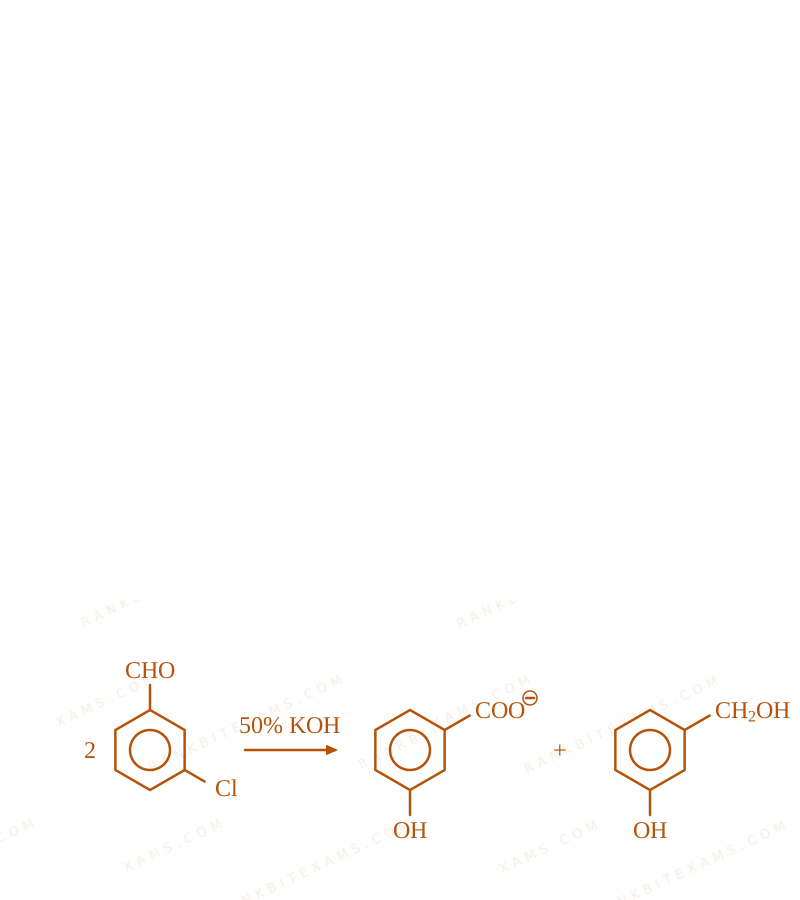
m-chlorobenzaldehyde lacks alpha-hydrogen atoms. Therefore, when treated with concentrated base like 50% KOH, it undergoes a disproportionation redox reaction known as the Cannizzaro reaction.

Two molecules of the aldehyde react: one gets oxidized to the corresponding carboxylate ion (m-chlorobenzoate ion), and the other gets reduced to the corresponding alcohol (m-chlorobenzyl alcohol).

Step 1: Reaction

The reaction proceeds as:

Cannizzaro reaction of m-chlorobenzaldehyde diagram for Q64 - JEE Main 2024 Evening

Pattern Recognition

No α-hydrogen + Conc. Alkali (50% KOH/NaOH) = Cannizzaro (Oxidation to salt of carboxylic acid + Reduction to primary alcohol).

Chapter Mix

Class 12 Chemistry: Aldehydes Ketones and Carboxylic Acids

More Aldehydes, Ketones and Carboxylic Acids Questions — jee_main_2025_28_jan_morning

Practice all Aldehydes, Ketones and Carboxylic Acids previous-year questions →

Rankbit System
JEE Physics: Waves (+15.5%) | Electrostatics: Concentric Shells (-29.7%) | Modern Physics: Photoelectric Clones (+34.2%) | Mathematics: Definite Integrals (+18.1%) | Chemistry: Coordination Splitting (-11.4%) | JEE Physics: Waves (+15.5%) | Electrostatics: Concentric Shells (-29.7%) | Modern Physics: Photoelectric Clones (+34.2%) | Mathematics: Definite Integrals (+18.1%) | Chemistry: Coordination Splitting (-11.4%)