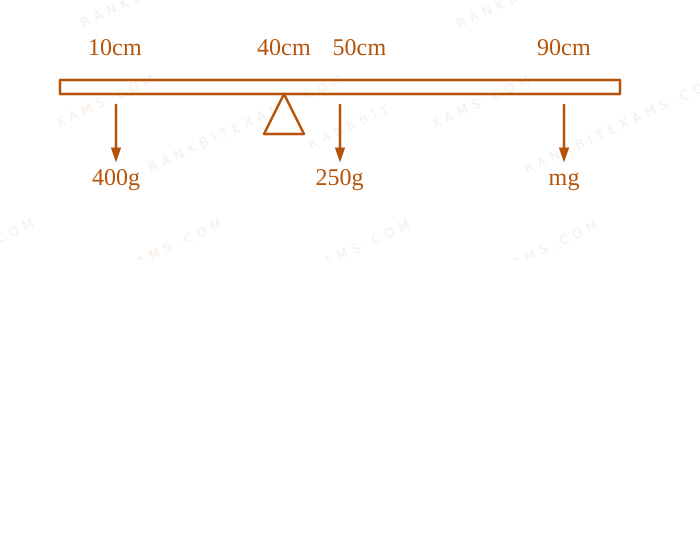
A uniform rod of mass 250mathrmg$250\mathrm{g}$ having length 100mathrmcm$100\mathrm{cm}$ is balanced on a sharp edge at 40mathrmcm$40\mathrm{cm}$ mark[cite: 150, 151]. A mass of 400mathrmg$400\mathrm{g}$ is suspended at 10mathrmcm$10\mathrm{cm}$ mark. To maintain the balance of the rod, the mass to be suspended at 90mathrmcm$90\mathrm{cm}$ mark, is [cite: 154, 156]
A.300mathrmg$300\mathrm{g}$
B.190mathrmg$190\mathrm{g}$
C.200mathrmg$200\mathrm{g}$
D.290mathrmg$290\mathrm{g}$
Solution & Explanation
### Related Formula
For rotational equilibrium, the \sum of all counter-clockwise torques about the pivot point must exactly balance the \sum of all clockwise torques:
sum tau_textpivot = 0 implies sum (m_i cdot g cdot x_i) = 0$\sum \tau_{\text{pivot}} = 0 \implies \sum (m_i \cdot g \cdot x_i) = 0$
### Core Logic
The rod is uniform, meaning its mass (250text g$250\text{ g}$) acts exactly at its geometric center of mass, the 50text cm$50\text{ cm}$ mark[cite: 150, 151]. Let the pivot point be the sharp edge at the 40text cm$40\text{ cm}$ mark .
Calculate the relative lever arms from the pivot [cite: 775, 776, 777]:
* 400text g$400\text{ g}$ mass at 10text cm$10\text{ cm}$ mark: lever arm = 40 - 10 = 30text cm$= 40 - 10 = 30\text{ cm}$ (counter-clockwise)
* 250text g$250\text{ g}$ rod mass at 50text cm$50\text{ cm}$ mark: lever arm = 50 - 40 = 10text cm$= 50 - 40 = 10\text{ cm}$ (clockwise)
* Unknown mass M$M$ at 90text cm$90\text{ cm}$ mark: lever arm = 90 - 40 = 50text cm$= 90 - 40 = 50\text{ cm}$ (clockwise)
Setting up the torque balance equation:
400 times 30 = (250 times 10) + (M times 50)$400 \times 30 = (250 \times 10) + (M \times 50)$12000 = 2500 + 50M$12000 = 2500 + 50M$50M = 9500 implies M = frac950050 = 190text g$50M = 9500 \implies M = \frac{9500}{50} = 190\text{ g}$
### Step 1: Visual Context
The structural layout of forces acting on the balanced rod system is shown below:
Torque and Equilibrium balancing diagram for Q17
### Pattern Recognition
Never forget to include the weight of a uniform rod itself in equilibrium equations. It is a common oversight to omit the rod's mass, which always acts at its geometric center.
### Evaluation Rubric / Model Answer
null
### Chapter Mix
Class 11 Physics: System of Particles and Rotational Motion
Keywords:#balancing a uniform rod torque equation#JEE Main 2025 Evening Q17#System of Particles and Rotational Motion JEE Main 2025#center of mass rotational equilibrium
More System of Particles and Rotational Motion Previous-Year Questions — Page 2
Q192025Centre of Mass of Continuous Mass Distribution
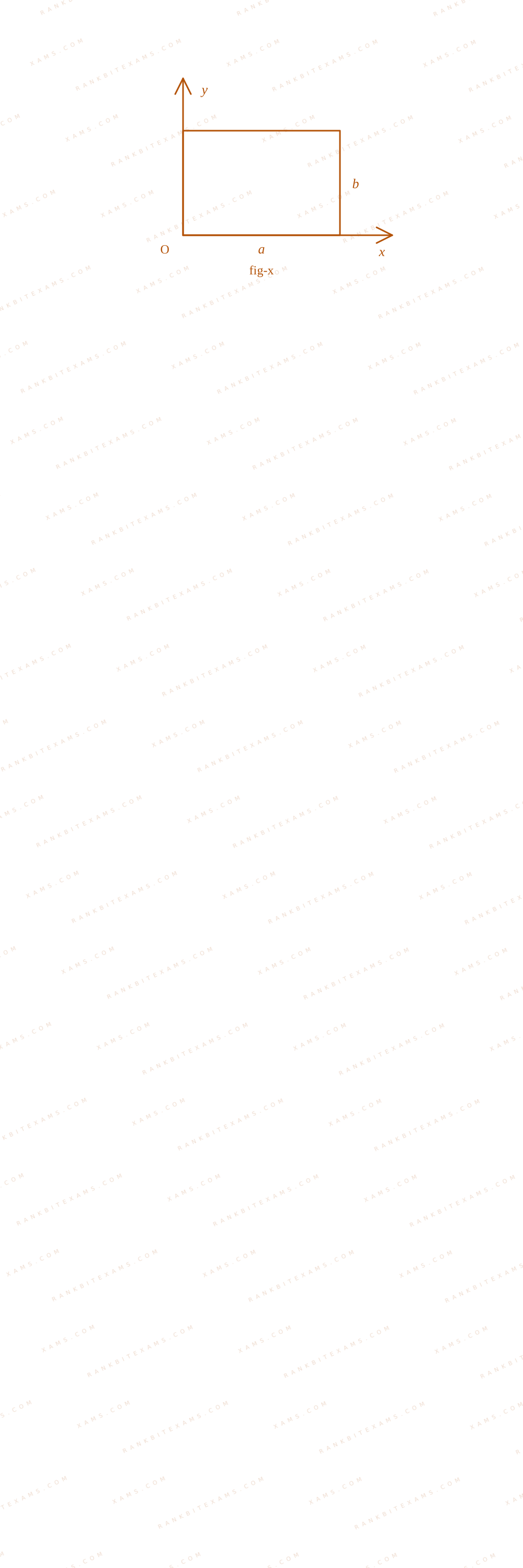
The centre of mass of a thin rectangular plate (fig - x) with sides of length a and b, whose mass per unit area (sigma)$(\sigma)$ varies as sigma = fracsigma_0xab$\sigma = \frac{\sigma_0x}{ab}$ (where sigma_0$\sigma_0$ is a constant), would be
A thin plate with variable linear density coordinates mapped across an XY grid system.
A.left(frac23 a, fracb2right)$\left(\frac{2}{3} a, \frac{b}{2}\right)$
B.left(frac23 a, frac23 bright)$\left(\frac{2}{3} a, \frac{2}{3} b\right)$
D.left(frac13 a, fracb2right)$\left(\frac{1}{3} a, \frac{b}{2}\right)$
Solution
### Core Logic
Since density sigma$\sigma$ is independent of the y-coordinate, the vertical center of mass resolves directly by symmetry:
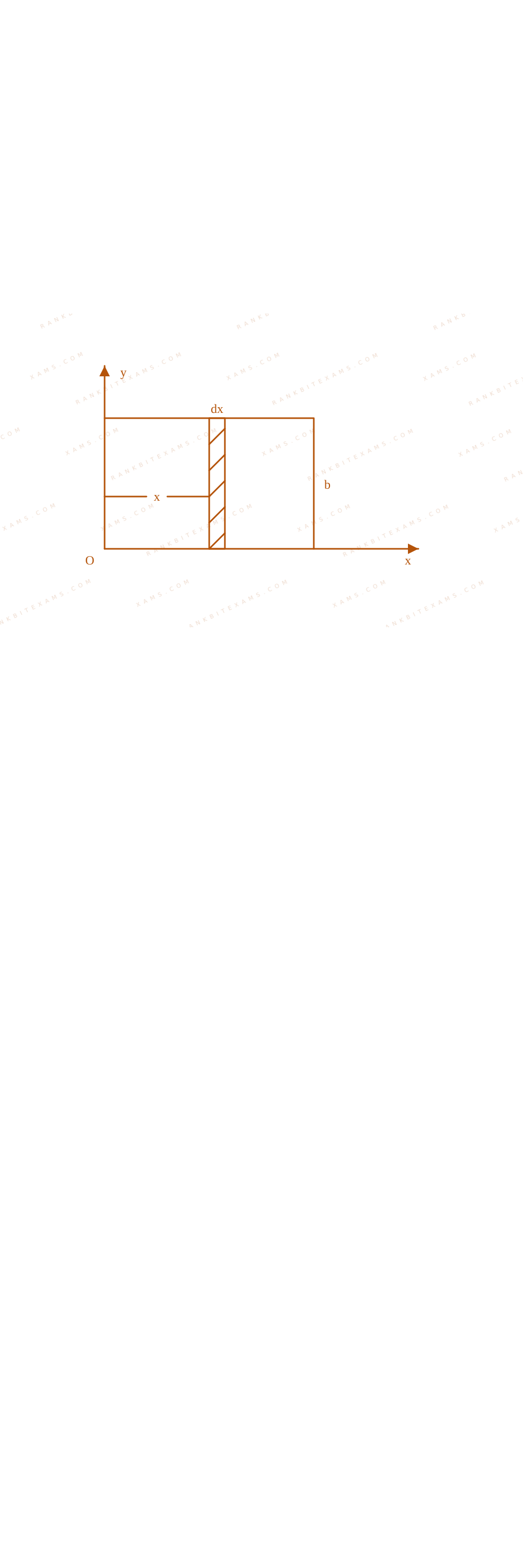
mathrmy_mathrmcm = fracmathrmb2$\mathrm{y}_{\mathrm{cm}} = \frac{\mathrm{b}}{2}$A thin plate with variable linear density coordinates mapped across an XY grid system.
To find the horizontal center of mass, evaluate the continuous mass integral along the x-axis:
mathrmx_mathrmcm = fracint_0^mathrma mathrmx \, dmint_0^mathrma mathrmdm = fracint_0^mathrma mathrmx left(fracsigma_0 mathrmxmathrmabright) mathrmb \, dxint_0^mathrma left(fracsigma_0 mathrmxmathrmabright) mathrmb \, dx$\mathrm{x}_{\mathrm{cm}} = \frac{\int_0^{\mathrm{a}} \mathrm{x \, dm}}{\int_0^{\mathrm{a}} \mathrm{dm}} = \frac{\int_0^{\mathrm{a}} \mathrm{x} \left(\frac{\sigma_0 \mathrm{x}}{\mathrm{ab}}\right) \mathrm{b \, dx}}{\int_0^{\mathrm{a}} \left(\frac{\sigma_0 \mathrm{x}}{\mathrm{ab}}\right) \mathrm{b \, dx}}$mathrmx_mathrmcm = fracint_0^mathrma mathrmx^2 \, mathrmdxint_0^mathrma mathrmx \, mathrmdx = fracleft[ fracmathrmx^33 right]_0^mathrmaleft[ fracmathrmx^22 right]_0^mathrma = fracmathrma^3 / 3mathrma^2 / 2 = frac2mathrma3$\mathrm{x}_{\mathrm{cm}} = \frac{\int_0^{\mathrm{a}} \mathrm{x}^2 \, \mathrm{dx}}{\int_0^{\mathrm{a}} \mathrm{x} \, \mathrm{dx}} = \frac{\left[ \frac{\mathrm{x}^3}{3} \right]_0^{\mathrm{a}}}{\left[ \frac{\mathrm{x}^2}{2} \right]_0^{\mathrm{a}}} = \frac{\mathrm{a}^3 / 3}{\mathrm{a}^2 / 2} = \frac{2\mathrm{a}}{3}$
### Step 1: Final Position Coordinates
The center of mass coordinates are left(frac23 mathrma, fracmathrmb2right)$\left(\frac{2}{3} \mathrm{a}, \frac{\mathrm{b}}{2}\right)$, which matches option (1).
### Pattern Recognition
When density varies linearly with position (sigma propto mathrmx$\sigma \propto \mathrm{x}$), the mass distribution shifts outward, moving the center of mass from the geometric midpoint fracmathrma2$\frac{\mathrm{a}}{2}$ to the frac23mathrma$\frac{2}{3}\mathrm{a}$ mark.
### Evaluation Rubric / Model Answer
null
### Chapter Mix
Class 11 Physics: System of Particles and Rotational Motion
Q222025Moment of Inertia
The moment of inertia of a solid disc rotating along its diameter is 2.5 times higher than the moment of inertia of a ring rotating in similar way. The moment of inertia of a solid sphere which has same radius as the disc and rotating in similar way, is n times higher than the moment of inertia of the given ring. Here, mathrmn =$\mathrm{n} =$ _____. Consider all the bodies have equal masses.
Numerical Answer.Answer: 4 to 4
Solution
### Related Formula
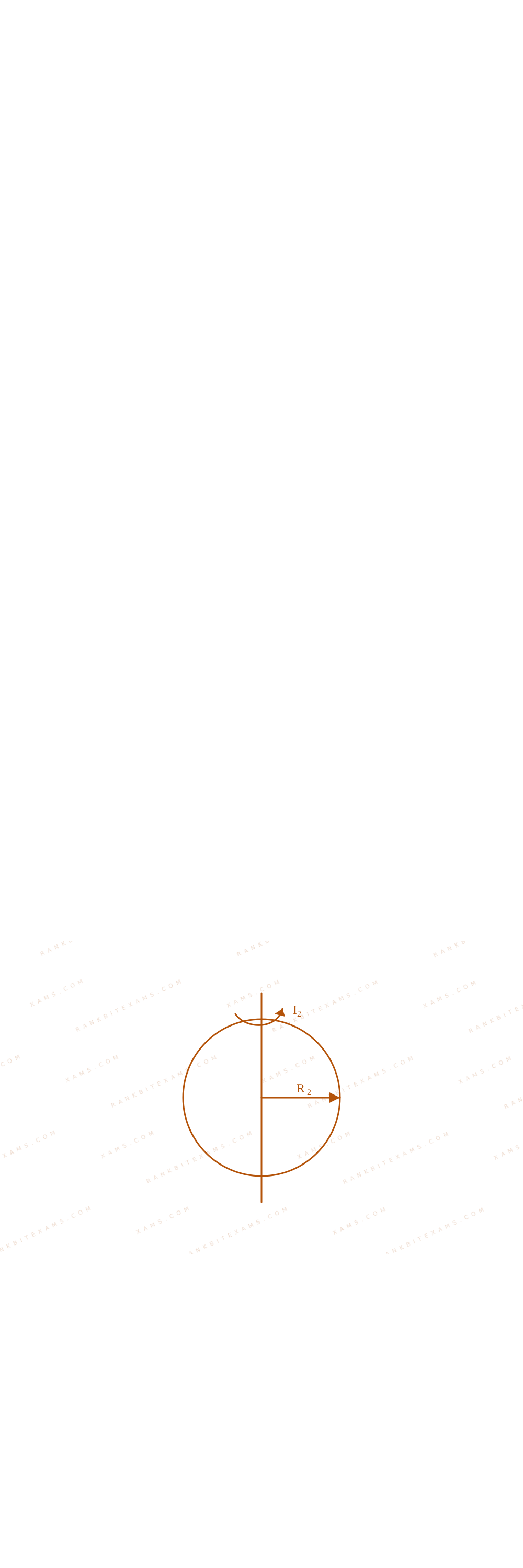
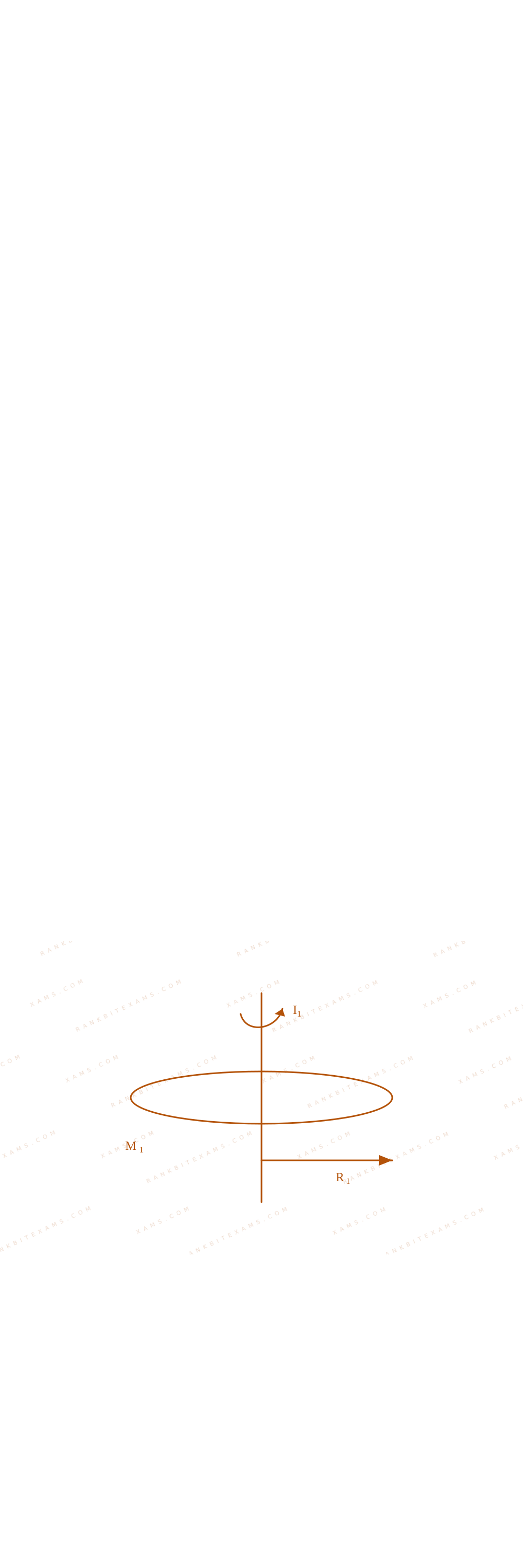
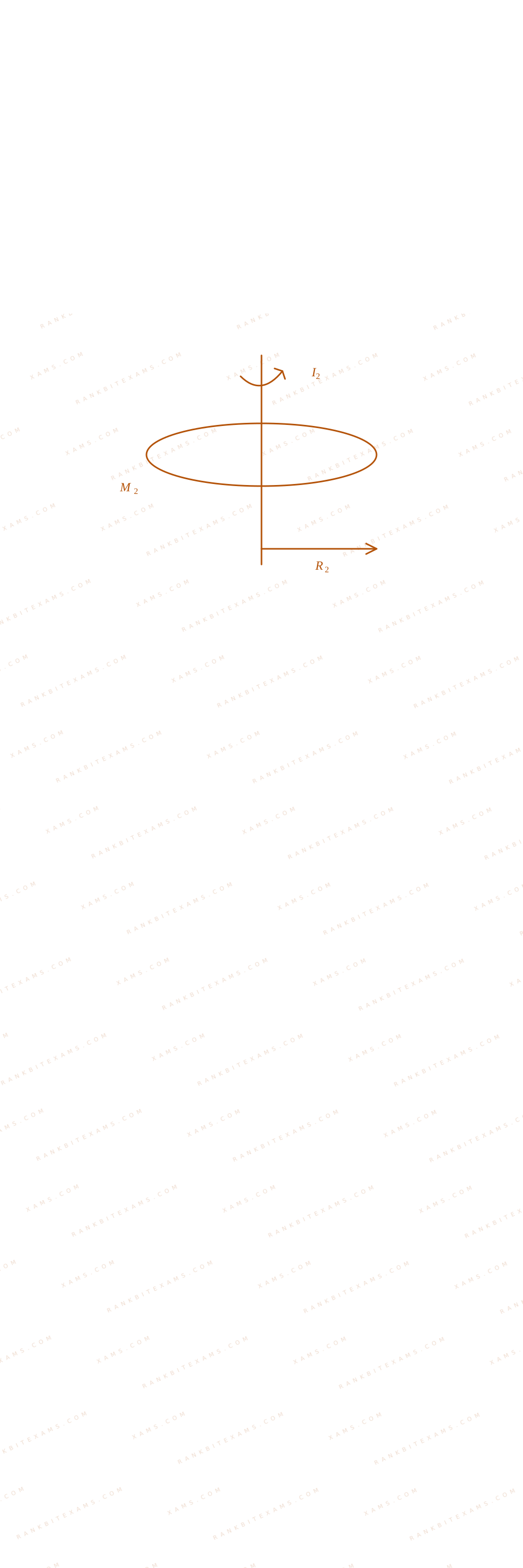
mathrmI_textdisc = fracmathrmMmathrmR_1^24, quad mathrmI_textring = fracmathrmMmathrmR_2^22, quad mathrmI_textsphere = frac2mathrmMmathrmR_1^25$\mathrm{I}_{\text{disc}} = \frac{\mathrm{M}\mathrm{R}_1^2}{4}, \quad \mathrm{I}_{\text{ring}} = \frac{\mathrm{M}\mathrm{R}_2^2}{2}, \quad \mathrm{I}_{\text{sphere}} = \frac{2\mathrm{M}\mathrm{R}_1^2}{5}$
### Core Logic
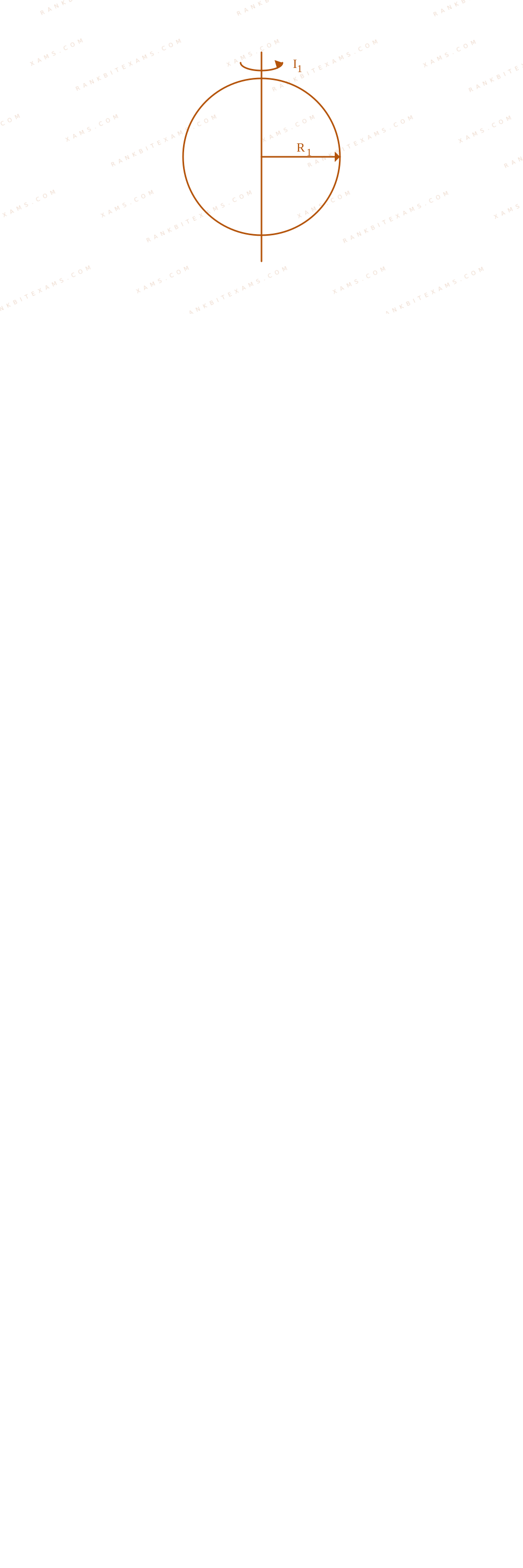
Let's list the relevant moment of inertia formulas based on their rotation axes:
Moment of inertia axial comparison steps for Q22Moment of inertia axial comparison steps for Q22Moment of inertia axial comparison steps for Q22
From the given problem statements:
fracmathrmI_textdiscmathrmI_textring = 2.5 implies fracfracmathrmMmathrmR_1^24fracmathrmMmathrmR_2^22 = frac52 implies fracmathrmR_1^2mathrmR_2^2 = 5$\frac{\mathrm{I}_{\text{disc}}}{\mathrm{I}_{\text{ring}}} = 2.5 \implies \frac{\frac{\mathrm{M}\mathrm{R}_1^2}{4}}{\frac{\mathrm{M}\mathrm{R}_2^2}{2}} = \frac{5}{2} \implies \frac{\mathrm{R}_1^2}{\mathrm{R}_2^2} = 5$
Now, evaluating the second geometric layout ratio:
fracmathrmI_textspheremathrmI_textring = mathrmn implies fracfrac2mathrmMmathrmR_1^25fracmathrmMmathrmR_2^22 = mathrmn implies frac4mathrmR_1^25mathrmR_2^2 = mathrmn$\frac{\mathrm{I}_{\text{sphere}}}{\mathrm{I}_{\text{ring}}} = \mathrm{n} \implies \frac{\frac{2\mathrm{M}\mathrm{R}_1^2}{5}}{\frac{\mathrm{M}\mathrm{R}_2^2}{2}} = \mathrm{n} \implies \frac{4\mathrm{R}_1^2}{5\mathrm{R}_2^2} = \mathrm{n}$
Substituting our radius parameter (fracmathrmR_1^2mathrmR_2^2 = 5$\frac{\mathrm{R}_1^2}{\mathrm{R}_2^2} = 5$):
mathrmn = frac45 cdot 5 = 4$\mathrm{n} = \frac{4}{5} \cdot 5 = 4$
### Step 1: Final Value Conclusion
The scale value parameter is found to be:
mathrmn = 4$\mathrm{n} = 4$
### Pattern Recognition
Be careful with rotation axis descriptions. Disc and ring components rotating along their structural diameter axes use values that are half of their standard perpendicular planar formulas.
### Evaluation Rubric / Model Answer
null
### Chapter Mix
Class 11 Physics: System of Particles and Rotational Motion
Q242025Moment of Inertia
Two iron solid discs of negligible thickness have radii mathbfR_1$\mathbf{R}_1$ and mathbfR_2$\mathbf{R}_2$ and moment of inertia mathrmI_1$\mathrm{I}_1$ and mathrmI_2$\mathrm{I}_2$ , respectively. For mathrmR_2 = 2mathrmR_1$\mathrm{R}_2 = 2\mathrm{R}_1$ , the ratio of mathrmI_1$\mathrm{I}_1$ and mathrmI_2$\mathrm{I}_2$ would be 1 / mathrmx$1 / \mathrm{x}$ , where mathrmx =$\mathrm{x} =$
Numerical Answer.Answer: 16 to 16
Solution
### Core Logic
Since mass scales with the face surface area for discs of identical thickness and material composition:
mathrmM = sigma cdot pi mathrmR^2 implies mathrmM propto mathrmR^2$\mathrm{M} = \sigma \cdot \pi \mathrm{R}^2 \implies \mathrm{M} \propto \mathrm{R}^2$Disk mass allocation scaling profile diagram for Q24Disk mass allocation scaling profile diagram for Q24mathrmM_1 = mathrmM_0, quad mathrmM_2 = sigma pi (2mathrmR_1)^2 = 4mathrmM_0$\mathrm{M}_1 = \mathrm{M}_0, \quad \mathrm{M}_2 = \sigma \pi (2\mathrm{R}_1)^2 = 4\mathrm{M}_0$
The moment of inertia formula for a disc is:
mathrmI = frac12mathrmMmathrmR^2 implies mathrmI propto mathrmMmathrmR^2 propto mathrmR^4$mathrm{I} = \frac{1}{2}\mathrm{M}\mathrm{R}^2 \implies \mathrm{I} \propto \mathrm{M}\mathrm{R}^2 \propto \mathrm{R}^4$
Calculating the ratio for the given radii configuration:
fracmathrmI_1mathrmI_2 = fracmathrmM_1 mathrmR_1^2mathrmM_2 mathrmR_2^2 = fracmathrmM_0 cdot mathrmR_1^24mathrmM_0 cdot (2mathrmR_1)^2 = frac116$\frac{\mathrm{I}_1}{\mathrm{I}_2} = \frac{\mathrm{M}_1 \mathrm{R}_1^2}{\mathrm{M}_2 \mathrm{R}_2^2} = \frac{\mathrm{M}_0 \cdot \mathrm{R}_1^2}{4\mathrm{M}_0 \cdot (2\mathrm{R}_1)^2} = \frac{1}{16}$
### Step 1: Value Convergence
Comparing this fraction to 1/mathrmx$1/\mathrm{x}$ yields:
mathrmx = 16$\mathrm{x} = 16$
### Pattern Recognition
For 2D uniform laminar objects, scaling the radius changes both the mass factor (by mathrmR^2$\mathrm{R}^2$) and the distribution distance (by mathrmR^2$\mathrm{R}^2$), resulting in an overall mathrmR^4$\mathrm{R}^4$ dependency rule.
### Evaluation Rubric / Model Answer
null
### Chapter Mix
Class 11 Physics: System of Particles and Rotational Motion
Q42025Torque and Angular Momentum
Which of the following are correct expression for torque acting on a body?
A. vectau=vecItimesvecL$\vec{\tau}=\vec{I}\timesvec{L}$
B. vectau=fracddt(vecrtimesvecp)$\vec{\tau}=\frac{d}{dt}(\vec{r}\timesvec{p})$
C. vectau=vecrtimesfracdvecpdt$\vec{\tau}=\vec{r}\times\frac{dvec{p}}{dt}$
D. vectau=Ivecalpha$\vec{\tau}=Ivec{\alpha}$
E. vectau=vecrtimesvecF$\vec{\tau}=\vec{r}\timesvec{F}$(vecr=$(\vec{r}=$ position vector; vecp=$\vec{p}=$ linear momentum; vecL=$\vec{L}=$ angular momentum; vecalpha=$\vec{\alpha}=$ angular acceleration; I=$I=$ moment of inertia; vecF=$\vec{F}=$ force; t=texttime)$t=\text{time})$
Choose the correct answer from the options given below:
A. B, D and E Only
B. C and D Only
C. B, C, D and E Only
D. A, B, D and E Only
Solution
### Related Formula
Fundamental mathematical definition of torque:
vectau = vecr times vecF
$
vec{\tau} = \vec{r} \times \vec{F}
$
Rotational analogue of Newton's second law:
vectau = fracdvecLdt = Ivecalpha
$
vec{\tau} = \frac{dvec{L}}{dt} = Ivec{\alpha}
$
Linear momentum relations:
vecL = vecr times vecp implies vectau = fracddt(vecr times vecp)
$
vec{L} = \vec{r} \times \vec{p} implies \vec{\tau} = \frac{d}{dt}(\vec{r} \times \vec{p})
$
### Core Logic
Let's check each expression sequentially:
* **A.** vectau=vecItimesvecL$\vec{\tau}=\vec{I}\timesvec{L}$ is dimensionally incorrect (Moment of inertia I$I$ is primarily treated as a tensor or scalar placeholder, not crossed directly like this).
* **B.** vectau=fracdvecLdt = fracddt(vecrtimesvecp)$\vec{\tau}=\frac{dvec{L}}{dt} = \frac{d}{dt}(\vec{r}\timesvec{p})$ is fundamentally correct.
* **C.** vectau=vecrtimesvecF = vecrtimesfracdvecpdt$\vec{\tau}=\vec{r}\timesvec{F} = \vec{r}\times\frac{dvec{p}}{dt}$ is correct since vecF = fracdvecpdt$\vec{F} = \frac{dvec{p}}{dt}$.
* **D.** vectau=Ivecalpha$\vec{\tau}=Ivec{\alpha}$ is the standard scalar component/fixed axis formulation.
* **E.** vectau=vecrtimesvecF$\vec{\tau}=\vec{r}\timesvec{F}$ is the true physical vector definition.
Thus, statements B, C, D, and E are universally correct representations.
### Pattern Recognition
Torque can be represented either through geometric structural parameters (position and force cross products) or via kinematic response properties (rate of change of angular momentum or product of rotational inertia and acceleration).
### Evaluation Rubric / Model Answer
null
### Chapter Mix
Class 11 Physics: System of Particles and Rotational Motion
Q112025Uniform Circular Motion and Dynamics
If vecL$\vec{L}$ and vecP$\vec{P}$ represent the angular momentum and linear momentum respectively of a particle of mass 'm' having position vector vecr = a(haticosomega t + hatjsinomega t)$\vec{r} = a(\hat{i}cosomega t + \hat{j}sinomega t)$. The direction of force is
A. Opposite to the direction of vecr$\vec{r}$
B. Opposite to the direction of vecL$\vec{L}$
C. Opposite to the direction of vecP$\vec{P}$
D. Opposite to the direction of vecLtimesvecP$\vec{L}\timesvec{P}$
Solution
### Related Formula
Acceleration vector equation via secondary derivation:
veca = fracd^2vecrdt^2
$\vec{a} = \frac{d^2\vec{r}}{dt^2}
$
Force equation:
vecF = mveca
$
vec{F} = mvec{a}
$
### Core Logic
Given position tracking trace:
vecr = a(haticosomega t + hatjsinomega t)
$
vec{r} = a(\hat{i}cosomega t + \hat{j}sinomega t)
$
Velocity vector vecv$\vec{v}$:
vecv = fracdvecrdt = aomega(-hatisinomega t + hatjcosomega t)
$
vec{v} = \frac{dvec{r}}{dt} = aomega(-\hat{i}sinomega t + \hat{j}cosomega t)
$
### Step 1: Differentiate to find Acceleration
veca = fracdvecvdt = aomega^2(-haticosomega t - hatjsinomega t)
$
vec{a} = \frac{dvec{v}}{dt} = aomega^2(-\hat{i}cosomega t - \hat{j}sinomega t)
$
veca = -omega^2 left[ a(haticosomega t + hatjsinomega t)
ight] = -omega^2vecr
$
vec{a} = -\omega^2 \left[ a(\hat{i}cosomega t + \hat{j}sinomega t)
ight] = -\omega^2\vec{r}
$
### Step 2: Establish Force Direction
vecF = mveca = -momega^2vecr$
vec{F} = mvec{a} = -momega^2\vec{r}$
The minus sign indicates the net centripetal pulling force aligns explicitly **opposite to the direction of vecr$\vec{r}$**.
### Pattern Recognition
The expression describes a standard uniform circular motion profile. In circular configurations, acceleration and centripetal forces point radially inward, directly opposing the outbound position tracker vector.
### Evaluation Rubric / Model Answer
null
### Chapter Mix
Class 11 Physics: Kinematics
Class 11 Physics: System of Particles and Rotational Motion
More System of Particles and Rotational Motion Questions — jee_main_2025_28_jan_evening
We Map Every Repeating Question in Competitive Exams.
Say goodbye to generic mock test fatigue. RankBit uses smart analysis to group past exam questions into their foundational Repeating Question Types. Find chapter weightage, track repeating questions, and score higher with targeted practice.
Select Your Target Exam
Choose an exam track below to find formulas per chapter and patterns.
Syncing Exam Intelligence
Mapping formulas and patterns across all tracks…
PATH A — FULL LENGTH PRACTICE
Full Mock Test Hub
Simulate real NTA exam conditions with fully tracked mocks. Time yourself against past papers.
Under Development
PATH B — TARGETED PRACTICE
Topic-wise Practice Hub
Practice past-year questions one chapter at a time. Pick an exam → subject → chapter and get every PYQ for that topic — pulled together from all past papers — with the chapter's key formulas alongside.