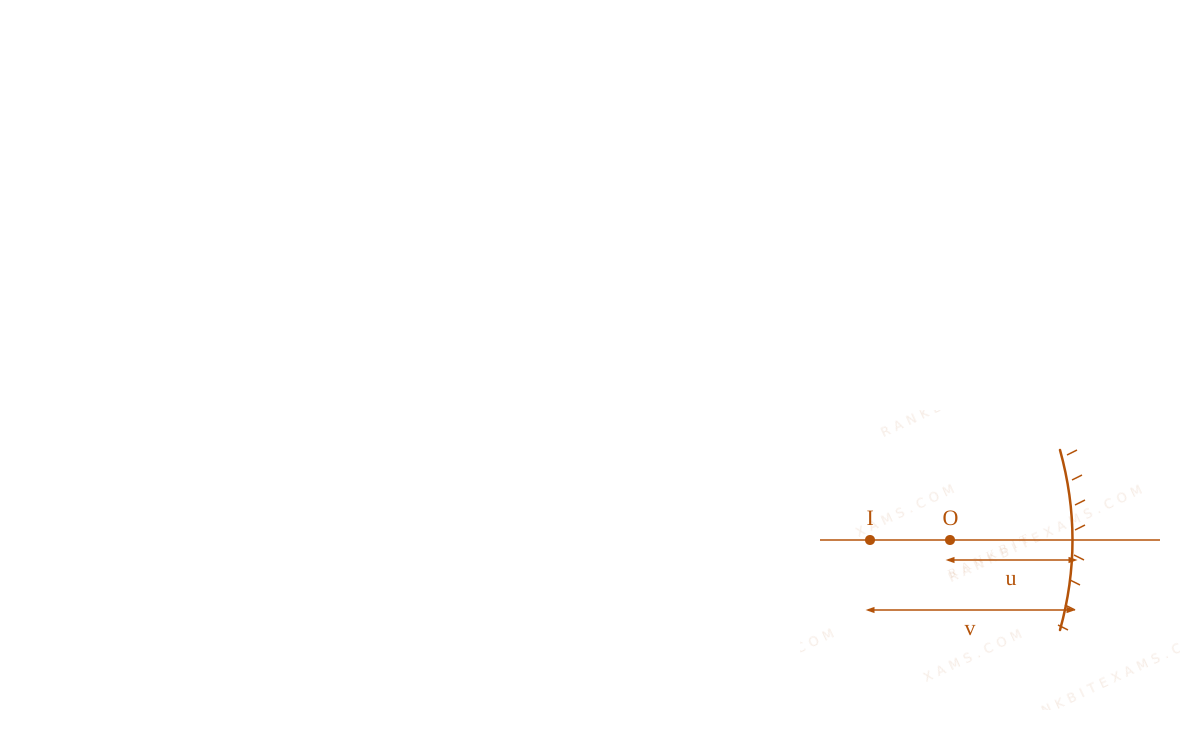
A concave mirror produces an image of an object such that the distance between the object and image is 20 cm. If the magnification of the image is -3' , then the magnitude of the radius of curvature of the mirror is:

Solution & Explanation

Related Formula

Magnification m of a mirror is given by:

m = -(v)/(u)

The mirror equation relates focal length to distance positions:

(1)/(f) = (1)/(v) + (1)/(u) f = (uv)/(u+v)

Radius of curvature R = 2f.

Core Logic

Given, magnification m = -3. This tells us the image is real and inverted[cite: 131, 757]:

-3 = -(v)/(u) v = 3u

Since both real objects and real images lie on the same side in front of a concave mirror, u and v are both negative fields. The physical distance separation between them is:

|v| - |u| = 20 3|u| - |u| = 20 2|u| = 20 |u| = 10 cm

Therefore, object distance u = -10 cm and image distance v = -30 cm .

Substitute into the focal equation formula:

f = ((-10)(-30))/(-10 - 30) = (300)/(-40) = -7.5 cm R = 2 × |f| = 2 × 7.5 = 15 cm
Step 1: Visual Diagram

The visual positioning profile tracking focal path boundaries is given below:

Reflection by Spherical Mirrors diagram for Q13 - JEE Main 2025 Evening

Pattern Recognition

A magnification of -3 tells you immediately that the object lies between the Focus (F) and Center of Curvature (C), while the image forms beyond C. This geometric layout instantly verifies that the radius value must exceed 10 cm.

Chapter Mix

Class 12 Physics: Ray Optics

Reference Study Guides

More Ray Optics Previous-Year Questions — Page 6

Q9 jee_main_2025_03_april_evening Refraction of Light and Refractive Index
A monochromatic light of frequency 5×10¹⁴~Hz travelling through air, is incident on a medium of refractive index '2'. Wavelength of the refracted light will be :
  • A. 300 nm
  • B. 600 nm
  • C. 400 nm
  • D. 500 nm

Solution

Related Formula

For light propagation, wave velocity, frequency, and wavelength are related by:

v = f λ ⇒ λₐᵢᵣ = (c)/(f)

When light passes into a medium of refractive index μ, the frequency remains constant, but the wavelength scales down to:

λmedium = λₐᵢᵣμ
Core Logic

Given parameters:

  • Frequency f = 5 × 10¹⁴~Hz
  • Speed of light in vacuum/air c ≈ 3 × 10⁸~m/s
  • Refractive index of medium μ = 2
Step 1: Calculate Wavelength in Air (Vacuum)
λₐᵢᵣ = 3 × 10⁸~m/s5 × 10¹⁴~Hz = 0.6 × 10⁻⁶~m = 600~nm
Step 2: Calculate Refracted Wavelength in Medium
λmedium = λₐᵢᵣμ = 600~nm2 = 300~nm
Pattern Recognition

Remember: Frequency is a source characteristic and never changes during refraction. Speed and wavelength both decrease by a factor of μ inside the medium.

Chapter Mix

Class 12 Physics: Ray Optics and Optical Instruments

Q jee_main_2025_07_april_morning Refraction at Plane Surfaces
A container contains a liquid with refractive index of 1.2 up to a height of 60~cm and another liquid having refractive index 1.6 is added to height H above first liquid. If viewed from above, the apparent shift in the position of bottom of container is 40~cm . The value of H is ______cm . (Consider liquids are immisible)
Numerical Answer. Answer: 80 to 80

Solution

Related Formula

The apparent shift Δ x in depth through multiple immiscible liquid layers viewed normally is the sum of the individual layer shifts:

Δ x = Σ dᵢ ( 1 - (1)/(μᵢ) )

Layer stack apparent depth diagram

Core Logic

For two liquid layers:

  • Layer 1: d₁ = 60 ~cm, μ₁ = 1.2
  • Layer 2: d₂ = H ~cm, μ₂ = 1.6
  • Total apparent shift is given as Δ x = 40 ~cm.

Step 1: Set Up and Solve the Equation

Substitute the parameters into the equation:

40 = 60 ( 1 - (1)/(1.2) ) + H ( 1 - (1)/(1.6) )

Calculate the fractional factors:

1 - (1)/(1.2) = 1 - (5)/(6) = (1)/(6) 1 - (1)/(1.6) = 1 - (5)/(8) = (3)/(8)

Substitute back:

40 = 60 ( (1)/(6) ) + H ( (3)/(8) ) 40 = 10 + (3)/(8) H (3)/(8) H = 30 H = (30 × 8)/(3) = 80 ~cm
Pattern Recognition

Sees: Two immiscible liquid layers with normal viewing shift. Shortcut: First layer has real depth 60, index 1.2

Pattern Recognition

Sees: Two immiscible liquid layers with normal viewing shift. Shortcut: First layer has real depth 60, index 1.2 $\impliesapparent shift is60 \times (1 - 5/6) = 10 \mathrm{~cm}. Since total shift is 40, the second layer must contribute30 \mathrm{~cm}of shift. Thus,H \times (1 - 5/8) = 30 \implies H \times (3/8) = 30 \implies H = 80 \mathrm{~cm}$.

Chapter Mix

Class 12 Physics: Ray Optics and Optical Instruments

Q8 jee_main_2025_07_april_morning Refraction at Spherical Surfaces and by Lenses
A lens having refractive index 1.6 has focal length of 12cm , when it is in air. Find the focal length of the lens when it is placed in water. (Take refractive index of water as 1.28)
  • A. 355mm
  • B. 288mm
  • C. 555mm
  • D. 655mm

Solution

Related Formula

Lens Maker's Formula in a surrounding medium with refractive index μm is:

(1)/(f) = ( (μL)/(μm) - 1 ) ( (1)/(R₁) - (1)/(R₂) )
Core Logic

In air (μm = 1):

(1)/(12) = (1.6 - 1) ( (1)/(R₁) - (1)/(R₂) ) (1)/(12) = 0.6 ( (1)/(R₁) - (1)/(R₂) ) ( (1)/(R₁) - (1)/(R₂) ) = (1)/(12 × 0.6) = (10)/(72)
Step 1: Calculate Focal Length in Water

In water (μm = 1.28):

(1)/(fw) = ( (1.6)/(1.28) - 1 ) ( (10)/(72) )

Simplify the relative index factor:

(1.6)/(1.28) = (160)/(128) = 1.25 (1)/(fw) = (1.25 - 1) ( (10)/(72) ) = 0.25 × (10)/(72) = (1)/(4) × (10)/(72) = (10)/(288) fw = 28.8 ~cm = 288 ~mm
Pattern Recognition

Sees: Lens index

Pattern Recognition

Sees: Lens index $\mu_L = 1.6, focal length in airf_a, and focal length in mediumf_m. Shortcut: Use the ratio of focal lengths directly:

(fm)/(fₐ) = (μL - 1)/((μL)/(μm) - 1) = (0.6)/((1.6)/(1.28) - 1) = (0.6)/(0.25) = 2.4fm = 2.4 × 12 = 28.8 ~cm = 288 ~mm$
Chapter Mix

Class 12 Physics: Ray Optics and Optical Instruments

Q10 jee_main_2025_07_april_morning Refraction at Spherical Surfaces and by Lenses
Two thin convex lenses of focal lengths 30~cm and 10~cm are placed coaxially, 10~cm apart. The power of this combination is :
  • A. 5 D
  • B. 1 ~D
  • C. 20D
  • D. 10D

Solution

Related Formula

The equivalent focal length feq of two thin coaxially aligned lenses separated by distance d is given by:

1feq = (1)/(f₁) + (1)/(f₂) - (d)/(f₁ f₂)

The equivalent power in diopters (D) when focal lengths are in meters is:

P = 1feq
Core Logic

Given parameters:

  • f₁ = 30 ~cm = 0.3 ~m
  • f₂ = 10 ~cm = 0.1 ~m
  • d = 10 ~cm = 0.1 ~m
Step 1: Calculate Power

Substitute parameters into the equivalent focal length equation:

1feq = (1)/(0.3) + (1)/(0.1) - (0.1)/(0.3 × 0.1) 1feq = (1)/(0.3) + 10 - (1)/(0.3) 1feq = 10 ~m⁻¹ P = 10 ~D
Pattern Recognition

Sees: Lenses separated by distance d where d = f₂. Shortcut: Notice that d = f₂ = 10 ~cm. When the separation distance between two thin lenses equals the focal length of the second lens, the equivalent power simplifies directly to P = P₂ = 1/f₂ = 10 ~D since the terms 1/f₁ and d/(f₁ f₂) cancel out.

Chapter Mix

Class 12 Physics: Ray Optics and Optical Instruments

Q jee_main_2025_08_april_evening Refraction through Lenses
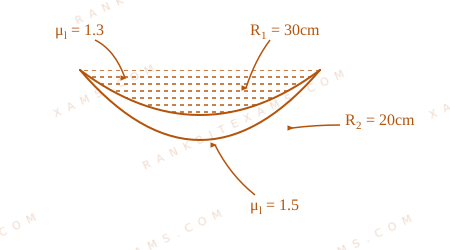
A concave-convex lens of refractive index 1.5 and the radii of curvature of its surfaces are 30~cm and 20~cm, respectively. The concave surface is upwards and is filled with a liquid of refractive index 1.3. The focal length of the liquid-glass combination will be
  • A. (500)/(11)~cm
  • B. (800)/(11)~cm
  • C. (700)/(11)~cm
  • D. (600)/(11)~cm

Solution

Related Formula
1feq = 1fliquid + 1fglass (1)/(f) = (μ - 1)((1)/(R₁) - (1)/(R₂))
Core Logic

Let's find the focal length of each individual lens in the combination:

  • Liquid Lens:
  • Refractive index, μl = 1.3
  • The upper surface is flat (exposed to air): R₁ = ∞
  • The lower surface matches the upward concave surface of the glass lens: R₂ = -30~cm
1fliquid = (1.3 - 1) ((1)/(∞) - (1)/(-30)) = 0.3 × (1)/(30) = (1)/(100)~cm⁻¹
  • Glass Lens:
  • Refractive index, μg = 1.5
  • First surface radius (concave upward), R₁ = -30~cm
  • Second surface radius (convex downward), R₂ = -20~cm (following light path downward)
1fglass = (1.5 - 1) ((1)/(-30) - (1)/(-20)) = 0.5 (-(1)/(30) + (1)/(20)) = 0.5 ((1)/(60)) = (1)/(120)~cm⁻¹

Ray Optics combination diagram

Step 1: Combination Focal Length

Add the powers of both lenses:

1feq = (1)/(100) + (1)/(120) = (6 + 5)/(600) = (11)/(600) feq = (600)/(11)~cm
Pattern Recognition

Sees: Glass lens with liquid poured on top → Think of it as a double lens system (liquid lens + glass lens). Trap: Be extremely careful with sign conventions for radii of curvature of the boundaries! Assume light travels from air through the liquid and then through the glass. This defines a consistent spatial propagation direction. ✓

Chapter Mix

Class 12 Physics: Ray Optics

More Ray Optics Questions — jee_main_2025_28_jan_evening

Practice all Ray Optics previous-year questions →

Rankbit System
JEE Physics: Waves (+15.5%) | Electrostatics: Concentric Shells (-29.7%) | Modern Physics: Photoelectric Clones (+34.2%) | Mathematics: Definite Integrals (+18.1%) | Chemistry: Coordination Splitting (-11.4%) | JEE Physics: Waves (+15.5%) | Electrostatics: Concentric Shells (-29.7%) | Modern Physics: Photoelectric Clones (+34.2%) | Mathematics: Definite Integrals (+18.1%) | Chemistry: Coordination Splitting (-11.4%)