Rankbit System
JEE Physics: Waves (+15.5%) | Electrostatics: Concentric Shells (-29.7%) | Modern Physics: Photoelectric Clones (+34.2%) | Mathematics: Definite Integrals (+18.1%) | Chemistry: Coordination Splitting (-11.4%) | JEE Physics: Waves (+15.5%) | Electrostatics: Concentric Shells (-29.7%) | Modern Physics: Photoelectric Clones (+34.2%) | Mathematics: Definite Integrals (+18.1%) | Chemistry: Coordination Splitting (-11.4%)

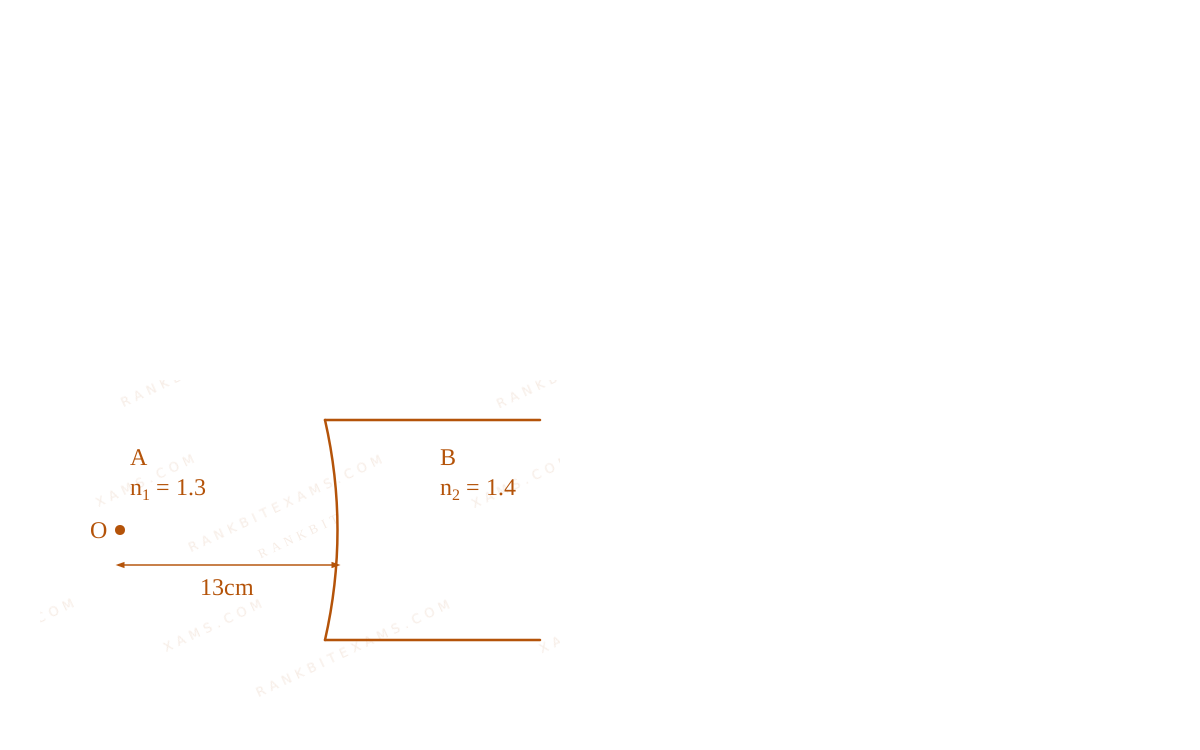
In a long glass tube, mixture of two liquids A and B with refractive indices 1.3 and 1.4 respectively, forms a convex refractive meniscus towards A. If an object placed at 13mathrmcm from the vertex of the meniscus in A forms an image with a magnification of -2 then the radius of curvature of meniscus is :

Solution & Explanation

### Related Formula For refraction at a single spherical surface separating two mediums : fracn_2v - fracn_1u = fracn_2 - n_1R Linear magnification for a spherical refracting boundary is given by: m = fracv / n_2u / n_1 = fracv cdot n_1u cdot n_2$ ### Core Logic Given parameters from the text [cite: 17, 651, 654]: * Refractive index of Medium A, $n_1 = 1.3$ * Refractive index of Medium B, $n_2 = 1.4$ * Object distance, $u = -13 text cm$ * Magnification, $m = -2$ Using the magnification formula to locate image position $v$ : -2 = \frac{v \cdot 1.3}{(-13) \cdot 1.4} -2 = \frac{1.3 \cdot v}{-18.2} \implies 1.3 v = 36.4 \implies v = 28 \text{ cm} Now substitute $u = -13$, $v = 28$, $n_1 = 1.3$, $n_2 = 1.4$ into the boundary equation: \frac{1.4}{28} - \frac{1.3}{-13} = \frac{1.4 - 1.3}{R} \frac{1}{20} + \frac{1}{10} = \frac{0.1}{R} \frac{1 + 2}{20} = \frac{0.1}{R} \implies \frac{3}{20} = \frac{1}{10R} 30 R = 20 \implies R = \frac{2}{3} \text{ cm}$ ### Step 1: Visual Context The visual system configuration of the refracting interface is tracked here:
Refraction at Spherical Surfaces diagram for Q6 - JEE Main 2025 Evening
### Pattern Recognition Keep precise track of sign conventions for single spherical surfaces. A convex meniscus towards A means the center of curvature lies inside medium B, meaning
R$ will mathematically return as a positive parameter. ### Evaluation Rubric / Model Answer null ### Chapter Mix Class 12 Physics: Ray Optics

Reference Study Guides

More Ray Optics Previous-Year Questions

Q4 2025 Refraction through Lenses
A slanted object AB is placed on one side of convex lens as shown in the diagram. The image is formed on the opposite side. Angle made by the image with principal axis is:
Slanted object diagram for Q4 - JEE Main 2025 Morning
A slanted object AB forming an angle alpha with the principal axis of a convex lens.
  • A. -fracalpha2
  • B. -45^circ
  • C. +45^circ
  • D. -alpha

Solution

### Related Formula frac1v - frac1u = frac1f m = fracvu m_L = fracdvdu = m^2 ### Core Logic Let the pole of the lens be the origin. Point A of the slanted object lies on the principal axis at u = -30mathrm~cm from the convex lens (f = +20mathrm~cm). Let's locate the image of A: frac1v - frac1-30 = frac120 implies frac1v = frac120 - frac130 = frac160 implies v = +60mathrm~cm Thus, the transverse magnification m at point A is: m = fracvu = frac60-30 = -2 Since the longitudinal extension of the object is small (du = 1mathrm~cm along the axis): dv = m^2 du = (-2)^2 times 1 = 4mathrm~cm The height of the object at point B is h_o = 2mathrm~cm. Its image height is: h_i = m cdot h_o = (-2) times 2 = -4mathrm~cm Now, compute the angle beta made by the image with the principal axis: tanbeta = frach_idv = frac-4mathrm~cm4mathrm~cm = -1 beta = -45^circ ### Step 1: Final Conclusion The angle made by the image with the principal axis is -45^{\circ}. ### Pattern Recognition For small objects tilted with respect to the principal axis: 1. Axial displacement scales by m^2. 2. Transverse height scales by m. 3. Slope scales by \frac{m}{m^2} = \frac{1}{m}$. ### Evaluation Rubric / Model Answer null ### Chapter Mix Class 12 Physics: Ray Optics
Q17 2025 Refraction at Spherical Surfaces
A spherical surface separates two media of refractive indices 1 and 1.5 as shown in the figure. Distance of the image of an object 'O', is: (C is the center of curvature of the spherical surface and R is the radius of curvature)
Spherical refracting surface separates two media for Q17
A spherical surface of radius 0.4 m separating media of n1 = 1 and n2 = 1.5, with object O at 0.2 m.
  • A. 0.24mathrm~m right to the spherical surface
  • B. 0.4mathrm~m left to the spherical surface
  • C. 0.24mathrm~m left to the spherical surface
  • D. 0.4mathrm~m right to the spherical surface

Solution

### Related Formula $fracmu_2v - fracmu_1u = fracmu_2 - mu_1R ### Core Logic From the given diagram, using the standard Cartesian sign convention with the pole of the surface as origin: - Refractive index of first medium, \mu_1 = 1.0 - Refractive index of second medium, \mu_2 = 1.5 - Object distance, u = -0.2\mathrm{~m} (left of surface) - Radius of curvature, R = +0.4\mathrm{~m} (convex surface towards first medium, center C lies in second medium) Applying the formula for refraction at a spherical interface: frac1.5v - frac1-0.2 = frac1.5 - 10.4 frac1.5v + 5.0 = frac0.50.4 = 1.25 frac1.5v = 1.25 - 5.0 = -3.75 v = frac1.5-3.75 = -0.4mathrm~m The negative sign indicates that the image is formed to the left of the spherical refracting surface. ### Step 1: Final Conclusion The image of object 'O' is formed 0.4\mathrm{~m}$ left to the spherical surface. ### Pattern Recognition Ensure to strictly implement the coordinate sign conventions: the direction of incident light is positive. Since light goes from left to right, left-side points have a negative coordinate, and right-side points have a positive coordinate. ### Evaluation Rubric / Model Answer null ### Chapter Mix Class 12 Physics: Ray Optics
Q6 2025 Refraction through Lenses
A concave-convex lens of refractive index 1.5 and the radii of curvature of its surfaces are 30mathrm~cm and 20mathrm~cm, respectively. The concave surface is upwards and is filled with a liquid of refractive index 1.3. The focal length of the liquid-glass combination will be
  • A. frac50011mathrm~cm
  • B. frac80011mathrm~cm
  • C. frac70011mathrm~cm
  • D. frac60011mathrm~cm

Solution

### Related Formula frac1f_texteq = frac1f_textliquid + frac1f_textglass frac1f = (mu - 1)left(frac1R_1 - frac1R_2right) ### Core Logic Let's find the focal length of each individual lens in the combination: 1. **Liquid Lens**: - Refractive index, mu_l = 1.3 - The upper surface is flat (exposed to air): R_1 = infty - The lower surface matches the upward concave surface of the glass lens: R_2 = -30mathrm~cm frac1f_textliquid = (1.3 - 1) left(frac1infty - frac1-30right) = 0.3 times frac130 = frac1100mathrm~cm^-1 2. **Glass Lens**: - Refractive index, mu_g = 1.5 - First surface radius (concave upward), R_1 = -30mathrm~cm - Second surface radius (convex downward), R_2 = -20mathrm~cm (following light path downward) frac1f_textglass = (1.5 - 1) left(frac1-30 - frac1-20right) = 0.5 left(-frac130 + frac120right) = 0.5 left(frac160right) = frac1120mathrm~cm^-1 ### Step 1: Combination Focal Length Add the powers of both lenses: frac1f_texteq = frac1100 + frac1120 = frac6 + 5600 = frac11600 f_texteq = frac60011mathrm~cm ### Pattern Recognition Sees: Glass lens with liquid poured on top → Think of it as a double lens system (liquid lens + glass lens). Trap: Be extremely careful with sign conventions for radii of curvature of the boundaries! Assume light travels from air through the liquid and then through the glass. This defines a consistent spatial propagation direction. ✓ ### Evaluation Rubric / Model Answer null ### Chapter Mix Class 12 Physics: Ray Optics
Q12 2025 Refraction through Lenses
A convex lens of focal length 30mathrm~cm is placed in contact with a concave lens of focal length 20mathrm~cm. An object is placed at 20mathrm~cm to the left of this lens system. The distance of the image from the lens in mathrm~cm is:
  • A. 30
  • B. 45
  • C. frac607
  • D. 15

Solution

### Related Formula $frac1f_texteq = frac1f_1 + frac1f_2 frac1v - frac1u = frac1f where, f_1 = focal length of the convex lens f_2 = focal length of the concave lens u = object distance v = image distance ### Core Logic Given parameters: - Convex lens: f_1 = +30\mathrm{~cm} - Concave lens: f_2 = -20\mathrm{~cm} - Object distance: u = -20\mathrm{~cm} (placed to the left of the lens system) First, find the equivalent focal length of the lens combination in contact: frac1f_texteq = frac130 + frac1-20 = frac2 - 360 = -frac160 implies f_texteq = -60mathrm~cm ### Step 1: Image Distance Calculation Use the thin lens formula: frac1v - frac1u = frac1f_texteq frac1v - frac1-20 = frac1-60 implies frac1v + frac120 = -frac160 frac1v = -frac160 - frac120 = frac-1 - 360 = -frac460 = -frac115 v = -15mathrm~cm ### Pattern Recognition Sees: Lenses in contact + object distance → Combination focal length first, then thin lens formula. Trap: Keep proper sign conventions. An object to the left implies u = -20\mathrm{~cm}. A negative image distance v = -15\mathrm{~cm} means a virtual image formed on the same side as the object. The question asks for "distance", which is the magnitude: |-15| = 15\mathrm{~cm}$. ✓ ### Evaluation Rubric / Model Answer null ### Chapter Mix Class 12 Physics: Ray Optics

More Ray Optics Questions — jee_main_2025_28_jan_evening

Practice all Ray Optics previous-year questions →

YOUR FIRST PREP STEP STARTS HERE

We Map Every Repeating Question in Competitive Exams.

Say goodbye to generic mock test fatigue. RankBit uses smart analysis to group past exam questions into their foundational Repeating Question Types. Find chapter weightage, track repeating questions, and score higher with targeted practice.

Select Your Target Exam

Choose an exam track below to find formulas per chapter and patterns.

Syncing Exam Intelligence

Mapping formulas and patterns across all tracks…

PATH A — FULL LENGTH PRACTICE

Full Mock Test Hub

Simulate real NTA exam conditions with fully tracked mocks. Time yourself against past papers.

Under Development
PATH B — TARGETED PRACTICE

Topic-wise Practice Hub

Practice past-year questions one chapter at a time. Pick an exam → subject → chapter and get every PYQ for that topic — pulled together from all past papers — with the chapter's key formulas alongside.

Loading Questions... Browse Topics
Latest from the Blog
View all →

Loading articles...