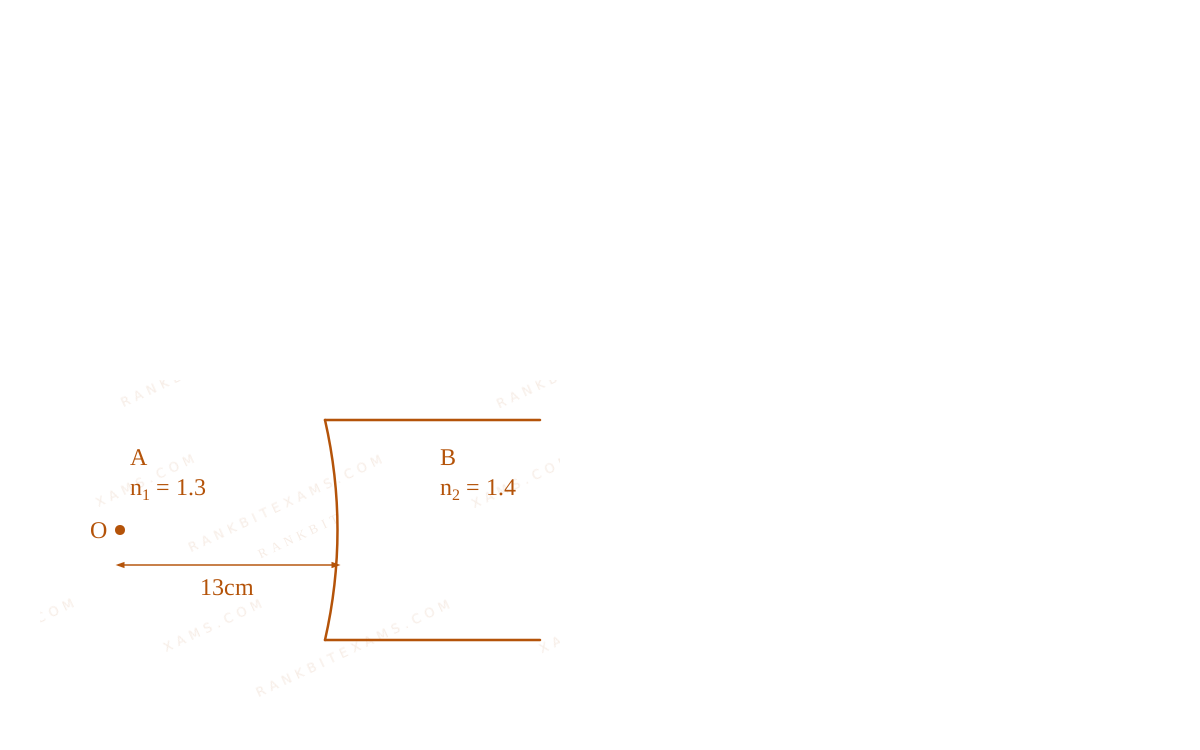
A concave mirror produces an image of an object such that the distance between the object and image is 20 \, textcm. If the magnification of the image is -3' , then the magnitude of the radius of curvature of the mirror is:

Solution & Explanation

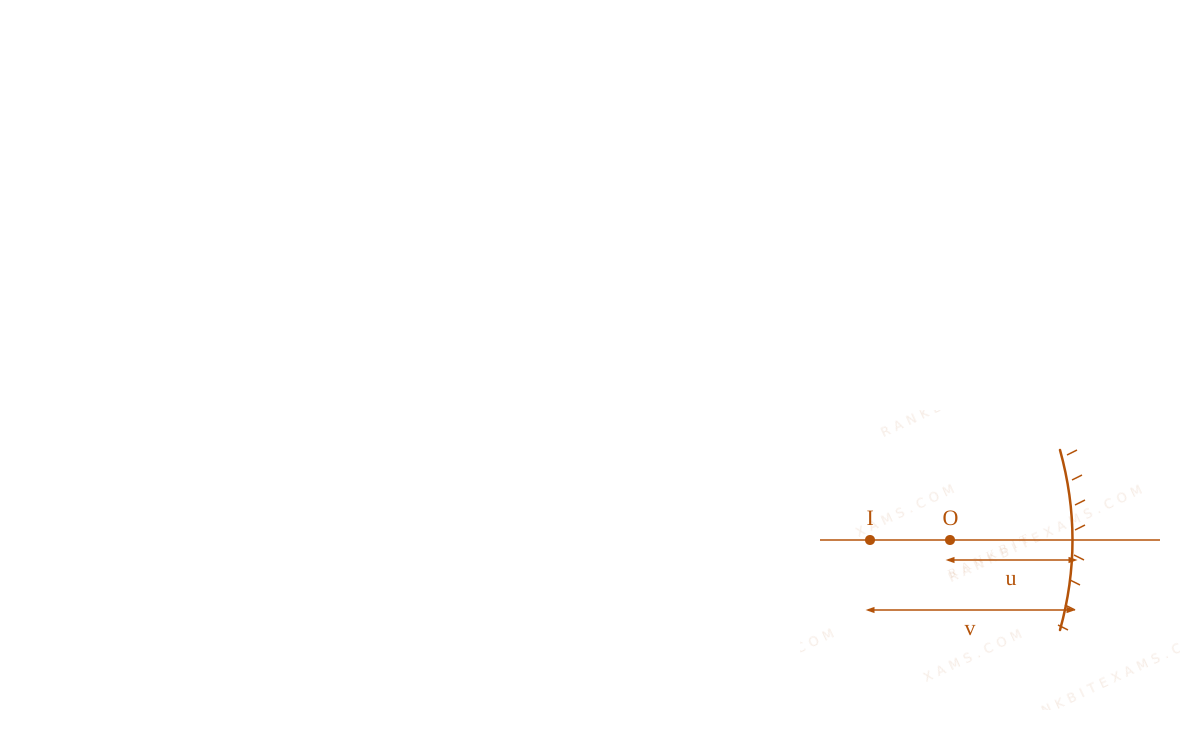
### Related Formula Magnification m of a mirror is given by: m = -fracvu The mirror equation relates focal length to distance positions: frac1f = frac1v + frac1u implies f = fracuvu+v Radius of curvature R = 2f. ### Core Logic Given, magnification m = -3. This tells us the image is real and inverted[cite: 131, 757]: -3 = -fracvu implies v = 3u Since both real objects and real images lie on the same side in front of a concave mirror, u and v are both negative fields. The physical distance separation between them is: |v| - |u| = 20 implies 3|u| - |u| = 20 implies 2|u| = 20 implies |u| = 10 text cm Therefore, object distance u = -10 text cm and image distance v = -30 text cm . Substitute into the focal equation formula: f = frac(-10)(-30)-10 - 30 = frac300-40 = -7.5 text cm R = 2 times |f| = 2 times 7.5 = 15 text cm ### Step 1: Visual Diagram The visual positioning profile tracking focal path boundaries is given below:
Reflection by Spherical Mirrors diagram for Q13 - JEE Main 2025 Evening
### Pattern Recognition A magnification of -3 tells you immediately that the object lies between the Focus (F) and Center of Curvature (C), while the image forms beyond C. This geometric layout instantly verifies that the radius value must exceed 10text cm. ### Evaluation Rubric / Model Answer null ### Chapter Mix Class 12 Physics: Ray Optics

Reference Study Guides

More Ray Optics Previous-Year Questions — Page 10

Q34 jee_main_2024_31_jan_morning Prism Deviation
The refractive index of a prism with apex angle A is cot(A/2). The angle of minimum deviation is :
  • A. delta_mathrmm = 180^circ - A
  • B. delta_mathrmm = 180^circ - 3A
  • C. delta_mathrmm = 180^circ - 4A
  • D. delta_mathrmm = 180^circ - 2A

Solution

### Related Formula mu = fracsinleft(fracA + delta_m2right)sinleft(fracA2right) ### Core Logic Given that the refractive index mu = cotleft(fracA2right). Substituting this into the prism formula: cotleft(fracA2right) = fracsinleft(fracA + delta_m2right)sinleft(fracA2right) fraccosleft(fracA2right)sinleft(fracA2right) = fracsinleft(fracA + delta_m2right)sinleft(fracA2right) Equating the numerators: cosleft(fracA2right) = sinleft(fracA + delta_m2right) We can rewrite cosine in terms of sine: sinleft(fracpi2 - fracA2right) = sinleft(fracA + delta_m2right) ### Step 2: Solve for Deviation Comparing the angles inside the sine functions: fracpi2 - fracA2 = fracA2 + fracdelta_m2 Multiply the entire equation by 2: pi - A = A + delta_m delta_m = pi - 2A Converting radians to degrees: delta_m = 180^circ - 2A ### Pattern Recognition Whenever refractive index mu = cot(A/2), the relation sin(90^circ - A/2) strictly matches the prism sine equation, meaning minimum deviation delta_m is always 180^circ - 2A. ### Evaluation Rubric / Model Answer null ### Chapter Mix Class 12 Physics: Ray Optics And Optical Instruments

More Ray Optics Questions — jee_main_2025_28_jan_evening

Practice all Ray Optics previous-year questions →

Rankbit System
JEE Physics: Waves (+15.5%) | Electrostatics: Concentric Shells (-29.7%) | Modern Physics: Photoelectric Clones (+34.2%) | Mathematics: Definite Integrals (+18.1%) | Chemistry: Coordination Splitting (-11.4%) | JEE Physics: Waves (+15.5%) | Electrostatics: Concentric Shells (-29.7%) | Modern Physics: Photoelectric Clones (+34.2%) | Mathematics: Definite Integrals (+18.1%) | Chemistry: Coordination Splitting (-11.4%)