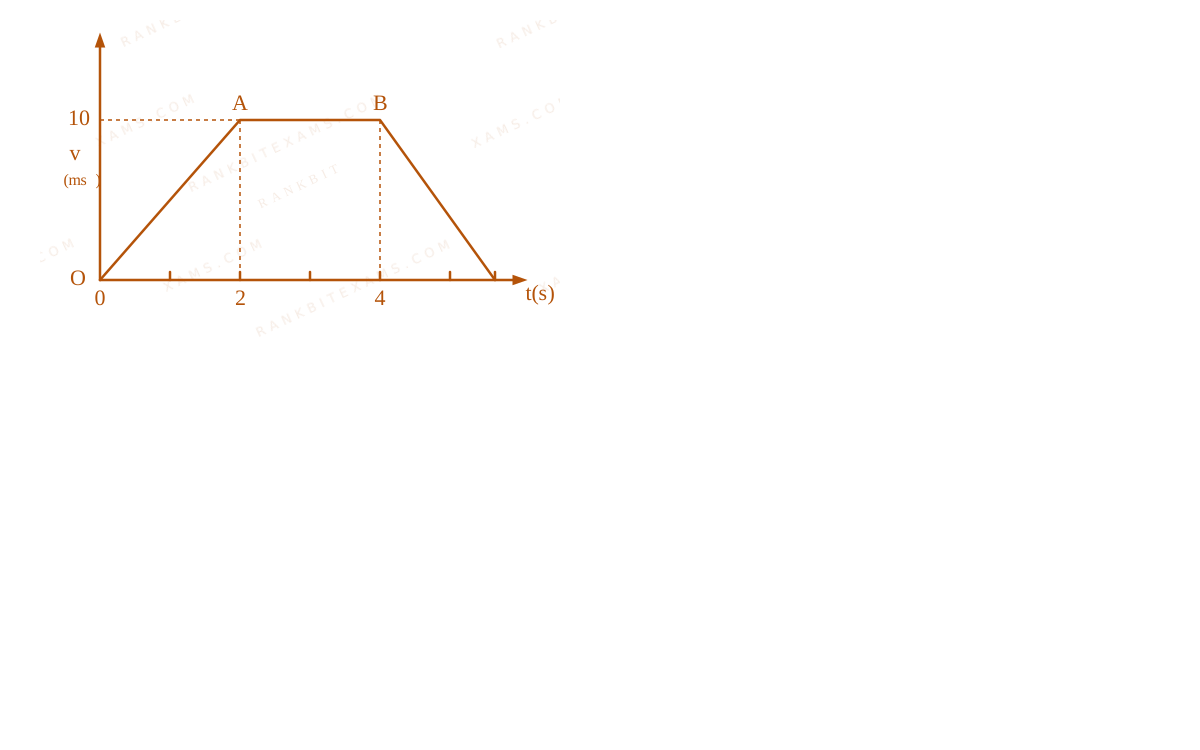
The velocity-time graph of an object moving along a straight line is shown in figure. What is the distance covered by the object between t = 0 to t = 4s ?
Velocity Time Graphs diagram for Q9 - JEE Main 2025 Evening
The velocity-time profile tracking motion across consecutive geometric shapes up to 4 seconds.

Solution & Explanation

Related Formula

The distance traveled by an object equals the total area enclosed under its velocity-time (v-t) plot along the time axis, treating all regional boundaries as strictly positive metrics:

Distance = ∫ |v| dt
Core Logic

From the geometric grid profile between t = 0 and t = 4 s:

  • First Region (t=0 to t=2 s): Forms a \right-angled \triangle with base = 2 s and peak height = 10 ms⁻¹.
Area₁ = (1)/(2) × 2 × 10 = 10 m
  • Second Region (t=2 to t=4 s): Forms a standard rectangle with width = (4 - 2) = 2 s and height = 10 ms⁻¹.
Area₂ = 2 × 10 = 20 m

Summing the areas together to extract total displacement path:

Total Distance = 10 + 20 = 30 m
Pattern Recognition

Always differentiate between distance and displacement on graph tracks. Displacement treats components below the axis as negative fields, while distance calculates absolute geometric magnitudes without direction.

Chapter Mix

Class 11 Physics: Motion in a Straight Line

Reference Study Guides

More Motion in a Straight Line Previous-Year Questions — Page 3

Q25 jee_main_2025_02_april_morning Motion in a Straight Line
A person travelling on a straight line moves with a uniform velocity v₁ for a distance x and with a uniform velocity v₂ for the next (3)/(2)x distance. The average velocity in this motion is (50)/(7)~m/s. If v₁ is 5~m/s then v₂ = ____ m/s.
Numerical Answer. Answer: 10 to 10

Solution

Related Formula
vavg = Total DistanceTotal Time
Core Logic

Let's find the time taken for each section of the motion:

  • First section of distance x with velocity v₁ = 5~m/s:
t₁ = (x)/(v₁) = (x)/(5)
  • Second section of distance (3)/(2)x with velocity v₂:
t₂ = (3x/2)/(v₂) = (3x)/(2v₂)

Total distance is:

dtotal = x + (3)/(2)x = (5)/(2)x

Average velocity is:

vavg = dtotalt₁ + t₂ = ((5)/(2)x)/((x)/(5) + (3x)/(2v₂))

We are given vavg = (50)/(7)~m/s. Equating the two values (noting x cancels out):

(50)/(7) = ((5)/(2))/((1)/(5) + (3)/(2v₂))

Divide both sides by 5:

(10)/(7) = ((1)/(2))/((1)/(5) + (3)/(2v₂)) 10 ((1)/(5) + (3)/(2v₂)) = (7)/(2) 2 + (15)/(v₂) = 3.5 (15)/(v₂) = 1.5 v₂ = (15)/(1.5) = 10~m/s
Step 1: Final Conclusion

The velocity v₂ is 10~m/s.

Pattern Recognition

Never take simple arithmetic averages of velocities! Average velocity must always be calculated as Total DistanceTotal Time. Because total distance and time intervals are proportional to x, x cleanly cancels out.

Chapter Mix

Class 11 Physics: Kinematics

Q11 jee_main_2025_03_april_evening Projectile Motion
A particle is projected with velocity u so that its horizontal range is three times the maximum height attained by it. The horizontal range of the projectile is given as (nu²)/(25g) , where value of n is: (Given ' g' is the acceleration due to gravity).
  • A. 6
  • B. 18
  • C. 12
  • D. 24

Solution

Related Formula

For a projectile with launch speed u and angle θ:

  • Horizontal Range:
R = (u² (2θ))/(g) = (2 u² θ θ)/(g)
  • Maximum Height:
H = (u² ²θ)/(2g)

The general ratio linking range and maximum height is:

θ = (4H)/(R)
Core Logic

Given state:

R = 3H ⇒ (H)/(R) = (1)/(3)
Step 1: Determine the projection angle (θ)

Substitute the ratio into the relation:

θ = 4 ((H)/(R)) = 4 ((1)/(3)) = (4)/(3)

This is a standard Pythagorean triangle angle:

θ = (4)/(5), θ = (3)/(5)
Step 2: Compute the horizontal range (R)
R = (2 u² θ θ)/(g) R = (2 u² ((4)/(5)) ((3)/(5)))/(g) = (24 u²)/(25 g)

Comparing this with the given format (nu²)/(25g):

n = 24

Pattern Recognition

The relation θ = 4H/R is an essential identity in projectile dynamics. Whenever R = k H, then θ = 4/k. Recognizing standard angles like θ = 4/3 or 3/4 directly yields trigonometric values immediately.

Chapter Mix

Class 11 Physics: Motion in a Plane

Q14 jee_main_2025_03_april_evening Kinematics and Derivative Relations
A particle moves along the x-axis and has its displacement x varying with time t according to the equation x=c₀(t²-2)+c(t-2)² where c₀ and c are constants of appropriate dimensions. Then, which of the following statements is correct?
  • A. the acceleration of the particle is 2c₀
  • B. the acceleration of the particle is 2c
  • C. the initial velocity of the particle is 4c
  • D. the acceleration of the particle is 2(c+c₀)

Solution

Related Formula

In rectilinear kinematics:

  • Velocity:
v = (dx)/(dt)
  • Acceleration:
a = (dv)/(dt) = (d²x)/(dt²)
Core Logic

Given position-time function:

x(t) = c₀ (t² - 2) + c (t - 2)²
Step 1: Differentiate once to get velocity (
$
v = (dx)/(dt) = (d)/(dt)[c₀(t² - 2)] + (d)/(dt)[c(t-2)²]v = c₀ (2t) + c · 2(t-2) = 2 c₀ t + 2 c(t - 2)
Step 2: Differentiate again to get acceleration (
$
a = (dv)/(dt) = (d)/(dt)[2 c₀ t + 2 c(t - 2)]a = 2 c₀ + 2 c = 2(c + c₀)

This shows acceleration is constant and equals

This shows acceleration is constant and equals $2(c + c_0), matching Statement (4).

Pattern Recognition

Whenever a position function is a pure quadratic polynomial in

Pattern Recognition

Whenever a position function is a pure quadratic polynomial in $t, the acceleration is constant and equal to2 \timesthe coefficient of thet^2term. Rewritingx(t):

x(t) = (c₀ + c)t² - 4ct + (4c - 2c₀)

The coefficient of

The coefficient of $t^2is(c_0 + c). Thus, acceleration is2(c_0 + c)$ directly.

Chapter Mix

Class 11 Physics: Motion in a Straight Line

Q12 jee_main_2025_07_april_morning Projectile Motion
Two projectiles are fired from ground with same initial speeds from same point at angles (45° + α) and (45° - α) with horizontal direction. The ratio of their times of flights is
  • A. 1
  • B. (1 - α)/(1 + α)
  • C. (1 + 2α)/(1 - 2α)
  • D. (1 + α)/(1 - α)

Solution

Related Formula

The time of flight T of a projectile launched with speed u at an angle θ with the horizontal is:

T = (2u θ)/(g)
Core Logic

The launch angles of the two projectiles are:

θ₁ = 45^° + αθ₂ = 45^° - α

Since they have the same speed

Since they have the same speed $u:

(T₁)/(T₂) = ( (45^° + α))/( (45^° - α))
Step 1: Simplify Trigonometric Ratio

Using the angle sum and difference formulas:

(T₁)/(T₂) = ( 45^° α + 45^° α)/( 45^° α - 45^° α)(T₁)/(T₂) = 1√(2) α + 1√(2) α 1√(2) α - 1√(2) α = ( α + α)/( α - α)

Divide numerator and denominator by

Divide numerator and denominator by $\cos\alpha:

(T₁)/(T₂) = (1 + α)/(1 - α)$
Pattern Recognition

Sees: Projectile angles complementary to

Pattern Recognition

Sees: Projectile angles complementary to $45^\circ. Shortcut: Remember the identity\tan(45^\circ + \alpha) = \frac{1+\tan\alpha}{1-\tan\alpha}. Since complementary angles have sine ratios proportional to\sin(45^\circ + \alpha)/\sin(45^\circ - \alpha) = \tan(45^\circ + \alpha), the answer is directly\frac{1+\tan\alpha}{1-\tan\alpha}$.

Chapter Mix

Class 11 Physics: Motion in a Plane

Q16 jee_main_2025_08_april_evening Projectile Motion
Two balls with same mass and initial velocity, are projected at different angles in such a way that maximum height reached by first ball is 8 times higher than that of the second ball. T₁ and T₂ are the total flying times of first and second ball, respectively, then the ratio of T₁ and T₂ is:
  • A. 2√(2) : 1
  • B. 2 : 1
  • C. √(2) : 1
  • D. 4 : 1

Solution

Related Formula
H = (u² ²θ)/(2g) and T = (2u θ)/(g)

where, H = maximum height reached T = total time of flight u = initial projection velocity θ = angle of projection

Core Logic

From the formulas, we see that:

H ∝ ²θ and T ∝ θ

Thus, we can directly link time of flight to the square root of the maximum height:

T ∝ √(H) (T₁)/(T₂) = √((H₁)/(H₂))
Step 1: Compute Ratio

Given:

H₁ = 8 H₂ (H₁)/(H₂) = 8

Substitute this ratio:

(T₁)/(T₂) = √(8) = 2√(2)

Thus, the ratio is 2√(2) : 1.

Pattern Recognition

Sees: Projectile heights ratio → Time of flight ratio. Shortcut: Since H ∝ uy² and T ∝ uy, we have T ∝ √(H). If the height is 8 times larger, the flying time is √(8) = 2√(2) times larger. ✓

Chapter Mix

Class 11 Physics: Kinematics

More Motion in a Straight Line Questions — jee_main_2025_28_jan_evening

Practice all Motion in a Straight Line previous-year questions →

Rankbit System
JEE Physics: Waves (+15.5%) | Electrostatics: Concentric Shells (-29.7%) | Modern Physics: Photoelectric Clones (+34.2%) | Mathematics: Definite Integrals (+18.1%) | Chemistry: Coordination Splitting (-11.4%) | JEE Physics: Waves (+15.5%) | Electrostatics: Concentric Shells (-29.7%) | Modern Physics: Photoelectric Clones (+34.2%) | Mathematics: Definite Integrals (+18.1%) | Chemistry: Coordination Splitting (-11.4%)