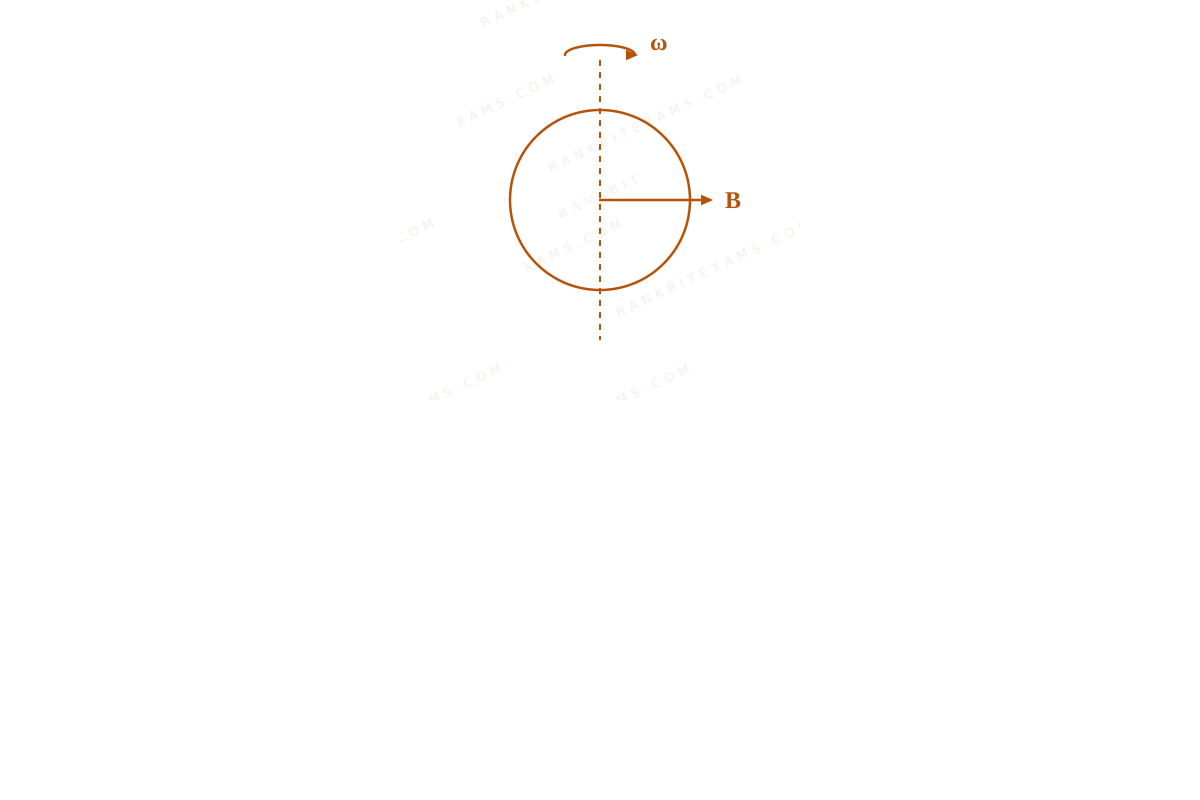
A uniform magnetic field of 0.4 mathrmT acts perpendicular to a circular copper disc 20 mathrm~cm in radius. The disc is having a uniform angular velocity of 10 pi rad mathrms^-1 about an axis through its centre and perpendicular to the disc. What is the potential difference developed between the axis of the disc and the rim? ( pi = 3.14 )

Solution & Explanation

### Related Formula The induced electromotive force (EMF) developed between the center and the rim of a rotating disc in a perpendicular magnetic field is given by: E = frac12 B omega R^2 ### Core Logic Given parameters from the problem statement [cite: 655, 657, 658]: * Magnetic field, B = 0.4 text T * Radius of the disc, R = 20 text cm = 0.2 text m * Angular velocity, \omega = 10\pi \text{ rad s}^{-1} Substituting the values into the governing formula: E = frac12 times 0.4 times (10 times 3.14) times (0.2)^2 E = 0.2 times 31.4 times 0.04 E = 0.2512 text V ### Step 1: Evaluation The potential difference developed between the axis of the disc and the rim is precisely 0.2512 text V. ### Pattern Recognition For any rotating conductor of length R or a continuous disc rotating about its center in a perpendicular magnetic field, the induced EMF is mathematically equivalent to a single radial rod sweeping the area, leading directly to the formula frac12Bomega R^2. ### Evaluation Rubric / Model Answer null ### Chapter Mix Class 12 Physics: Electromagnetic Induction
Reference Study Guides

More Electromagnetic Induction Previous-Year Questions — Page 4

Q53 jee_main_2024_31_jan_evening Faraday's Law
The magnetic flux phi (in weber) linked with a closed circuit of resistance 8 \, Omega varies with time (in seconds) as phi = 5t^2 - 36t + 1. The induced current in the circuit at t = 2 text s is ________ A.
Numerical Answer. Answer: 2 to 2

Solution

### Related Formula varepsilon = -fracdphidt I = frac|varepsilon|R ### Core Logic Calculate the time derivative of the magnetic flux to find the induced EMF. Evaluate it at the requested time, and then apply Ohm's law to find the current magnitude. ### Step 1: Calculate Induced EMF varepsilon = -fracddt (5t^2 - 36t + 1) varepsilon = -(10t - 36) At t = 2 text s: varepsilon = - (10 times 2 - 36) varepsilon = -(20 - 36) = 16 text V ### Step 2: Calculate Induced Current I = fracvarepsilonR = frac168 = 2 text A ### Pattern Recognition Flux polynomials (At^2 - Bt + C) instantly trigger a simple derivative test. Remember to drop the negative sign for final current magnitude unless direction is specifically asked. ### Evaluation Rubric / Model Answer null ### Chapter Mix Class 12 Physics: Electromagnetic Induction

Q44 jee_main_2024_31_jan_morning Faraday's Law
A coil is placed perpendicular to a magnetic field of 5000 mathrm~T. When the field is changed to 3000 mathrm~T in 2mathrms, an induced emf of 22 mathrm~V is produced in the coil. If the diameter of the coil is 0.02 mathrm~m, then the number of turns in the coil is:
  • A. 7
  • B. 70
  • C. 35
  • D. 140

Solution

### Related Formula varepsilon = N left| fracDeltaphiDelta t right| Deltaphi = (Delta B) A costheta ### Core Logic Given data: Initial Magnetic Field, B_i = 5000mathrm\,T Final Magnetic Field, B_f = 3000mathrm\,T Time interval, Delta t = 2mathrm\,s Diameter, d = 0.02mathrm\,m Rightarrow r = 0.01mathrm\,m Induced emf, varepsilon = 22mathrm\,V Change in magnetic field magnitude |Delta B| = 5000 - 3000 = 2000mathrm\,T. Area of the coil A = pi r^2 = pi (0.01)^2 = 10^-4pi mathrm\,m^2. ### Step 2: Equation Evaluation Deltaphi = |Delta B| A = (2000) pi (0.01)^2 = 0.2pi Using Faraday's Law: 22 = N left( frac0.2pi2 right) 22 = N (0.1pi) Taking pi approx 22/7: 22 = N left( 0.1 times frac227 right) 1 = fracN70 Rightarrow N = 70 ### Evaluation Rubric / Model Answer null ### Chapter Mix Class 12 Physics: Electromagnetic Induction
Q57 jee_main_2024_31_jan_morning Mutual Inductance
A small square loop of wire of side ell is placed inside a large square loop of wire of side L (L = ell^2). The loops are coplanar and their centers coincide. The value of the mutual inductance of the system is sqrtx times 10^-7mathrm\ H, where x =
Numerical Answer. Answer: 128 to 128

Solution

### Related Formula M = fracphi_2i_1 B_textstraight wire segment = fracmu_0 i4pi d (sintheta_1 + sintheta_2) ### Core Logic
Mutual Inductance diagram for Q57 - JEE Main 2024 Morning
Assume a current i flows through the larger square loop of side L. The magnetic field generated by it at its center acts as a uniform field across the very small inner loop of side ell. The magnetic field at the center of the large square loop (distance d = L/2 from each side, angles 45^circ): B = 4 times left[ fracmu_0 i4pi (L/2) (sin 45^circ + sin 45^circ) right] B = fracmu_0 ipi (L/2) left( frac2sqrt2 right) B = frac2sqrt2 mu_0 ipi L ### Step 2: Mutual Inductance Calculation Flux linkage for the inner loop: phi = B cdot ell^2 phi = frac2sqrt2 mu_0 ipi L ell^2 Given L = ell^2: phi = frac2sqrt2 mu_0 ipi (ell^2) ell^2 = frac2sqrt2 mu_0 ipi Mutual inductance M: M = fracphii = frac2sqrt2 mu_0pi Using mu_0 = 4pi times 10^-7: M = frac2sqrt2 times 4pi times 10^-7pi M = 8sqrt2 times 10^-7mathrm\,H M = sqrt128 times 10^-7mathrm\,H Comparing with sqrtx times 10^-7, we get x = 128. ### Evaluation Rubric / Model Answer null ### Chapter Mix Class 12 Physics: Electromagnetic Induction

More Electromagnetic Induction Questions — jee_main_2025_28_jan_evening

Practice all Electromagnetic Induction previous-year questions →

Rankbit System
JEE Physics: Waves (+15.5%) | Electrostatics: Concentric Shells (-29.7%) | Modern Physics: Photoelectric Clones (+34.2%) | Mathematics: Definite Integrals (+18.1%) | Chemistry: Coordination Splitting (-11.4%) | JEE Physics: Waves (+15.5%) | Electrostatics: Concentric Shells (-29.7%) | Modern Physics: Photoelectric Clones (+34.2%) | Mathematics: Definite Integrals (+18.1%) | Chemistry: Coordination Splitting (-11.4%)