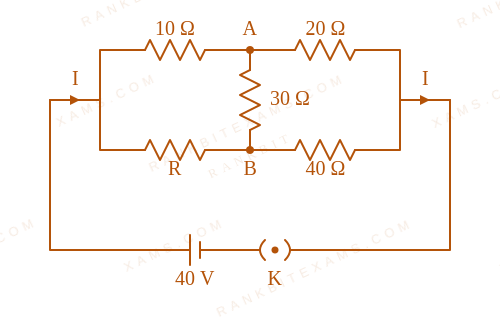
The value of current I in the electrical circuit as given below, when potential at A is equal to the potential at B, will be ________ A.
A bridge resistor network supplied by a 40V DC voltage source terminal layout.
Numerical Answer Type:
Enter a numerical valueAnswer: 2+4 marks
Solution & Explanation
Related Formula
For a balanced Wheatstone bridge network, if the potentials at opposite nodes are equal (VA = VB$V_A = V_B$), no current flows through the central branch. The resistance arms satisfy the balance ratio:
Now restructure the equivalent network :
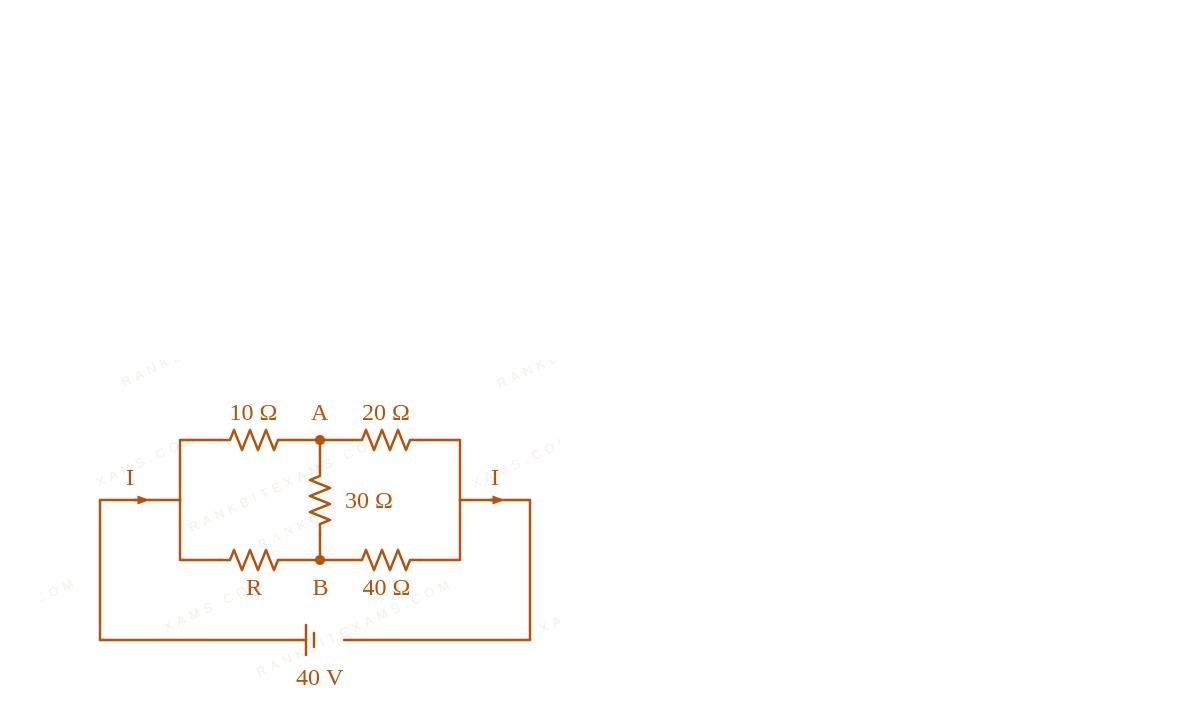
Since the central 30 Ω$30 \ \Omega$ resistor branch carries zero current, it can be removed from the calculation [cite: 820, 834].
The balanced bridge network layout with branch currents is shown below:
A bridge resistor network supplied by a 40V DC voltage source terminal layout.
Pattern Recognition
When a question states that two nodes are at equal potential (VA = VB$V_A = V_B$), immediately identify it as a balanced Wheatstone bridge. This allows you to remove the central branch and simplify the circuit into basic series-\parallel resistor combinations.
Keywords:#balanced wheatstone bridge circuit problem#JEE Main 2025 Evening Q24#Current Electricity JEE Main 2025#equivalent resistance total current#wheatstone bridge#balanced bridge#current electricity
More Current Electricity Previous-Year Questions — Page 7
Qjee_main_2024_01_february_morningCells and EMF
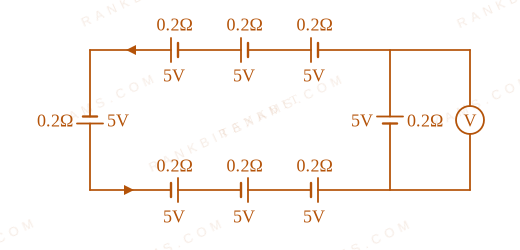
The reading in the ideal voltmeter (V) shown in the given circuit diagram is:
A schematic showing a symmetric loop containing multiple identical 5V sources with 0.2 Ohm internal resistances coupled across an ideal voltmeter terminal.
A.5~V$5\mathrm{~V}$
B.10~V$10\mathrm{~V}$
C.0~V$0\mathrm{~V}$
D.3~V$3\mathrm{~V}$
Solution
Related Formula
Total effective loop EMF and internal resistance:
I = Eₙₑₜrₙₑₜ$$I = \frac{E_{\text{net}}}{r_{\text{net}}}$$
Terminal potential difference across a discharging cell:
V = E - Ir$V = E - Ir$
Core Logic
The loop has a set of 8 cells all aiding the same current flow sequence direction.
I = 40~V1.6~Ω = 25~A$$I = \frac{40\mathrm{~V}}{1.6\mathrm{~\Omega}} = 25\mathrm{~A}$$
Step 1: Terminal Voltage Calculation
The ideal voltmeter measures the potential drop across the localized parallel branch configuration:
V = E - Ir = 5 - (25 × 0.2) = 5 - 5 = 0~V$$V = E - Ir = 5 - (25 \times 0.2) = 5 - 5 = 0\mathrm{~V}$$
Pattern Recognition
A closed loop composed entirely of identical series active cells short circuits itself perfectly relative to the localized node drop points, reducing the net external voltage drop to zero.
Chapter Mix
Class 12 Physics: Current Electricity
Q59jee_main_2024_01_february_morningElectric Charge and Current
The current in a conductor is expressed as I = 3t² + 4t³$I = 3t^2 + 4t^3$, where I$I$ is in Ampere and t$t$ is in second. The amount of electric charge that flows through a section of the conductor during t = 1~s$t = 1\mathrm{~s}$ to t = 2~s$t = 2\mathrm{~s}$ is _______ C$\mathrm{C}$.
Numerical Answer.Answer: 22 to 22
Solution
Related Formula
Relationship between charge and time-varying current:
I = (dq)/(dt) q = ∫t₁t₂ I dt$$I = \frac{dq}{dt} \implies q = \int_{t_1}^{t_2} I \, dt$$
Core Logic
Set up the definite integral using the given bounds t=1~s$t=1\mathrm{~s}$ to t=2~s$t=2\mathrm{~s}$:
Simple polynomial integration. Always evaluate both boundary points explicitly to avoid dropped terms from the lower bound.
Chapter Mix
Class 12 Physics: Current Electricity
Q46jee_main_2024_29_january_eveningSeries and Parallel Combination of Resistors
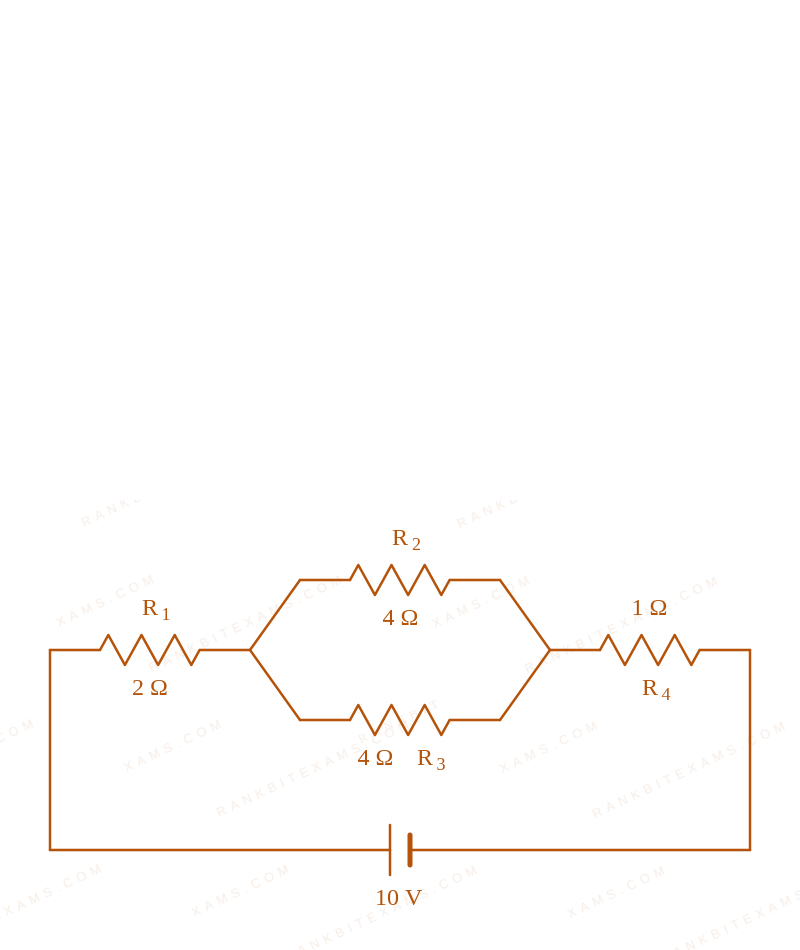
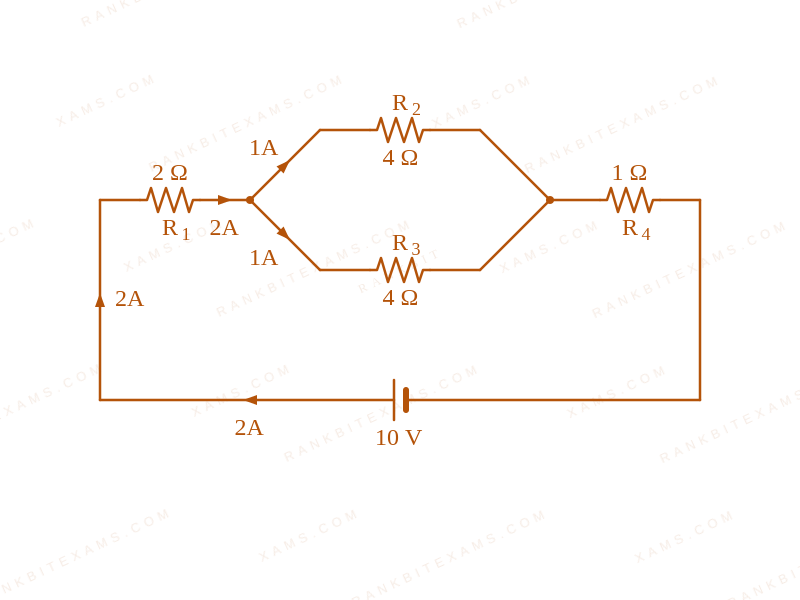
In the given circuit, the current in resistance R₃$R_3$ is:
The diagram displays a circuit consisting of series-parallel combinations of R1, R2, R3, and R4 with a 10V voltage source.
The total current of 2 A$2\text{ A}$ enters the parallel branch of R₂$R_2$ and R₃$R_3$. Since R₂ = R₃ = 4 Ω$R_2 = R_3 = 4\ \Omega$, the current divides equally between them:
The diagram displays a circuit consisting of series-parallel combinations of R1, R2, R3, and R4 with a 10V voltage source.
Pattern Recognition
Equal parallel resistors split current exactly down the middle. Once total current is found to be 2 A$2\text{ A}$, the parallel branches share it as 1 A$1\text{ A}$ each without further math.
Chapter Mix
Class 12 Physics: Current Electricity
Q58jee_main_2024_29_january_eveningKirchhoff's Laws and Mesh Analysis
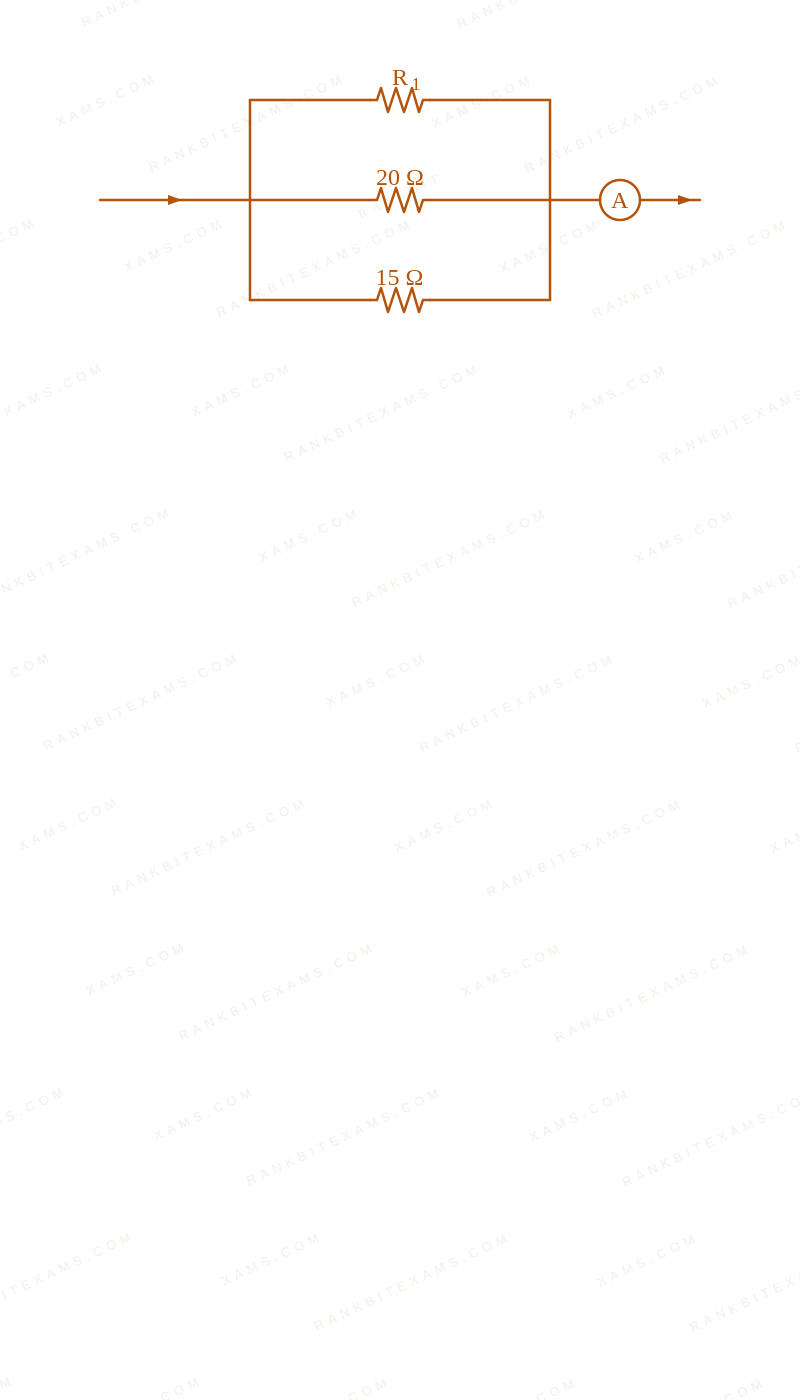
In the given circuit, the current flowing through the resistance 20 Ω$20\ \Omega$ is 0.3 A$0.3\text{ A}$, while the ammeter reads 0.9 A$0.9\text{ A}$. The value of R₁$R_1$ is ________ Ω$\Omega$.
The diagram displays a circuit consisting of three parallel branches containing R1, a 20 Ohm resistor, and a 15 Ohm resistor, with an ammeter in series.
Numerical Answer.Answer: 30 to 30
Solution
Related Formula
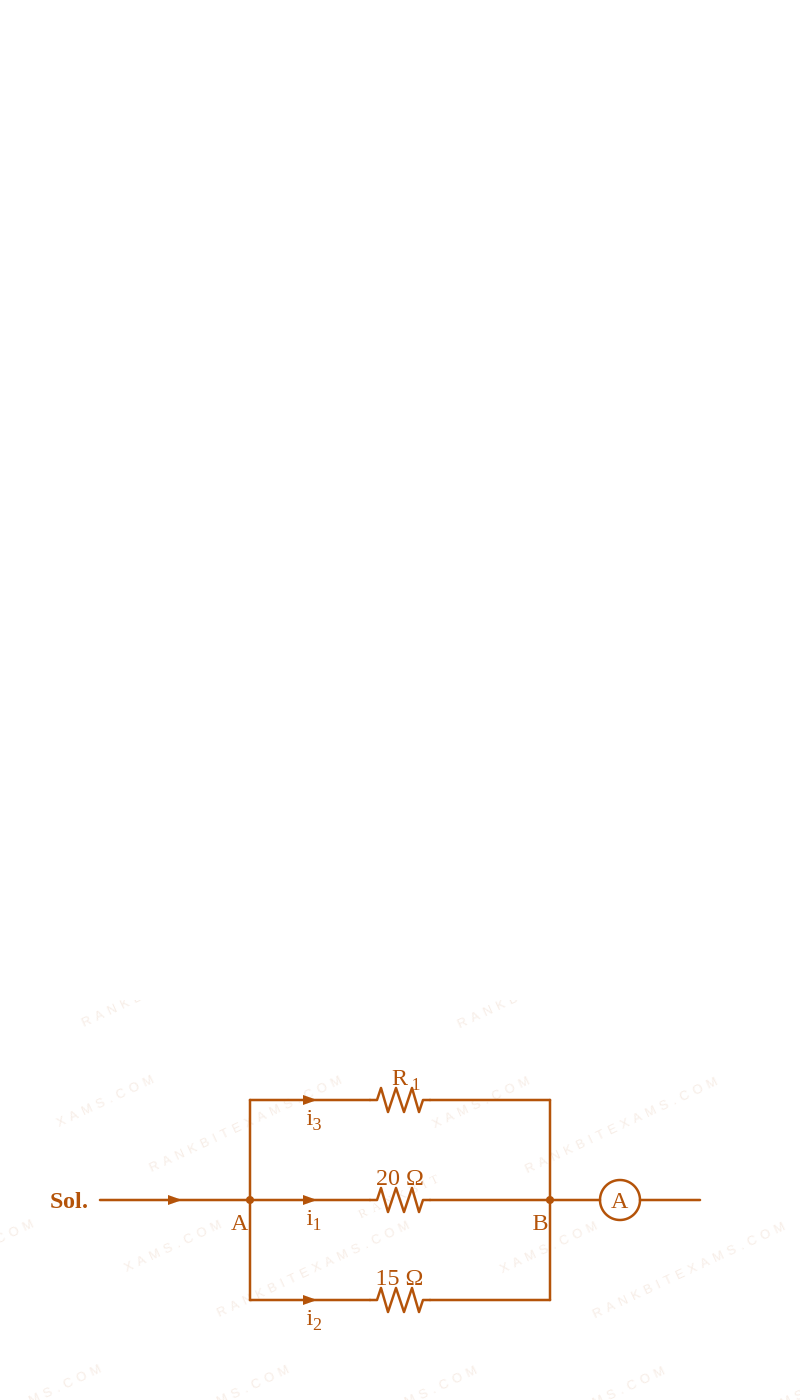
For parallel branches, the potential difference V$V$ across each branch is identical:
V = Iᵢ Rᵢ$V = I_i R_i$
According to Kirchhoff's Current Law, the total current Itotal$I_{\text{total}}$ is the sum of currents in all parallel branches:
The diagram displays a circuit consisting of three parallel branches containing R1, a 20 Ohm resistor, and a 15 Ohm resistor, with an ammeter in series.
Pattern Recognition
In parallel networks, finding the branch voltage is always the primary step. Once V = 6 V$V = 6\text{ V}$ is established, the remaining branch currents are easily found using Ohm's Law and current conservation.
Chapter Mix
Class 12 Physics: Current Electricity
More Current Electricity Questions — jee_main_2025_28_jan_evening
Practice past-year questions one chapter at a time. Pick an exam → subject → chapter and get every PYQ for that topic — pulled together from all past papers — with the chapter's key formulas alongside.