JEE Main · Physics ↓ Falling

Atoms appeared 22 times across 3 years — 2.5% of Physics. This question is from Bohr Model.

Year 2026 2025 2024 Total
Questions 5 8 9 22

The frequency of revolution of the electron in Bohr's orbit varies with n , the principal quantum number as

Solution & Explanation

Related Formula

The orbital frequency of revolution f of an electron is inversely proportional to its time period T:

f = (1)/(T) = (v)/(2π r)

In Bohr's Atomic Model:

  • Velocity v ∝ (Z)/(n)
  • Radius r ∝ (n²)/(Z)
Core Logic

Substitute the proportional relationships of v and r into the frequency expression:

f ∝ (((1)/(n)))/(n²) f ∝ (1)/(n³)
Step 1: Verification

Thus, the frequency varies inversely with the cube of the principal quantum number: f ∝ (1)/(n³).

Pattern Recognition

Remember the sequence of powers of n in Bohr's model: radius expands as n², velocity drops as n⁻¹, angular momentum grows as n¹, and orbital time period or frequency changes as n³ or n⁻³ respectively.

Chapter Mix

Class 12 Physics: Atoms

Reference Study Guides

More Atoms Previous-Year Questions — Page 3

Q20 jee_main_2025_29_jan_evening Hydrogen Spectrum
The number of spectral lines emitted by atomic hydrogen that is in the 4th energy level, is:
  • A. 6
  • B. 0
  • C. 3
  • D. 1

Solution

Related Formula
N = (n(n - 1))/(2)

where n is the principal quantum number of the starting energy level.

Core Logic

For a hydrogen sample initially in the n = 4 level, the possible downward transition pathways to reach the ground state (n=1) are:
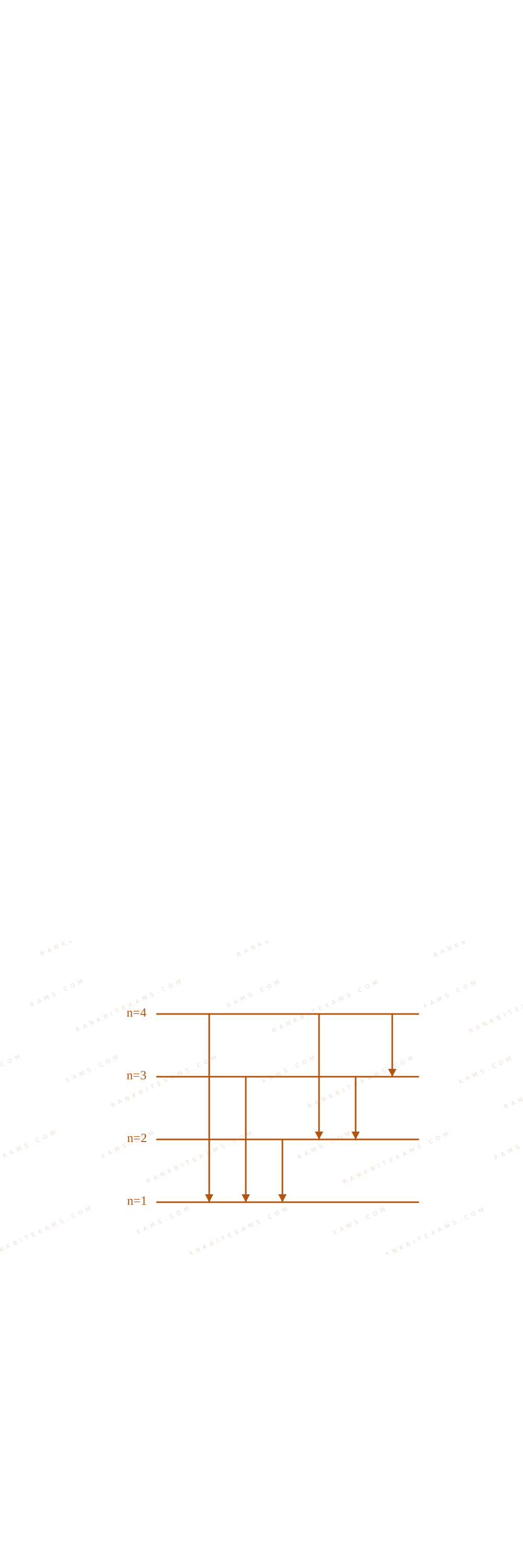
Hydrogen Spectrum Transitions diagram for Q20 - JEE Main 2025 Evening

Using the combination formula for all transitions:

N = (4(4 - 1))/(2) = (4 × 3)/(2) = 6

Thus, 6 distinct spectral lines are generated.

Pattern Recognition

Think of it as counting combinations of transitions between levels: ₙC₂. For n=4, ₄C₂ = 6 lines.

Chapter Mix

Class 12 Physics: Atoms
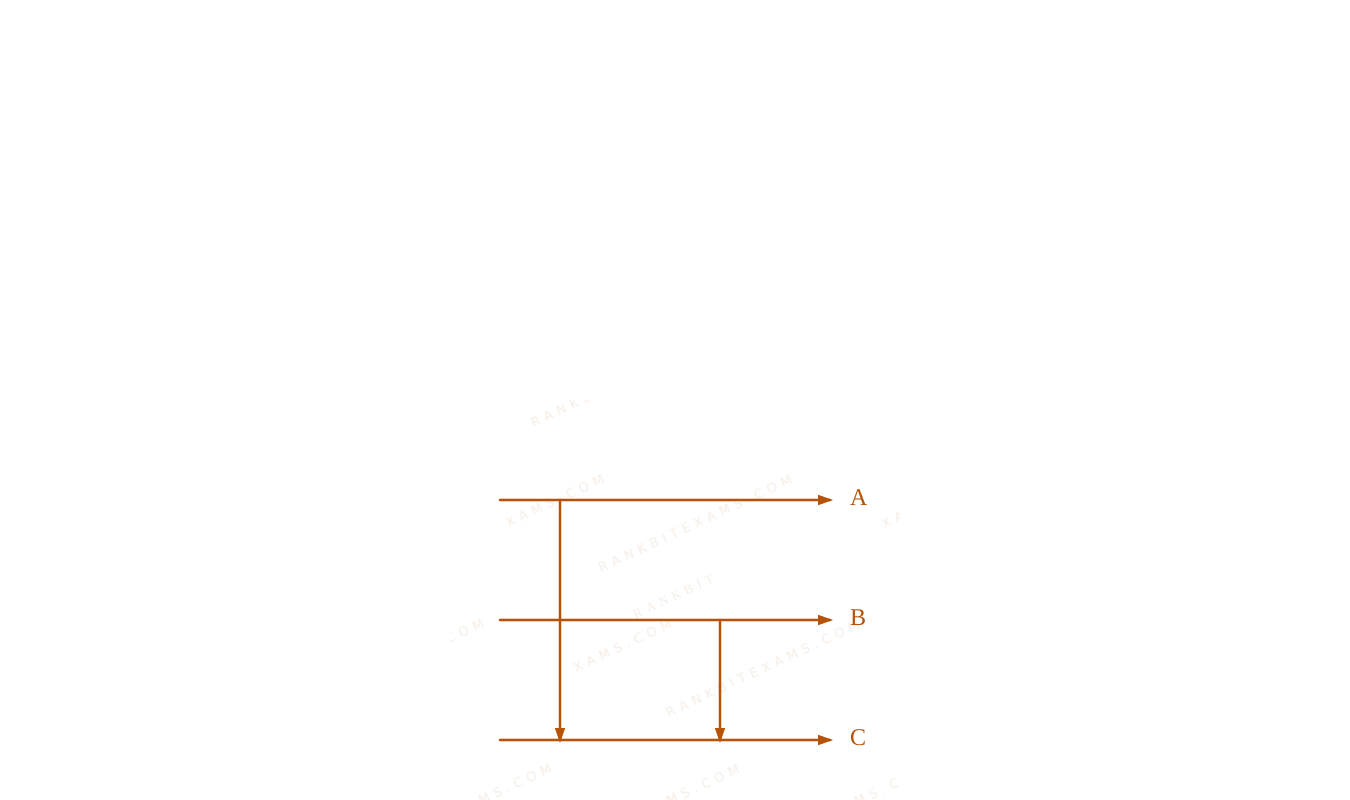
Q5 jee_main_2025_24_jan_morning Bohr Model of the Hydrogen Atom
During the transition of electron from state A to state C of a Bohr atom, the wavelength of emitted radiation is 2000 Å and it becomes 6000 Å when the electron jumps from state B to state C. Then the wavelength of the radiation emitted during the transition of electrons from state A to state B is :-
  • A. 3000 Å
  • B. 6000 Å
  • C. 4000 Å
  • D. 2000 Å

Solution

Related Formula

The energy of the emitted photon during an atomic transition between energy states is given by:

Δ E = (hc)/(λ)

where h is Planck's constant, c is speed of light, and λ is the photon wavelength.

Core Logic

Write equations for the energy transitions from the layout of levels

Bohr Model of the Hydrogen Atom diagram for Q5 - JEE Main 2025 Morning
:

EA - EC = hcλAC = hc2000 AA (i) EB - EC = hcλBC = hc6000 AA (ii)
Step 1: Finding Transition A to B

Subtracting equation (ii) from equation (i) gives the net transition energy from A to B :

EA - EB = (EA - EC) - (EB - EC) hcλAB = (hc)/(2000) - (hc)/(6000) 1λAB = (3 - 1)/(6000) = (2)/(6000) = (1)/(3000) λAB = 3000 AA
Pattern Recognition

Energy differences add linearly, which means their corresponding inverse wavelengths satisfy a parallel reciprocal subtraction rule: 1λAB = 1λAC - 1λBC.

Chapter Mix

Class 12 Physics: Atoms

Q49 jee_main_2024_01_february_morning Hydrogen Spectrum
The minimum energy required by a hydrogen atom in ground state to emit radiation in Balmer series is nearly:
  • A. 1.5 eV
  • B. 13.6 eV
  • C. 1.9 eV
  • D. 12.1 eV

Solution

Related Formula

Bohr state energy level values:

Eₙ = -(13.6)/(n²)~eV

Transition excitation requirement:

Δ E = Efinal - Einitial
Core Logic

To emit radiation in the Balmer series, the hydrogen electron must first be excited to at least the n=3 shell. This allows it to jump down to n=2 and produce the first spectral line of the Balmer series.

Energy required to transition from ground state (n=1) to n=3:

E₁ = -13.6~eV E₃ = -(13.6)/(3²) = -1.51~eV
Step 1: Calculate Energy Gap
Δ E = E₃ - E₁ = -1.51 - (-13.6) = 12.09~eV ≈ 12.1~eV
Pattern Recognition

Balmer emissions always return down to n=2. Thus, the initial excitation starting from ground state n=1 must reach at least n=3 to create a valid Balmer transition.

Chapter Mix

Class 12 Physics: Atoms

Q49 jee_main_2024_29_january_evening Alpha-particle Scattering and Rutherford's Nuclear Model
Given below are two statements: Statement I: Most of the mass of the atom and all its positive charge are concentrated in a tiny nucleus and the electrons revolve around it, is Rutherford's model. Statement II: An atom is a spherical cloud of positive charges with electrons embedded in it, is a special case of Rutherford's model. In the light of the above statements, choose the most appropriate from the options given below:
  • A. Both statement I and statement II are false.
  • B. Statement I is false but statement II is true
  • C. Statement I is true but statement II is false.
  • D. Both statement I and statement II are true.

Solution

Core Logic
  • Statement I: According to Rutherford's planetary model of the atom, almost the entire mass of an atom and all of its positive charge are concentrated in a centrally located small volume called the nucleus, with electrons revolving around it. Thus, Statement I is true.
  • Statement II: Thomson's model of the atom (plum-pudding model) describes the atom as a spherical cloud of positive charge with electrons embedded in it. This model was proposed before Rutherford's nuclear model and is not a special case of Rutherford's model. Thus, Statement II is false.
Step 1: Conclusion

Therefore, Statement I is true but Statement II is false.

Pattern Recognition

Understand the evolutionary timeline of atomic models:

  • Thomson's Plum Pudding Model (spherical cloud with embedded electrons)
  • Rutherford's Nuclear Model (planetary orbital model with tiny centralized nucleus)
  • They are conceptually distinct, making Statement II false.

Chapter Mix

Class 12 Physics: Atoms

More Atoms Questions — jee_main_2025_28_jan_evening

Practice all Atoms previous-year questions →

Rankbit System
JEE Physics: Waves (+15.5%) | Electrostatics: Concentric Shells (-29.7%) | Modern Physics: Photoelectric Clones (+34.2%) | Mathematics: Definite Integrals (+18.1%) | Chemistry: Coordination Splitting (-11.4%) | JEE Physics: Waves (+15.5%) | Electrostatics: Concentric Shells (-29.7%) | Modern Physics: Photoelectric Clones (+34.2%) | Mathematics: Definite Integrals (+18.1%) | Chemistry: Coordination Splitting (-11.4%)
