JEE Main · Mathematics ↓ Falling

Binomial Theorem appeared 37 times across 3 years — 4.3% of Mathematics. This question is from Properties of Coefficients and Rational Terms.

Year 2026 2025 2024 Total
Questions 9 17 11 37

Let the coefficients of three consecutive terms Tᵣ, Tᵣ₊₁ and Tᵣ₊₂ in the binomial expansion of (a+b)¹² be in a G.P. and let p be the number of all possible values of r. Let q be the sum of all rational terms in the binomial expansion of (4√(3)+3√(4))¹² . Then p+q is equal to :

Solution & Explanation

Related Formula

General term of binomial expansion (x + y)ⁿ:

Tk+1 = nk xn-k y^k

Condition for three terms A, B, C to be in G.P.: B² = A · C

Core Logic

Part 1: Coefficients of Tᵣ, Tᵣ₊₁, Tᵣ₊₂ are 12r-1, 12r, 12r+1. Since they are in G.P.:

[ 12r]² = 12r-1 · 12r+1 12r 12r-1 = 12r+1 12r (12-r+1)/(r) = (12-r)/(r+1) (13-r)(r+1) = r(12-r) 13r + 13 - r² - r = 12r - r² 12r + 13 = 12r 13 = 0 (Not possible)

Thus, no real integer solution for r exists, so p = 0.

Step 1: Calculate Rational Terms Sum q

Part 2: Rational terms in expansion of (31/4 + 41/3)¹². General term:

Tk+1 = 12k (31/4)12-k (41/3)^k = 12k 3(12-k)/(4) 4(k)/(3)

For the term to be rational, (12-k)/(4) and \frac{k}{3} must both be integers:

  • k must be a multiple of 3: k in 0, 3, 6, 9, 12
  • 12-k must be a multiple of 4, so k must be a multiple of 4: k in 0, 4, 8, 12
  • The common values for k are k = 0 and k = 12.

  • At k = 0:
T₁ = 120 3³ 4⁰ = 1 × 27 × 1 = 27
  • At k = 12:
T₁₃ = 1212 3⁰ 4⁴ = 1 × 1 × 256 = 256

Sum of rational terms q = 27 + 256 = 283.

Step 2: Final Combination
p + q = 0 + 283 = 283
Pattern Recognition

To find common values for divisibility constraints, look for multiples of the least common multiple (3, 4) = 12 within the range [0, 12].

Chapter Mix

Class 11 Mathematics: Binomial Theorem

Reference Study Guides

More Binomial Theorem Previous-Year Questions — Page 4

Q67 jee_main_2025_29_jan_evening Remainder Problems
The remainder, when 7¹⁰³ is divided by 23, is equal to:
  • A. 14
  • B. 9
  • C. 17
  • D. 6

Solution

Related Formula

Modular arithmetic congruence rules:

A ≡ B m Aⁿ ≡ Bⁿ m
Core Logic

We need to compute 7¹⁰³ 23. Let's break the exponent down into manageable powers:

7¹⁰³ = 7 · (7²)⁵¹ = 7 · (49)⁵¹

Since 49 ≡ 3 23:

7¹⁰³ ≡ 7 · 3⁵¹ 23
Step 1: Simplify Higher Power Components

Break down 3⁵¹ using 3³ = 27 ≡ 4 23:

3⁵¹ = (3³)¹⁷ = 27¹⁷ ≡ 4¹⁷ 23

So the expression becomes:

7 · 4¹⁷ = 7 · 4 · (4²)⁸ = 28 · 16⁸

Since 28 ≡ 5 23 and 16 ≡ -7 23:

≡ 5 · (-7)⁸ = 5 · 7⁸ 23
Step 2: Final Remainder Evaluation

Now compute 7⁸ using 7² = 49 ≡ 3 23:

7⁸ = (7²)⁴ ≡ 3⁴ = 81 23

Since 81 ≡ 12 23:

Expression ≡ 5 · 12 = 60 23

Dividing 60 by 23 (23 × 2 = 46) yields a remainder of: 60 - 46 = 14

Pattern Recognition

Using negative remainders (like 16 ≡ -7) reduces large multiplication outputs instantly during binary power modular loops.

Chapter Mix

Class 11 Mathematics: Binomial Theorem
Q jee_main_2025_03_april_morning Rational Terms in Expansion
The sum of all rational terms in the expansion of (2 + √(3))⁸ is:
  • A. 16923
  • B. 3763
  • C. 33845
  • D. 18817

Solution

Related Formula

General term in the binomial expansion of (a+b)ⁿ:

Tᵣ₊₁ = ⁿCᵣ · an-r · b^r
Core Logic

For a term to be rational in (2+√(3))⁸, the power of √(3) must be an even integer[cite: 1218]. Thus, r can only take even values from 0 to 8

r in 0, 2, 4, 6, 8
Step 1: Calculating individual rational terms

Sum up terms explicitly for all valid values of r :

Sum = ⁸C₀(2)⁸ + ⁸C₂(2)⁶(√(3))² + ⁸C₄(2)⁴(√(3))⁴ + ⁸C₆(2)²(√(3))⁶ + ⁸C₈(√(3))⁸

Compute the individual numeric values :

  • r=0: 1 · 256 = 256
  • r=2: 28 · 64 · 3 = 5376
  • r=4: 70 · 16 · 9 = 10080
  • r=28 · 4 · 27 = 3024
  • r=8: 1 · 1 · 81 = 81
Total Sum = 256 + 5376 + 10080 + 3024 + 81 = 18817
Pattern Recognition

Notice that the sum of all rational terms can also be viewed as the rational part of the expanded configuration, equivalent to (2+√(3))⁸ + (2-√(3))⁸2.

Chapter Mix

Class 11 Mathematics: Binomial Theorem

Q59 jee_main_2025_03_april_morning Binomial Coefficients Series
If Σr=1⁹( r + 32r)·⁹Cᵣ = α ((3)/(2))⁹ - β [cite: 596], where α, β in N [cite: 596], then (α + β)² is equal to[cite: 608]:
  • A. 27
  • B. 9
  • C. 81
  • D. 18

Solution

Related Formula
  • Σr=1ⁿ r · ⁿCᵣ x^r = nx(1+x)ⁿ⁻¹
  • Binomial Theorem expansion: Σr=0ⁿ ⁿCᵣ x^r = (1+x)ⁿ
Core Logic

Split the given series summation into two independent parts [cite: 1316]: Sum = Σr=1⁹ (r)/(2^r) · ⁹Cᵣ + 3Σr=1⁹ (1)/(2^r) · ⁹Cᵣ [cite: 1316]

Simplify the first sub-sum using the index relation r · ⁹Cᵣ = 9 · ⁸Cᵣ₋₁ [cite: 1316]: Σr=1⁹ (9)/(2^r) · ⁸Cᵣ₋₁ = (9)/(2)Σr=1⁹ ⁸Cᵣ₋₁((1)/(2))r-1 = (9)/(2)(1 + (1)/(2))⁸ = (9)/(2)((3)/(2))⁸ [cite: 1316]

Simplify the second sub-sum by including missing index r=0 [cite: 1316]: 3[Σr=0⁹ ⁹Cᵣ((1)/(2))^r - 1] = 3[(1 + (1)/(2))⁹ - 1] = 3((3)/(2))⁹ - 3 [cite: 1316]

Step 1: Combining the components

Combine both evaluations to fit into requested representation shape [cite: 1316]: Total Sum = (9)/(2)((3)/(2))⁸ + 3((3)/(2))⁹ - 3 [cite: 1316] Convert the fractional leading term [cite: 1316]: (9)/(2)((3)/(2))⁸ = 3 · (3)/(2)((3)/(2))⁸ = 3((3)/(2))⁹ [cite: 1316] Total Sum = 3((3)/(2))⁹ + 3((3)/(2))⁹ - 3 = 6((3)/(2))⁹ - 3 [cite: 1316]

Matching coefficients gives [cite: 1317]: α = 6, β = 3 [cite: 1317]

Evaluate the required squared value [cite: 1317]: (α + β)² = (6 + 3)² = 81 [cite: 1317]

Pattern Recognition

Splitting variable factors into standard combinatoric property fractions simplifies coefficient conversions with geometric series denominators.

Chapter Mix

Class 11 Mathematics: Binomial Theorem

Q63 jee_main_2025_04_april_evening Properties of Binomial Coefficients
If 1² · ( ¹⁵ C₁ ) + 2² · ( ¹⁵ C₂ ) + 3² · ( ¹⁵ C₃ ) + + 15² · ( ¹⁵ C₁₅ ) = 2m · 3ⁿ · 5k, where m, n, k ∈ N, then m + n + k is equal to :-
  • A. 19
  • B. 21
  • C. 18
  • D. 20

Solution

Related Formula

The general property linking indices to binomial coefficients is:

r · nr = n · n-1r-1
Core Logic

The given series can be structured using summation notation:

S = Σr=1¹⁵ r² · 15r

Apply the identity r · 15r = 15 · 14r-1 to reduce one factor of r:

S = Σr=1¹⁵ r · [ 15 · 14r-1 ] = 15 Σr=1¹⁵ r · 14r-1
Step 1: Splitting the linear term

Rewrite the index variable r as (r - 1) + 1 to align with the binomial lower index:

S = 15 Σr=1¹⁵ ((r - 1) + 1) · 14r-1 S = 15 Σr=1¹⁵ (r - 1) · 14r-1 + 15 Σr=1¹⁵ 14r-1

Applying the property again to the first summation term: (r-1) 14r-1 = 14 13r-2:

S = 15 · 14 Σr=2¹⁵ 13r-2 + 15 Σr=1¹⁵ 14r-1
Step 2: Evaluating the Sums and Prime Factorization

Using the standard total sum of binomial coefficients Σk=0ⁿ nk = 2ⁿ:

S = 15 · 14 · 2¹³ + 15 · 2¹⁴

Factor out 15 · 2¹³ from the expression:

S = 15 · 2¹³ (14 + 2) = 15 · 2¹³ (16) = 15 · 2¹³ · 2⁴ S = 15 · 2¹⁷ = (3¹ · 5¹) · 2¹⁷

Matching this with the given format 2^m · 3ⁿ · 5^k, we identify: m = 17, n = 1, and k = 1.

Step 3: Calculating the sum of exponents

Evaluating the targeted summation:

m + n + k = 17 + 1 + 1 = 19
Pattern Recognition

For a series of the type Σ r² nr, remember the standard identity shortcut: n(n-1)2ⁿ⁻² + n2ⁿ⁻¹. Plugging in n=15 instantly outputs 15(14)2¹³ + 15(2¹⁴), bypasses matching terms manually.

Chapter Mix

Class 11 Mathematics: Binomial Theorem

Q54 jee_main_2025_04_april_morning Properties of Binomial Coefficients
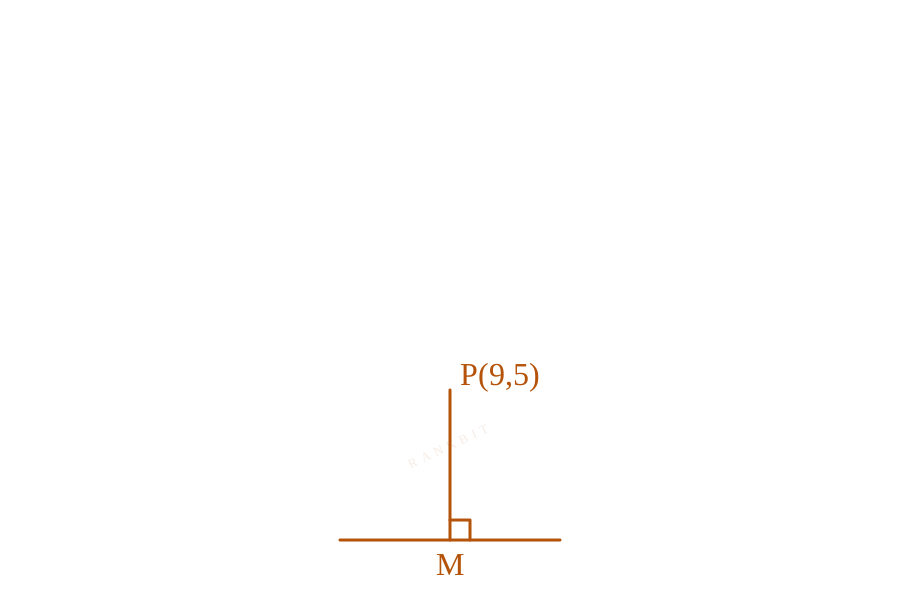
For an integer n ≥ 2, if the arithmetic mean of all coefficients in the binomial expansion of (x + y)2n - 3 is 16, then the distance of the point P(2n - 1, n² - 4n) from the line x + y = 8 is:
  • A. √(2)
  • B. 2√(2)
  • C. 5√(2)
  • D. 3√(2)

Solution

Related Formula

Sum of binomial coefficients for (x+y)^m is 2^m. Total number of terms is m + 1. Perpendicular distance formula from (x₀, y₀) to ax + by + c = 0:

d = |ax₀ + by₀ + c|√(a² + b²)
Core Logic

The power is m = 2n - 3. Sum of coefficients = 22n - 3. Total terms = 2n - 2. Given Arithmetic Mean:

22n - 32n - 2 = 16 22n - 32(n - 1) = 16 22n - 4 = 16(n - 1)

Testing integer values, n = 5 satisfies the equation perfectly since 2⁶ = 64 and 16(5 - 1) = 64.

Step 1: Determine Coordinates of Point P

Substitute n = 5 into P(2n - 1, n² - 4n): x₀ = 2(5) - 1 = 9 y₀ = 5² - 4(5) = 5 Thus, P = (9, 5).

Properties of Binomial Coefficients diagram for Q54 - JEE Main 2025 Morning

Step 2: Calculate Perpendicular Distance

Find the distance from (9,5) to the line x + y - 8 = 0:

d = | 9 + 5 - 8√(1² + 1²)| = 6√(2) = 3√(2)
Pattern Recognition

Binomial coefficient logic tightly constrains n to small integers. Use inspection quickly when polynomial-exponential configurations arise.

Chapter Mix

Class 11 Mathematics: Binomial Theorem Class 11 Mathematics: Straight Lines

More Binomial Theorem Questions — jee_main_2025_28_jan_evening

Practice all Binomial Theorem previous-year questions →

Rankbit System
JEE Physics: Waves (+15.5%) | Electrostatics: Concentric Shells (-29.7%) | Modern Physics: Photoelectric Clones (+34.2%) | Mathematics: Definite Integrals (+18.1%) | Chemistry: Coordination Splitting (-11.4%) | JEE Physics: Waves (+15.5%) | Electrostatics: Concentric Shells (-29.7%) | Modern Physics: Photoelectric Clones (+34.2%) | Mathematics: Definite Integrals (+18.1%) | Chemistry: Coordination Splitting (-11.4%)