Rankbit System
JEE Physics: Waves (+15.5%) | Electrostatics: Concentric Shells (-29.7%) | Modern Physics: Photoelectric Clones (+34.2%) | Mathematics: Definite Integrals (+18.1%) | Chemistry: Coordination Splitting (-11.4%) | JEE Physics: Waves (+15.5%) | Electrostatics: Concentric Shells (-29.7%) | Modern Physics: Photoelectric Clones (+34.2%) | Mathematics: Definite Integrals (+18.1%) | Chemistry: Coordination Splitting (-11.4%)

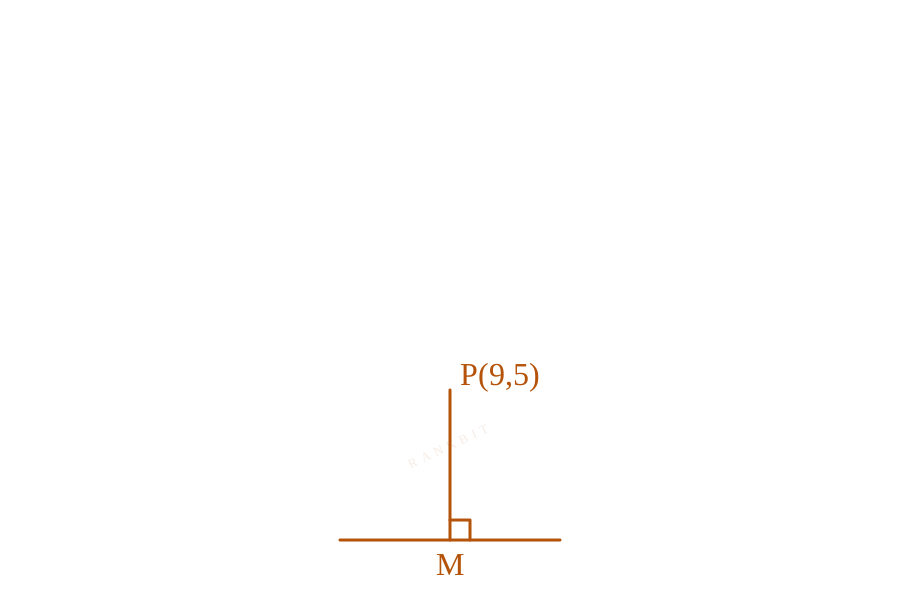
For an integer n ge 2, if the arithmetic mean of all coefficients in the binomial expansion of (x + y)^2n - 3 is 16, then the distance of the point P(2n - 1, n^2 - 4n) from the line x + y = 8 is:

Solution & Explanation

### Related Formula Sum of binomial coefficients for (x+y)^m is 2^m. Total number of terms is m + 1. Perpendicular distance formula from (x_0, y_0) to ax + by + c = 0: d = frac|ax_0 + by_0 + c|sqrta^2 + b^2 ### Core Logic The power is m = 2n - 3. Sum of coefficients = 2^2n - 3. Total terms = 2n - 2. Given Arithmetic Mean: frac2^2n - 32n - 2 = 16 implies frac2^2n - 32(n - 1) = 16 implies 2^2n - 4 = 16(n - 1) Testing integer values, n = 5 satisfies the equation perfectly since 2^6 = 64 and 16(5 - 1) = 64. ### Step 1: Determine Coordinates of Point P Substitute n = 5 into P(2n - 1, n^2 - 4n): x_0 = 2(5) - 1 = 9 y_0 = 5^2 - 4(5) = 5 Thus, P = (9, 5).
Properties of Binomial Coefficients diagram for Q54 - JEE Main 2025 Morning
### Step 2: Calculate Perpendicular Distance Find the distance from (9,5) to the line x + y - 8 = 0: d = left|frac9 + 5 - 8sqrt1^2 + 1^2right| = frac6sqrt2 = 3sqrt2 ### Pattern Recognition Binomial coefficient logic tightly constrains n to small integers. Use inspection quickly when polynomial-exponential configurations arise. ### Evaluation Rubric / Model Answer null ### Chapter Mix Class 11 Mathematics: Binomial Theorem Class 11 Mathematics: Straight Lines

Reference Study Guides

More Binomial Theorem Previous-Year Questions

Q65 2025 Properties of Binomial Coefficients
If sum_mathrmr = 0^10left(frac10^mathrmr + 1 - 110^mathrmrright) cdot binom11r + 1 = fracalpha^11 - 11^1110^10, then alpha is equal to:
  • A. 15
  • B. 11
  • C. 24
  • D. 20

Solution

### Related Formula textSum of binomial coefficients: sum_k=0^n binomnk x^k = (1 + x)^n textShifted binomial sum: sum_k=1^n binomnk x^k = (1+x)^n - 1 ### Core Logic We split the summation into two parts, express each as a binomial series expansion, and equate the resulting algebraic fraction to solve for alpha. ### Step 1: Split the summation The general term inside the summation can be written as: left( frac10^r+1 - 110^r right) = 10 - frac110^r = 10 - 10 left( frac110 right)^r+1 Substitute this back into the sum: S = sum_r=0^10 left[ 10 - 10 left( frac110 right)^r+1 right] binom11r+1 S = 10 sum_r=0^10 binom11r+1 - 10 sum_r=0^10 binom11r+1 left( frac110 right)^r+1 ### Step 2: Evaluate both parts of the sum For the first part, let s = r+1: sum_r=0^10 binom11r+1 = sum_s=1^11 binom11s = 2^11 - 1 For the second part, using s = r+1: sum_r=0^10 binom11r+1 left( frac110 right)^r+1 = sum_s=1^11 binom11s left( frac110 right)^s = left( 1 + frac110 right)^11 - 1 = left( frac1110 right)^11 - 1 ### Step 3: Combine and find alpha Multiply both parts by 10: S = 10 left( 2^11 - 1 right) - 10 left[ left( frac1110 right)^11 - 1 right] S = 10 cdot 2^11 - 10 - 10 cdot frac11^1110^11 + 10 = 10 cdot 2^11 - frac11^1110^10 Express the first term with a denominator of 10^10: 10 cdot 2^11 = frac10^11 cdot 2^1110^10 = frac20^1110^10 Thus, the total sum is: S = frac20^11 - 11^1110^10 Comparing this with fracalpha^11 - 11^1110^10, we find: alpha = 20 ### Pattern Recognition Binomial base scaling: Whenever you see a sum of the form sum a^r binomnr, it is simply the expanded form of a shifted binomial expansion of (1 + a)^n. Factoring out scaling constants yields standard analytical forms. ### Evaluation Rubric / Model Answer null ### Chapter Mix Class 11 Mathematics: Binomial Theorem
Q 2025 Term Independent of x
The term independent of x in the expansion of left(frac (x + 1)(x ^ frac 23 + 1 - x ^ frac 13) - frac (x - 1)(x - x ^ frac 12)right) ^ 1 0, x > 1 is:
  • A. 210
  • B. 150
  • C. 240
  • D. 120

Solution

### Related Formula Algebraic factorizations: x+1 = left(x^1/3right)^3 + 1^3 = left(x^1/3+1right)left(x^2/3-x^1/3+1right) x-1 = left(sqrtxright)^2 - 1^2 = (sqrtx-1)(sqrtx+1) ### Core Logic Simplify inside the parentheses before using the Binomial general term formula. ### Step 1: Simplify Bracket Terms First fraction: fracx+1x^2/3-x^1/3+1 = x^1/3+1 Second fraction: fracx-1x-x^1/2 = frac(sqrtx-1)(sqrtx+1)sqrtx(sqrtx-1) = fracsqrtx+1sqrtx = 1 + x^-1/2 Subtract the two simplified results: left(x^1/3+1right) - left(1+x^-1/2right) = x^1/3 - x^-1/2 ### Step 2: Apply Binomial Theorem The expression simplifies to left(x^1/3 - x^-1/2right)^10. Write the general term T_r+1: T_r+1 = binom10r left(x^1/3right)^10-r left(-x^-1/2right)^r = binom10r (-1)^r x^frac10-r3 - fracr2 ### Step 3: Solve for Independent Term Set the net power of x to zero: frac10-r3 - fracr2 = 0 implies 20 - 2r - 3r = 0 implies 5r = 20 implies r = 4 Substitute r=4 into the general term expression: textCoefficient = binom104 (-1)^4 = frac10 times 9 times 8 times 74 times 3 times 2 times 1 = 210 ### Pattern Recognition The initial fractions look complex but contain simple hidden identities (a^3+b^3 and a^2-b^2). Identifying these transforms a daunting fraction expansion into a classic two-term independent coefficient puzzle. ### Evaluation Rubric / Model Answer null ### Chapter Mix Class 11 Mathematics: Binomial Theorem
Q72 2025 Trinomial Expansion
Let (1 + x + x^2)^10 = a_0 + a_1x + a_2x^2 + dots + a_20x^20. If (a_1 + a_3 + a_5 + dots + a_19) - 11a_2 = 121k, then k is equal to
Numerical Answer. Answer: 239 to 239

Solution

### Related Formula For trinomial expansion: (1+x+x^2)^n = sum_r=0^2n a_r x^r Symmetric coefficients can be extracted by substituting x=1 and x=-1. ### Core Logic Let's perform the substitution: - For x = 1: 3^10 = a_0 + a_1 + a_2 + dots + a_20 quad text--- (1) - For x = -1: 1^10 = a_0 - a_1 + a_2 - a_3 + dots + a_20 quad text--- (2) ### Step 1: Extracting odd term sum Subtracting (2) from (1): 3^10 - 1 = 2(a_1 + a_3 + a_5 + dots + a_19) a_1 + a_3 + a_5 + dots + a_19 = frac3^10 - 12 Since 3^5 = 243 implies 3^10 = 59049: a_1 + a_3 + a_5 + dots + a_19 = frac59049 - 12 = 29524 ### Step 2: Finding a_2 and k Using expansion formula to find a_2 (coefficient of x^2): (1 + x + x^2)^10 = sum frac10!p! q! r! x^q + 2r quad (p+q+r = 10) For q + 2r = 2: - Case 1: r=1, q=0 implies p=9. Coefficient = frac10!9! 0! 1! = 10 - Case 2: r=0, q=2 implies p=8. Coefficient = frac10!8! 2! 0! = 45 a_2 = 10 + 45 = 55 Now substitute into the target relation: 29524 - 11(55) = 29524 - 605 = 28919 121k = 28919 implies k = 239 ### Pattern Recognition Substituting standard complex roots or positive units is the fastest way to resolve sum of subset coefficients in polynomial expansions. Always use partition calculations for the early index terms (a_1, a_2) rather than standard multinomial permutations to avoid calculation mistakes. ### Evaluation Rubric / Model Answer null ### Chapter Mix Class 11 Mathematics: Binomial Theorem
Q54 2025 Remainder Problems
The remainder when left((64)^(64)right)^(64) is divided by 7 is equal to
  • A. 4
  • B. 1
  • C. 3
  • D. 6

Solution

### Related Formula Binomial expansion for checking remainders: (1 + kx)^n = 1 + n(kx) + fracn(n-1)2(kx)^2 + dots equiv 1 pmod x ### Core Logic Let the target expression be N = left((64)^64right)^64. Using power rules, N = 64^64 times 64 = 64^64^2. Let the large exponent exponent be n = 64^2. We need to find the remainder of 64^n when divided by 7. ### Step 1: Express Base in Terms of Modulus Observe that 64 = 63 + 1 = 7 times 9 + 1. Substituting this into the expression: N = (1 + 63)^n Expanding using the binomial theorem: N = 1 + ^nC_1(63) + ^nC_2(63)^2 + dots + ^nC_n(63)^n N = 1 + 63 cdot lambda = 1 + 7(9lambda) Since 7(9lambda) is perfectly divisible by 7, the remaining term is 1. ### Pattern Recognition Whenever the base can be written as km + 1, where m is the divisor, the value of (km + 1)^n equiv 1^n equiv 1 pmod m instantly, regardless of the size or complexity of the exponent layout. ### Evaluation Rubric / Model Answer null ### Chapter Mix Class 11 Mathematics: Binomial Theorem
Q66 2025 Integral Terms in Binomial Expansion
The number of integral terms in the expansion of left(5^frac12 + 7^frac18right)^1016 is
  • A. 127
  • B. 130
  • C. 129
  • D. 128

Solution

### Related Formula T_r = binomnr a^n-r b^r ### Core Logic Formulate general progression steps. Isolate divisor common multiples to find non fraction power configurations tracking perfectly over boundaries. ### Step 1: State the General Binomial Term T_r = binom1016r (5)^frac1016-r2 (7)^fracr8 ### Step 2: Apply Rational Power Constraints For expressions to map purely to integer categories, indexing tracker index paths r must explicitly scale as multiples of 8 over the domain range: r in \0, 8, 16, 24, dots, 1016\ ### Step 3: Enumerate Arithmetic Progression Size Using standard progression length mapping tools: 1016 = 0 + (n - 1)8 n - 1 = frac10168 = 127 implies n = 128 ### Pattern Recognition Finding pure integer steps matches finding values that fit LCM tracking parameters for base radical roots across whole block lengths. ### Evaluation Rubric / Model Answer null ### Chapter Mix Class 11 Mathematics: Binomial Theorem

More Binomial Theorem Questions — jee_main_2025_04_april_morning

Practice all Binomial Theorem previous-year questions →

YOUR FIRST PREP STEP STARTS HERE

We Map Every Repeating Question in Competitive Exams.

Say goodbye to generic mock test fatigue. RankBit uses smart analysis to group past exam questions into their foundational Repeating Question Types. Find chapter weightage, track repeating questions, and score higher with targeted practice.

Select Your Target Exam

Choose an exam track below to find formulas per chapter and patterns.

Syncing Exam Intelligence

Mapping formulas and patterns across all tracks…

PATH A — FULL LENGTH PRACTICE

Full Mock Test Hub

Simulate real NTA exam conditions with fully tracked mocks. Time yourself against past papers.

Under Development
PATH B — TARGETED PRACTICE

Topic-wise Practice Hub

Practice past-year questions one chapter at a time. Pick an exam → subject → chapter and get every PYQ for that topic — pulled together from all past papers — with the chapter's key formulas alongside.

Loading Questions... Browse Topics
Latest from the Blog
View all →

Loading articles...
