Rankbit System
JEE Physics: Waves (+15.5%) | Electrostatics: Concentric Shells (-29.7%) | Modern Physics: Photoelectric Clones (+34.2%) | Mathematics: Definite Integrals (+18.1%) | Chemistry: Coordination Splitting (-11.4%) | JEE Physics: Waves (+15.5%) | Electrostatics: Concentric Shells (-29.7%) | Modern Physics: Photoelectric Clones (+34.2%) | Mathematics: Definite Integrals (+18.1%) | Chemistry: Coordination Splitting (-11.4%)

Consider the following data: Heat of formation of CO_2(g) = -393.5mathrm~kJ~mol^-1 Heat of formation of H_2O(l) = -286.0mathrm~kJ~mol^-1 Heat of combustion of benzene = -3267.0mathrm~kJ~mol^-1 The heat of formation of benzene is ______ mathrmkJ~mol^-1 (Nearest integer).

Numerical Answer Type:
Enter a numerical value Answer: 48 to 48 +4 marks

Solution & Explanation

### Related Formula Enthalpy of reaction from enthalpy of formation data: Delta H_textreaction = sum Delta H_f(textProducts) - sum Delta H_f(textReactants) ### Core Logic Write out the balanced thermochemical equation for the combustion of benzene (C_6H_6): C_6H_6(l) + frac152O_2(g) rightarrow 6CO_2(g) + 3H_2O(l) Given parameters: - Delta H_c = -3267.0mathrm\ kJ/mol - Delta H_f[CO_2] = -393.5mathrm\ kJ/mol - Delta H_f[H_2O] = -286.0mathrm\ kJ/mol - Delta H_f[O_2] = 0mathrm\ kJ/mol ### Step 1: Applying Hess's Law Substitute these values into the reaction expression: -3267 = [6(-393.5) + 3(-286.0)] - Delta H_f[C_6H_6] -3267 = [-2361.0 - 858.0] - Delta H_f[C_6H_6] -3267 = -3219.0 - Delta H_f[C_6H_6] Delta H_f[C_6H_6] = -3219.0 + 3267.0 = 48mathrm\ kJ/mol ### Pattern Recognition Always set up products minus reactants when using heat of formation data. Pay close attention to stoichiometric coefficients (multiply CO_2 by 6 and H_2O by 3) to ensure accurate bookkeeping. ### Evaluation Rubric / Model Answer null ### Chapter Mix Class 11 Chemistry: Thermodynamics

Reference Study Guides

More Thermodynamics Previous-Year Questions — Page 5

Q31 2025 Enthalpy of Neutralization
Which of the following mixing of 1M base and 1M acid leads to the largest increase in temperature?
  • A. \text{30 mL HCl and 30 mL NaOH}
  • B. \text{30 mL } \mathrm{CH_{3}COOH} \text{ and 30 mL NaOH}
  • C. \text{50 mL HCl and 20 mL NaOH}
  • D. \text{45 mL } \mathrm{CH_{3}COOH} \text{ and 25 mL NaOH}

Solution

### Related Formula Q = n_textreacted cdot Delta H_textneutralization Delta T = fracQm cdot c ### Core Logic The temperature rise depends directly on the total heat released (Q) normalized by the total heat capacity of the resulting mixed volume (m cdot c). Let's evaluate the millimoles of mathrmH^+ and mathrmOH^- that react in each mixture: 1. **Option 1:** 30text mL of 1mathrmM mathrmHCl + 30text mL of 1mathrmM mathrmNaOH textReactive millimoles = 30text mmol. Both are strong electrolytes, releasing full neutralization energy (sim -57.3text kJ/mol). Total volume = 60text mL. 2. **Option 2:** 30text mL of 1mathrmM mathrmCH_3COOH + 30text mL of 1mathrmM mathrmNaOH textReactive millimoles = 30text mmol. However, since acetic acid is a weak acid, part of the heat is consumed in its ionization. Thus, less total heat is evolved compared to Option 1. 3. **Option 3:** 50text mL of 1mathrmM mathrmHCl + 20text mL of 1mathrmM mathrmNaOH textLimiting reagent = mathrmNaOH = 20text mmol. Only 20text mmol reacts. Total volume = 70text mL. 4. **Option 4:** 45text mL of 1mathrmM mathrmCH_3COOH + 25text mL of 1mathrmM mathrmNaOH textLimiting reagent = 25text mmol weak neutralization profile. Comparing Option 1 and Option 3, Option 1 releases significantly more heat (30text mmol vs 20text mmol) into a smaller volume (60text mL vs 70text mL), yielding the largest increase in temperature Delta T. ### Pattern Recognition To maximize Delta T, look for the option that maximizes the amount of reacting strong acid and strong base equivalents while keeping the total solution volume as small as possible. ### Evaluation Rubric / Model Answer null ### Chapter Mix Class 11 Chemistry: Thermodynamics Class 11 Chemistry: Equilibrium
Q41 2025 Hess's Law of Constant Heat Summation
mathrmS(g) + frac32 O_2(g) ightarrow SO_3(g) + 2xtext kcal mathrmSO2(mathrmg) + frac12mathrmO2(mathrmg) ightarrow mathrmSO3(mathrmg) + ytext kcal The heat of formation of mathrmSO_2(mathrmg) is given by:
  • A. \frac{2x}{y}\mathrm{\ kcal}
  • B. y - 2x\mathrm{\ kcal}
  • C. 2x + y\mathrm{\ kcal}
  • D. x + y\mathrm{\ kcal}

Solution

### Related Formula Using Hess's Law, the enthalpy change of a net reaction can be determined by linearly combining the steps: Delta Htextnet = sum Delta Htextproducts - sum Delta Htextreactants ### Core Logic The heat of formation of mathrmSO_2(g) corresponds to the target thermochemical equation: textTarget: mathrmS(g) + mathrmO2(g) ightarrow mathrmSO2(g) quad Delta H_f = ? Let's write out the given equations along with their enthalpy changes (remembering that exothermic reactions release heat, so Delta H = -Q): 1. mathrmS(g) + frac32mathrmO_2(g) ightarrow mathrmSO_3(g) quad Delta H_1 = -2xtext kcal 2. mathrmSO_2(g) + frac12mathrmO_2(g) ightarrow mathrmSO_3(g) quad Delta H_2 = -ytext kcal To isolate mathrmSO_2(g) on the product side, subtract Equation (2) from Equation (1): left[mathrmS(g) + frac32mathrmO2(g) ight] - left[mathrmSO2(g) + frac12mathrmO2(g) ight] ightarrow mathrmSO3(g) - mathrmSO3(g) mathrmS(g) + mathrmO2(g) ightarrow mathrmSO2(g) Now apply the same operation to the enthalpy values: Delta H_f = Delta H1 - Delta H_2 = -2x - (-y) = y - 2xtext kcal This matches Option (2). ### Pattern Recognition To isolate your target species on the desired side of the equation, use Hess's Law to add or subtract the given elemental equations. Make sure to invert the sign of the enthalpy change if you reverse a reaction. ### Evaluation Rubric / Model Answer null ### Chapter Mix Class 11 Chemistry: Thermodynamics
Q20 2025 Thermodynamic Processes
An ideal gas goes from an initial state to final state. During the process, the pressure of gas increases linearly with temperature. A. The work done by gas during the process is zero. B. The heat added to gas is different from change in its internal energy. C. The volume of the gas is increased. D. The internal energy of the gas is increased. E. The process is isochoric (constant volume process) Choose the correct answer from the options given below :-
  • A. A, B, C, D Only
  • B. A, D, E Only
  • C. E Only
  • D. A, C Only

Solution

### Related Formula From the Ideal Gas Law: PV = nRT According to the First Law of Thermodynamics: Delta Q = Delta U + W ### Core Logic The question states that pressure increases linearly with temperature, which means their ratio is constant : P = kT implies fracPT = textconstant Since fracPT = fracnRV, the volume V must remain constant throughout the process. This identifies it as an isochoric process (Statement E is true). ### Step 1: Evaluate All Statements * Statement A: True. In an isochoric process, dV = 0 implies W = int P dV = 0. * Statement B: False. Since work is zero, the First Law simplifies to Delta Q = Delta U, meaning heat added equals the change in internal energy. * Statement C: False. Volume is constant, so it does not increase. * Statement D: True. As pressure increases linearly with temperature, temperature increases, which causes the internal energy of the gas to increase. ### Step 2: Final Selection Gathering the true statements (A, D, and E) points directly to Option (2). ### Pattern Recognition A linear P-T line passing through the origin always indicates a constant volume graph. For constant volume graphs, work done is zero, which simplifies the first law calculation. ### Evaluation Rubric / Model Answer null ### Chapter Mix Class 11 Physics: Thermodynamics
Q25 2025 Specific Heat Capacities of Gases
The temperature of 1 mole of an ideal monoatomic gas is increased by 50^circC at constant pressure. The total heat added and change in internal energy are E_1 and E_2, respectively. If fracE_1E_2=fracx9 then the value of x is
Numerical Answer. Answer: 15 to 15

Solution

### Related Formula For an ideal gas thermodynamic process: * Total heat added at constant pressure (isobaric process) is : E_1 = n C_P Delta T * Total change in internal energy is given by : E_2 = n C_V Delta T The ratio of specific heat capacities is defined as: gamma = fracC_PC_V ### Core Logic Taking the ratio of the two energy expressions[cite: 179, 823]: fracE_1E_2 = fracn C_P Delta Tn C_V Delta T = fracC_PC_V = gamma ### Step 1: Evaluating for a Monoatomic Gas For an ideal monoatomic gas, the degrees of freedom are f = 3. This gives an adiabatic index of : gamma = 1 + frac2f = 1 + frac23 = frac53 Equating this value to the given ratio expression [cite: 179, 826]: frac53 = fracx9 x = frac5 times 93 = 15 ### Pattern Recognition The ratio of heat added to the change in internal energy during an isobaric process is always equal to the adiabatic exponent gamma of the gas. ### Evaluation Rubric / Model Answer null ### Chapter Mix Class 11 Physics: Thermodynamics
Q33 2025 First Law of Thermodynamics and State Functions
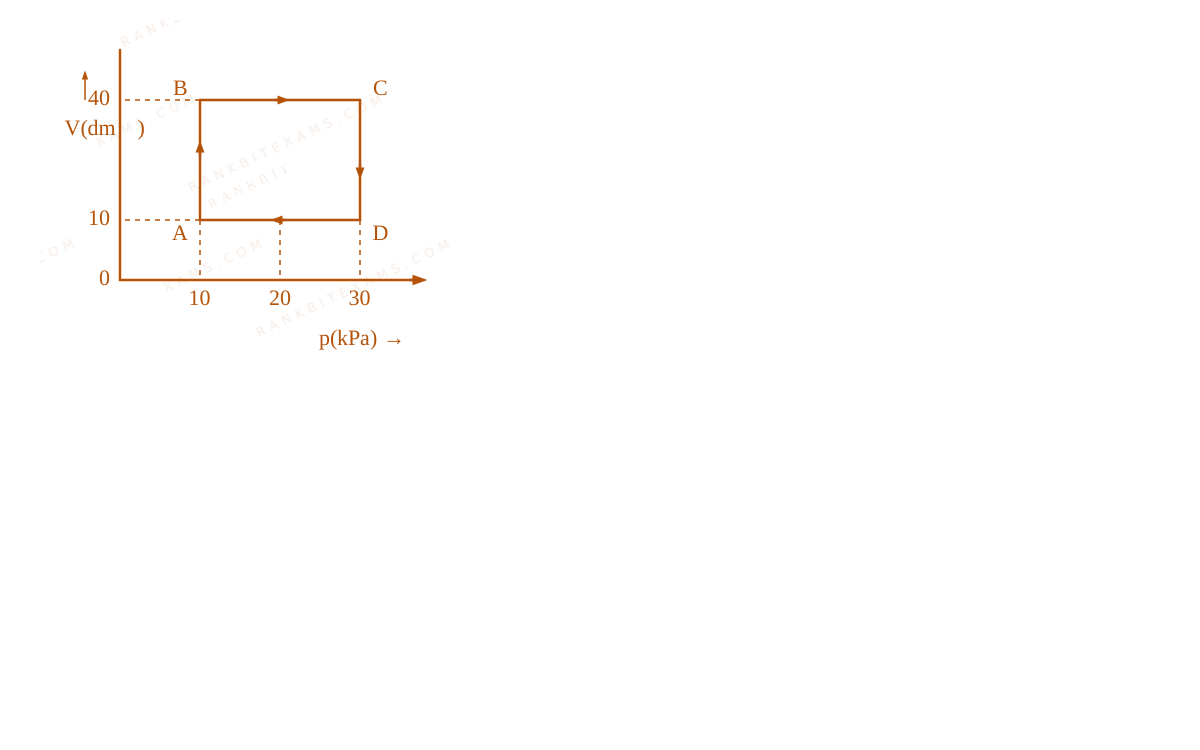
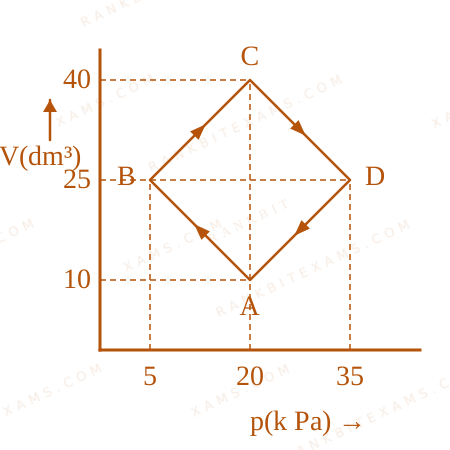
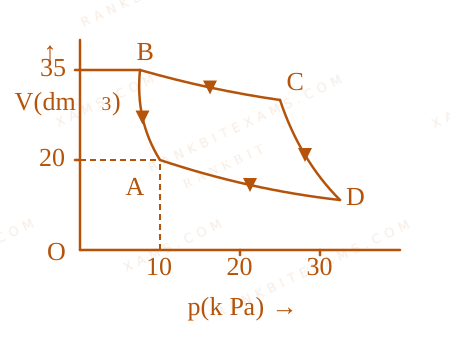
An ideal gas undergoes a cyclic transformation starting from the point A and coming back to the same point by tracing the path mathrmAto mathrmBto mathrmC rightarrow mathrmDrightarrow mathrmA as shown in the three cases below.
Thermodynamic cyclic path diagrams for Q33 - JEE Main 2025
The diagram displays three distinct cyclic paths (Case I, Case II, Case III) on volume vs pressure graphs.
Choose the correct option regarding Delta U:
Thermodynamic cyclic path diagrams for Q33 - JEE Main 2025
The diagram displays three distinct cyclic paths (Case I, Case II, Case III) on volume vs pressure graphs.
Thermodynamic cyclic path diagrams for Q33 - JEE Main 2025
The diagram displays three distinct cyclic paths (Case I, Case II, Case III) on volume vs pressure graphs.
  • A. Delta Utext (Case-III) > Delta Utext (Case-II) > Delta Utext (Case-I)
  • B. Delta Utext (Case-I) > Delta Utext (Case-II) > Delta Utext (Case-III)
  • C. Delta Utext (Case-I) > Delta Utext (Case-III) > Delta Utext (Case-II)
  • D. Delta Utext (Case-I) = Delta Utext (Case-II) = Delta Utext (Case-III)

Solution

### Related Formula For any state function like Internal Energy (U), the cyclic integral over a complete closed loop is identically zero: oint dU = 0 implies Delta U_textcyclic = 0 ### Core Logic Internal energy (U) depends only on the initial and final states of the thermodynamic system, not on the path followed. In all three listed cases, the ideal gas undergoes a complete cyclic path that returns to its original configuration state A. ### Step 1: Final Evaluation Since every transformation begins and ends at point A: Delta U_textCase-I = 0 Delta U_textCase-II = 0 Delta U_textCase-III = 0 Therefore, Delta Utext (Case-I) = Delta Utext (Case-II) = Delta Utext (Case-III). ### Pattern Recognition Do not waste time calculating path areas or values if the question asks for a state function change (Delta U, Delta H, Delta S, Delta G) over a cyclic loop. The answer is instantly zero for all cases! ### Evaluation Rubric / Model Answer null ### Chapter Mix Class 11 Chemistry: Thermodynamics

More Thermodynamics Questions — jee_main_2025_28_jan_evening

Practice all Thermodynamics previous-year questions →

YOUR FIRST PREP STEP STARTS HERE

We Map Every Repeating Question in Competitive Exams.

Say goodbye to generic mock test fatigue. RankBit uses smart analysis to group past exam questions into their foundational Repeating Question Types. Find chapter weightage, track repeating questions, and score higher with targeted practice.

Select Your Target Exam

Choose an exam track below to find formulas per chapter and patterns.

Syncing Exam Intelligence

Mapping formulas and patterns across all tracks…

PATH A — FULL LENGTH PRACTICE

Full Mock Test Hub

Simulate real NTA exam conditions with fully tracked mocks. Time yourself against past papers.

Under Development
PATH B — TARGETED PRACTICE

Topic-wise Practice Hub

Practice past-year questions one chapter at a time. Pick an exam → subject → chapter and get every PYQ for that topic — pulled together from all past papers — with the chapter's key formulas alongside.

Loading Questions... Browse Topics
Latest from the Blog
View all →

Loading articles...