
Rankbit System
JEE Physics: Waves (+15.5%) | Electrostatics: Concentric Shells (-29.7%) | Modern Physics: Photoelectric Clones (+34.2%) | Mathematics: Definite Integrals (+18.1%) | Chemistry: Coordination Splitting (-11.4%) | JEE Physics: Waves (+15.5%) | Electrostatics: Concentric Shells (-29.7%) | Modern Physics: Photoelectric Clones (+34.2%) | Mathematics: Definite Integrals (+18.1%) | Chemistry: Coordination Splitting (-11.4%)

Consider the following data: Heat of formation of CO_2(g) = -393.5mathrm~kJ~mol^-1 Heat of formation of H_2O(l) = -286.0mathrm~kJ~mol^-1 Heat of combustion of benzene = -3267.0mathrm~kJ~mol^-1 The heat of formation of benzene is ______ mathrmkJ~mol^-1 (Nearest integer).

Numerical Answer Type:
Enter a numerical value Answer: 48 to 48 +4 marks

Solution & Explanation

### Related Formula Enthalpy of reaction from enthalpy of formation data: Delta H_textreaction = sum Delta H_f(textProducts) - sum Delta H_f(textReactants) ### Core Logic Write out the balanced thermochemical equation for the combustion of benzene (C_6H_6): C_6H_6(l) + frac152O_2(g) rightarrow 6CO_2(g) + 3H_2O(l) Given parameters: - Delta H_c = -3267.0mathrm\ kJ/mol - Delta H_f[CO_2] = -393.5mathrm\ kJ/mol - Delta H_f[H_2O] = -286.0mathrm\ kJ/mol - Delta H_f[O_2] = 0mathrm\ kJ/mol ### Step 1: Applying Hess's Law Substitute these values into the reaction expression: -3267 = [6(-393.5) + 3(-286.0)] - Delta H_f[C_6H_6] -3267 = [-2361.0 - 858.0] - Delta H_f[C_6H_6] -3267 = -3219.0 - Delta H_f[C_6H_6] Delta H_f[C_6H_6] = -3219.0 + 3267.0 = 48mathrm\ kJ/mol ### Pattern Recognition Always set up products minus reactants when using heat of formation data. Pay close attention to stoichiometric coefficients (multiply CO_2 by 6 and H_2O by 3) to ensure accurate bookkeeping. ### Evaluation Rubric / Model Answer null ### Chapter Mix Class 11 Chemistry: Thermodynamics

Reference Study Guides

More Thermodynamics Previous-Year Questions — Page 4

Q12 2025 Adiabatic Compression
A gas is kept in a container having walls which are thermally non-conducting. Initially the gas has a volume of 800~mathrmcm^3 and temperature 27^circmathrmC . The change in temperature when the gas is adiabatically compressed to 200~mathrmcm^3 is: (Take gamma = 1.5)
  • A. 327mathrm~K
  • B. 600mathrm~K
  • C. 522mathrm~K
  • D. 300mathrm~K

Solution

### Related Formula For an adiabatic process: T V^gamma - 1 = textconstant where, T = absolute temperature in Kelvin, V = volume of the gas, gamma = adiabatic exponent. ### Core Logic Given values: - Initial volume, V_1 = 800mathrm~cm^3 - Final volume, V_2 = 200mathrm~cm^3 - Initial temperature, T_1 = 27^circmathrmC = 27 + 273 = 300mathrm~K - Adiabatic exponent, gamma = 1.5 implies gamma - 1 = 0.5 ### Step 1: Calculating Final Temperature Apply the adiabatic relation: T_1 V_1^gamma - 1 = T_2 V_2^gamma - 1 T_2 = T_1 left(fracV_1V_2right)^gamma - 1 Substitute the values: T_2 = 300 left(frac800200right)^0.5 = 300 times (4)^0.5 T_2 = 300 times 2 = 600mathrm~K ### Step 2: Calculating Change in Temperature Now compute the change in temperature (Delta T): Delta T = T_2 - T_1 = 600mathrm~K - 300mathrm~K = 300mathrm~K ### Pattern Recognition Always read carefully to see if the question asks for the **final temperature** or the **change in temperature**. Many students lose marks by choosing 600mathrm~K (the final temperature) instead of the difference 300mathrm~K! Stay sharp. ### Evaluation Rubric / Model Answer null ### Chapter Mix Class 11 Physics: Thermodynamics
Q17 2025 Thermodynamic Processes
Match List-I with List-II:
List-IList-II
(A) Isobaric(I) Delta Q=Delta W
(B) Isochoric(II) Delta Q=Delta U
(C) Adiabatic(III) Delta Q=textzero
(D) Isothermal(IV) Delta Q=Delta U+PDelta V
Choose the correct answer from the options given below:
  • A. \text{(A)-(IV), (B)-(III), (C)-(II), (D)-(I)}
  • B. \text{(A)-(IV), (B)-(I), (C)-(III), (D)-(II)}
  • C. \text{(A)-(IV), (B)-(II), (C)-(III), (D)-(I)}
  • D. \text{(A)-(II), (B)-(IV), (C)-(III), (D)-(I)}

Solution

### Related Formula First Law of Thermodynamics: Delta Q = Delta U + Delta W ### Core Logic - **Isobaric**: Pressure is constant, work done Delta W = PDelta V. Thus, Delta Q = Delta U + PDelta V (Matches IV). - **Isochoric**: Volume is constant, Delta V = 0 implies Delta W = 0. Thus, Delta Q = Delta U (Matches II). - **Adiabatic**: No heat transfer, Delta Q = 0 (Matches III). - **Isothermal**: Temperature is constant, internal energy change Delta U = 0 for an ideal gas. Thus, Delta Q = Delta W (Matches I). ### Step 1: Match Compilation Combining everything gives: (A)-(IV), (B)-(II), (C)-(III), (D)-(I). ### Pattern Recognition Adiabatic definition is always heat-isolated (Q=0), isochoric implies rigid boundaries (W=0). Identifying these two immediately isolates the correct match permutation in seconds. ### Evaluation Rubric / Model Answer null ### Chapter Mix Class 11 Physics: Thermodynamics
Q17 2025 Thermodynamic Processes
Match List-I with List-II.
List-IList-II
(A) Isothermal(I) Delta W (work done) =0
(B) Adiabatic(II) Delta Q (supplied heat) =0
(C) Isobaric(III) Delta U (change in internal energy) ne0
(D) Isochoric(IV) Delta U=0
Choose the correct answer from the options given below: [cite: 151, 152]
  • A. (A)-(III), (B)-(II), (C)-(I), (D)-(IV) [cite: 153]
  • B. (A)-(IV), (B)-(I), (C)-(III), (D)-(II) [cite: 154]
  • C. (A)-(IV), (B)-(II), (C)-(III), (D)-(I) [cite: 155]
  • D. (A)-(II), (B)-(IV), (C)-(I), (D)-(III) [cite: 156]

Solution

### Core Logic Let's evaluate each process condition based on the first law of thermodynamics: * **(A) Isothermal:** Continuous constant temperature (Delta T = 0) implies that the internal energy change of an ideal gas is zero, so Delta U = 0 implies text(IV) [cite: 730]. * **(B) Adiabatic:** No thermal energy transfer occurs between the system and surroundings, meaning Delta Q = 0 implies text(II) [cite: 731]. * **(C) Isobaric:** Constant pressure process where both volume and temperature typically vary, so internal energy changes continuously, Delta U neq 0 implies text(III) [cite: 732]. * **(D) Isochoric:** Rigid boundary condition at constant volume (Delta V = 0) ensures work done Delta W = PDelta V = 0 implies text(I) [cite: 733]. Putting these together yields: (A)-(IV), (B)-(II), (C)-(III), (D)-(I)[cite: 155, 729]. ### Pattern Recognition Matching 'Isochoric' with zero work done (Delta W=0) or 'Adiabatic' with zero heat exchange (Delta Q=0) are fundamental definitions that let you rapidly break down multi-choice grids[cite: 731, 733]. ### Evaluation Rubric / Model Answer null ### Chapter Mix Class 11 Physics: Thermodynamics
Q6 2025 Adiabatic Processes
Given below are two statements. One is labelled as Assertion (A) and the other is labelled as Reason (R). Assertion (A) : In an insulated container, a gas is adiabatically shrunk to half of its initial volume. The temperature of the gas decreases. Reason (R) : Free expansion of an ideal gas is an irreversible and an adiabatic process. In the light of the above statement, choose the correct answer from the options given below :
  • A. Both (A) and (R) are true and (R) is the correct explanation of (A)
  • B. (A) is true but (R) is false
  • C. (A) is false but (R) is true
  • D. Both (A) and (R) are true but (R) is NOT the correct explanation of (A)

Solution

### Related Formula T_1 V_1^gamma-1 = T_2 V_2^gamma-1 ### Core Logic Assertion (A) review: An insulated container means the process is adiabatic (Q=0). When the gas is shrunk (compressed) to half its volume (V_2 = V_1 / 2), T_2 = T_1 left(fracV_1V_2 ight)^gamma-1 = T_1 (2)^gamma-1 Since gamma > 1, T_2 > T_1. Therefore, temperature increases during adiabatic compression, which makes Assertion (A) false. Reason (R) review: Free expansion occurs when a gas expands into a vacuum inside an insulated container. No work is done (W=0) and no heat is exchanged (Q=0), hence it is adiabatic. It cannot spontaneously reverse, so it is irreversible. Thus, Reason (R) is true. ### Pattern Recognition Adiabatic compression always raises temperature due to work being done on the gas, while free expansion keeps the temperature of an ideal gas constant (dI=0 as W=0, Q=0). ### Evaluation Rubric / Model Answer null ### Chapter Mix Class 11 Physics: Thermodynamics
Q13 2025 Cyclic Processes
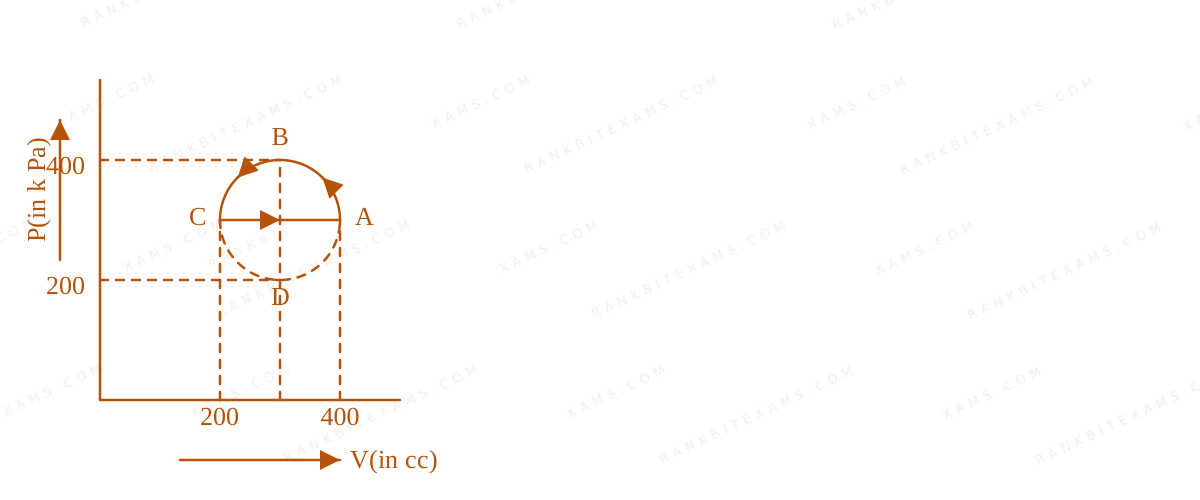
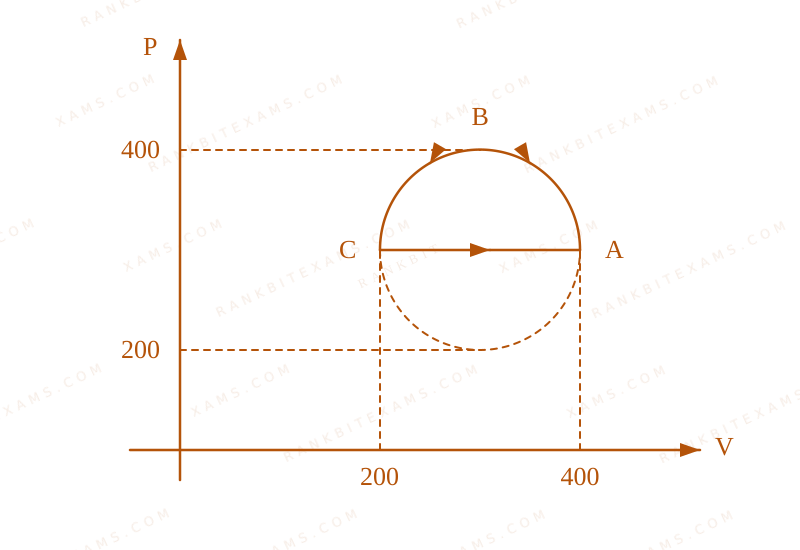
The magnitude of heat exchanged by a system for the given cyclic process ABCA (as shown in figure
Cyclic semi-circular P-V process indicator diagram Q13
The image shows a P-V cycle consisting of a horizontal line from C to A and a semicircular loop from A back to C via B.
) is (in SI unit)
  • A. 10pi
  • B. 5pi
  • C. zero
  • D. 40pi

Solution

### Related Formula From the first law of thermodynamics for a complete cycle: Delta U = 0 implies Q = W = textArea of the loop ### Core Logic The graph shows a semicircle in a Ptext-V indicator diagram.
P-V cycle geometry calculation graph Q13
The image shows a P-V cycle consisting of a horizontal line from C to A and a semicircular loop from A back to C via B.
- Pressure dimension diameter: Delta P = 400 - 200 = 200\ mathrmkPa = 200 times 10^3\ mathrmPa - Volume dimension diameter: Delta V = 400 - 200 = 200\ mathrmcc = 200 times 10^-6\ mathrmm^3 Radius along Pressure axis: R_P = 100 times 10^3\ mathrmPa Radius along Volume axis: R_V = 100 times 10^-6\ mathrmm^3 Area of the closed semicircular path: W = frac12 pi R_P R_V W = frac12 times pi times (100 times 10^3) times (100 times 10^-6) W = frac10pi2 = 5pi\ mathrmJ Since Q = W, the heat exchanged has a magnitude of 5pi\ mathrmJ. ### Pattern Recognition For a cycle on an indicator chart with mismatched scales, use the elliptic area template pi a b (or frac12pi a b for a half-ellipse/semicircle). ### Evaluation Rubric / Model Answer null ### Chapter Mix Class 11 Physics: Thermodynamics

More Thermodynamics Questions — jee_main_2025_28_jan_evening

Practice all Thermodynamics previous-year questions →

YOUR FIRST PREP STEP STARTS HERE

We Map Every Repeating Question in Competitive Exams.

Say goodbye to generic mock test fatigue. RankBit uses smart analysis to group past exam questions into their foundational Repeating Question Types. Find chapter weightage, track repeating questions, and score higher with targeted practice.

Select Your Target Exam

Choose an exam track below to find formulas per chapter and patterns.

Syncing Exam Intelligence

Mapping formulas and patterns across all tracks…

PATH A — FULL LENGTH PRACTICE

Full Mock Test Hub

Simulate real NTA exam conditions with fully tracked mocks. Time yourself against past papers.

Under Development
PATH B — TARGETED PRACTICE

Topic-wise Practice Hub

Practice past-year questions one chapter at a time. Pick an exam → subject → chapter and get every PYQ for that topic — pulled together from all past papers — with the chapter's key formulas alongside.

Loading Questions... Browse Topics
Latest from the Blog
View all →

Loading articles...