An ideal gas goes from an initial state to final state. During the process, the pressure of gas increases linearly with temperature.
A. The work done by gas during the process is zero.
B. The heat added to gas is different from change in its internal energy.
C. The volume of the gas is increased.
D. The internal energy of the gas is increased.
E. The process is isochoric (constant volume process)
Choose the correct answer from the options given below :-
A.A, B, C, D Only
B.A, D, E Only
C.E Only
D.A, C Only
Solution & Explanation
Related Formula
From the Ideal Gas Law:
PV = nRT$PV = nRT$
According to the First Law of Thermodynamics:
Δ Q = Δ U + W$$\Delta Q = \Delta U + W$$
Core Logic
The question states that pressure increases linearly with temperature, which means their ratio is constant :
Since (P)/(T) = (nR)/(V)$\frac{P}{T} = \frac{nR}{V}$, the volume V$V$ must remain constant throughout the process. This identifies it as an isochoric process (Statement E is true).
Step 1: Evaluate All Statements
Statement A: True. In an isochoric process, dV = 0 W = ∫ P dV = 0$dV = 0 \implies W = \int P dV = 0$.
Statement B: False. Since work is zero, the First Law simplifies to Δ Q = Δ U$\Delta Q = \Delta U$, meaning heat added equals the change in internal energy.
Statement C: False. Volume is constant, so it does not increase.
Statement D: True. As pressure increases linearly with temperature, temperature increases, which causes the internal energy of the gas to increase.
Step 2: Final Selection
Gathering the true statements (A, D, and E) points directly to Option (2).
Pattern Recognition
A linear P-T$P-T$ line passing through the origin always indicates a constant volume graph. For constant volume graphs, work done is zero, which simplifies the first law calculation.
Keywords:#pressure of gas increases linearly with temperature#JEE Main 2025 Morning Q20#Thermodynamics JEE Main 2025#Thermodynamic Processes JEE Main 2025
More Thermodynamics Previous-Year Questions — Page 8
Qjee_main_2024_31_jan_morningIsobaric Process
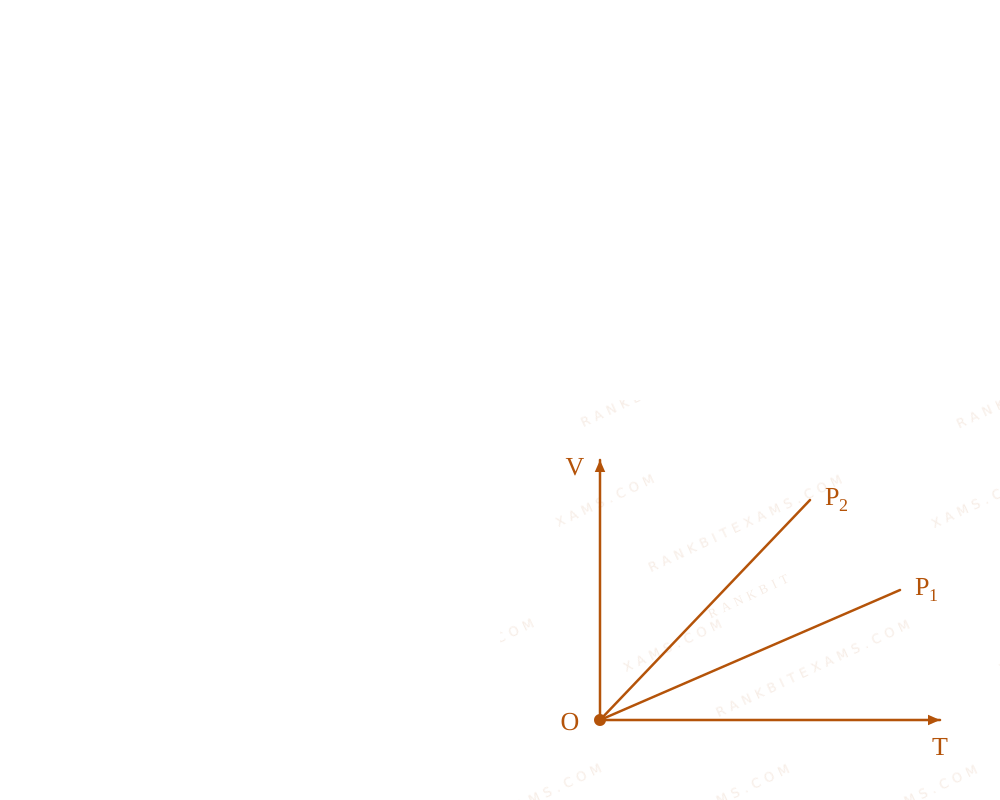
The given figure represents two isobaric processes for the same mass of an ideal gas, then
A Volume vs Temperature (V-T) graph showing two straight lines starting from the origin representing distinct constant pressures P1 and P2.
A.P₂≥ P₁$\mathrm{P}_2\geq \mathrm{P}_1$
B.P₂ > P₁$\mathrm{P}_2 > \mathrm{P}_1$
C.P₁ = P₂$\mathrm{P_1 = P_2}$
D.P₁ > P₂$\mathrm{P}_1 > \mathrm{P}_2$
Solution
Related Formula
PV = nRT$PV = nRT$
Core Logic
From the Ideal Gas Law:
V = ((nR)/(P)) T$$V = \left(\frac{nR}{P}\right) T$$
In a V-T$V-T$ graph, the equation of the line represents y = mx$y = mx$, where the slope m$m$ is:
Practice past-year questions one chapter at a time. Pick an exam → subject → chapter and get every PYQ for that topic — pulled together from all past papers — with the chapter's key formulas alongside.