An ideal gas goes from an initial state to final state. During the process, the pressure of gas increases linearly with temperature.
A. The work done by gas during the process is zero.
B. The heat added to gas is different from change in its internal energy.
C. The volume of the gas is increased.
D. The internal energy of the gas is increased.
E. The process is isochoric (constant volume process)
Choose the correct answer from the options given below :-
A.A, B, C, D Only
B.A, D, E Only
C.E Only
D.A, C Only
Solution & Explanation
Related Formula
From the Ideal Gas Law:
PV = nRT$PV = nRT$
According to the First Law of Thermodynamics:
Δ Q = Δ U + W$$\Delta Q = \Delta U + W$$
Core Logic
The question states that pressure increases linearly with temperature, which means their ratio is constant :
Since (P)/(T) = (nR)/(V)$\frac{P}{T} = \frac{nR}{V}$, the volume V$V$ must remain constant throughout the process. This identifies it as an isochoric process (Statement E is true).
Step 1: Evaluate All Statements
Statement A: True. In an isochoric process, dV = 0 W = ∫ P dV = 0$dV = 0 \implies W = \int P dV = 0$.
Statement B: False. Since work is zero, the First Law simplifies to Δ Q = Δ U$\Delta Q = \Delta U$, meaning heat added equals the change in internal energy.
Statement C: False. Volume is constant, so it does not increase.
Statement D: True. As pressure increases linearly with temperature, temperature increases, which causes the internal energy of the gas to increase.
Step 2: Final Selection
Gathering the true statements (A, D, and E) points directly to Option (2).
Pattern Recognition
A linear P-T$P-T$ line passing through the origin always indicates a constant volume graph. For constant volume graphs, work done is zero, which simplifies the first law calculation.
Keywords:#pressure of gas increases linearly with temperature#JEE Main 2025 Morning Q20#Thermodynamics JEE Main 2025#Thermodynamic Processes JEE Main 2025
More Thermodynamics Previous-Year Questions — Page 3
Q47jee_main_2026_28_january_eveningWork Done in Cyclic Process
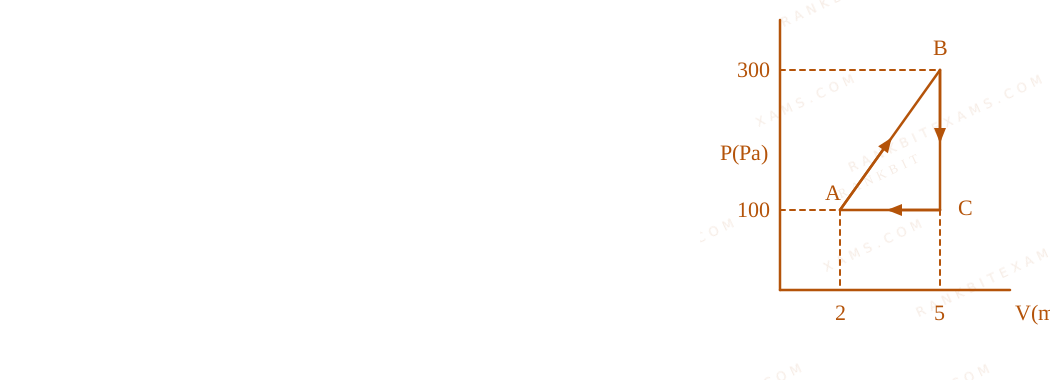
A thermodynamic system is taken through the cyclic process ABC as shown in the figure. The total work done by the system during the cycle ABC is ____ J.
A Pressure-Volume indicator diagram showing a clockwise triangular cycle ABC.
Numerical Answer.Answer: 300 to 300
Solution
Related Formula
Wcycle = Area enclosed by the P-V cycle$$W_{\text{cycle}} = \text{Area enclosed by the P-V cycle}$$
Core Logic
In a P-V diagram, the work done in a cyclic process is equal to the area of the enclosed loop. Since the cycle ABC is clockwise (A arrow$\rightarrow$ B arrow$\rightarrow$ C arrow$\rightarrow$ A), the net work done by the system is positive.
Step 1: Calculate the Area
The shape ABC is a right-angled triangle.
Base of the triangle = Δ V = VC - VA = 5 - 2 = 3 m³$= \Delta V = V_C - V_A = 5 - 2 = 3 \text{ m}^3$
Height of the triangle = Δ P = PB - PC = 300 - 100 = 200 Pa$= \Delta P = P_B - P_C = 300 - 100 = 200 \text{ Pa}$
Always verify axis units (kPa, atm, Liters, cc) before blindly multiplying area. Here units are cleanly in standard SI (Pa and m³$m^3$), so 1 Pa · 1 m³ = 1 Joule$1 \text{ Pa} \cdot 1 \text{ m}^3 = 1 \text{ Joule}$.
Chapter Mix
Class 11 Physics: Thermodynamics
Q10jee_main_2025_02_april_eveningAdiabatic Process
Identify the characteristics of an adiabatic process in a monoatomic gas.
(A) Internal energy is constant.
(B) Work done in the process is equal to the change in internal energy.
(C) The product of temperature and volume is a constant.
(D) The product of pressure and volume is a constant.
(E) The work done to change the temperature from T₁$T_1$ to T₂$T_2$ is proportional to (T₂ - T₁)$(T_2 - T_1)$
Choose the correct answer from the options given below:
A.(A), (C), (D) only$\text{(A), (C), (D) only}$
B.(A), (C), (E) only$\text{(A), (C), (E) only}$
C.(B), (E) only$\text{(B), (E) only}$
D.(B), (D) only$\text{(B), (D) only}$
Solution
Related Formula
First Law of Thermodynamics:
dQ = dU + dW$dQ = dU + dW$
In an adiabatic process:
dQ = 0 dW = -dU$$dQ = 0 \implies dW = -dU$$
Change in Internal Energy:
dU = n Cv dT = n Cv (T₂ - T₁)$$dU = n C_v dT = n C_v (T_2 - T_1)$$
Core Logic
Let's analyze each statement:
(A) Internal energy is constant: Incorrect. Since temperature changes during an adiabatic expansion/compression, internal energy (U ∝ T$U \propto T$) must change.
(B) Work done is equal to the change in internal energy: Correct in magnitude (|dW| = |dU|$|dW| = |dU|$). By definition, dW = -dU$dW = -dU$, which correlates the magnitude of work to the change in internal energy.
(C) Product of temperature and volume is constant: Incorrect. The adiabatic equation of state is T Vγ-1 = constant$T V^{\gamma-1} = \text{constant}$.
(D) Product of pressure and volume is constant: Incorrect. The relation is P V^γ = constant$P V^\gamma = \text{constant}$.
(E) Work done is proportional to (T₂ - T₁)$(T_2 - T_1)$: Correct. Since dW = -dU = -n Cv (T₂ - T₁)$dW = -dU = -n C_v (T_2 - T_1)$, work done is directly proportional to the temperature change (T₂ - T₁)$(T_2 - T_1)$.
Step 1: Determine the correct option
Since only statements (B) and (E) are correct, the correct option is (3).
Pattern Recognition
Sees: Characteristics of adiabatic thermodynamic process.
Trap: Confusing adiabatic state relations (PV^γ = C$PV^\gamma = C$, TVγ-1 = C$TV^{\gamma-1} = C$) with isothermal state relations (PV = C$PV = C$, T = C$T = C$).
Shortcut: First law of thermodynamics under dQ=0$dQ=0$ strictly enforces |dW| = |dU|$|dW| = |dU|$, which validates statement B and E immediately.
Option (2): From the First Law (dQ = dU + dW dW = -dU$dQ = dU + dW \implies dW = -dU$), the work done equals the decrease in internal energy.
Option (4): The internal energy of an ideal gas (dU = n Cv dT$dU = n C_{\mathrm{v}} dT$) increases directly as temperature increases.
Step 2: Final Conclusion
The statement 'The molar heat capacity is zero' is true.
Pattern Recognition
Adiabatic = no heat flow (dQ=0$dQ=0$). Since molar heat capacity tracks the ratio of heat input to temperature change, C$C$ must be 0. Conversely, isothermal has infinite capacity because heat is absorbed without any temperature change (dT=0$dT=0$).
Chapter Mix
Class 11 Physics: Thermodynamics
Qjee_main_2025_03_april_eveningThermodynamic Processes and First Law
An ideal gas exists in a state with pressure P₀$P_{0}$, volume V₀$V_{0}$. It is isothermally expanded to 4 times of its initial volume (V₀)$(V_{0})$, then isobarically compressed to its original volume. Finally the system is heated isochorically to bring it to its initial state. The amount of heat exchanged in this process is :
A.P₀V₀(2ln 2-0.75)$P_{0}V_{0}(2\ln 2-0.75)$
B.P₀V₀(ln 2-0.75)$P_{0}V_{0}(\ln 2-0.75)$
C.P₀V₀(ln 2-0.25)$P_{0}V_{0}(\ln 2-0.25)$
D.P₀V₀(2ln 2-0.25)$P_{0}V_{0}(2\ln 2-0.25)$
Solution
Related Formula
For a cyclic thermodynamic process, the net change in internal energy is zero:
Δ Ucyclic = 0$$\Delta U_{\text{cyclic}} = 0$$
By the First Law of Thermodynamics, the total heat exchanged QT$Q_T$ equals the net work done Wₙₑₜ$W_{\text{net}}$:
In any cyclic system returning to its initial state, finding total heat is mathematically equivalent to calculating the enclosed area on a P-V diagram. Here, the isobaric step occurs at the lowest expanded pressure, resulting in a simple negative rectangular area correction subtracted from the logarithmic isothermal expansion curve.
Chapter Mix
Class 11 Physics: Thermodynamics
Qjee_main_2025_07_april_morningWork Done in Thermodynamic Processes
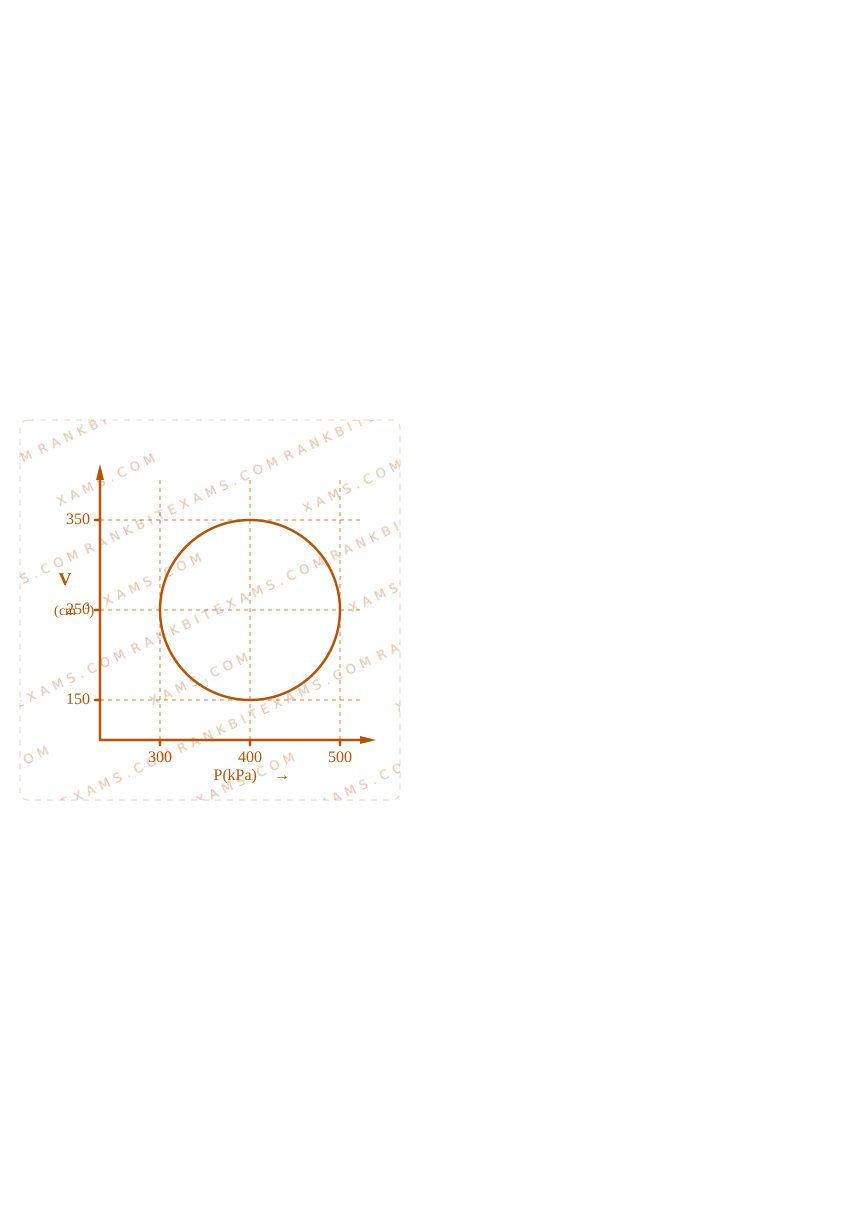
An ideal gas has undergone through the cyclic process as shown in the figure. Work done by the gas in the entire cycle is × 10⁻¹$\times 10^{-1}$ J. (Take π = 3.14$\pi = 3.14$ )
A cycle plot in which the volume lies in cm^3 (150 to 350) and pressure is in kPa (300 to 500), forming an ellipse.
Numerical Answer.Answer: 314 to 314
Solution
Related Formula
The work done W$W$ in a cyclic thermodynamic process is equal to the area enclosed by the loop on a Pressure-Volume (P-V$P-V$) diagram:
W = Area of Closed Loop$$W = \text{Area of Closed Loop}$$
For an ellipse with semi-major axis a$a$ and semi-minor axis b$b$:
Area = π a b$$\text{Area} = \pi a b$$
Core Logic
Determine the semi-axes of the elliptical cycle on the P-V$P-V$ plane:
Sees: Circular/elliptical thermodynamic cycle.
Shortcut: Work done is always π Δ P Δ V / 4$\pi \Delta P \Delta V / 4$. Simply compute the semi-axes difference 100 ~kPa$100 \mathrm{~kPa}$ and 100 ~cm³$100 \mathrm{~cm^3}$ and multiply by π$\pi$ directly, keeping tracking of metric prefixes (10³ × 10⁻⁶ = 10⁻³$10^3 \times 10^{-6} = 10^{-3}$).
Chapter Mix
Class 11 Physics: Thermodynamics
More Thermodynamics Questions — jee_main_2025_24_jan_morning
Practice past-year questions one chapter at a time. Pick an exam → subject → chapter and get every PYQ for that topic — pulled together from all past papers — with the chapter's key formulas alongside.
.svg)