The temperature of 1 mole of an ideal monoatomic gas is increased by 50°C$50^{\circ}C$ at constant pressure. The total heat added and change in internal energy are E₁$E_{1}$ and E₂$E_{2}$, respectively. If E₁E₂=(x)/(9)$\frac{E_{1}}{E_{2}}=\frac{x}{9}$ then the value of x is
Numerical Answer Type:
Enter a numerical valueAnswer: 15 to 15+4 marks
Solution & Explanation
Related Formula
For an ideal gas thermodynamic process:
Total heat added at constant pressure (isobaric process) is :
E₁ = n CP Δ T$$E_{1} = n C_{P} \Delta T$$
Total change in internal energy is given by :
E₂ = n CV Δ T$$E_{2} = n C_{V} \Delta T$$
The ratio of specific heat capacities is defined as:
γ = CPCV$$\gamma = \frac{C_{P}}{C_{V}} $$
Core Logic
Taking the ratio of the two energy expressions[cite: 179, 823]:
Keywords:#total heat added and change in internal energy#JEE Main 2025 Morning Q25#Thermodynamics JEE Main 2025#Specific Heat Capacities of Gases JEE Main 2025
More Thermodynamics Previous-Year Questions — Page 8
Qjee_main_2024_31_jan_morningIsobaric Process
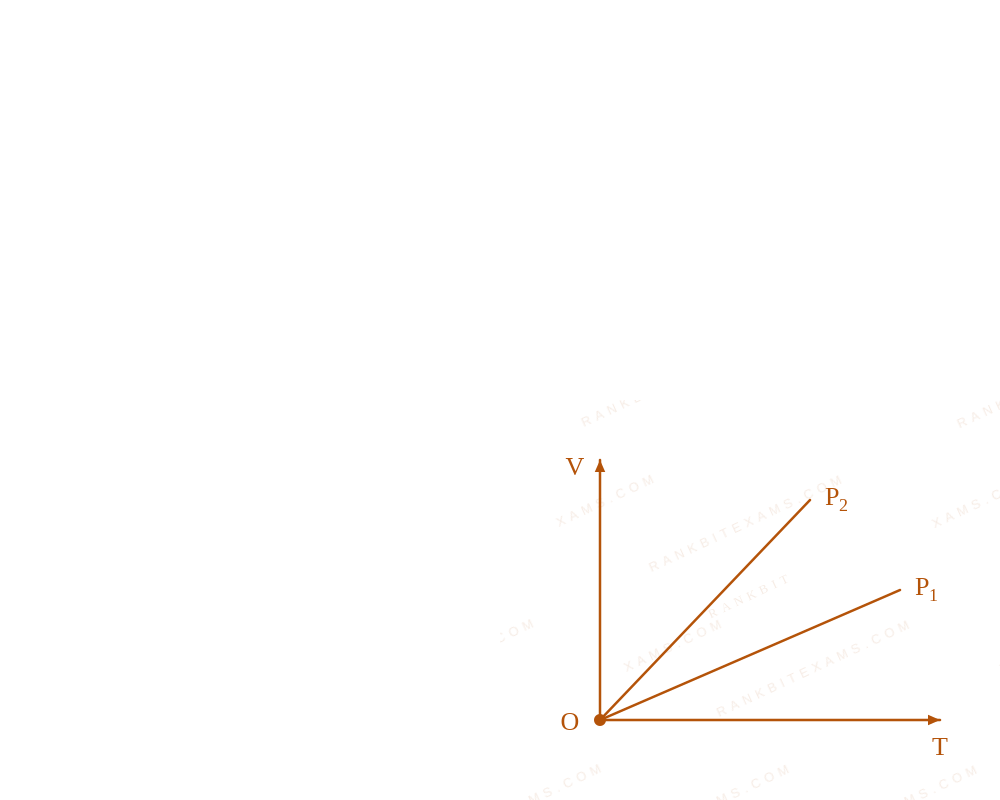
The given figure represents two isobaric processes for the same mass of an ideal gas, then
A Volume vs Temperature (V-T) graph showing two straight lines starting from the origin representing distinct constant pressures P1 and P2.
A.P₂≥ P₁$\mathrm{P}_2\geq \mathrm{P}_1$
B.P₂ > P₁$\mathrm{P}_2 > \mathrm{P}_1$
C.P₁ = P₂$\mathrm{P_1 = P_2}$
D.P₁ > P₂$\mathrm{P}_1 > \mathrm{P}_2$
Solution
Related Formula
PV = nRT$PV = nRT$
Core Logic
From the Ideal Gas Law:
V = ((nR)/(P)) T$$V = \left(\frac{nR}{P}\right) T$$
In a V-T$V-T$ graph, the equation of the line represents y = mx$y = mx$, where the slope m$m$ is:
Practice past-year questions one chapter at a time. Pick an exam → subject → chapter and get every PYQ for that topic — pulled together from all past papers — with the chapter's key formulas alongside.