JEE Main · Physics ↓ Falling

Atoms appeared 22 times across 3 years — 2.5% of Physics. This question is from Bohr Model of the Hydrogen Atom.

Year 2026 2025 2024 Total
Questions 5 8 9 22

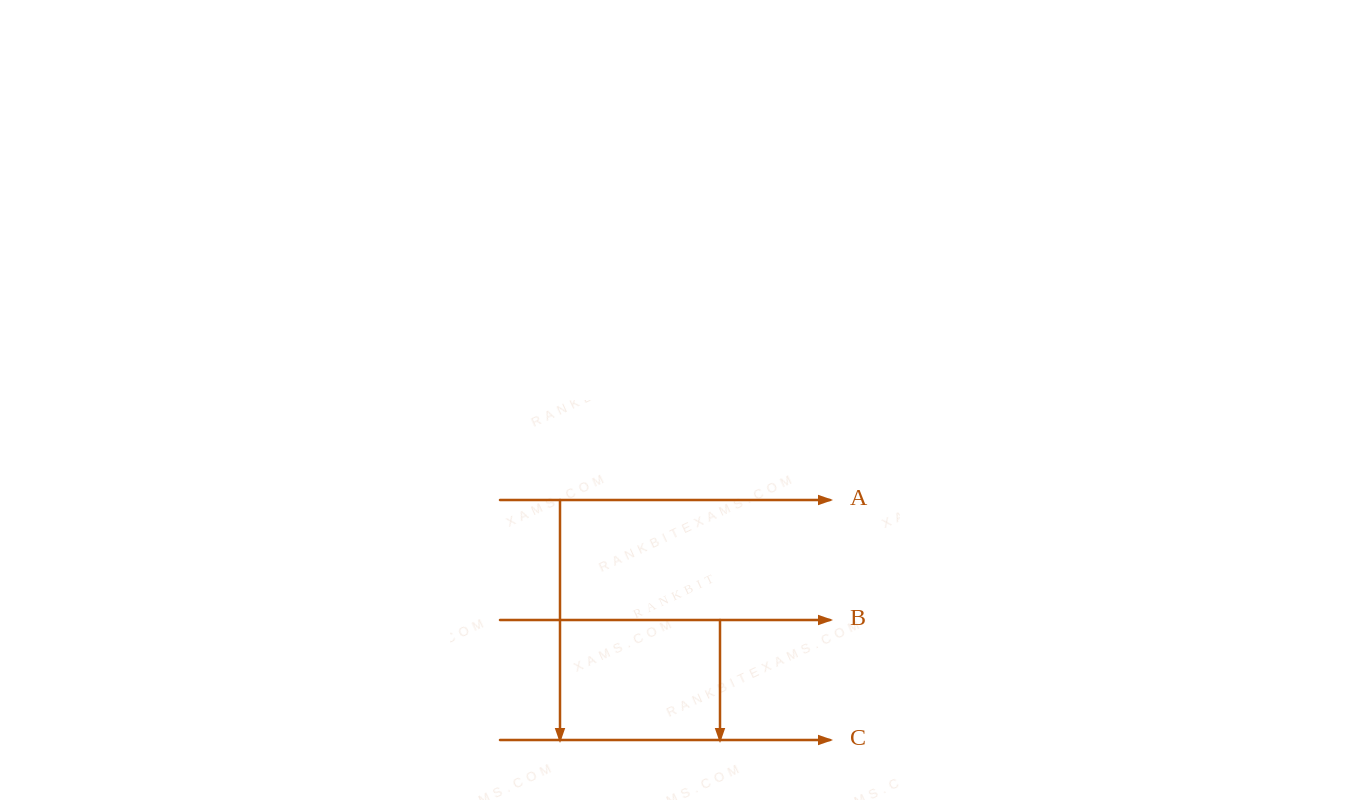
During the transition of electron from state A to state C of a Bohr atom, the wavelength of emitted radiation is 2000 Å and it becomes 6000 Å when the electron jumps from state B to state C. Then the wavelength of the radiation emitted during the transition of electrons from state A to state B is :-

Solution & Explanation

Related Formula

The energy of the emitted photon during an atomic transition between energy states is given by:

Δ E = (hc)/(λ)

where h is Planck's constant, c is speed of light, and λ is the photon wavelength.

Core Logic

Write equations for the energy transitions from the layout of levels

Bohr Model of the Hydrogen Atom diagram for Q5 - JEE Main 2025 Morning
:

EA - EC = hcλAC = hc2000 AA (i) EB - EC = hcλBC = hc6000 AA (ii)
Step 1: Finding Transition A to B

Subtracting equation (ii) from equation (i) gives the net transition energy from A to B :

EA - EB = (EA - EC) - (EB - EC) hcλAB = (hc)/(2000) - (hc)/(6000) 1λAB = (3 - 1)/(6000) = (2)/(6000) = (1)/(3000) λAB = 3000 AA
Pattern Recognition

Energy differences add linearly, which means their corresponding inverse wavelengths satisfy a parallel reciprocal subtraction rule: 1λAB = 1λAC - 1λBC.

Chapter Mix

Class 12 Physics: Atoms

Reference Study Guides

More Atoms Previous-Year Questions — Page 5

Q53 jee_main_2024_30_jan_morning Hydrogen Energy Levels and Transitions
A electron of hydrogen atom on an excited state is having energy Eₙ = -0.85 ~eV. The maximum number of allowed transitions to lower energy level is ....
Numerical Answer. Answer: 6 to 6

Solution

Related Formula
Eₙ = -(13.6)/(n²) ~eV Number of transitions = (n(n - 1))/(2)
Core Logic

First, identify the principal quantum number n corresponding to the energy -0.85 ~eV. Then, use the combinatorics formula to find the total possible downward emission transitions.

Step 1: Find Quantum State
Eₙ = -(13.6)/(n²) -0.85 = -(13.6)/(n²) n² = (13.6)/(0.85) = 16

n = 4

Step 2: Calculate Transitions

Maximum number of transitions from n=4 to lower levels (n=3, 2, 1):

= (n(n - 1))/(2) = (4(4 - 1))/(2) = (12)/(2) = 6
Pattern Recognition

Energy states in Hydrogen are heavily standardized: n=1 arrow -13.6, n=2 arrow -3.4, n=3 arrow -1.51, n=4 arrow -0.85. Recognize -0.85 ~eV as state 4 immediately.

Chapter Mix

Class 12 Physics: Atoms

Q36 jee_main_2024_31_jan_morning Hydrogen Spectrum
If the wavelength of the first member of Lyman series of hydrogen is λ. The wavelength of the second member will be
  • A. (27)/(32) λ
  • B. (32)/(27)λ
  • C. (27)/(5) λ
  • D. (5)/(27)λ

Solution

Related Formula
(1)/(λ) = R Z² [ (1)/(n₁²) - (1)/(n₂²) ]
Core Logic

For the first member of the Lyman series of hydrogen (n₁ = 1, n₂ = 2):

(1)/(λ) = (13.6 Z²)/(hc) [ (1)/(1²) - (1)/(2²) ] (1)/(λ) = (13.6 Z²)/(hc) [ (3)/(4) ] (i)
Step 2: Second Member Calculation

For the second member of the Lyman series (n₁ = 1, n₂ = 3):

(1)/(λ') = (13.6 Z²)/(hc) [ (1)/(1²) - (1)/(3²) ] (1)/(λ') = (13.6 Z²)/(hc) [ (8)/(9) ] (ii)
Step 3: Ratio

On dividing equation (i) by (ii):

(λ')/(λ) = (3/4)/(8/9) = (3)/(4) × (9)/(8) (λ')/(λ) = (27)/(32) λ' = (27)/(32) λ
Pattern Recognition

Rydberg ratios between members of the same series are purely derived from the bracket terms [1/n₁² - 1/n₂²]. For Lyman 1st and 2nd, the ratio is (3/4) / (8/9) = 27/32.

Chapter Mix

Class 12 Physics: Atoms

More Atoms Questions — jee_main_2025_24_jan_morning

Practice all Atoms previous-year questions →

Rankbit System
JEE Physics: Waves (+15.5%) | Electrostatics: Concentric Shells (-29.7%) | Modern Physics: Photoelectric Clones (+34.2%) | Mathematics: Definite Integrals (+18.1%) | Chemistry: Coordination Splitting (-11.4%) | JEE Physics: Waves (+15.5%) | Electrostatics: Concentric Shells (-29.7%) | Modern Physics: Photoelectric Clones (+34.2%) | Mathematics: Definite Integrals (+18.1%) | Chemistry: Coordination Splitting (-11.4%)