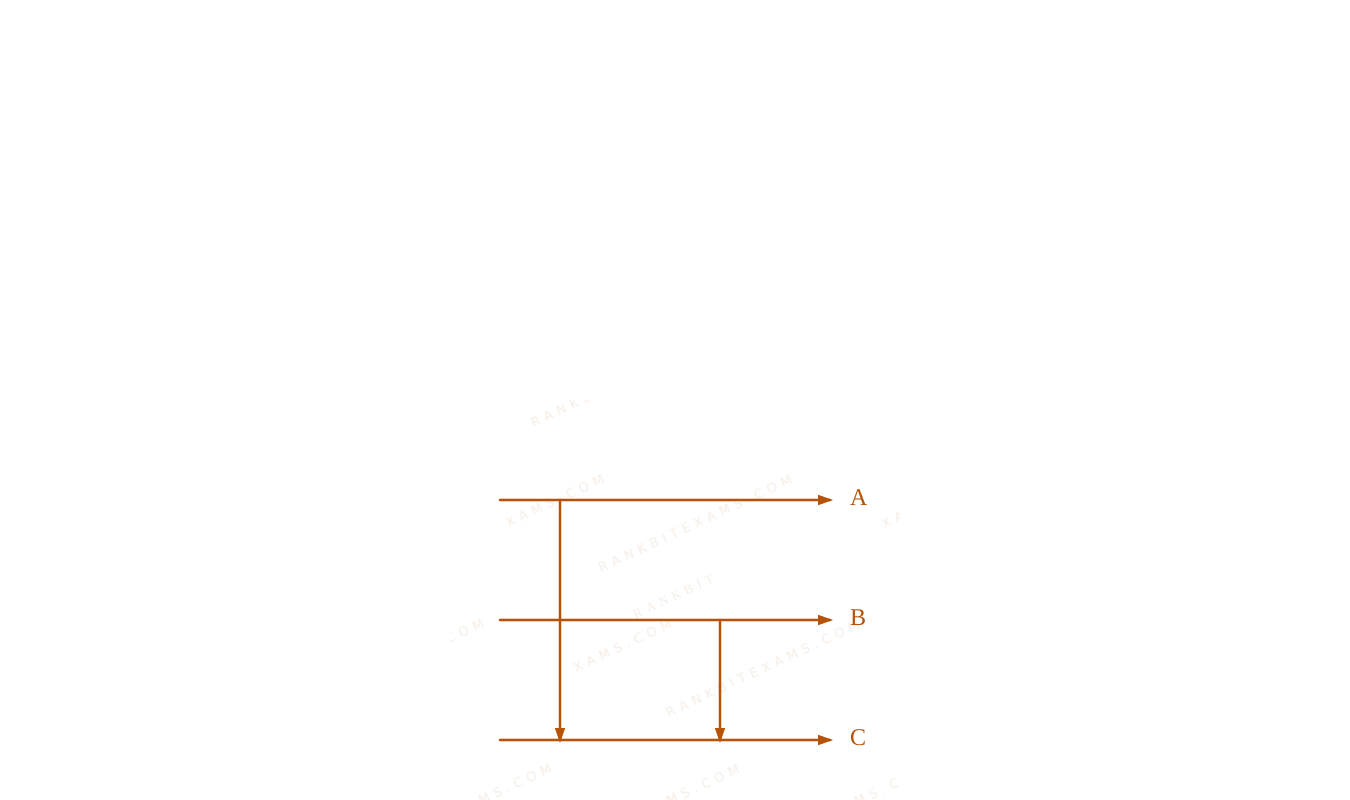
During the transition of electron from state A to state C of a Bohr atom, the wavelength of emitted radiation is 2000 Å and it becomes 6000 Å when the electron jumps from state B to state C. Then the wavelength of the radiation emitted during the transition of electrons from state A to state B is :-

Solution & Explanation

### Related Formula The energy of the emitted photon during an atomic transition between energy states is given by: Delta E = frachclambda where h is Planck's constant, c is speed of light, and lambda is the photon wavelength. ### Core Logic Write equations for the energy transitions from the layout of levels
Bohr Model of the Hydrogen Atom diagram for Q5 - JEE Main 2025 Morning
: E_A - E_C = frachclambda_AC = frachc2000text AA quad dots (i) E_B - E_C = frachclambda_BC = frachc6000text AA quad dots (ii) ### Step 1: Finding Transition A to B Subtracting equation (ii) from equation (i) gives the net transition energy from A to B : E_A - E_B = (E_A - E_C) - (E_B - E_C) frachclambda_AB = frachc2000 - frachc6000 frac1lambda_AB = frac3 - 16000 = frac26000 = frac13000 lambda_AB = 3000text AA ### Pattern Recognition Energy differences add linearly, which means their corresponding inverse wavelengths satisfy a parallel reciprocal subtraction rule: frac1lambda_AB = frac1lambda_AC - frac1lambda_BC. ### Evaluation Rubric / Model Answer null ### Chapter Mix Class 12 Physics: Atoms

Reference Study Guides

More Atoms Previous-Year Questions — Page 4

Q36 jee_main_2024_30_jan_morning Bohr Model and Electron Energy
The ratio of the magnitude of the kinetic energy to the potential energy of an electron in the 5^textth excited state of a hydrogen atom is :
  • A. 4
  • B. frac14
  • C. frac12
  • D. 1

Solution

### Related Formula textKE = -E textPE = 2E textKE = frac12 |textPE| ### Core Logic In any allowed Bohr orbit (for any value of principal quantum number n), the relationship between kinetic energy (KE), potential energy (PE), and total energy (E) strictly obeys the virial theorem for a Coulombic force field. |textPE| = 2 times textKE ### Step 1: Formulate the Ratio The question asks for the ratio of the magnitude of KE to the magnitude of PE. fractextKE|textPE| = frac12 This ratio is independent of the orbit state. Even though it is the 5^textth excited state, the ratio remains frac12. ### Pattern Recognition Energy relationships in Bohr orbits (and planetary motion): K = -E = -U/2. The state number (n) is given solely as a distractor. ### Evaluation Rubric / Model Answer null ### Chapter Mix Class 12 Physics: Atoms

Q53 jee_main_2024_30_jan_morning Hydrogen Energy Levels and Transitions
A electron of hydrogen atom on an excited state is having energy E_n = -0.85 mathrm~eV. The maximum number of allowed transitions to lower energy level is ....
Numerical Answer. Answer: 6 to 6

Solution

### Related Formula E_n = -frac13.6n^2 mathrm~eV textNumber of transitions = fracn(n - 1)2 ### Core Logic First, identify the principal quantum number n corresponding to the energy -0.85 mathrm~eV. Then, use the combinatorics formula to find the total possible downward emission transitions. ### Step 1: Find Quantum State E_n = -frac13.6n^2 -0.85 = -frac13.6n^2 n^2 = frac13.60.85 = 16 n = 4 ### Step 2: Calculate Transitions Maximum number of transitions from n=4 to lower levels (n=3, 2, 1): = fracn(n - 1)2 = frac4(4 - 1)2 = frac122 = 6 ### Pattern Recognition Energy states in Hydrogen are heavily standardized: n=1 rightarrow -13.6, n=2 rightarrow -3.4, n=3 rightarrow -1.51, n=4 rightarrow -0.85. Recognize -0.85 mathrm~eV as state 4 immediately. ### Evaluation Rubric / Model Answer null ### Chapter Mix Class 12 Physics: Atoms
Q36 jee_main_2024_31_jan_morning Hydrogen Spectrum
If the wavelength of the first member of Lyman series of hydrogen is lambda. The wavelength of the second member will be
  • A. frac2732 lambda
  • B. frac3227lambda
  • C. frac275 lambda
  • D. frac527lambda

Solution

### Related Formula frac1lambda = R Z^2 left[ frac1n_1^2 - frac1n_2^2 right] ### Core Logic For the first member of the Lyman series of hydrogen (n_1 = 1, n_2 = 2): frac1lambda = frac13.6 Z^2hc left[ frac11^2 - frac12^2 right] frac1lambda = frac13.6 Z^2hc left[ frac34 right] dots dots (texti) ### Step 2: Second Member Calculation For the second member of the Lyman series (n_1 = 1, n_2 = 3): frac1lambda' = frac13.6 Z^2hc left[ frac11^2 - frac13^2 right] frac1lambda' = frac13.6 Z^2hc left[ frac89 right] dots dots (textii) ### Step 3: Ratio On dividing equation (i) by (ii): fraclambda'lambda = frac3/48/9 = frac34 times frac98 fraclambda'lambda = frac2732 lambda' = frac2732 lambda ### Pattern Recognition Rydberg ratios between members of the same series are purely derived from the bracket terms [1/n_1^2 - 1/n_2^2]. For Lyman 1st and 2nd, the ratio is (3/4) / (8/9) = 27/32. ### Evaluation Rubric / Model Answer null ### Chapter Mix Class 12 Physics: Atoms

More Atoms Questions — jee_main_2025_24_jan_morning

Practice all Atoms previous-year questions →

Rankbit System
JEE Physics: Waves (+15.5%) | Electrostatics: Concentric Shells (-29.7%) | Modern Physics: Photoelectric Clones (+34.2%) | Mathematics: Definite Integrals (+18.1%) | Chemistry: Coordination Splitting (-11.4%) | JEE Physics: Waves (+15.5%) | Electrostatics: Concentric Shells (-29.7%) | Modern Physics: Photoelectric Clones (+34.2%) | Mathematics: Definite Integrals (+18.1%) | Chemistry: Coordination Splitting (-11.4%)