JEE Main · Chemistry ↓ Falling

d-and f-Block Elements appeared 45 times across 3 years — 5.2% of Chemistry. This question is from Preparation and Properties of Potassium Permanganate.

Year 2026 2025 2024 Total
Questions 10 18 17 45

Preparation of potassium permanganate from MnO₂ involves two step process in which the 1st step is a reaction with KOH and KNO₃ to produce

Solution & Explanation

Related Formula
2MnO₂ + 4KOH + O₂ KNO₃ 2K₂MnO₄ + 2H₂O
Core Logic

The standard preparation of potassium permanganate begins with the oxidative fusion of pyrolusite ore (MnO₂). Fusing the solid reactant directly along an alkaline base payload (KOH) combined explicitly with an oxidizing carrier (KNO₃) yields the intermediate green product, potassium manganate (K₂MnO₄).

Pattern Recognition

Step 1 yields the +6 green compound (K₂MnO₄); the subsequent Step 2 steps oxidize this intermediate to synthesize the target deep purple +7 agent (KMnO₄).

Chapter Mix

Class 12 Chemistry: The d-and f-Block Elements

Reference Study Guides

More The d-and f-Block Elements Previous-Year Questions — Page 8

Q63 jee_main_2024_29_jan_morning Potassium Dichromate and Chromyl Chloride Test
In chromyl chloride test for confirmation of Cl^- ion, a yellow solution is obtained. Acidification of the solution and addition of amyl alcohol and 10% H₂O₂ turns organic layer blue indicating formation of chromium pentoxide. The oxidation state of chromium in that is
  • A. +6
  • B. +5
  • C. +10
  • D. +3

Solution

Core Logic

The reaction sequence for the chromyl chloride test is:

Cl^- + K₂Cr₂O₇ + H₂SO₄ arrow CrO₂Cl₂

The chromyl chloride gas is then passed through a basic medium (like NaOH) to form a yellow solution of chromate ions:

CrO₂Cl₂ Basic medium CrO₄²⁻ + Cl^-

Acidification of the yellow CrO₄²⁻ solution followed by the addition of H₂O₂ and amyl alcohol yields a blue-colored organic layer due to the formation of chromium pentoxide (CrO₅).

CrO₄²⁻ [yellow solution, 1. Acidification CrO₅ (blue compound)

Step 1: Oxidation State Calculation
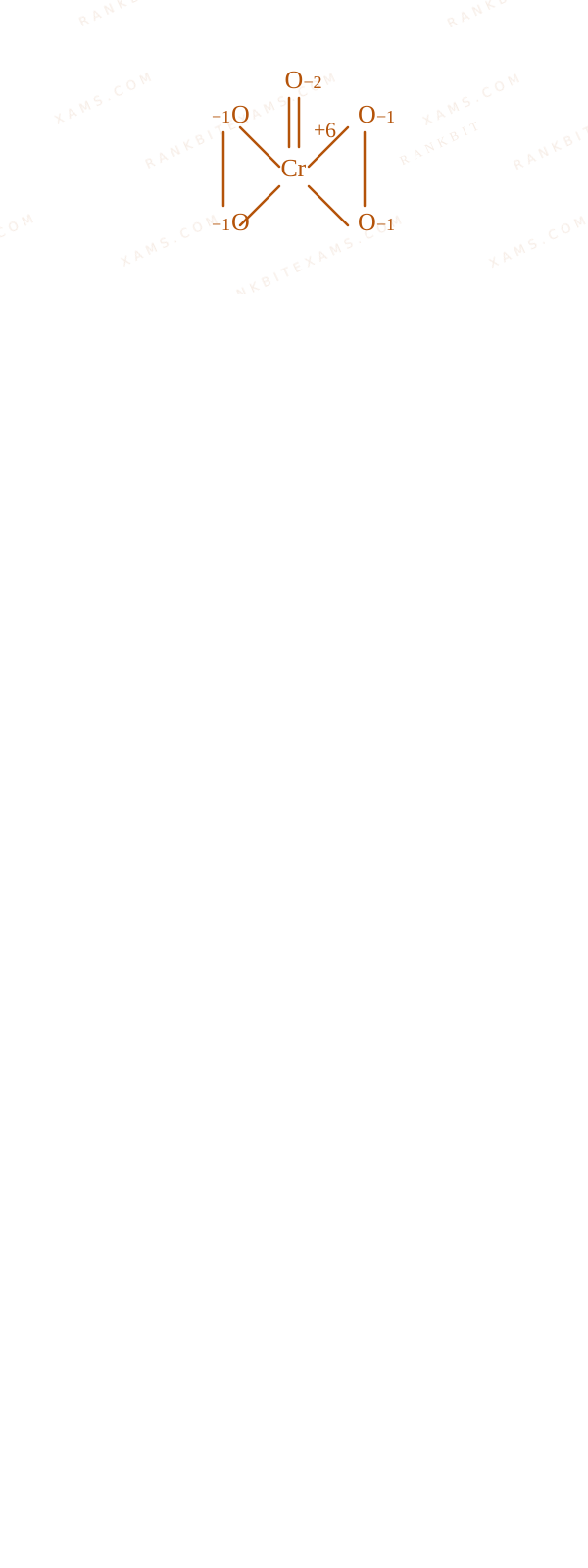
Potassium Dichromate and Chromyl Chloride Test diagram for Q63 - JEE Main 2024 Morning

The structure of chromium pentoxide (CrO₅) features a distinctive "butterfly" arrangement. It contains one double-bonded oxide oxygen (O²⁻) and four peroxide oxygens (O₂²⁻). Therefore, there are 2 peroxo linkages.

Let the oxidation state of Chromium be x.

x + 1(-2) + 4(-1) = 0

x - 2 - 4 = 0 x = +6

Thus, the oxidation state of Cr in CrO₅ is +6.

Pattern Recognition

A classic oxidation state trap. Calculating simply via formula CrO₅ yields x - 10 = 0 x = +10, which is impossible for Chromium (max +6). Whenever calculation exceeds the maximum group valency, peroxide bonds are present.

Chapter Mix

Class 12 Chemistry: d and f Block Elements Class 11 Chemistry: Redox Reactions
Q80 jee_main_2024_29_jan_morning Potassium Permanganate Reactions
In alkaline medium. MnO₄^- oxidises I^- to
  • A. IO₄^-
  • B. IO^-
  • C. I₂
  • D. IO₃^-

Solution

Core Logic

The behavior of the permanganate ion (MnO₄^-) varies with the pH of the medium. In a faintly alkaline or neutral medium, MnO₄^- oxidizes iodide (I^-) completely to iodate (IO₃^-) while getting reduced to manganese dioxide (MnO₂).

The balanced ionic equation is:

2MnO₄^- + H₂O + I^- arrow 2MnO₂ + 2OH^- + IO₃^-
Pattern Recognition

Rule of thumb for I^- oxidation by KMnO₄: In acidic medium: I^- arrow I₂ In alkaline/neutral medium: I^- arrow IO₃^-

Chapter Mix

Class 12 Chemistry: d and f Block Elements

Q jee_main_2024_30_january_evening Compounds of Transition Elements
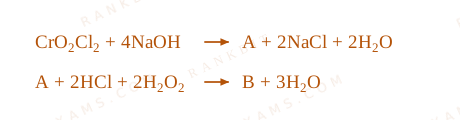
A and B formed in the following reactions are:
Compounds of Transition Elements
  • A. A = Na₂CrO₄, B = CrO₅
  • B. A = Na₂Cr₂O₄, B = CrO₄
  • C. A = Na₂Cr₂O₇, B = CrO₃
  • D. A = Na₂Cr₂O₇, B = CrO₅

Solution

Core Logic

Step 1: Chromyl chloride (CrO₂Cl₂) reacts with an alkali like NaOH to give a yellow solution of sodium chromate (Na₂CrO₄).

CrO₂Cl₂ + 4NaOH arrow Na₂CrO₄ (A) + 2NaCl + 2H₂O

Step 2: Sodium chromate (Na₂CrO₄) reacts with hydrogen peroxide (H₂O₂) in an acidic medium (HCl) to yield the deep blue colored chromium pentoxide (CrO₅, also known as chromium(VI) oxide peroxide).

Na₂CrO₄ + 2H₂O₂ + 2HCl arrow CrO₅ (B) + 2NaCl + 3H₂O

Note: NaCl formation implies the overall balanced reaction uses the acid for neutralization/salt formation.

Pattern Recognition

Chromyl chloride test intermediate: Yellow solution = Na₂CrO₄. Reaction of chromate with H₂O₂ in acid = Blue peroxide CrO₅ (butterfly structure).

Chapter Mix

Class 12 Chemistry: The d and f Block Elements Class 11 Chemistry: Redox Reactions

Q70 jee_main_2024_30_january_evening Properties of Transition Metal Compounds
The orange colour of K₂Cr₂O₇ and purple colour of KMnO₄ is due to
  • A. Charge transfer transition in both.
  • B. d arrow d transition in KMnO₄ and charge transfer transitions in K₂Cr₂O₇
  • C. d arrow d transition in K₂Cr₂O₇ and charge transfer transitions in KMnO₄.
  • D. d arrow d transition in both.

Solution

Core Logic

In K₂Cr₂O₇, Chromium is in the +6 oxidation state, which means its electronic configuration is d⁰. Since there are no d-electrons, d-d transitions cannot occur. The orange color is due to ligand-to-metal charge transfer (LMCT) from oxygen to chromium.

Similarly, in KMnO₄, Manganese is in the +7 oxidation state, which also corresponds to a d⁰ configuration. Again, no d-d transitions are possible. The intense purple color is due to ligand-to-metal charge transfer (LMCT) from oxygen to manganese.

Step 1: Final Conclusion

Both compounds owe their colors to charge transfer transitions.

Pattern Recognition

Compounds of transition metals in their highest oxidation states (where they have d⁰ configurations, like Cr⁺⁶, Mn⁺⁷, V⁺⁵) are deeply colored primarily due to Charge Transfer spectra, NOT d-d transitions.

Chapter Mix

Class 12 Chemistry: The d and f Block Elements

Q71 jee_main_2024_30_january_evening Preparation and Properties of KMnO4
Alkaline oxidative fusion of MnO₂ gives "A" which on electrolytic oxidation in alkaline solution produces B. A and B respectively are:
  • A. Mn₂O₇ and MnO₄^-
  • B. MnO₄²⁻ and MnO₄^-
  • C. Mn₂O₃ and MnO₄²⁻
  • D. MnO₄²⁻ and Mn₂O₇

Solution

Core Logic

Step 1: Alkaline oxidative fusion of MnO₂ (pyrolusite ore) with KOH in the presence of O₂ (or an oxidizing agent like KNO₃) yields the green-colored manganate ion (MnO₄²⁻).

2MnO₂ + 4OH^- + O₂ arrow 2MnO₄²⁻ + 2H₂O

So, A is MnO₄²⁻.

Step 2: Electrolytic oxidation of the manganate ion (MnO₄²⁻) in an alkaline medium converts it to the purple-colored permanganate ion (MnO₄^-).

MnO₄²⁻ arrow MnO₄^- + e^-

So, B is MnO₄^-.

Pattern Recognition

Industrial preparation sequence of KMnO₄: MnO₂ fusion, KOH, O₂ MnO₄²⁻ (green) electrolytic oxidation MnO₄^- (purple).

Chapter Mix

Class 12 Chemistry: The d and f Block Elements

More The d-and f-Block Elements Questions — jee_main_2025_24_jan_morning

Practice all The d-and f-Block Elements previous-year questions →

Rankbit System
JEE Physics: Waves (+15.5%) | Electrostatics: Concentric Shells (-29.7%) | Modern Physics: Photoelectric Clones (+34.2%) | Mathematics: Definite Integrals (+18.1%) | Chemistry: Coordination Splitting (-11.4%) | JEE Physics: Waves (+15.5%) | Electrostatics: Concentric Shells (-29.7%) | Modern Physics: Photoelectric Clones (+34.2%) | Mathematics: Definite Integrals (+18.1%) | Chemistry: Coordination Splitting (-11.4%)