Which of the following oxidation reactions are carried out by both K₂Cr₂O₇$\mathrm{K}_2\mathrm{Cr}_2\mathrm{O}_7$ and KMnO₄$\mathrm{KMnO}_4$ in acidic medium?
A. I^- arrow I₂$\mathrm{I}^- \rightarrow \mathrm{I}_2$
B. S²⁻ arrow S$\mathrm{S}^{2-} \rightarrow \mathrm{S}$
C. Fe²⁺ arrow Fe³⁺$\mathrm{Fe}^{2+} \rightarrow \mathrm{Fe}^{3+}$
D. I⁻ arrow IO₃⁻$\mathrm{I}^{-} \rightarrow \mathrm{IO}_{3}^{-}$
E. S₂O₃²⁻ arrow SO₄²⁻$\mathrm{S}_2\mathrm{O}_3^{2-} \rightarrow \mathrm{SO}_4^{2-}$
Choose the correct answer from the options given below:
A.B, C and D only$\text{B, C and D only}$
B.A, D and E only$\text{A, D and E only}$
C.A, B and C only$\text{A, B and C only}$
D.C, D and E only$\text{C, D and E only}$
Solution & Explanation
Core Logic
In an acidic medium, both K₂Cr₂O₇$\mathrm{K}_2\mathrm{Cr}_2\mathrm{O}_7$ and KMnO₄$\mathrm{KMnO}_4$ act as strong oxidizing agents and carry out the following transformations:
A: Oxidize iodide to iodine: I^- arrow I₂$\mathrm{I}^- \rightarrow \mathrm{I}_2$
Iodide is oxidized to iodate (IO₃^-$\mathrm{IO}_3^-$) by KMnO₄$\mathrm{KMnO}_4$ primarily in a neutral or faintly alkaline medium, not acidic.
Thiosulfate (S₂O₃²⁻$\mathrm{S}_2\mathrm{O}_3^{2-}$) undergoes a disproportionation/precipitation reaction in acid rather than clean oxidation to sulfate by dichromate.
Thus, statements A, B, and C are valid for both under acidic conditions.
Pattern Recognition
Sees: Shared oxidation products in an acidic environment.
Shortcut: Remember that I^- arrow IO₃^-$\mathrm{I}^- \rightarrow \mathrm{IO}_3^-$ is the signature reaction for alkaline permanganate, allowing quick elimination of choices containing D.
Keywords:#oxidation reactions carried out by both K2Cr2O7 and KMnO4#JEE Main 2025 Morning Q44#Inorganic Oxidations JEE Main 2025#d-Block Reagents JEE Main 2025
More The d-and f-Block Elements Previous-Year Questions
Q63jee_main_2026_21_jan_morningCompounds of Transition Elements
MnO₄²⁻$MnO_{4}^{2-}$, in acidic medium, disproportionates to :
A.Mn₂O₇ and MnO₂$Mn_{2}O_{7}\text{ and }MnO_{2}$
B.MnO₄^- and MnO$\mathrm{MnO}_4^-\text{ and }MnO$
C.MnO₄^- and MnO₂$\mathrm{MnO}_4^-\text{ and }\mathrm{MnO}_2$
D.Mn₂O₇ and MnO$\mathrm{Mn}_{2}\mathrm{O}_{7}\text{ and }MnO$
Manganate ion (MnO₄²⁻$\mathrm{MnO}_4^{2-}$), where Mn is in +6 oxidation state, is unstable in acidic medium and undergoes disproportionation.
It oxidizes to Permanganate (MnO₄^-$\mathrm{MnO}_4^-$, +7 state) and reduces to Manganese dioxide (MnO₂$\mathrm{MnO}_2$, +4 state).
Pattern Recognition
Manganate (green, +6) disproportionates in acid to Permanganate (purple, +7) and MnO₂$MnO_2$ (brown/black precipitate, +4).
Chapter Mix
Class 12 Chemistry: d and f Block Elements
Q75jee_main_2026_21_jan_morningChromyl Chloride Test and Chromate Chemistry
Consider the following reactions:
NaCl + K₂Cr₂O₇ + H₂SO₄ arrow A + KHSO₄ + NaHSO₄ + H₂O$NaCl + K_{2}Cr_{2}O_{7} + H_{2}SO_{4} \rightarrow A + KHSO_{4} + NaHSO_{4} + H_{2}O$A + NaOH arrow B + NaCl + H₂O$A + NaOH \rightarrow B + NaCl + H_{2}O$B + H₂SO₄ + H₂O₂ arrow C + Na₂SO₄ + H₂O$B + H_{2}SO_{4} + H_{2}O_{2} \rightarrow C + Na_{2}SO_{4} + H_{2}O$
In the product 'C', 'X' is the number of O₂²⁻$O_{2}^{2-}$ units, 'Y' is the total number oxygen atoms present and 'Z' is the oxidation state of Cr. The value of X + Y + Z$X + Y + Z$ is ____.
Numerical Answer.Answer: 13 to 13
Solution
Core Logic
The first reaction is the classical Chromyl Chloride Test:
4NaCl + K₂Cr₂O₇ + 6H₂SO₄ arrow 2CrO₂Cl₂ (A) + 2KHSO₄ + 4NaHSO₄ + 3H₂O$4\mathrm{NaCl} + \mathrm{K_2Cr_2O_7} + 6\mathrm{H_2SO_4} \rightarrow 2\mathrm{CrO_2Cl_2} (\text{A}) + 2\mathrm{KHSO_4} + 4\mathrm{NaHSO_4} + 3\mathrm{H_2O}$
Product A is Chromyl chloride (CrO₂Cl₂$\mathrm{CrO_2Cl_2}$), a red-orange gas.
When Chromyl chloride gas is passed into NaOH solution, it forms a yellow solution of sodium chromate (B):
CrO₂Cl₂ (A) + 4NaOH arrow Na₂CrO₄ (B) + 2NaCl + 2H₂O$\mathrm{CrO_2Cl_2} (\text{A}) + 4\mathrm{NaOH} \rightarrow \mathrm{Na_2CrO_4} (\text{B}) + 2\mathrm{NaCl} + 2\mathrm{H_2O}$
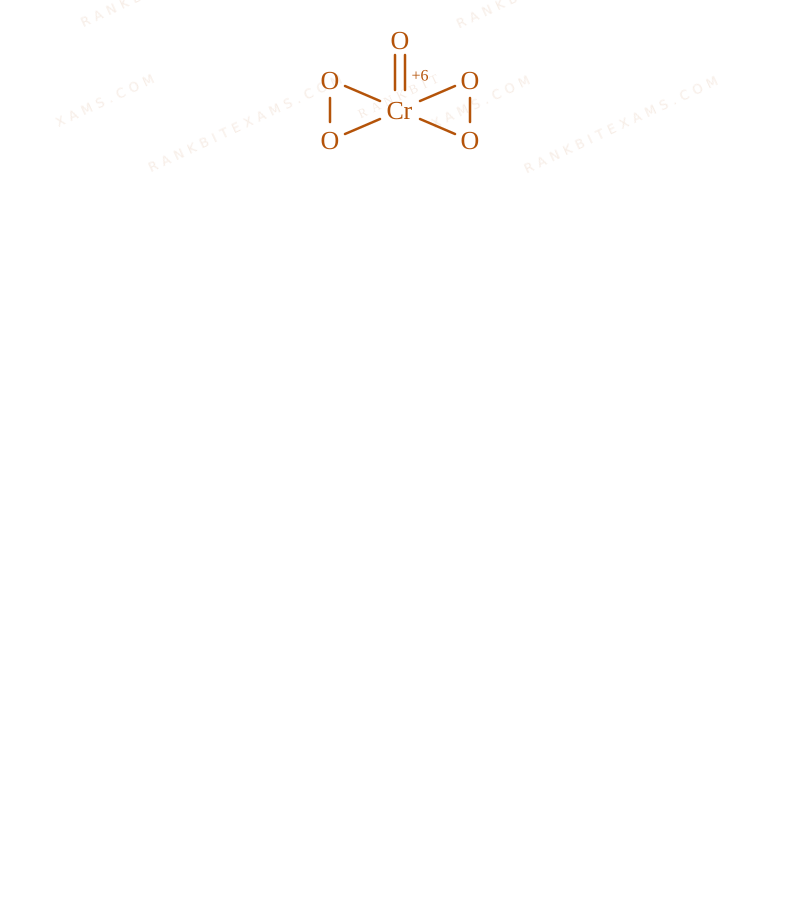
Acidifying the sodium chromate solution with H₂SO₄$H_2SO_4$ and adding H₂O₂$H_2O_2$ yields a deep blue solution of Chromium(VI) peroxide, CrO₅$CrO_5$ (C):
Na₂CrO₄ (B) + H₂SO₄ + 2H₂O₂ arrow CrO₅ (C) + Na₂SO₄ + 3H₂O$\mathrm{Na_2CrO_4} (\text{B}) + \mathrm{H_2SO_4} + 2\mathrm{H_2O_2} \rightarrow \mathrm{CrO_5} (\text{C}) + \mathrm{Na_2SO_4} + 3\mathrm{H_2O}$
Structure of CrO₅$CrO_5$:
Chromyl Chloride Test diagram for Q75 - JEE Main 2026 Morning
It has a butterfly structure.
Number of peroxy units (O₂²⁻$O_2^{2-}$), X = 2$X = 2$.
Total number of oxygen atoms, Y = 5$Y = 5$.
Oxidation state of Cr, Z = +6$Z = +6$.
Sum: X + Y + Z = 2 + 5 + 6 = 13$X + Y + Z = 2 + 5 + 6 = 13$.
Step 1: Final Calculation
X + Y + Z = 13$X + Y + Z = 13$
Pattern Recognition
Chromyl chloride testarrow$\rightarrow$CrO₂Cl₂$CrO_2Cl_2$ (red gas). Absorbed in NaOH arrow$\rightarrow$Na₂CrO₄$Na_2CrO_4$ (yellow). Tested with H₂O₂/H^+$H_2O_2/H^+$arrow$\rightarrow$CrO₅$CrO_5$ (butterfly structure, blue, two peroxy links, Cr in +6).
Chapter Mix
Class 12 Chemistry: d and f Block Elements
Class 11 Chemistry: Redox Reactions
Q66jee_main_2026_21_jan_eveningOxides of Manganese and Properties
Given below are some of the statements about Mn$\text{Mn}$ and Mn₂O₇$\text{Mn}_2\text{O}_7$. Identify the correct statements:
A. Mn forms the oxide Mn₂O₇$\text{Mn}_2\text{O}_7$ in which Mn is in its highest oxidation state.
B. Oxygen stabilizes the Mn in higher oxidation states by forming multiple bonds with Mn.
C. Mn₂O₇$\text{Mn}_2\text{O}_7$ is an ionic oxide.
D. The structure of Mn₂O₇$\text{Mn}_2\text{O}_7$ consists of one bridged oxygen.
Choose the correct answer from the options given below:
A.(1) A, B, C and D$(1) \text{ A, B, C and D}$
B.(2) A, B and D Only$(2) \text{ A, B and D Only}$
C.(3) A, C and D Only$(3) \text{ A, C and D Only}$
D.(4) A, B and C Only$(4) \text{ A, B and C Only}$
Solution
Core Logic
A is correct: Mn₂O₇$\text{Mn}_2\text{O}_7$ features Mn in +7 state (its highest oxidation state).
B is correct: Oxygen stabilizes high oxidation states via multiple bonding.
C is incorrect: Mn₂O₇$\text{Mn}_2\text{O}_7$ is a covalent green oil/oxide, not ionic.
D is correct: Structure consists of two MnO₄$\text{MnO}_4$ tetrahedra sharing one bridging oxygen atom (O₃Mn-O-MnO₃$\text{O}_3\text{Mn}-\text{O}-\text{MnO}_3$).
Step 1: Final Conclusion
Statements A, B and D are correct, matching option (2).
Pattern Recognition
Sees: Properties and bonding of transition metal oxides like Mn₂O₇$\text{Mn}_2\text{O}_7$.
Trap: Assuming high oxidation state oxides of transition metals are ionic.
Chapter Mix
Class 12 Chemistry: The d- and f-Block Elements
Q58jee_main_2026_22_january_morningReactions of Transition Metals
A first row transition metal (M) does not liberate H₂$H_{2}$ gas from dilute HCl. 1 mol of aqueous solution of MSO₄$MSO_{4}$ is treated with excess of aqueous KCN and then H₂S(g)$H_{2}S(g)$ is passed through the solution. The amount of MS (metal sulphide) formed from the above reaction is ____ mol.
A.2$\text{2}$
B.1$\text{1}$
C.3$\text{3}$
D.0$\text{0}$
Solution
Related Formula
Cu²⁺ + 4CN⁻ arrow [Cu(CN)₄]³⁻ (after redox with CN^-)$$Cu^{2+} + 4CN^{-} \rightarrow [Cu(CN)_{4}]^{3-} \quad (\text{after redox with } CN^-)$$
Core Logic
The first-row transition metal that does not liberate H₂$H_{2}$ gas from dilute HCl is Copper (Cu), because its standard reduction potential is positive (E°Cu²⁺/Cu = +0.34 V$E^{\circ}_{Cu^{2+}/Cu} = +0.34\text{ V}$).
When CuSO₄$CuSO_{4}$ is treated with excess KCN, it forms a very stable soluble cyano complex:
The complex ion [Cu(CN)₄]³⁻$[Cu(CN)_{4}]^{3-}$ is highly stable (a perfect complex). When H₂S$H_{2}S$ is passed through this solution, it does not yield sufficient Cu⁺$Cu^{+}$ ions to exceed the solubility product (Kₛₚ$K_{sp}$) of Cu₂S$Cu_{2}S$.
Step 1: Final Conclusion
Since no copper sulphide precipitates, the amount of MS formed is 0 moles.
Pattern Recognition
Cu and Cd separation: Cu²⁺$Cu^{2+}$ forms a very stable cyanide complex that does not precipitate with H₂S$H_2S$, whereas Cd²⁺$Cd^{2+}$ forms a less stable complex that does precipitate as CdS$CdS$.
Chapter Mix
Class 12 Chemistry: d and f Block Elements
Class 12 Chemistry: Coordination Compounds
Q54jee_main_2026_22_january_eveningIonization Enthalpy Trends in Transition Metals
Given below are two statements:
Statement-I: The first ionization enthalpy of Cr is lower than that of Mn.
Statement-II: The second and third ionization enthalpies of Cr are higher than those of Mn.
In the light of the above statements, choose the correct answer from the options given below:
Cr: 4s¹ Removal of single 4s electron requires less energy than removing 4s² in Mn.$$\text{Cr}: 4s^1 \implies \text{Removal of single } 4s \text{ electron requires less energy than removing } 4s^2 \text{ in Mn.}$$
Hence, IE₁(Cr) < IE₁(Mn)$IE_1(\text{Cr}) < IE_1(\text{Mn})$ (Statement-I is TRUE).
Step 2: Compare IE₂$IE_2$ and IE₃$IE_3$:
Cr^+ = 3d⁵ stable half-filled configuration d⁵, so IE₂(Cr) > IE₂(Mn)$$\text{Cr}^+ = 3d^5 \implies \text{stable half-filled configuration } d^5, \text{ so } IE_2(\text{Cr}) > IE_2(\text{Mn})$$For IE₃, Mn²⁺ = 3d⁵ removing electron from stable 3d⁵ in Mn²⁺ requires more energy than Cr²⁺ (3d⁴).$$\text{For } IE_3, \text{Mn}^{2+} = 3d^5 \implies \text{removing electron from stable } 3d^5 \text{ in Mn}^{2+} \text{ requires more energy than Cr}^{2+} (3d^4).$$
Hence, IE₃(Cr) < IE₃(Mn)$IE_3(\text{Cr}) < IE_3(\text{Mn})$. Thus Statement-II is FALSE.
Pattern Recognition
Sees: Ionization enthalpy comparison of Cr and Mn.
Shortcut: Stable 3d⁵$3d^5$ configuration in Cr^+$\text{Cr}^+$ makes IE₂$IE_2$ very high, whereas 3d⁵$3d^5$ in Mn²⁺$\text{Mn}^{2+}$ makes IE₃$IE_3$ of Mn higher than Cr.
Chapter Mix
Class 12 Chemistry: d- and f-Block Elements
Class 11 Chemistry: Classification of Elements and Periodicity in Properties
More The d-and f-Block Elements Questions — jee_main_2025_28_jan_morning
Practice past-year questions one chapter at a time. Pick an exam → subject → chapter and get every PYQ for that topic — pulled together from all past papers — with the chapter's key formulas alongside.