JEE Main · Chemistry → Steady

Solutions appeared 45 times across 3 years — 5.2% of Chemistry. This question is from Depression in Freezing Point.

Year 2026 2025 2024 Total
Questions 14 20 11 45

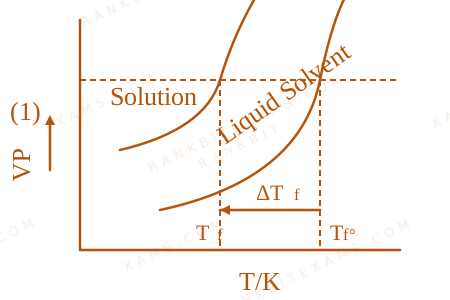
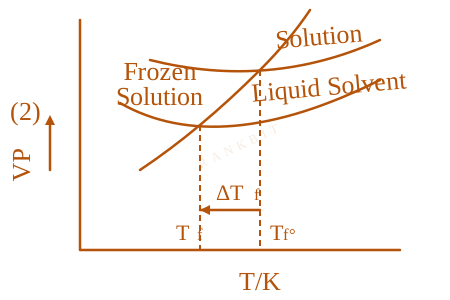
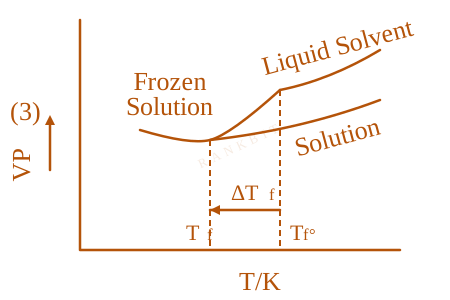
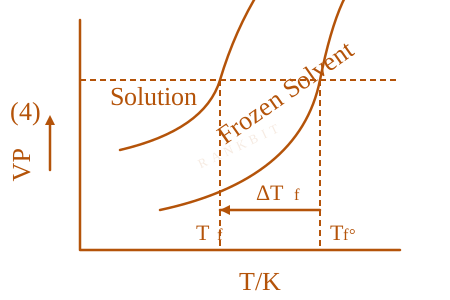
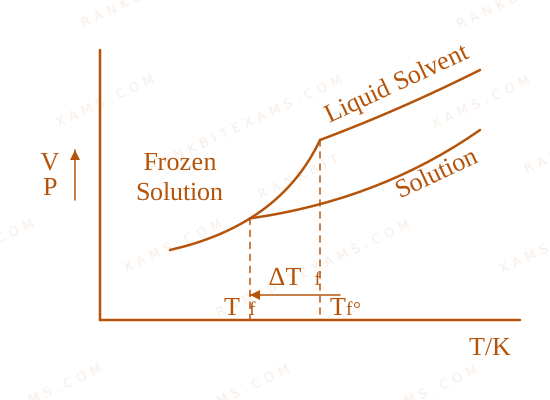
Consider the given plots of vapour pressure (VP) vs temperature (T/K) Which amongst the following options is correct graphical representation showing Δ Tf , depression in the freezing point of solvent in a solution?

Solution & Explanation

Core Logic

Let the initial pressure of the reactant N₂O₅ be P₀.

Setting up the stoichiometric reaction table:

arraylcccc & N₂O5(g) & arrow & 2NO2(g) & + & (1)/(2)O2(g) Initially (t = 0): & P₀ & & 0 & & 0 At time t: & P₀ - x & & 2x & & (x)/(2) array

The total pressure of the gaseous mixture at any time t is given by:

Ptotal = (P₀ - x) + 2x + (x)/(2) = P₀ + (3x)/(2)

When 50% of the reaction is completed, the change in the reactant's pressure is:

x = 0.5 P₀ = (P₀)/(2)

Substituting the value of x into the total pressure expression:

Ptotal = P₀ + (3)/(2)((P₀)/(2)) = P₀ + (3P₀)/(4) = (7)/(4)P₀
Pattern Recognition

Track the change in the total pressure carefully using stoichiometric coefficients. For a 50% completion step, substitute the fractional equivalent (x = 0.5 P₀) directly into your total pressure expression.

Depression in Freezing Point solution plot for Q42 - JEE Main 2025 Morning

More Solutions Previous-Year Questions — Page 8

Q jee_main_2024_29_january_evening Interconversion of Concentration Terms
Molality of 0.8 M H₂SO₄ solution (density 1.06 g cm⁻³) is **815** × 10⁻³ m.
Numerical Answer. Answer: 815 to 815

Solution

Related Formula
m = (M × 1000)/((1000 × d) - (M × MB))

where,

  • M = Molarity = 0.8 M
  • d = Density = 1.06 g/cm³
  • MB = Molar mass of solute (H₂SO₄) = 98 g/mol
Core Logic

Substituting the given values into the equation:

m = (0.8 × 1000)/((1000 × 1.06) - (0.8 × 98))

Calculating the denominator parameters:

Denominator = 1060 - 78.4 = 981.6 g
Step 1: Final Resolution

Solving for molality:

m = (800)/(981.6) ≈ 0.815 m = 815 × 10⁻³ m

Thus, the integer factor value is 815.

Pattern Recognition

Ensure you explicitly subtract the mass of the solute from the total mass of the solution to correctly isolate the mass of the solvent needed for molality calculations.

Chapter Mix

Class 12 Chemistry: Solutions

Q67 jee_main_2024_27_jan_morning Vapour Pressure and Deviations from Raoult's Law
A solution of two miscible liquids showing negative deviation from Raoult's law will have:
  • A. increased vapour pressure, increased boiling point
  • B. increased vapour pressure, decreased boiling point
  • C. decreased vapour pressure, decreased boiling point
  • D. decreased vapour pressure, increased boiling point

Solution

Core Logic

A system demonstrating a negative deviation from Raoult's law implies tighter molecular attractions between components (A-B interactions are stronger than A-A or B-B). This decreases the aggregate escaping tendency, yielding a decreased total vapour pressure. Consequently, a higher thermal energy threshold is required to reach the boiling threshold, causing an increased boiling point.

Pattern Recognition

Negative deviation arrow Vapour Pressure drops arrow Boiling Point rises inversely.

Chapter Mix

Class 12 Chemistry: Solutions

Q85 jee_main_2024_29_jan_morning Concentration Terms
A solution of H₂SO₄ is 31.4% H₂SO₄ by mass and has a density of 1.25g / mL . The molarity of the H₂SO₄ solution is ______ M (nearest integer) [Given molar mass of H₂SO₄ = 98g mol⁻¹ ]
Numerical Answer. Answer: 4 to 4

Solution

Related Formula
Molarity (M) = % by mass × 10 × dMw
Core Logic

Let's assume we have 100 g of the solution. Mass of H₂SO₄ in 100 g solution = 31.4 g. Moles of H₂SO₄ (nsolute) = (31.4)/(98) mol.

Volume of the solution (V) can be found using density:

V = Mass of solutionDensity = (100)/(1.25) mL
Step 1: Calculating Molarity

Molarity is defined as moles of solute per liter of solution:

M = nsoluteV(in mL) × 1000 M = (31.4 / 98)/(100 / 1.25) × 1000 M = (31.4 × 1.25)/(98 × 100) × 1000 M = (39.25)/(98) × 10 M = 0.4005 × 10 M = 4.005 M

Rounding off to the nearest integer gives 4.

Pattern Recognition

Whenever percentage by mass (w/w) and density (d in g/mL) are given, use the direct formula: M = (%(w/w) × d × 10)/(Mw). This saves enormous time.

Chapter Mix

Class 12 Chemistry: Solutions Class 11 Chemistry: Some Basic Concepts of Chemistry

Q86 jee_main_2024_29_jan_morning Osmotic Pressure
The osmotic pressure of a dilute solution is 7 × 10⁵ ~Pa at 273 ~K . Osmotic pressure of the same solution at 283 ~K is ______ × 10⁴ Nm⁻² .
Numerical Answer. Answer: 72.5 to 73

Solution

Related Formula

π = C R T

where π is osmotic pressure, C is molar concentration, R is gas constant, and T is absolute temperature.

Core Logic

For a given dilute solution, the concentration (C) and the gas constant (R) are constant. Therefore, osmotic pressure is directly proportional to the absolute temperature. π ∝ T

(π₁)/(T₁) = (π₂)/(T₂)
Step 1: Calculation

Given values: π₁ = 7 × 10⁵ Pa = 70 × 10⁴ Nm⁻² T₁ = 273 K T₂ = 283 K

Rearranging for π₂:

π₂ = (π₁ · T₂)/(T₁) π₂ = (7 × 10⁵ × 283)/(273) π₂ = (1981 × 10⁵)/(273) π₂ = 7.2564 × 10⁵ Pa

Converting to the requested format (× 10⁴ Nm⁻²):

π₂ = 72.564 × 10⁴ Nm⁻²

Rounding off yields 72.56 (or 73 depending on required decimal places).

Chapter Mix

Class 12 Chemistry: Solutions

Q72 jee_main_2024_30_january_evening Concentration Terms
If a substance 'A' dissolves in solution of a mixture of 'B' and 'C' with their respective number of moles as nA, nB and nC, mole fraction of C in the solution is:
  • A. (nC)/(nA × nB × nC)
  • B. (nC)/(nA + nB + nC)
  • C. (nC)/(nA - nB - nC)
  • D. (nB)/(nA + nB)

Solution

Related Formula
χᵢ = nᵢntotal
Core Logic

The mole fraction of a component in a mixture is defined as the ratio of the number of moles of that component to the total number of moles of all components present in the solution.

Total number of moles in the solution = nA + nB + nC

Mole fraction of C (χC) = (nC)/(nA + nB + nC)

Chapter Mix

Class 12 Chemistry: Solutions

Rankbit System
JEE Physics: Waves (+15.5%) | Electrostatics: Concentric Shells (-29.7%) | Modern Physics: Photoelectric Clones (+34.2%) | Mathematics: Definite Integrals (+18.1%) | Chemistry: Coordination Splitting (-11.4%) | JEE Physics: Waves (+15.5%) | Electrostatics: Concentric Shells (-29.7%) | Modern Physics: Photoelectric Clones (+34.2%) | Mathematics: Definite Integrals (+18.1%) | Chemistry: Coordination Splitting (-11.4%)