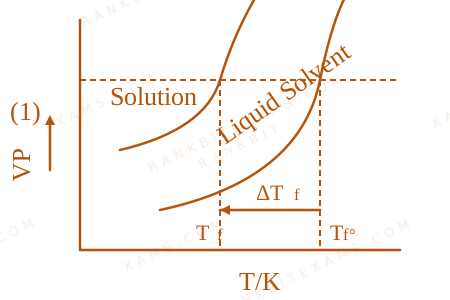
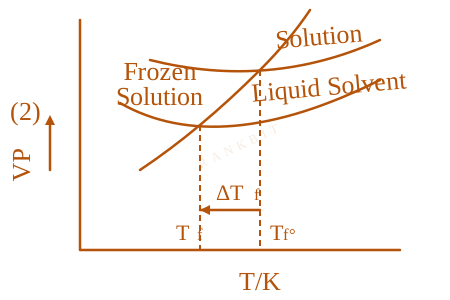
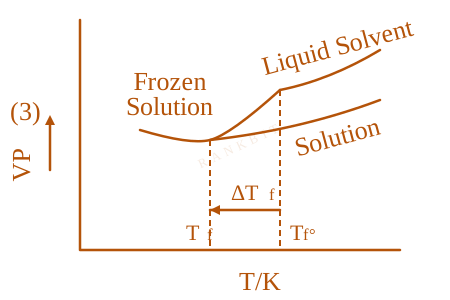
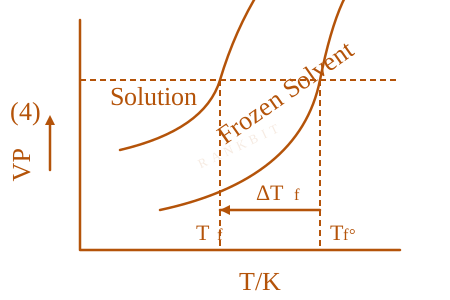
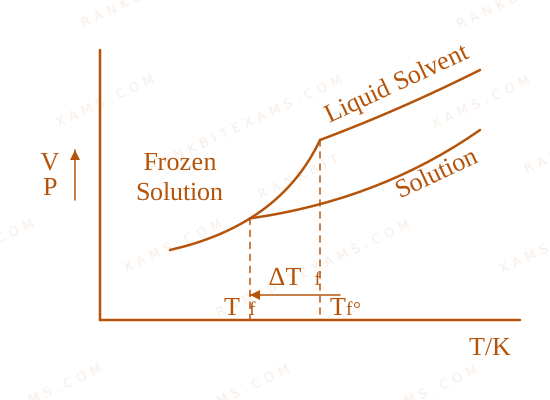
Consider the given plots of vapour pressure (VP) vs temperature (T/K) Which amongst the following options is correct graphical representation showing Delta T_mathrmf , depression in the freezing point of solvent in a solution?

Solution & Explanation

### Related Formula Delta T_f = T_f^0 - T_f ### Core Logic Dissolving a non-volatile solute lower the vapor pressure of the solution relative to the pure solvent across all temperature thresholds. The freezing point is defined as the temperature at which the vapor pressure of the liquid phase matches that of its solid phase. Because the solution's vapor pressure curve lies below that of the pure liquid solvent, its intersection with the frozen solvent curve occurs at a lower temperature (T_f < T_f^0). This shift creates the characteristic freezing point depression step: Delta T_f = T_f^0 - T_f. Plot (3) correctly displays this thermodynamic behavior.
Depression in Freezing Point solution plot for Q42 - JEE Main 2025 Morning
### Pattern Recognition The vapor pressure curve for the solution always runs lower than that of the pure solvent, shifting the freezing intersection to the left. ### Evaluation Rubric / Model Answer null ### Chapter Mix Class 12 Chemistry: Solutions

Reference Study Guides

More Solutions Previous-Year Questions — Page 7

Q87 jee_main_2024_31_jan_evening Concentration Terms
The molarity of 1text L orthophosphoric acid (H_3PO_4) having 70\% purity by weight (specific gravity 1.54text g cm^-3) is ________ textM. (Molar mass of H_3PO_4 = 98text g mol^-1)
Numerical Answer. Answer: 11 to 11

Solution

### Related Formula M = frac\% text purity times textdensity times 10textMolar Mass ### Core Logic Specific gravity is numerically equivalent to density in textg/cm^3, so density = 1.54text g/mL. Volume of solution = 1text L = 1000text mL. Mass of solution = textVolume times textDensity = 1000 times 1.54 = 1540text g. ### Step 1: Finding Solute Mass and Molarity Since the purity is 70\% by weight, the mass of H_3PO_4 in the solution is: textMass of H_3PO_4 = 1540 times 0.70 = 1078text g. Moles of H_3PO_4 = frac107898 = 11text moles. Since this is dissolved in 1text L of solution, the Molarity is: M = frac11text moles1text L = 11text M ### Pattern Recognition Shortcut formula directly substitutes the values: M = frac70 times 1.54 times 1098 = frac107898 = 11. ### Evaluation Rubric / Model Answer null ### Chapter Mix Class 12 Chemistry: Solutions Class 11 Chemistry: Some Basic Concepts of Chemistry
Q63 jee_main_2024_31_jan_morning Non-Ideal Solutions
Identify the mixture that shows positive deviations from Raoult's Law
  • A. (CH_3)_2CO + C_6H_5NH_2
  • B. CHCl_3 + C_6H_6
  • C. CHCl_3 + (CH_3)_2CO
  • D. (CH_3)_2CO + CS_2

Solution

### Core Logic (CH_3)_2CO + CS_2 exhibits positive deviations from Raoult's Law because the interactions between acetone and carbon disulphide molecules are weaker than the respective pure component interactions. ### Pattern Recognition Mixtures like Acetone + Aniline or Chloroform + Benzene/Acetone form stronger hydrogen bonds after mixing, showing negative deviation. Acetone + CS_2 or Ethanol + Acetone break existing strong interactions, leading to positive deviation. ### Evaluation Rubric / Model Answer null ### Chapter Mix Class 12 Chemistry: Solutions

More Solutions Questions — jee_main_2025_24_jan_morning

Practice all Solutions previous-year questions →

Rankbit System
JEE Physics: Waves (+15.5%) | Electrostatics: Concentric Shells (-29.7%) | Modern Physics: Photoelectric Clones (+34.2%) | Mathematics: Definite Integrals (+18.1%) | Chemistry: Coordination Splitting (-11.4%) | JEE Physics: Waves (+15.5%) | Electrostatics: Concentric Shells (-29.7%) | Modern Physics: Photoelectric Clones (+34.2%) | Mathematics: Definite Integrals (+18.1%) | Chemistry: Coordination Splitting (-11.4%)