The position vector of a moving body at any instant of time is given as r = (5t² i - 5t j)m$\vec{\mathrm{r}} = (5\mathrm{t}^2\hat{\mathrm{i}} - 5\mathrm{t}\hat{\mathrm{j}})\mathrm{m}$. The magnitude and direction of velocity at t = 2s$t = 2s$ is,
A.5√(15)$5\sqrt{15}$ m/s, making an angle of ⁻¹4$\tan^{-1}4$ with -ve Y axis
B.5√(15)$5\sqrt{15}$ m/s, making an angle of ⁻¹4$\tan^{-1}4$ with +ve X axis
C.5√(17)$5\sqrt{17}$ m/s, making an angle of ⁻¹4$\tan^{-1}4$ with -ve Y axis
D.5√(17)$5\sqrt{17}$ m/s, making an angle of ⁻¹4$\tan^{-1}4$ with +ve X axis
Solution & Explanation
Related Formula
v = d rdt$$\vec{v} = \frac{d\vec{r}}{dt}$$
Core Logic
Given position vector:
r = 5t² i - 5t j$$\vec{r} = 5t^2\hat{i} - 5t\hat{j}$$
Differentiating with respect to t$t$:
v = 10t i - 5 j$$\vec{v} = 10t\hat{i} - 5\hat{j}$$
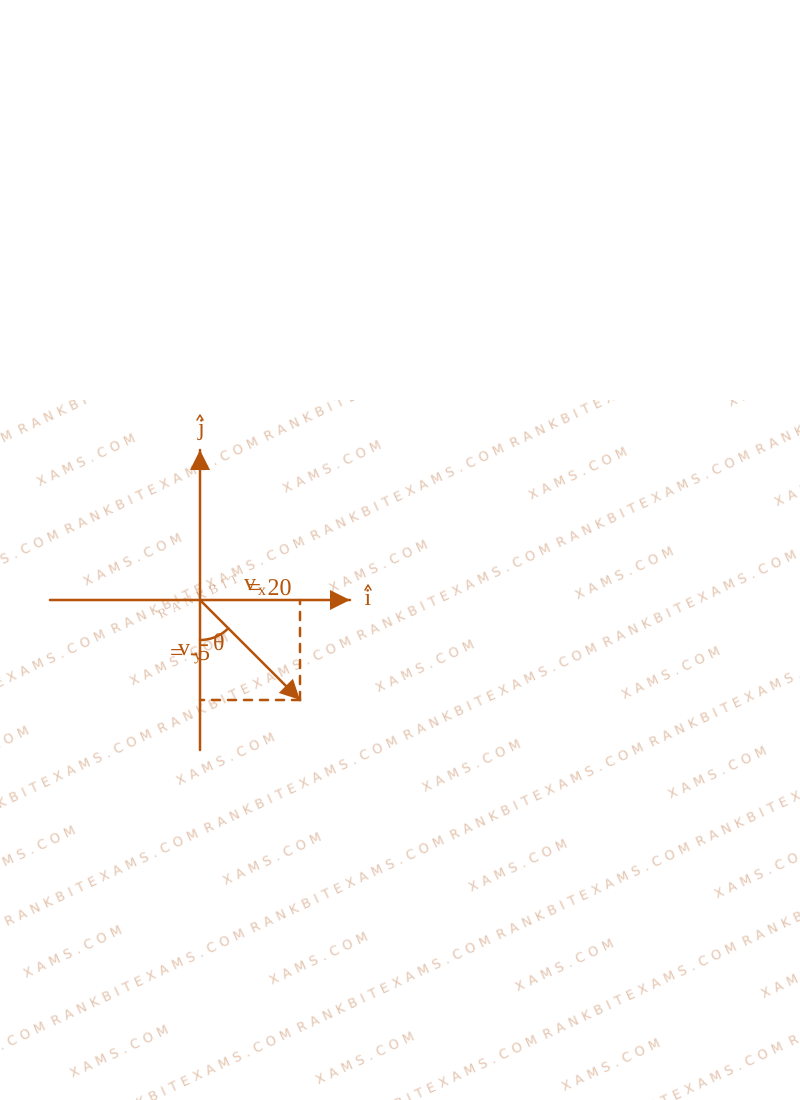
Direction analysis: Velocity vector components angle calculation Q8vₓ = 20$v_x = 20$ along +x$+x$ axis, vy = -5$v_y = -5$ along -y$-y$ axis.
Let θ$\theta$ be the angle made with the negative Y$Y$-axis:
Always read the reference axis carefully in direction questions. Here, the angle is measured from the negative Y$Y$-axis, making θ = vₓ / |vy|$\tan\theta = v_x / |v_y|$.
A body starts moving from rest with constant acceleration covers displacement S₁$S_{1}$ in first (p - 1)$(p - 1)$ seconds and S₂$S_{2}$ in first p seconds. The displacement S₁ + S₂$S_{1} + S_{2}$ will be made in time:
When dealing with equations of motion from rest, notice that displacement scales quadratically with time (S ∝ t²$S \propto t^2$). This means if displacement sums up (Sₜ = S₁ + S₂$S_t = S_1 + S_2$), the corresponding times will add in quadrature: t = √(t₁² + t₂²)$t = \sqrt{t_1^2 + t_2^2}$.
Therefore, the ratio of their velocities is √(3):2$\sqrt{3}:2$.
Pattern Recognition
For problems involving steady values under constraint variations, establish the proportionality relation first. Here, F ∝ (v²)/(r) v ∝ √(r)$F \propto \frac{v^2}{r} \implies v \propto \sqrt{r}$ when F$F$ and m$m$ are held constant.
Chapter Mix
Class 11 Physics: Motion in a Plane
Qjee_main_2024_30_january_eveningProjectile Motion from a Tower
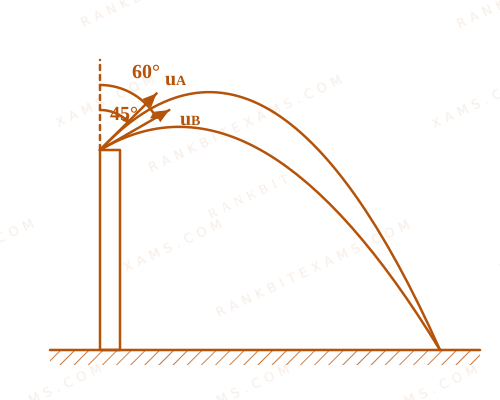
Projectiles A$\mathrm{A}$ and B$\mathrm{B}$ are thrown at angles of 45°$45^{\circ}$ and 60°$60^{\circ}$ with vertical respectively from top of a 400 ~m$400 \mathrm{~m}$ high tower. If their ranges and times of flight are same, the ratio of their speeds of projection vA: vB$\mathrm{v_A}: \mathrm{v_B}$ is:
A.1: √(3)$1: \sqrt{3}$
B.√(2):1$\sqrt{2}:1$
C.1:2$1:2$
D.1:√(2)$1:\sqrt{2}$
Solution
Core Logic
Projectile Motion from a Tower diagram for Q50 - JEE Main 2024 Evening
For two projectiles launched from the same height to have the same time of flight (T$T$), their vertical components of velocity must be equal.
Since the angles given are with the vertical, the vertical components are vA (45°)$v_A \cos(45^{\circ})$ and vB (60°)$v_B \cos(60^{\circ})$.
If TA = TB$T_A = T_B$, then vAy = vBy$v_{Ay} = v_{By}$.
For the ranges to be the same while having the same time of flight, their horizontal components of velocity must also be equal: vAx = vBx$v_{Ax} = v_{Bx}$.
This yields a contradiction. It is impossible for both the ranges and the times of flight to be simultaneously equal for different angles of projection from a tower.
Step 2: Conclusion
The question contains inconsistent data and is technically a Bonus question. However, if one arbitrarily equates only the time of flight (or if NTA intended a different scenario), the ratio (vA)/(vB) = 1√(2)$\frac{v_A}{v_B} = \frac{1}{\sqrt{2}}$ matches option (4), which was the officially provided key before corrections.
Pattern Recognition
Be wary of over-constrained physics problems. If a question specifies both range AND time of flight are identical for two different angles, check if the math yields a contradiction. NTA often accepts the result of one partial constraint
By NTA 4
BY Rankbit (Bonus).
A vector has magnitude same as that of A = 3 i + 4 j$\vec{\mathrm{A}} = 3\hat{\mathrm{i}} + 4\hat{\mathrm{j}}$ and is parallel to B = 4 i + 3 j$\vec{\mathrm{B}} = 4\hat{\mathrm{i}} + 3\hat{\mathrm{j}}$. The x$x$ and y$y$ components of this vector in first quadrant are x$x$ and 3$3$ respectively where x =$x = $ ________
We need to find a new vector N$\vec{N}$ that has the magnitude of A$\vec{A}$ and the direction of B$\vec{B}$.
Magnitude of A$\vec{A}$: | A| = √(3² + 4²) = √(25) = 5$|\vec{A}| = \sqrt{3^2 + 4^2} = \sqrt{25} = 5$.
Unit vector in the direction of B$\vec{B}$: B = B| B| = 4 i + 3 j√(4² + 3²) = 4 i + 3 j5$\hat{B} = \frac{\vec{B}}{|\vec{B}|} = \frac{4\hat{i} + 3\hat{j}}{\sqrt{4^2 + 3^2}} = \frac{4\hat{i} + 3\hat{j}}{5}$.
Step 1: Construct the Vector
N = | A| B = 5 ( 4 i + 3 j5 )$$\vec{N} = |\vec{A}| \hat{B} = 5 \left( \frac{4\hat{i} + 3\hat{j}}{5} \right)$$N = 4 i + 3 j$$\vec{N} = 4\hat{i} + 3\hat{j}$$
Step 2: Match Components
The x$x$ and y$y$ components are given as x$x$ and 3$3$.
From N = 4 i + 3 j$\vec{N} = 4\hat{i} + 3\hat{j}$, we see the x$x$-component is 4$4$.
Therefore, x = 4$x = 4$.
Pattern Recognition
Constructing a vector matching magnitude and direction is a simple scalar multiplication of the desired magnitude by the target direction's unit vector.
Chapter Mix
Class 11 Physics: Motion in a Plane
Q56jee_main_2024_30_jan_morningEquations of Motion
The displacement and the increase in the velocity of a moving particle in the time interval of t$t$ to (t + 1) ~s$(t + 1) \mathrm{~s}$ are 125 ~m$125 \mathrm{~m}$ and 50 ~m / s$50 \mathrm{~m / s}$, respectively. The distance travelled by the particle in (t + 2)th ~s$(t + 2)^{\mathrm{th}} \mathrm{~s}$ is _ _ _ _ _ m$\_ \_ \_ \_ \_ \mathrm{m}$.
Numerical Answer.Answer: 175 to 175
Solution
Related Formula
v = u + at$v = u + at$
s = ut + (1)/(2)at²$$s = ut + \frac{1}{2}at^2$$Snth = u + (a)/(2)(2n - 1)$$S_{n^{\text{th}}} = u + \frac{a}{2}(2n - 1)$$
Core Logic
Let the velocity at time t$t$ be u$u$. The time interval Δ t = (t+1) - t = 1 ~s$\Delta t = (t+1) - t = 1 \mathrm{~s}$. The increase in velocity over 1 second is exactly the acceleration a$a$. The displacement in that 1-second interval acts as the (t+1)th$(t+1)^{\text{th}}$ second displacement equation.
Step 1: Determine Acceleration
Increase in velocity Δ v = 50 ~m/s$\Delta v = 50 \mathrm{~m/s}$ in 1 ~s$1 \mathrm{~s}$.
v = u + at$v = u + at$
u + 50 = u + a(1) ⇒ a = 50 ~m/s²$$u + 50 = u + a(1) \Rightarrow a = 50 \mathrm{~m/s^2}$$
Step 2: Determine Velocity 'u' at time t
Displacement in the 1-second interval from t$t$ to t+1$t+1$ is 125 ~m$125 \mathrm{~m}$.
Using s = ut' + (1)/(2)at'²$s = ut' + \frac{1}{2}at'^2$ where t' = 1 ~s$t' = 1 \mathrm{~s}$:
125 = u(1) + (1)/(2)a(1)²$$125 = u(1) + \frac{1}{2}a(1)^2$$125 = u + (50)/(2)$$125 = u + \frac{50}{2}$$125 = u + 25 ⇒ u = 100 ~m/s$$125 = u + 25 \Rightarrow u = 100 \mathrm{~m/s}$$
Step 3: Distance in the next second
We need the distance travelled in the (t+2)th$(t+2)^{\text{th}}$ second, which corresponds to the 1-second interval starting with an initial velocity equal to the velocity at t+1$t+1$.
Alternatively, we can use the nth$n^{\text{th}}$ second formula directly by re-indexing. The velocity at start of this interval is unew = u + a = 100 + 50 = 150 ~m/s$u_{new} = u + a = 100 + 50 = 150 \mathrm{~m/s}$.
Distance S₁ₛₜ$S_{1\text{st}}$ using new parameters:
Practice past-year questions one chapter at a time. Pick an exam → subject → chapter and get every PYQ for that topic — pulled together from all past papers — with the chapter's key formulas alongside.