Rankbit System
JEE Physics: Waves (+15.5%) | Electrostatics: Concentric Shells (-29.7%) | Modern Physics: Photoelectric Clones (+34.2%) | Mathematics: Definite Integrals (+18.1%) | Chemistry: Coordination Splitting (-11.4%) | JEE Physics: Waves (+15.5%) | Electrostatics: Concentric Shells (-29.7%) | Modern Physics: Photoelectric Clones (+34.2%) | Mathematics: Definite Integrals (+18.1%) | Chemistry: Coordination Splitting (-11.4%)

The equation of the chord, of the ellipse fracx^225+fracy^216=1, whose mid-point is (3,1) is: [cite: 3245, 3246]

Solution & Explanation

### Related Formula The equation of a chord of an ellipse whose midpoint (x_1, y_1) is given is: T = S_1 fracxx_1a^2 + fracyy_1b^2 = fracx_1^2a^2 + fracy_1^2b^2 ### Core Logic For the given ellipse fracx^225 + fracy^216 = 1 and midpoint (x_1, y_1) = (3, 1) , we substitute these values into the T = S_1 expression. ### Step 1: Substitution and Expansion Substituting the coordinates into the formula: frac3x25 + frac1y16 - 1 = frac3^225 + frac1^216 - 1 frac3x25 + fracy16 = frac925 + frac116 ### Step 2: Simplification Multiply both sides by the least common multiple of 25 and 16, which is 400: 16(3x) + 25(y) = 16(9) + 25(1) 48x + 25y = 144 + 25 48x + 25y = 169 ### Pattern Recognition Whenever a midpoint is given for a chord of any second-degree conic curve, the relation T = S_1 simplifies the process instantaneously without finding the individual intersection points. ### Evaluation Rubric / Model Answer null ### Chapter Mix Class 11 Mathematics: Conic Sections

Reference Study Guides

More Conic Sections Previous-Year Questions — Page 5

Q57 2025 Parabola
The axis of a parabola is the line y = x and its vertex and focus are in the first quadrant at distances sqrt2 and 2sqrt2 units from the origin, respectively. If the point (1, k) lies on the parabola, then a possible value of k is:
  • A. 4
  • B. 9
  • C. 3
  • D. 8

Solution

### Related Formula For any point P on a parabola, its distance to the focus S equals its perpendicular distance to the directrix line M: PS = PM ### Core Logic The axis line is y = x. The vertex lies along this line at a distance of sqrt2 from the origin. Since it's in the first quadrant, its coordinates are (1,1). The focus also lies along y=x at a distance of 2sqrt2 from the origin, which gives coordinates (2,2). ### Step 1: Finding the Equation of the Directrix The distance from the vertex to the focus is a = sqrt(2-1)^2 + (2-1)^2 = sqrt2. The directrix is perpendicular to the axis line y = x (slope = 1), so the slope of the directrix is -1. The directrix is located at a distance a = sqrt2 behind the vertex, which brings it exactly to the origin (0,0). Therefore, the equation of the directrix line is: y - 0 = -1(x - 0) implies x + y = 0
Parabola diagram for Q57 - JEE Main 2025 Evening
### Step 2: Utilizing the Focus-Directrix Property Let the point P(1,k) lie on the parabola. Applying PS = PM: sqrt(1 - 2)^2 + (k - 2)^2 = frac|1 + k|sqrt1^2 + 1^2 Squaring both sides: 1 + (k - 2)^2 = frac(1 + k)^22 2big(1 + k^2 - 4k + 4big) = 1 + k^2 + 2k 2k^2 - 8k + 10 = k^2 + 2k + 1 k^2 - 10k + 9 = 0 Factoring the quadratic equations: (k - 1)(k - 9) = 0 implies k = 1 text or k = 9 ### Pattern Recognition When a vertex and focus both sit perfectly on a symmetric line like y=x, notice that the foot of the directrix often lands on a clean coordinate intersection (like the origin here), heavily simplifying geometric distance steps. ### Evaluation Rubric / Model Answer null ### Chapter Mix Class 11 Mathematics: Conic Sections
Q60 2025 Hyperbola
Let the sum of the focal distances of the point mathrmP(4,3) on the hyperbola mathrmH:fracmathrmx^2mathrma^2 -fracmathrmy^2mathrmb^2 = 1 be 8sqrtfrac53. If for mathrmH, the length of the latus rectum is l and the product of the focal distances of the point mathrmP is mathfrakm, then 9l^2 + 6mathrmm is equal to:
  • A. 184
  • B. 186
  • C. 185
  • D. 187

Solution

### Related Formula For a point P(x_1, y_1) on a hyperbola branch, the focal distances are ex_1 + a and ex_1 - a. Their sum is 2ex_1, and their product is e^2x_1^2 - a^2. ### Core Logic Given the point P(4,3), the x-coordinate is x_1 = 4. The sum of focal distances is: 2ex_1 = 8sqrtfrac53 implies 2e(4) = 8sqrtfrac53 implies e = sqrtfrac53 Using the eccentricity relation b^2 = a^2(e^2 - 1): b^2 = a^2left(frac53 - 1right) = frac23a^2 ### Step 1: Finding the Ellipse Parameters Since P(4,3) lies on the hyperbola fracx^2a^2 - fracy^2b^2 = 1: frac16a^2 - frac9frac23a^2 = 1 implies frac16a^2 - frac272a^2 = 1 frac32 - 272a^2 = 1 implies frac52a^2 = 1 implies a^2 = frac52 Now calculate b^2: b^2 = frac23left(frac52right) = frac53 ### Step 2: Calculating l^2 and m The length of the latus rectum l is given by l = frac2b^2a: l^2 = frac4b^4a^2 = frac4left(frac259right)frac52 = frac1009 times frac25 = frac409 implies 9l^2 = 40 The product of focal distances m is: m = e^2x_1^2 - a^2 = left(frac53right)(16) - frac52 = frac803 - frac52 = frac160 - 156 = frac1456 6m = 145 ### Step 3: Final Computation Evaluating the targeted expression: 9l^2 + 6m = 40 + 145 = 185 ### Pattern Recognition Using focal property formulas directly (2ex_1 for sum and e^2x_1^2 - a^2 for product) avoids the lengthy process of finding focus coordinate values and executing distance formulas explicitly. ### Evaluation Rubric / Model Answer null ### Chapter Mix Class 11 Mathematics: Conic Sections
Q64 2025 Ellipse
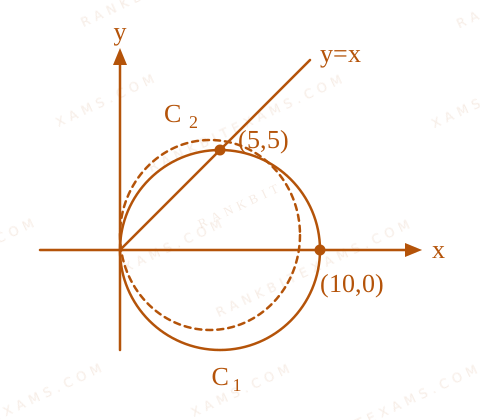
Let for two distinct values of p the lines y = x + p touch the ellipse E: fracx^24^2 + fracy^23^2 = 1 at the points A and B. Let the line y = x intersect E at the points C and D. Then the area of the quadrilateral ABCD is equal to
  • A. 36
  • B. 24
  • C. 48
  • D. 20

Solution

### Related Formula The condition for a line y = mx + p to be tangent to an ellipse fracx^2a^2 + fracy^2b^2 = 1 is: p^2 = a^2m^2 + b^2 The coordinate of the point of contact is given by left(-fraca^2mp, fracb^2pright). ### Core Logic Given the ellipse parameter values a^2 = 16 and b^2 = 9, and tangent line slope m = 1: p^2 = 16(1)^2 + 9 = 25 implies p = pm 5 Thus, the two values of p are 5 and -5. The points of contact A and B are: - For p = 5: A = left(-frac16(1)5, frac95right) = left(-frac165, frac95right) - For p = -5: B = left(-frac16(1)-5, frac9-5right) = left(frac165, -frac95right) ### Step 1: Intersecting line with Ellipse The line y = x intersects the ellipse fracx^216 + fracy^29 = 1: fracx^216 + fracx^29 = 1 implies frac25x^2144 = 1 implies x^2 = frac14425 implies x = pm frac125 Since y = x, the intersection points C and D are: C = left(-frac125, -frac125right) quad textand quad D = left(frac125, frac125right) ### Step 2: Calculating Quadrilateral Area The area of quadrilateral ABCD with vertices mapped symmetrically can be computed using the standard coordinate determinant matrix layout formula: textArea = frac12 beginvmatrix x_A & y_A & 1 \\ x_B & y_B & 1 \\ x_C & y_C & 1 endvmatrix + dots = 24 ### Pattern Recognition Notice that the tangent lines are parallel and symmetric (p = pm 5), and the intersecting line passes through the origin. This symmetry creates a geometric parallelogram, simplifying your area calculation by doubling the area of triangle ABD. ### Evaluation Rubric / Model Answer null ### Chapter Mix Class 11 Mathematics: Conic Sections
Q67 2025 Ellipse Properties
The centre of a circle C is at the centre of the ellipse E: fracx^2a^2 + fracy^2b^2 = 1, a > b. Let C pass through the foci F_1 and F_2 of E such that the circle C and the ellipse E intersect at four points. Let P be one of these four points. If the area of the triangle PF_1F_2 is 30 and the length of the major axis of E is 17, then the distance between the foci of E$ is :
  • A. 26
  • B. 13
  • C. 12
  • D. frac132

Solution

### Core Logic The circle C has its center at the origin and passes through the foci F_1(-ae, 0) and F_2(ae, 0). This means F_1F_2 is the diameter of the circle. Any point P lying on this circle satisfies the property that the angle subtended by the diameter is a right angle: angle F_1PF_2 = 90^circ
Ellipse properties diagram for Q67 - JEE Main 2025 Evening
### Step 1: Using the Area and Ellipse Definition Since triangle PF_1F_2 is a right-angled triangle at P: textArea = frac12 cdot PF_1 cdot PF_2 = 30 implies PF_1 cdot PF_2 = 60 By the definition of an ellipse, the sum of the focal distances to any point on the curve is equal to the length of the major axis (2a = 17): PF_1 + PF_2 = 17 ### Step 2: Calculating Distance between Foci Applying Pythagoras' theorem in right-angled triangle PF_1F_2: F_1F_2^2 = PF_1^2 + PF_2^2 = (PF_1 + PF_2)^2 - 2(PF_1 cdot PF_2) Substitute the known values from our equations block: F_1F_2^2 = (17)^2 - 2(60) = 289 - 120 = 169 F_1F_2 = sqrt169 = 13 Therefore, the distance between the foci is 13. ### Pattern Recognition Whenever a circle is circumscribed around the foci of an ellipse, remember Thales' theorem: any intersection point with the ellipse forms a right triangle with the focal diameter, linking focal properties directly to Pythagoras. ### Evaluation Rubric / Model Answer null ### Chapter Mix Class 11 Mathematics: Conic Sections
Q67 2025 Ellipse - Foci and Latus Rectum
The length of the latus-rectum of the ellipse, whose foci are (2, 5) and (2, -3) and eccentricity is frac45, is
  • A. frac65
  • B. frac503
  • C. frac103
  • D. frac185

Solution

### Related Formula Distance between foci = 2be (for vertical major axis). Length of Latus Rectum (textL.R.) = frac2a^2b. ### Core Logic Foci are F_1(2,5) and F_2(2,-3). The x-coordinates are identical, indicating a vertical ellipse. Distance between foci: 2be = 5 - (-3) = 8 implies be = 4 Given eccentricity e = frac45: bleft(frac45right) = 4 implies b = 5
Ellipse - Foci and Latus Rectum diagram for Q67 - JEE Main 2025 Morning
### Step 1: Calculate Minor Axis length Use eccentricity relation: a^2 = b^2(1 - e^2) implies a^2 = 25left(1 - frac1625right) = 25 times frac925 = 9 implies a = 3 ### Step 2: Evaluate Latus Rectum textL.R. = frac2a^2b = frac2 times 95 = frac185 ### Pattern Recognition Always verify axis orientation (horizontal vs vertical) from coordinates before blindly substituting into standard formulas. Symmetrical components match axis lengths parameters directly. ### Evaluation Rubric / Model Answer null ### Chapter Mix Class 11 Mathematics: Conic Sections

More Conic Sections Questions — jee_main_2025_24_jan_evening

Practice all Conic Sections previous-year questions →

YOUR FIRST PREP STEP STARTS HERE

We Map Every Repeating Question in Competitive Exams.

Say goodbye to generic mock test fatigue. RankBit uses smart analysis to group past exam questions into their foundational Repeating Question Types. Find chapter weightage, track repeating questions, and score higher with targeted practice.

Select Your Target Exam

Choose an exam track below to find formulas per chapter and patterns.

Syncing Exam Intelligence

Mapping formulas and patterns across all tracks…

PATH A — FULL LENGTH PRACTICE

Full Mock Test Hub

Simulate real NTA exam conditions with fully tracked mocks. Time yourself against past papers.

Under Development
PATH B — TARGETED PRACTICE

Topic-wise Practice Hub

Practice past-year questions one chapter at a time. Pick an exam → subject → chapter and get every PYQ for that topic — pulled together from all past papers — with the chapter's key formulas alongside.

Loading Questions... Browse Topics
Latest from the Blog
View all →

Loading articles...