(B) The Match List displays chemical transformations side-by-side with their respective named organic chemical reactions.
(II) Gatterman-Koch reaction
(C) The Match List displays chemical transformations side-by-side with their respective named organic chemical reactions.
(III) Rosenmund reduction
(D) The Match List displays chemical transformations side-by-side with their respective named organic chemical reactions.
(IV) Stephen reaction
Choose the correct answer from the options given below:
A.\text{(A)-(IV), (B)-(III), (C)-(I), (D)-(II)}
B.\text{(A)-(III), (B)-(IV), (C)-(II), (D)-(I)}
C.\text{(A)-(I), (B)-(III), (C)-(II), (D)-(IV)}
D.\text{(A)-(III), (B)-(IV), (C)-(I), (D)-(II)}
Solution & Explanation
Core Logic
Let's match each aldehyde preparation method with its official named organic reaction:
(A) RCN arrow RCHO$\mathrm{RCN} \rightarrow \mathrm{RCHO}$ using SnCl₂/HCl$\mathrm{SnCl}_{2}/\mathrm{HCl}$ followed by hydrolysis: This is the classic Stephen reactionarrow$\rightarrow$(IV).
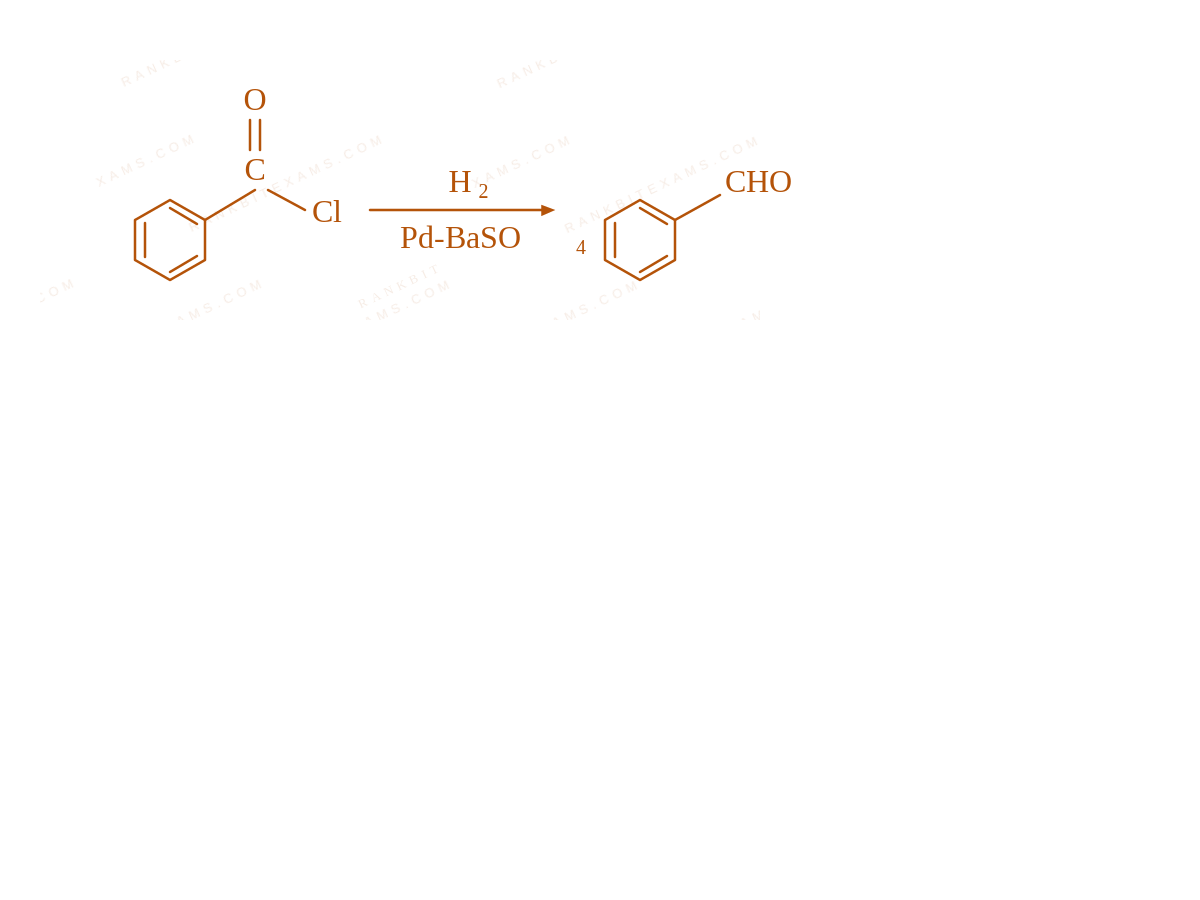
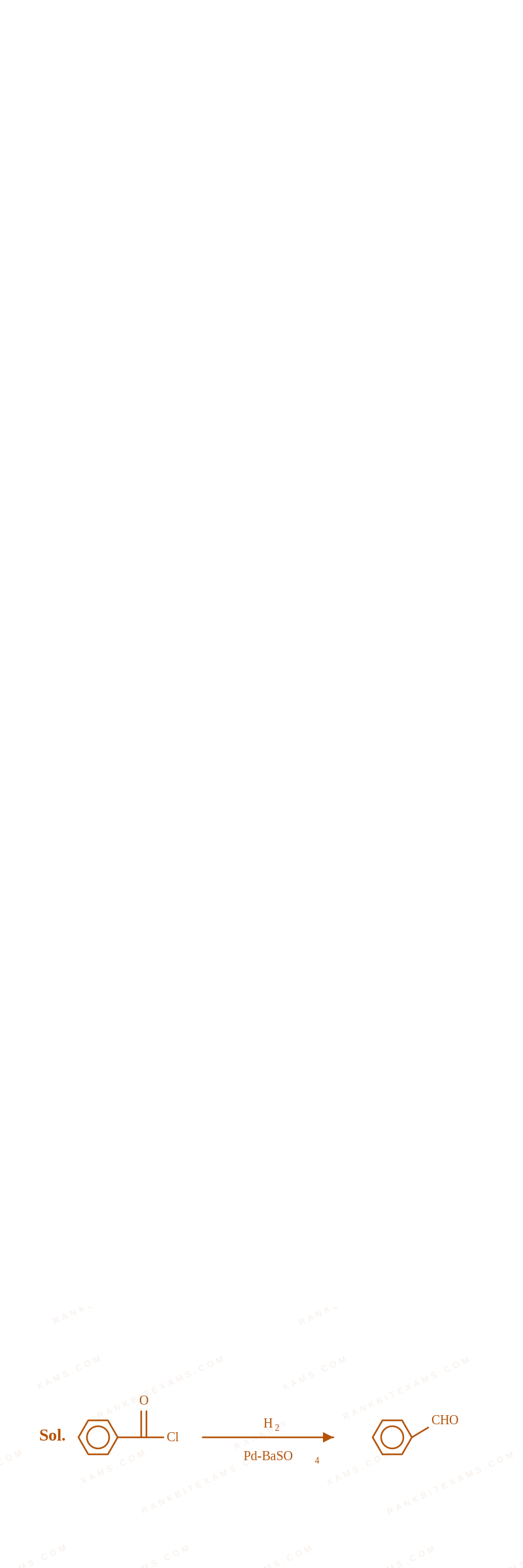
(B) Reducing an acyl chloride (RCOCl$\mathrm{RCOCl}$) to an aldehyde using H₂$\mathrm{H}_{2}$ over Pd-BaSO₄$\mathrm{Pd-BaSO}_{4}$: This partial reduction is known as the Rosenmund reductionarrow$\rightarrow$(III).
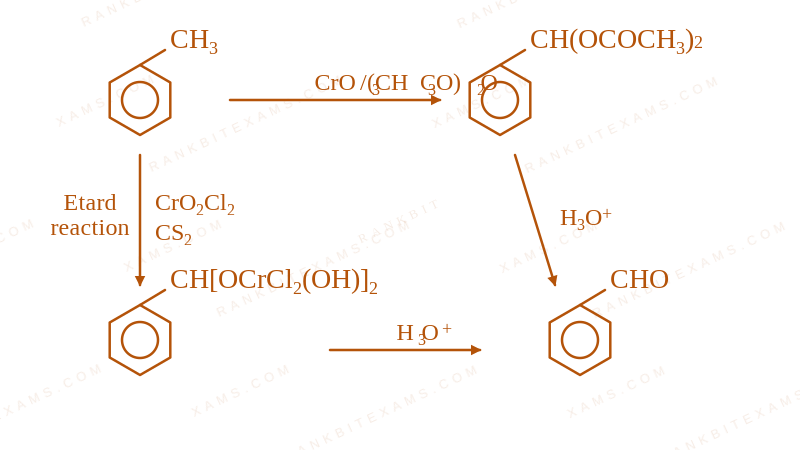
(C) Oxidizing toluene to benzaldehyde using chromyl chloride (CrO₂Cl₂$\mathrm{CrO}_{2}\mathrm{Cl}_{2}$) in CS₂$\mathrm{CS}_{2}$: This selective oxidation method is the Etard reactionarrow$\rightarrow$(I).
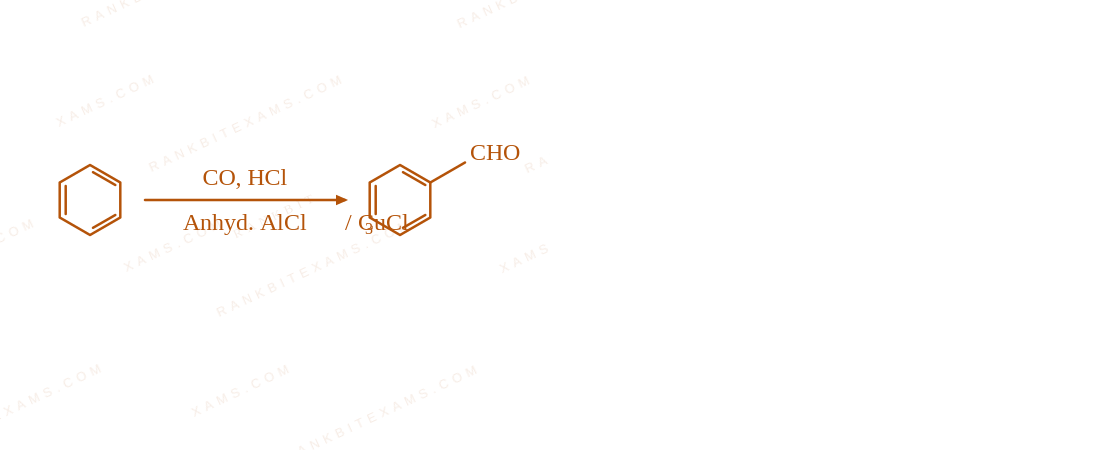
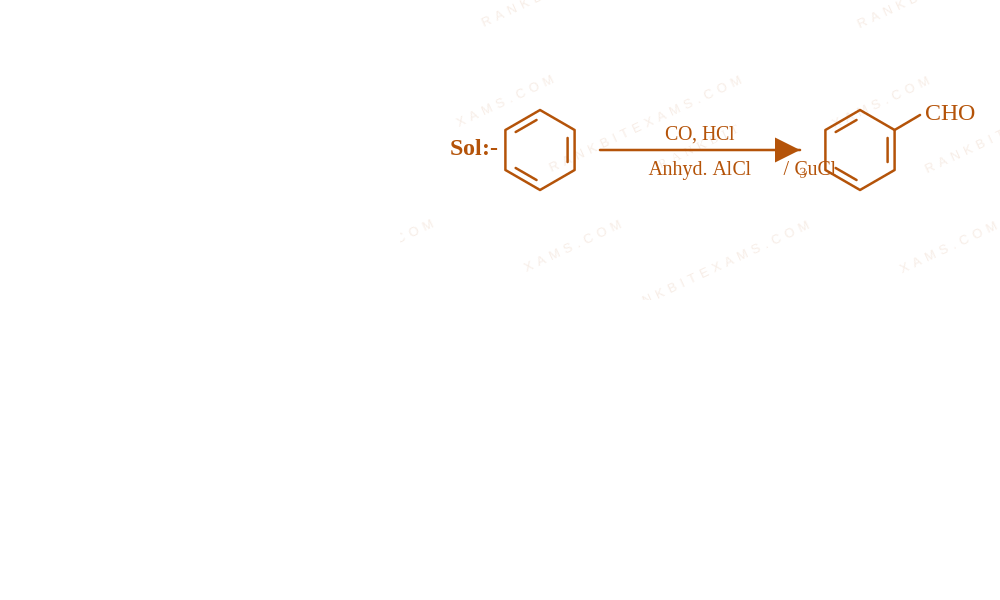
(D) Converting benzene to benzaldehyde using CO$\mathrm{CO}$ and HCl$\mathrm{HCl}$ in the presence of anhydrous AlCl₃/CuCl$\mathrm{AlCl}_{3}/\mathrm{CuCl}$: This formylation process is the Gatterman-Koch reactionarrow$\rightarrow$(II).
Combining these assignments yields the final sequence: (A)-(IV), (B)-(III), (C)-(I), (D)-(II).
Step-by-Step Layout
The visual reaction components correspond directly to the official structural transformations:
The Match List displays chemical transformations side-by-side with their respective named organic chemical reactions.The Match List displays chemical transformations side-by-side with their respective named organic chemical reactions.The Match List displays chemical transformations side-by-side with their respective named organic chemical reactions.
The reaction depicts the partial reduction of an acid chloride (benzoyl chloride) to an aldehyde (benzaldehyde) using hydrogen gas in the presence of a poisoned palladium catalyst (Pd supported on BaSO₄$BaSO_4$).
The image shows the catalytic hydrogenation of benzoyl chloride to benzaldehyde in the presence of Pd-BaSO4.
This specific reaction is known as the Rosenmund reduction.
Pattern Recognition
Acid Chloride + H₂, Pd/BaSO₄$H_2, Pd/BaSO_4$arrow$\rightarrow$ Aldehyde is strictly the Rosenmund reduction. The BaSO₄$BaSO_4$ poisons the catalyst to prevent over-reduction to an alcohol.
Chapter Mix
Class 12 Chemistry: Aldehydes, Ketones and Carboxylic Acids
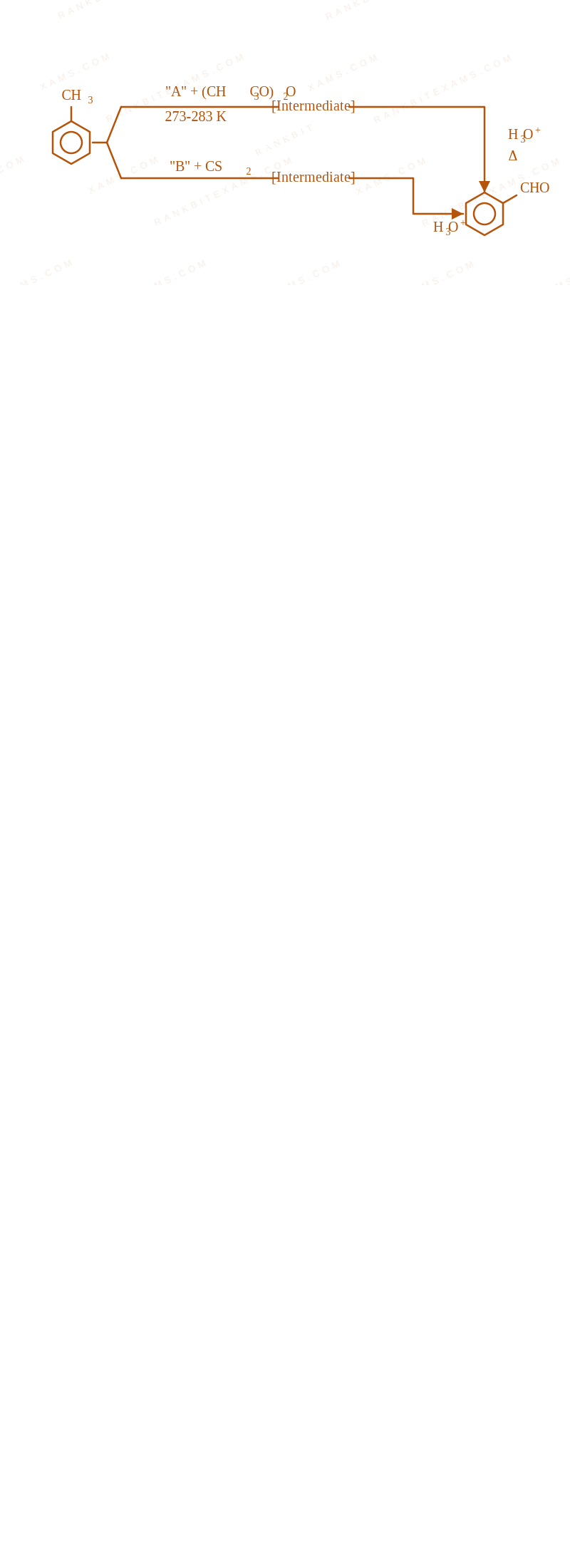
Pathway 1 (Upper): Toluene is treated with Reagent 'A' and acetic anhydride (CH₃CO)₂O$(CH_3CO)_2O$ to form an intermediate (benzylidene diacetate), which on hydrolysis gives benzaldehyde. The reagent used here is Chromic oxide (CrO₃$CrO_3$). Thus, A is CrO₃$CrO_3$.
Pathway 2 (Lower): Toluene is treated with Reagent 'B' in CS₂$CS_2$ to form a chromium complex intermediate, which on hydrolysis yields benzaldehyde. This is the Etard reaction, and the reagent used is Chromyl chloride (CrO₂Cl₂$CrO_2Cl_2$). Thus, B is CrO₂Cl₂$CrO_2Cl_2$.
The image shows the oxidation of toluene to benzaldehyde via two different pathways requiring reagents A and B.
Step 1: Selection
Therefore, A = CrO₃$CrO_3$ and B = CrO₂Cl₂$CrO_2Cl_2$.
Pattern Recognition
Etard reaction always uses Chromyl chloride (CrO₂Cl₂$CrO_2Cl_2$). Oxidation of toluene with acetic anhydride uses Chromic acid (CrO₃$CrO_3$). Both stop the oxidation at the aldehyde stage via intermediate formation.
Chapter Mix
Class 12 Chemistry: Aldehydes, Ketones and Carboxylic Acids
Ethanal (CH₃CHO$CH_3CHO$) reacts with semicarbazide (H₂N-NH-CO-NH₂$H_2N-NH-CO-NH_2$) via nucleophilic addition followed by elimination of water to form a semicarbazone.
Step 1: Product Analysis
The product is Ethanal semicarbazone: CH₃-CH=N-NH-CO-NH₂$CH_3-CH=N-NH-CO-NH_2$.
Counting the nitrogen atoms in this structure:
The imine nitrogen (=N-$=N-$)
The amine nitrogen (-NH-$-NH-$)
The amide nitrogen (-NH₂$-NH_2$)
Total = 3 Nitrogen atoms.
Chapter Mix
Class 12 Chemistry: Aldehydes, Ketones and Carboxylic Acids
Qjee_main_2024_31_jan_eveningPreparation of Aldehydes and Ketones
Identify the name reaction.
The image shows the conversion of benzene to benzaldehyde using CO, HCl, and Anhydrous AlCl3/CuCl.
The reaction of benzene with carbon monoxide (CO$CO$) and hydrogen chloride (HCl$HCl$) in the presence of anhydrous aluminium chloride (AlCl₃$AlCl_3$) and cuprous chloride (CuCl$CuCl$) to give benzaldehyde is known as the Gatterman-Koch reaction.
The image shows the conversion of benzene to benzaldehyde using CO, HCl, and Anhydrous AlCl3/CuCl.
Pattern Recognition
CO + HCl arrow$CO + HCl \rightarrow$ Formyl chloride intermediate (in situ) with Lewis acid arrow$\rightarrow$ formylation of benzene. This is definitively the Gatterman-Koch formylation.
Chapter Mix
Class 12 Chemistry: Aldehydes, Ketones and Carboxylic Acids
More Aldehydes, Ketones and Carboxylic Acids Questions — jee_main_2025_24_jan_evening
Practice past-year questions one chapter at a time. Pick an exam → subject → chapter and get every PYQ for that topic — pulled together from all past papers — with the chapter's key formulas alongside.
 "named organic pathways, stephen rosenmund reduction, etard gatterman koch aromatic schemes")
 "named organic pathways, stephen rosenmund reduction, etard gatterman koch aromatic schemes")
 "named organic pathways, stephen rosenmund reduction, etard gatterman koch aromatic schemes")
 "named organic pathways, stephen rosenmund reduction, etard gatterman koch aromatic schemes")
 "named organic pathways, stephen rosenmund reduction, etard gatterman koch aromatic schemes")
 "named organic pathways, stephen rosenmund reduction, etard gatterman koch aromatic schemes")